This study investigates the role of generative artificial intelligence as a mediating tool in interdisciplinary design education, focusing on its impact on design communication and collaborative participation. The research was conducted within a university-level interdisciplinary design course involving both design and non-design students working on product design tasks. Text-based AI tools were introduced for prompt refinement, while image-generation tools were used to support early-stage visual ideation.A qualitative research approach was adopted, including classroom observation, analysis of student design artifacts, and semi-structured interviews. The results indicate that generative AI is most effective during the conceptual ideation phase, where AI-generated images function as shared visual references that facilitate discussion, negotiation, and collective decision-making. In particular, AI-supported visualization lowered participation barriers for non-design students by enabling visual articulation of ideas without reliance on traditional drawing skills. Design students assumed integrative roles, focusing on interpretation, refinement, and the translation of AI-generated concepts into feasible design outcomes.The study further identifies prompt authoring as a critical human–AI interaction layer, emphasizing its role in design reasoning and communication. While limitations remain in later-stage design refinement, generative AI demonstrates clear pedagogical value in supporting interdisciplinary collaboration.
In recent years, interdisciplinary innovation has become a key driver of academic and industrial development, with cross-disciplinary collaboration increasingly regarded as essential in entrepreneurship programs and design competitions. However, in educational practice, students from different disciplinary backgrounds often face communication and comprehension challenges due to differences in training and ways of thinking. Non-design students, in particular, frequently struggle to articulate their ideas because of limited visual expression skills and design-related vocabulary, which constrains the effectiveness of interdisciplinary collaboration.
With the rapid advancement of generative artificial intelligence, AI tools that integrate language models and image generation have begun to enter design education, offering new possibilities to address these challenges. By using ChatGPT to refine prompts and image-generation tools to visualize concepts, students can translate abstract ideas into concrete visual representations. This process not only improves design efficiency but also lowers the barrier for non-design students to participate in design discussions, allowing AI-generated visuals to function as shared communication artifacts within interdisciplinary teams.
This study investigates how the integration of information visualization strategies and generative AI technologies can enhance students’ design expression, communication skills, and collaborative performance in interdisciplinary courses. Focusing on interactions between design and non-design students, the research examines whether AI tools can support conceptual articulation, foster shared understanding, and improve collaboration outcomes. Through course-based interventions, pre- and post-assessments, and analysis of student feedback, this study aims to propose a sustainable AI-supported instructional model for interdisciplinary design education, contributing practical insights for future pedagogical innovation.
LITERATURE REVIEW
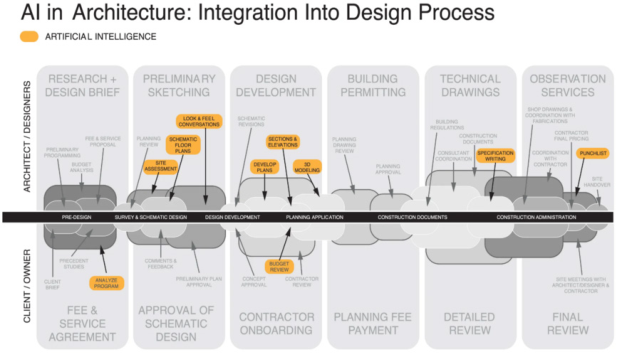
Generative AI in Design Practice and Education Recent studies indicate that generative artificial intelligence has been increasingly integrated into design practice, reshaping traditional design workflows and creative production processes. Prior research suggests that generative AI and large language models (LLMs) are particularly effective in supporting concept generation and early-stage exploration, significantly accelerating ideation and divergent thinking (Hong et al., 2023). However, this efficiency also introduces a critical tension between creative flexibility and design precision, as insufficient human intervention may lead to gaps in feasibility and challenges in practical implementation. Designers are therefore required to maintain active control and establish shared understanding with AI systems to ensure that user needs, technical constraints, and market considerations are translated into viable design outcomes. This tendency is further illustrated in architectural design practice. Seificar, (2023) framework on AI integration across architectural design phases demonstrates that AI tools are predominantly embedded in early stages such as research and design brief development, preliminary sketching, schematic planning, and design development, where visual exploration, conceptual generation, and early decision-making benefit most from computational support (Figure 1). In contrast, later stages involving technical drawings, regulatory compliance, construction documentation, and site administration remain largely dependent on professional expertise and human judgment. This distribution suggests that generative AI functions primarily as an augmentation tool for ideation and visualization rather than a replacement for expert-driven execution.
Figure 1: Shahram seificar "how to use AI in architecture and managing the design process phases".
In the context of design education, similar patterns have been observed. Fang, (2023) found that text-based and image-generative AI tools are especially effective during early concept development, enabling students, particularly those from non-design backgrounds, to overcome creative barriers and rapidly externalize ideas. Nevertheless, as design projects progress toward detailed refinement, engineering rationalization, and manufacturing feasibility, the benefits of AI assistance diminish, reaffirming the irreplaceable role of designers’ professional knowledge and experience. Review studies further emphasize that effective integration of generative AI in education requires curricular adaptation and interdisciplinary collaboration, positioning AI as a conceptual support and communication aid rather than a substitute for design expertise (Lu & Huang, 2024). Collectively, existing literature highlights the strong potential of generative AI in early-stage design thinking across both professional practice and education, while underscoring the need for systematic empirical studies that examine how AI-mediated workflows can be meaningfully embedded into design processes to support collaboration, communication, and learning.
Interdisciplinary Teams and Collaboration Previous studies indicate that interdisciplinary teams can stimulate creativity and collaborative engagement among team members, leading to higher- quality outcomes (Amabile et al., 1996). However, differences in professional language, knowledge structures, and cognitive frameworks often create communication barriers that hinder effective collaboration (Siedlok & Hibbert, 2014). As a result, establishing shared language and effective communication mechanisms is critical to the success of interdisciplinary teamwork.
Design Communication and Information Visualization Communication plays a central role in the design process by facilitating idea exchange, consensus building, and the development of design outcomes. Through communication, designers express ideas, needs, and intentions while coordinating understanding and collaboration among team members (Albrecht & Ropp, 1984). In design education and interdisciplinary contexts, design communication is particularly critical for integrating diverse disciplinary perspectives and ensuring that creative ideas remain both innovative and feasible.
Design communication encompasses multiple forms, including text, verbal language, visuals, and physical or digital models. Among these, visual representations are considered especially effective due to their intuitive nature, which helps reduce cognitive barriers and supports shared understanding (Maher et al., 2012). Studies have shown that sketches, drawings, digital renderings, and models function as essential communication tools that minimize misunderstandings and enhance collaborative efficiency in interdisciplinary design teams (Chang & Chiang, 2009).
Information visualization further strengthens design communication by transforming complex information into visual forms that facilitate comprehension and discussion. With advances in technology and increasing data complexity, information visualization has evolved from basic statistical charts to interactive and spatial representations, becoming a critical tool for supporting communication, collaboration, and innovation in design contexts (Hsu & Wang, 2013).
RESEARCH METHOD Study Design and Teaching Intervention
This study adopts an educational intervention research design conducted within a university-level interdisciplinary innovation course titled Creative Integration. The study examines the effects of integrating generative AI and information visualization strategies on students’ design communication and interdisciplinary collaboration. The instructional intervention was embedded into the existing course structure without altering its core learning objectives, ensuring ecological validity.
The instructional goals of the course focused on three aspects: (1) enabling students to use information visualization strategies for design expression, (2) familiarizing students with generative AI tools to enhance ideation efficiency, and (3) fostering collaborative interaction between design and non-design students to strengthen interdisciplinary communication.
Human–AI Interaction as a Catalyst for Interdisciplinary Co-Creation 15 Teaching Procedure
The instructional and research procedure consisted of three stages: Stage 1: Pre-test Survey
At the beginning of the course, students completed a pre-test questionnaire to assess their prior experience with AI tools, operational familiarity, and learning needs. No design tasks were assigned at this stage. The collected data served as baseline measurements for subsequent comparisons. In addition, students were introduced to two design approaches: redesigning existing products and new design development, to establish initial problem awareness.
Stage 2: AI Integration and Design Development During the design task phase, students were guided to use ChatGPT to refine textual ideas into prompts and to generate visual sketches or simulations using AI image-generation tools. These AI-generated outputs functioned as shared artifacts for group discussion, supporting requirement clarification, idea refinement, and early-stage design development.
Stage 3: Integration and Presentation Design students translated group discussions into 3D models and formal design language, while non-design students contributed requirement perspectives and contextual descriptions. Final outcomes were presented as project proposals, demonstrating how AI tools supported the design process from problem identification to redesign or new design realization.
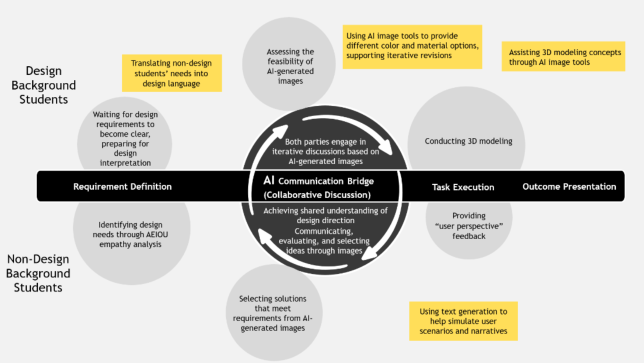
To clarify how generative AI was embedded in the instructional process, an AI-mediated communication framework was developed, as illustrated in Figure X. This framework outlines how AI supported requirement definition, collaborative discussion, task execution, and outcome presentation between design and non-design students.
Figure 2. AI-mediated communication framework in interdisciplinary design education. This figure illustrates how generative AI tools were integrated into the teaching
workflow to function as a communication bridge between design and non-design students, supporting requirement definition, collaborative discussion, task execution, and outcome presentation. (Drawn by this researcher)
Participants and Research Context Participants consisted of undergraduate students enrolled in the course, including both design majors and non-design students. Mixed grouping was employed to ensure interdisciplinary interaction within each team. The study was conducted in on-campus design studios and computer classrooms, supplemented by case- based simulations to approximate real-world design collaboration contexts.
Data Collection and Analysis A mixed-methods approach was employed in this study.
Quantitative data included pre- and post-test questionnaires assessing students’ familiarity with AI tools, self-evaluated design communication ability, and learning attitudes. Expert evaluation rubrics were also used to assess the creativity, completeness, and clarity of student design outcomes.
Qualitative data consisted of analyses of student design artifacts, focusing on the evolution from AI-generated sketches to final 3D models, as well as semi-structured interviews and learning reflections capturing students’ experiences and challenges when working with AI tools.
Data triangulation was conducted by integrating survey results, expert evaluations, and qualitative feedback to enhance the reliability and validity of the findings.
RESULTS AND DISCUSSIONS Learning Outcomes of AI-Supported Interdisciplinary Design
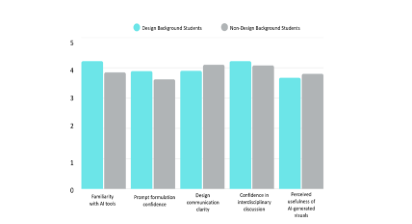
The results indicate that integrating generative AI into an interdisciplinary design course effectively enhanced students’ design communication, collaborative engagement, and creative confidence. Quantitative questionnaire results showed overall improvements in familiarity with AI tools, confidence in prompt formulation, and perceived clarity of design communication following the instructional intervention.
While design-background students demonstrated higher initial familiarity with AI tools, their degree of improvement was relatively moderate. In contrast, non-design-background students exhibited more substantial gains in prompt formulation confidence, design communication clarity, and confidence in interdisciplinary discussions. Both groups reported similarly high levels of perceived usefulness of AI-generated visuals, suggesting that AI-generated images functioned as shared communication artifacts in interdisciplinary teams.
Although generative AI did not eliminate differences in technical familiarity, it significantly reduced gaps in design communication and collaborative participation, highlighting its potential as a communication leveling mechanism in interdisciplinary learning contexts.
Figure 3: Comparison of self-reported learning outcomes between design-background and non-design-background students after AI-supported interdisciplinary design activities.Table 1: Changes in student perceptions after AI-supported design activities.
Table available in the original PDF paper.
Dimension Design Background Students
Non-Design Background Students
Overall Trend Familiarity with AI tools Increased Increased Positive
Lower baseline, significant increase Design communication clarity Improved Improved Positive
Moderate increase Significant increase Positive
Confidence in interdisciplinary discussion
High High Consistent
Perceived usefulness of AI-generated visuals
AI-Generated Visuals as Mediating Artifacts Analysis of student design artifacts revealed a clear transition from text-based descriptions to visually grounded communication following the integration of generative AI. AI-generated images were consistently used as intermediate artifacts that translated abstract ideas into tangible visual representations.
In redesign tasks, non-design students articulated functional requirements and improvement goals through AI-generated visuals, which became focal points for group discussion. Design students subsequently translated these shared concepts into structured 3D models, integrating professional design language and technical considerations. In new design tasks, AI-generated imagery supported divergent exploration during early ideation and facilitated convergence through visual comparison and negotiation.
From a human–AI collaboration perspective, these findings suggest that AI-generated visuals functioned as mediating artifacts that bridged ideation and development stages, supporting visual continuity throughout the design process.
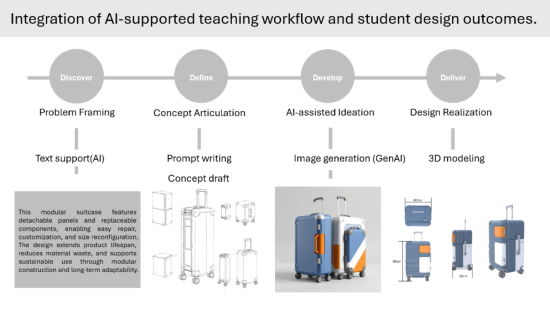
This figure illustrates an AI-supported teaching workflow integrated with student design outcomes across the Discover, Define, Develop, and Deliver stages. Generative AI tools support problem framing, prompt-based concept articulation, and visual ideation, serving as a communication bridge in interdisciplinary collaboration. Final design realization remains guided by human expertise through 3D modeling and feasibility assessment. (Figure 4).
Figure 4: Student project presentation (drawn by this researcher).
Interdisciplinary Collaboration and Role Transformation Observations of team interaction revealed complementary role distributions between design and non-design students. Non-design students primarily contributed through problem definition, articulation of user needs, and prompt formulation. The ability to generate visual representations via AI tools reduced reliance on traditional drawing skills and allowed non-design students to participate more actively in design discussions.
Design students assumed interpretive and integrative roles, refining AI-generated visuals and translating them into feasible design solutions. Rather than diminishing design expertise, AI shifted the focus of design students from initial visualization to evaluation, refinement, and technical realization.
These findings indicate that generative AI supports a redistribution of cognitive labor in interdisciplinary teams, fostering more balanced collaboration without undermining professional design roles.
Table 2: Role distribution in AI-supported interdisciplinary teams.
Table available in the original PDF paper.
Design Task Design Students Non-Design Students Role of AI Tools Problem definition Supporting Leading Text clarification
User needs articulation Supporting Leading Concept expansion Prompt formulation Supporting Leading Text-to-image translation
Prompt Authoring as a Human–AI Interaction Layer Prompt authoring emerged as a critical interaction layer in AI-supported design collaboration. Students’ ability to articulate intent, constraints, and context through prompts directly influenced the relevance and usefulness of AI-generated outputs. Teams with stronger prompt fluency produced more coherent visual results and experienced smoother collaborative discussions.
Human–AI Interaction as a Catalyst for Interdisciplinary Co-Creation 19 This suggests that prompt writing should be understood as a form of design reasoning and communication rather than a purely technical skill. Within interdisciplinary teams, prompt authoring became a shared cognitive activity that supported negotiation, reflection, and iterative refinement.
CONCLUSION
This study demonstrates that integrating generative AI into an interdisciplinary design course led to observable and meaningful changes in students’ design communication practices, collaboration patterns, and learning behaviors. Rather than positioning AI as a general creative aid, the instructional integration resulted in specific pedagogical outcomes that reshaped how students participated in and contributed to the design process.
One key outcome was the transformation of design communication practices. After the AI-supported intervention, students shifted from predominantly text-based explanations to visually mediated discussions supported by AI-generated imagery. These visuals functioned as concrete reference points during group work, allowing ideas to be discussed, negotiated, and refined more efficiently. This change was particularly evident among non-design students, who were able to externalize abstract ideas visually without relying on drawing skills, leading to clearer expression and increased participation.
Another notable outcome was the redistribution of roles within interdisciplinary teams. Non-design students became active contributors during problem definition and early ideation through prompt authoring and AI-assisted visualization, while design students focused more on interpretation, refinement, and 3D realization. This shift did not diminish the role of design expertise; instead, it allowed design students to engage more deeply with higher-level design reasoning and technical integration. The course thus moved from a designer-centered workflow toward a more balanced collaborative structure.
The study also highlights prompt authoring as a teachable design competency rather than a peripheral technical skill. Through repeated human–AI interactions, students learned to articulate intent, constraints, and context more precisely. This process supported reflection and iterative thinking, suggesting that prompt writing can serve as a new form of design literacy within AI-supported learning environments.
Taken together, these outcomes indicate that the educational value of generative AI lies not in automating design production, but in enabling new forms of participation, communication, and collaboration. When embedded within a structured pedagogical framework, generative AI can function as a mediating tool that supports learning by making design thinking visible, shareable, and discussable across disciplinary boundaries.
REFERENCES
Albrecht, T. L., & Ropp, V. A. (1984). Communicating about innovation in networks of three US organizations. Journal of Communication. Amabile, T. M., Conti, R., Coon, H., Lazenby, J., & Herron, M. (1996). Assessing
the work environment for creativity. Academy of management journal, 39(5), 1154–1184. Chang, W.-C., & Chiang, J.-H. (2009). Exploring the relationship between design communication models and team creativity. Design Education, 14(2), 1–18. Fang, Y.-M. (2023). The role of generative ai in industrial design: Enhancing the
design process and learning. IEEE conference proceedings: 2023 9th International Conference on Applied System Innovation (ICASI). Chiba, Japan on, Hong, M. K., Hakimi, S., Chen, Y.-Y., Toyoda, H., Wu, C., & Klenk, M. (2023).
Generative ai for product design: Getting the right design and the design right. arXiv preprint arXiv:2306.01217. Hsu, P., & Wang, C.-M. (2013). Information visualization in smart living technologies: A case study of the interactive design product “Serenity”. Design Research, 119–127. Lu, T.-J., & Huang, W.-T. (2024). Exploring the application of image-based generative
artificial intelligence in creative design. SEIDF 2024: Sustainable Everyday Innovation Design Forum, 2024, c25-05-21-10. Maher, M. L., Simoff, S. J., & Cicognani, A. (2012). Understanding virtual design studios. Springer Science & Business Media. Seificar, S. ( 2023, November 8, 2023). How To Use AI In Architecture and
Managing The Design Process Phases. https://www.linkedin.com/pulse/how-use- ai-architecture-managing-design-process-shahram-seificar-phd-1rmjc/ Siedlok, F., & Hibbert, P. (2014). The organization of interdisciplinary research: modes, drivers and barriers. International Journal of Management Reviews, 16(2), 194–210.
Read this individual research paper free through the original publisher, or explore the full digital proceedings book.
ISBN 979-8-950676-09-3
Explore this ISBN in the AHFE Bookstore ↗Listed in the July 2026 bookstore catalogue; search by ISBN to confirm current availability · Digital book purchase optional