Psychological distance plays a fundamental role in human conversational dynamics, influencing linguistic style, perceived intimacy, and interaction quality. Despite recent advances in dialogue generation, most existing systems primarily focus on response fluency and coherence, while adaptive modeling of interpersonal distance remains largely underexplored. This paper presents a text-based dialogue framework that estimates the psychological distance between a user and the system solely from user utterances and adaptively adjusts response styles accordingly. The proposed method consists of three stages: (1) estimation of psychological distance from textual input, (2) conditioning of response generation on the estimated distance, and (3) stylistic adjustment of responses to align with the inferred interpersonal relationship. Psychological distance is modeled as a binary category (“close” vs. “distant”) based on politeness-theory-inspired linguistic criteria. To evaluate the approach, we conducted a user study in which participants engaged in dialogues under three interaction conditions: close, distant, and neutral. Both dialogue log analysis and subjective questionnaire evaluations were performed. Linguistic adaptation effects were analyzed using politeness, lexical, and response-length metrics, while subjective assessments measured conversational ease, perceived human-likeness, perceived distance, and willingness for further interaction. Results indicate that interactions under the close condition achieved higher ratings in conversational ease, perceived human-likeness, and engagement, and that stylistic linguistic adaptations observed in dialogue logs were associated with these subjective improvements.
Human conversations are strongly influenced by psychological distance, which shapes linguistic style, perceived intimacy, and conversational dynamics. People naturally adjust their level of politeness, verbosity, and expressive tone depending on how close they feel to their conversational partner. Despite this fundamental role of interpersonal distance, most existing dialogue systems
Embedding Psychological Distance Awareness 549 primarily focus on improving response fluency and coherence, while adaptive modeling of psychological distance remains underexplored.
To address this limitation, this study proposes a dialogue framework that estimates psychological distance directly from user utterances and adaptively modifies response styles accordingly. Unlike approaches that rely on external sensors or explicit user profiles, the proposed method operates solely on textual dialogue signals, enabling lightweight integration into existing conversational systems while maintaining dynamic interpersonal adaptation.
To evaluate the effectiveness of the proposed framework, we conducted a controlled user study in which participants interacted with the dialogue system under multiple psychological distance conditions. The evaluation combined dialogue log analysis, examining linguistic adaptation effects such as politeness and response length changes, and subjective questionnaire assessments measuring conversational ease, perceived closeness, human- likeness, and interaction satisfaction. This dual evaluation enables investigation of how stylistic adaptations observed in dialogue behavior relate to users’ perceived conversational experience.
The contributions of this paper are as follows: (1) We propose a text-based framework for psychological distance estimation
and adaptive response style control. (2) We present a dual evaluation methodology combining dialogue log analysis and subjective user assessment for psychological distance adaptation. (3) We empirically demonstrate that stylistic linguistic adaptations associated
with inferred psychological distance contribute to improved perceived conversational quality and engagement.
RELATED WORK
Politeness Theory–Based Dialogue Systems Politeness-Aware Dialogue Research
Politeness theory proposed by Brown and Levinson describes how speakers manage interpersonal relationships through linguistic strategies that mitigate face-threatening acts and reflect social distance between interlocutors (Brown and Levinson, 1987). Because these strategies inherently encode relational information, politeness theory has been widely adopted in conversational agent design.
Early research focused on computational modeling and analysis of politeness in dialogue and textual communication, aiming to automatically detect politeness markers and understand their linguistic characteristics. For example, neural and feature-based approaches were proposed to predict politeness levels in natural language requests, demonstrating that politeness can be quantitatively modeled from textual features (Aubakirova and Bansal, 2016).
Subsequent studies incorporated politeness modeling into dialogue generation systems, enabling conversational agents to produce responses
with controlled politeness levels. Several works proposed politeness-adaptive dialogue frameworks or politeness-conditioned generation mechanisms to improve user experience in conversational interfaces (Mishra et al., 2022). These systems demonstrated that adjusting politeness levels can positively affect conversational engagement and interaction quality.
Recent research has investigated stylistic dialogue response generation, including methods for generating polite dialogue responses without parallel style datasets and transferring politeness patterns across domains (Niu and Bansal, 2018). In human–computer interaction studies, politeness-aware conversational design has also been shown to influence users’ perceptions of conversational naturalness and usability (Hu et al., 2022).
Despite these advances, most prior approaches treat politeness primarily as a stylistic control variable or predefined conversational parameter. Few studies explicitly estimate psychological interpersonal distance from user utterances and dynamically adapt conversational responses in real time, particularly using text-only signals without external user attributes. The present study addresses this gap by jointly modeling psychological distance estimation and adaptive response style control within a unified dialogue framework.
A comparative overview of politeness-aware dialogue research is summarized in Table 1.
Table 1: Comparative summary of politeness-based dialogue research.
Table available in the original PDF paper.
Category Main Focus Representative Work Limitation
Predict politeness from text
Aubakirova & Bansal (2016)
No dialogue adaptation
Politeness detection / modeling
Generate polite responses dynamically
Politeness-adaptive dialogue systems
Mishra et al. (2022) Adapt politeness but do not estimate interpersonal distance Niu & Bansal (2018) Style treated as fixed parameter
Style-controlled dialogue generation
Control stylistic dimensions (e.g., politeness) Evaluate politeness effects on UX
Hu et al. (2022) Limited linguistic adaptation modeling
HCI politeness- aware conversational design
This study —
Proposed work Estimate psychological distance and adapt responses dynamically
While previous studies have explored politeness detection and style- controlled dialogue generation, relatively little work has investigated the joint modeling of psychological distance estimation from dialogue behavior and real-time style adaptation, which forms the central focus of this study.
METHOD
System Workflow
Figure 1 illustrates the overall architecture of the proposed dialogue system. When a user utterance is received, the system first stores the utterance in the dialogue history database and retrieves relevant conversational context. Based on the latest user utterance and dialogue history, the psychological distance estimation module infers the interpersonal distance between the user and the system using prompt-based inference with a large language model. The estimation prompt included explicit linguistic criteria derived from politeness theory, such as the use of honorific forms, directness of requests, and degree of self-disclosure. Given the dialogue history and the most recent user utterance, the model was instructed to classify the interpersonal distance between the user and the system into two categories (“close” or “distant”) based on politeness-theory-inspired linguistic criteria.
The estimated psychological distance is then provided to the response generation module, which produces a candidate response conditioned on the inferred distance. After response generation, a tone adjustment module modifies the linguistic style of the response to ensure consistency with the estimated psychological distance, controlling stylistic dimensions such as politeness level and conversational tone. The final adjusted response is transmitted to the user, while the estimated psychological distance, generated response, and pre-adjustment response are recorded for subsequent analysis and adaptive dialogue control.
Psychological
System Response
User Input Reception
Response Generation
Response Adjustment Transmission
Distance Estimation
Instructions
Dialogue Log
Psychological Distance Estimate
..... ......
User's Utterance
LLM (GPT-4o)
Stylistic Adjustment
System's Response
..... ......
User's Utterances
..... ......
Provide instructions Conditioning Close or Distant prompt
Dialogue Records
Dialogue Log
Dialogue Log Distance Records
...
...
Stylistically Psychological Dialogue Log
Dialogue Log
Adjusted Response
Distance Estimate
Pre-Adjustment Response Records
Figure 1: System architecture of the proposed psychological-distance-adaptive dialogue framework.
Figure available in the original PDF paper.
This modular architecture enables independent analysis of distance estimation accuracy and stylistic adaptation effects, allowing both objective dialogue log analysis and subjective user evaluation to be jointly conducted.
Experimental Procedure Dialogue Sessions Ten participants were recruited for the study and asked to interact with the proposed dialogue system through a text-based chat interface. Each participant engaged in three dialogue sessions, each focusing on casual conversation about recent personal experiences.
The first session was conducted under a natural interaction condition, in which participants were instructed to converse normally without intentionally manipulating interpersonal distance. This session served as a baseline for evaluating participants’ impressions of the system.
The second and third sessions were designed to evaluate whether the system behaved as intended when psychological distance conditions were explicitly manipulated. Participants were instructed to converse while intentionally adopting either a psychologically close or psychologically distant interaction style. To counterbalance order effects, participants with odd identification numbers performed the close condition in the second session and the distant condition in the third session, while the order was reversed for participants with even identification numbers.
To prevent participants from being influenced by the system’s conversational tone, all dialogue sessions were initiated by the participant. The same general conversation topic—recent personal updates—was used across all sessions to control for topic effects.
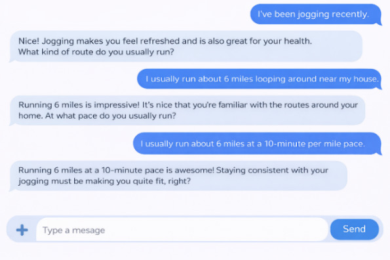
The chat interface used in the experiment was implemented using the cross-platform Flutter framework. The interface displayed user utterances on the right side and system responses on the left side, with a text input field and send button located at the bottom of the screen (see Figure 2).
Figure 2: Example interface of the experimental text-based dialogue system used in the user study.
Questionnaires Participants completed a pre-experiment questionnaire, a post-dialogue questionnaire after each session, and a final questionnaire after completing all dialogue sessions.
Embedding Psychological Distance Awareness 553 The post-dialogue questionnaires were designed to capture participants’ subjective impressions of each interaction, including conversational ease, perceived human-likeness, enjoyment of the conversation, willingness for continued interaction, perceived psychological distance, and perceived alignment between the participant’s intended interaction distance and the system’s conversational behavior.
Additional items assessed perceived conversational behaviors such as empathy, attentiveness, cooperativeness, and avoidance of imposing conversational pressure. Open-ended questions were also included to collect qualitative feedback regarding strengths, weaknesses, and perceived sources of psychological distance cues.
The final questionnaire evaluated overall impressions of the dialogue system across all sessions.
Analysis Methods Linguistic and Stylistic Analysis of Dialogue Logs
To examine how the proposed system adapted conversational style according to inferred psychological distance, dialogue logs were analyzed using linguistic and stylistic indicators computed at the utterance level and aggregated per participant. Three primary indicators were used: (1) politeness score, representing the relative level of formal versus casual expressions in system responses; (2) lexical interaction features, capturing empathy- and engagement-related expressions using a dictionary-based approach with length-normalized counts; and (3) utterance length change, defined as the difference in character length between responses before and after style adjustment. Participant-level scores were obtained by averaging these indicators across dialogue turns, and condition-wise comparisons were conducted to examine stylistic differences across psychological distance conditions.
Questionnaire-Based Evaluation Subjective interaction quality was evaluated using responses from post- dialogue and final questionnaires. Likert-scale responses were converted into numerical values (1–5), and participant-level scores were computed by aggregating responses across dialogue sessions. Detailed questionnaire items are provided in the Appendix to ensure transparency while maintaining readability of the main text.
Correlation Analysis To investigate relationships between objective linguistic adaptations and subjective user perceptions, Spearman’s rank correlation analysis was conducted between linguistic indicators derived from dialogue logs and questionnaire ratings. Correlations were examined for representative questionnaire measures, including conversational ease (Q4), perceived human-likeness (Q5), perceived psychological distance (Q8), perceived
distance alignment (Q12), and willingness for continued interaction (Q7). Spearman’s correlation was selected due to the ordinal nature of questionnaire responses and the relatively small sample size.
Descriptive Statistical Analysis In addition to correlation analysis, descriptive statistics (mean and standard deviation) were computed for each linguistic indicator across psychological distance conditions (close, distant, and neutral) to examine condition-wise stylistic differences. This combined analysis framework enables evaluation of how stylistic adaptations observed in dialogue behavior relate to users’ subjective conversational experiences.
RESULTS
Accuracy of Psychological Distance Estimation We first evaluated whether the psychological distance enacted by participants (close or distant) was reflected in the system’s distance estimation results derived from dialogue logs. For each participant, we calculated the proportion of utterances in which the system’s estimated distance matched the intended distance condition.
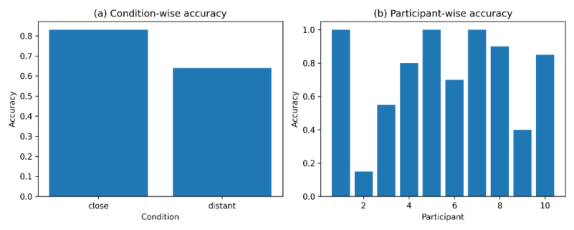
As shown in Figure 3(a), the system achieved higher estimation accuracy in the close condition than in the distant condition, while Figure 3(b) illustrates variability across participants. The results showed that, in the close condition, the system achieved a consistently higher matching rate across participants compared to the distant condition, indicating that linguistic cues associated with psychological proximity were detectable from user utterances. Although individual differences were observed, the overall trend suggests that users’ intentional manipulation of psychological distance was partially captured by the system’s estimation mechanism. The neutral condition was excluded from the accuracy analysis because no target psychological distance was specified for comparison.
Figure 3: Distance estimation accuracy across interaction settings. (a) Matching rate between intended and estimated psychological distance across interaction conditions (close and distant). (b) Participant-wise matching rate of distance estimation accuracy.
Embedding Psychological Distance Awareness 555 Linguistic Effects of Style Adaptation To examine how the system adapted its responses based on the estimated psychological distance, we analyzed linguistic differences between responses generated before and after style adaptation.
Three indicators were considered: (1) politeness score, (2) empathy-related lexical score, and (3) utterance length change.
Politeness Score The politeness score analysis revealed a clear tendency for responses in the close condition to shift toward a more casual style compared to the distant condition. This result indicates that the system systematically reduced formality when interacting under psychologically closer conditions. Such stylistic adjustments align with common conversational norms in human– human interaction, where reduced politeness often signals familiarity and interpersonal closeness.
As summarized in Table 2, responses in the close condition exhibited lower politeness scores and shorter response lengths compared to the other conditions, while empathy-related lexical scores showed relatively small variation.
Table 2: Mean (± SD) linguistic adaptation measures across psychological distance conditions.
Empathy-Related Lexical Features In contrast, empathy-related lexical scores showed relatively small variations across conditions. No strong condition-dependent differences were observed in the frequency of explicit empathy-related expressions. This finding suggests that psychological distance adaptation in the current system primarily manifests at the level of stylistic form rather than explicit lexical content, and that perceived empathy may be conveyed implicitly through phrasing and response structure rather than specific keywords.
Utterance Length Change Analysis of utterance length change revealed that responses in the close condition tended to become shorter after style adaptation, whereas length changes in the distant condition were less pronounced. Shorter responses in the close condition suggest a conversational strategy that assumes shared context and reduces explanatory redundancy, which is consistent with communication patterns observed in familiar interpersonal relationships.
Relationship Between Linguistic Features and Subjective Evaluation The correlation results between linguistic adaptation measures and subjective questionnaire ratings are summarized in Table 3. Response length change showed the strongest association with conversational evaluation scores, particularly enjoyment of conversation (ρ = −0.81, p < .01). Politeness-related measures showed moderate associations with perceived conversational appropriateness, suggesting that stylistic response adaptation influenced users’ subjective interaction experience.
Table 3: The correlation results between linguistic adaptation measures and subjective questionnaire ratings.
Table available in the original PDF paper.
Linguistic Measure Questionnaire Item ρ p Length change Enjoyment of conversation –0.81 <.01 Length change Empathy perception –0.70 <.05
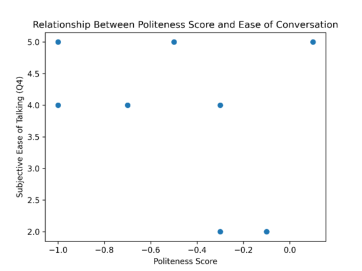
Politeness score Avoiding conversational pressure –0.67 <.05 The relationship between stylistic adaptation and subjective conversational experience is illustrated in Figure 4, which shows the association between politeness score and conversational ease ratings (Q4). Figure 4 suggests a weak negative tendency between politeness score and conversational ease ratings, although individual variability was observed.
Figure 4: Relationship between politeness score and subjective ease-of-conversation rating (Q4). Each point represents participant-level aggregated dialogue responses.
DISCUSSION
Overall, the results indicate that psychological distance can be partially inferred from dialogue logs and that the proposed system primarily adapts stylistic aspects of responses, such as politeness and verbosity, rather than explicit affective vocabulary. These stylistic adaptations were associated with subjective perceptions of conversational ease, closeness, and interaction quality, suggesting that subtle linguistic form control can effectively support psychological-distance-aware dialogue systems.
Embedding Psychological Distance Awareness 557 Correlation analyses showed that response length adaptation was particularly related to conversational enjoyment and engagement, indicating that shorter responses aligned with perceived interpersonal proximity may contribute to more natural interactions. In addition, moderate relationships between politeness-related measures and perceived conversational appropriateness suggest that interpersonal distance is conveyed not only through emotional expressions but also through stylistic cues such as formality and verbosity.
Several limitations should be noted. The small participant sample limits statistical generalizability, and the binary representation of psychological distance does not fully capture the continuous nature of interpersonal relationships. Future work will investigate larger-scale evaluations and more fine-grained distance modeling to better understand the role of adaptive conversational style control in long-term human–AI interaction.
CONCLUSION
This study presented a dialogue framework that estimates psychological distance from textual utterances and adaptively adjusts response styles accordingly. Experimental analyses demonstrated that psychological distance can be achieved moderate estimation accuracy and that stylistic adaptations—particularly in politeness and response length—are associated with users’ perceptions of conversational closeness, ease of interaction, and overall interaction quality.
These findings suggest that incorporating psychological-distance-aware stylistic control into dialogue systems offers a promising approach for enhancing user-centered conversational experiences. Future work will investigate larger-scale evaluations, more fine-grained representations of interpersonal distance, and real-time adaptive dialogue strategies to support more natural and personalized human–AI communication.
ACKNOWLEDGMENT
This work was supported by the General Insurance Association of Japan (GIAJ) under the project “Research on a Multimodal Dementia Self-Check System Aimed at Preventing Automobile Accidents Caused by Cognitive Impairment,” and by JSPS KAKENHI Grant Number 25K13383 and 24K15193.
REFERENCES
Aubakirova, Malika and Bansal, Mohit (2016). Interpreting Neural Networks to Improve Politeness Comprehension. Proceedings of the 2016 Conference on Empirical Methods in Natural Language Processing, pp. 2035–2041. Brown, Penelope and Levinson, C. Stephen (1987). Politeness: Some Universals in
Language Usage, Cambridge University Press.
Hu, Yaxin, Qu,Yuxiao, Maus, Adam and Mutlu, Bilge. (2022). Polite or Direct?
Conversation Design of a Smart Display for Older Adults Based on Politeness Theory. CHI ‘22: Proceedings of the 2022 CHI Conference on Human Factors in Computing Systems, Article No. 307, pp. 1–15. Mishra, Kshitij, Firdaus, Mauajama and Ekbal Asif (2022). Please be polite: Towards building a politeness adaptive dialogue system for goal-oriented conversations. Neurocomputing, Vol. 494, pp. 242–254. Niu, Tong and Bansal, Mohit (2018). Polite Dialogue Generation Without Parallel
Data. Transactions of the Association for Computational Linguistics (TACL), pp. 373–389.
APPENDIX
Questionnaire Structure The questionnaire consisted of:
Human Interaction and Emerging Technologies (IHIET-AI 2026): Artificial Intelligence and Future Applications
Read this individual research paper free through the original publisher, or explore the full digital proceedings book.
ISBN 978-1-964867-77-9
Explore this ISBN in the AHFE Bookstore ↗Listed in the July 2026 bookstore catalogue; search by ISBN to confirm current availability · Digital book purchase optional