Zeynep Erol, Emily Groves, Sebastian Baez Lugo, Nicolas Henchoz, Margherita Motta (2026). Capturing Food Culture for Adaptive AI: Generative Insights From a Multimodal Profiling Study. In: Human Interaction and Emerging Technologies (IHIET-AI 2026): Artificial Intelligence and Future Applications. AHFE Open Access, vol. 201. https://doi.org/10.54941/ahfe1007162
Artificial intelligence (AI) is creating new possibilities for digital systems that adapt to users in culturally sensitive ways. This study examines multimodal profiling as an early step for capturing culturally meaningful information in the context of healthy and sustainable eating. The aim is to provide a foundation for future interface adaptations that better support healthier and more sustainable practices. Building on earlier qualitative work involving interviews and cultural probes, we drew on insights that revealed complex personal food frameworks in which health and sustainability intersect with relationships, place, habit, and emotion. Using these insights as a foundation, we explored how different modalities of sharing information help people express these cultural dimensions in ways that are accessible to AI systems. 15 participants across diverse European contexts participated in this study. They described their everyday food practices, motivational drivers, and food heritage through spoken audio reflections, visual tasks, and written text. The results show that each modality elicits distinct types of cultural expression and that organising content into three dimensions gives the AI system a clear interpretive structure. Then, the AI generated summaries based on participants’ multimodal inputs across the three cultural dimensions, reflecting their food culture. These summaries were rated as highly familiar and accurate, indicating strong cultural resonance. Overall, the findings suggest that multimodal profiling supports the capture of culturally grounded aspects of food practice that are difficult to obtain through single input formats and can serve as an early foundation for adaptive interfaces that personalise interactions in culturally meaningful ways.
Digital technologies designed to promote healthy and sustainable eating often fail to account for the cultural contexts that shape food practices. Eating is not only a biological act but also a social, emotional, and cultural one, rooted in identity, habit, and place (Mintz and Bois, 2002). Food is both a biological necessity and a cultural practice, shaped by shared traditions, social norms, and individual histories (Fischler, 1988). Digital health and nutrition technologies, however, tend to prioritise quantifiable metrics such as calories or nutrients, neglecting the symbolic and emotional dimensions of eating ReceivedSeptember 5, 2025; Revised November 28, 2025; Accepted December 5, 2025; Available online April 1, 2026 For more information, seehttps://creativecommons.org/licenses/by- nc -nd/4.0/
(Bomfim et al., 2023). Consequently, many interventions fail to resonate with users’ lived experiences or support sustainable behaviour change. Design research has begun to integrate ethnographic and participatory methods to better account for cultural diversity in food practices (Comber et al., 2013). When digital systems overlook these cultural dimensions of eating, they struggle to create behavioural change (Thomas Craig et al., 2021). To address this gap, this research explores how digital systems, specifically those involving AI, can be designed to recognise and respond to the cultural particularities that shape food practices, fostering interactions that feel situated and personally relevant. We approach profiling, the initial moment when people introduce themselves to a system, as an opportunity for cultural understanding rather than a routine data- collection step. During profiling, users can share who they are, what matters to them, and how food fits into their everyday lives. This framing positions profiling as a foundation for cultural resonance, understood as the sense of familiarity, accuracy, and personal relevance that arises when technology reflects users’ lived experiences (Ruthven, 2021).
Building on this idea, our study investigates how multimodal profiling can help people articulate and reflect on their food culture while allowing the AI system to interpret these expressions meaningfully. Specifically, we examine three research questions. First, how do different input modalities (text, visuals, and audio) shape both the quality of user expression for AI systems and the user experience during profiling, particularly in helping participants articulate aspects of food culture that are often implicit or difficult to describe? Second, how accurately do AI-generated summaries reflect participants’ own self-descriptions of food culture? Third, how can organizing cultural information into distinct dimensions support the creation of adaptive, culturally grounded profiles? To address these questions, we designed a two-phase online study simulating the profiling phase of a large language model–based application for healthy and sustainable eating. The findings offer preliminary insights that extend current research on culturally adaptive AI, highlighting how multimodal profiling and cultural resonance can inform future design directions, especially in the food domain. RELATEDWORKCulturalAdaptationandHuman– AI Interaction Cultural adaptation in human–computer interaction (HCI) refers to designing systems that recognise and respond to users’ cultural contexts rather than assuming universal norms of use (Reinecke and Bernstein, 2011). Early work on culturally adaptive interfaces showed that localisation of language, colour, and interaction patterns could improve usability and engagement (Alexander et al., 2021). More recent research has expanded this focus toward adaptive systems that dynamically adjust to users’ values, communication styles, and social practices (Bassetti et al., 2022; Khan and Khusro, 2023). Within AI, recent advances in personalization and user modelling explore how systems can infer preferences, goals, behaviours and affective states from multimodal user data to provide context-sensitive adaptation (Wei et al., 2024). Despite this progress, most adaptive frameworks still treat cultural variation as a parameter to be predicted or classified rather than a lived context that can be expressed by users during interaction. Empirical studies examining how systems might learn from such situated cultural expressions remain limited. Profilingin Adaptive SystemsInteractionWithin HCI, profiling has been studied as a design process that shapes how users are introduced to system functionality, complete initial tasks, and build profiles that support later personalisation (Purificato, Boratto and Luca, 2024). In AI- assisted systems, profiling has evolved from static demographic models to dynamic representations that integrate behavioural and contextual information (Chen et al., 2025). However, most approaches still rely on structured forms or passive data collection, with limited opportunities for users to influence how they are represented. Recent work explores more expressive and context-aware profiling strategies to enable systems to capture richer, adaptive representations of users across platforms. However, how such approaches could capture cultural meaning and support adaptive interaction has not been systematically examined.
Multimodality inAI and ProfilingMultimodal systems combine text, visuals, audio and different kinds of input types to capture a richer understanding of human expression (Baig and Kavakli, 2020). Early multimodal HCI work demonstrated that combining modalities fundamentally reduces cognitive load and increases robustness in interaction, challenging assumptions that speech or text alone are sufficient (Oviatt, 1999). Multimodal input provides complementary and redundant channels that enhance expressiveness while reducing error rates, a principle highlighted in multimodal HCI research (Jaimes and Sebe, 2007). This conceptual shift positioned multimodal interfaces as a central direction in HCI, where supporting users’ communicative diversity became a central design priority (Dumas, Lalanne and Oviatt, 2009). In AI, multimodality enhances interpretive accuracy and reduces ambiguity compared to single-channel inputs (Baltrušaitis, Ahuja and Morency, 2017). Large language models (LLMs) now integrate multimodal data to contextualise meaning beyond text (Zhao et al., 2025), expanding possibilities for more natural human–AI interaction. Within HCI, multimodal profiling has recently been proposed as a way to personalise systems early in the user journey by allowing people to communicate through diverse expressive forms. However, most studies examine multimodality as a technical enhancement of system performance rather than as a means for users to express culturally grounded meanings and experiences. Recent research suggests that the modality of cultural input users provide, whether through text, visuals, or voice, can significantly shape how AI models interpret identity and context (Chavan et al., 2025). This indicates that multimodal interaction is not only about richer communication but also about how cultural expression influences the profile AI constructs of its users.
METHODOLOGYTo investigate how profiling can capture culturally relevant information for adaptive AI systems, we designed a study simulating the profiling phase of an LLM–based application for healthy and sustainable eating. The study examined how people express their food culture through different modalities and how AI can interpret those expressions to generate culturally resonant user profiles. In this context, cultural resonance refers to the extent to which a digital system is perceived as familiar, accurate, and personally relevant, aligning its tone and content with users’ lived experiences.
StudyDesignThe study conceptualises food culture through three dimensions, building on prior research that frames eating as the intersection of daily routines, value systems, and biographical identity (Fischler, 1988; Rozin, 2005). The first dimension, Everyday Food Practices, addresses habitual and practical aspects of food preparation and consumption. Motivational Drivers capture the values guiding food choice, such as health, pleasure, or sustainability (Steptoe, Pollard and Wardle, 1995). Food Heritage draws on research about memory and place attachment, reflecting how early experiences and local traditions continue to shape current habits (Mintz and Bois, 2002).
Drawing on these dimensions and different input modalities, we designed a 3 (cultural dimensions) × 3 (input modalities) within-subjects study. Each cultural dimension was examined through a dimension-specific question designed to capture relevant aspects of participants’ food practices and perspectives. For each dimension, participants had to answer a personal question through the three modalities (Table 1). Visual tasks differed across dimensions and were tailored to the type of cultural information each question targeted. This structure allowed us to examine (1) whether modality preferences varied across dimensions, (2) how each modality influenced the quality and type of information expressed, and (3) whether AI could synthesise these inputs into culturally resonant summaries. All participants completed the nine combinations of tasks, resulting in a total of 135 multimodal responses in Phase I and 135 corresponding AI-generated summaries evaluated in Phase II (see Procedure). Table1: Cultural dimensionsof food practiceand corresponding multimodal profiling tasks.
Questions Visual Text Audio Cultural Dimension Everyday food practices What is in your fridge? Photo of the inside of the fridge Short written answer Short spoken answer
Motivational drivers
What things matter most to you when you choose food?
Mind map of what matters when choosing food
Short written answer
Short spoken answer Collage / set of 5 photos representing influential places Short written answer Short spoken answer
Food heritage Are there any places—like where you grew up, live now, or have spent time—that have influenced the way you eat or think about food?
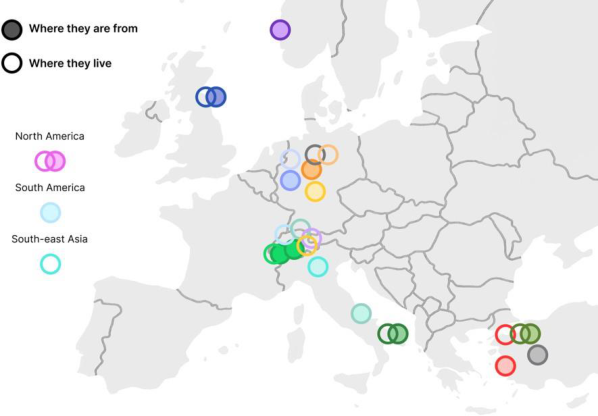
A total of 15 adult participants (P1–P15) from different parts of Europe participated in this study (Figure 1). They were recruited through mailing lists, professional networks, and word of mouth. The sample included eight women and seven men, with ages ranging from 26 to 73 years (mean age = 40.9). Six participants were between 18 and 30 years old, five were between 31 and 50, and four were over 51, providing coverage across major age categories. Professional backgrounds were mixed, reflecting heterogeneous routines and priorities around food. Participants’ recruitment, data collection, and analysis were conducted in accordance with institutional ethical guidelines.
Figure 1: Geographic distribution of participants showing countries of origin (filled circles) and residence (outlined circles).
ProcedureThe study was conducted online via Qualtrics over a four-week period and consisted of two main phases.
Phase I: Participants completed nine expression tasks corresponding to each combination of cultural dimension and input modality (Figure 2). After each task, they responded to short reflection questions to contextualise their choices and assess which format they considered most suitable for expressing their thoughts.
Figure 2: Overview of multimodal participant inputs showing examples of written,visual, and audio responses for each cultural dimension.
Figure available in the original PDF paper.
Phase II: First author generated AI-based summaries for each participant using their nine multimodal inputs. All summaries were produced with OpenAI’s GPT-4 model (June 2025 release), configured with memory off in an effort to avoid participant data being stored or used for model retraining. A single base prompt was refined through iterative prompt engineering to maintain clarity and consistency across outputs. The model synthesised each textual, visual, and audio input into a concise summary representing aspects of participants’ food cultures (Figure 3).
Figure3: Example of how participantinputina visual format(mindmap)was interpreted into an AI-generated summary.
Participants then self-evaluated how well each AI-generated summary reflected their food culture using a 1–7 Likert-type rating scale in response to the question, “How much does this summary resonate with you?” They also provided brief written explanations of their ratings, describing what made each summary feel more or less reflective of their food culture.
Data Collection andAnalysisThe study produced both quantitative and qualitative data. Quantitative measures included participants’ preference for expressing their food-related experiences through text, visual, and audio modalities, obtained via the MaxDiff (best–worst scaling) survey method, as well as their perceived cultural resonance of the AI-generated summaries measured using 1–7 Likert-type ratings. Qualitative data consisted of participants’ open-ended reflections on their modality preferences and written explanations of their resonance ratings. The analysis integrated both data types to interpret patterns across modalities and cultural dimensions. Primary outcomes focused on (1) the user-experience fit of
each modality, inferred from the MaxDiff method and supported by qualitative rationales, and (2) the perceived cultural resonance of AI summaries, based on participant ratings and explanations. All analyses were conducted in RStudio,
combining descriptive statistics with thematic coding of qualitative responses.
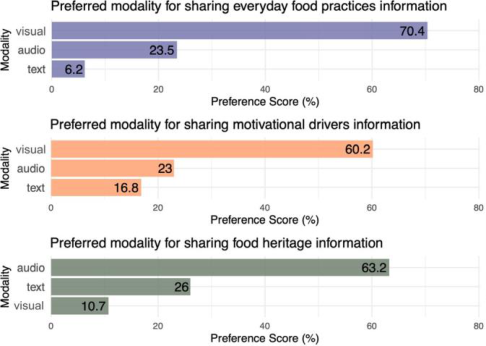
RESULTSPhaseI: User ExperienceAcrossModalitiesThe MaxDiff analysis revealed distinct modality preferences across the three cultural dimensions (Figure 4). For Everyday Food Practices and Motivational Drivers of Food Choice, visual input was the most preferred modality, with preference scores of 70.4% and 60.2% respectively. For Food Heritage, this pattern reversed: visual preference dropped to 10.7%, while audio emerged as the dominant modality with a score of 63.2%.
Open-ended reflections provided context for these preferences. Participants described photographs as the most effortless and accurate way to answer the Everyday Food Practices question, “What is in your fridge?”. Taking a photo required little cognitive effort and conveyed information that would have been cumbersome to describe verbally or in writing. For Motivational Drivers of Food Choice, visual mind maps were preferred because their non-linear format supported connections among abstract values and facilitated reflection on priorities. As one participant (P07) explained, “Since it’s not a linear process, the visual is able to express the complexity, while text is a bit limiting.” For Food Heritage, participants showed a preference for audio recordings. Speaking about memories felt more natural and emotionally expressive, enabling storytelling and subtle nuance. Participant P09 commented that audio helped them “focus on what really matters.” However, this modality was not equally accessible for everyone: a few participants expressed discomfort with hearing their own voice, and some, particularly older participants, reported technical difficulties such as background noise. In these cases, text responses were perceived as safer and more familiar.
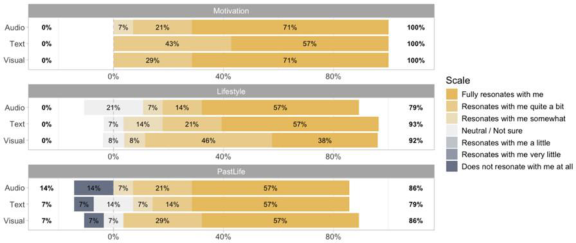
PhaseII: Cultural ResonanceofAI-Generated SummariesParticipants reviewed the AI-generated summaries derived from their multimodal inputs then evaluated each summary based on its cultural resonance. Overall, participants’ evaluations indicated high levels of cultural resonance across modalities and dimensions (Figure 5). More than 78% of all participants reported that the AI-generated summaries reflected their food-related perspectives to a significant degree. The Motivational Drivers dimension achieved the highest resonance, with 100% of positive evaluations across the three modalities. Interestingly, the Audio and Visual inputs provided the highest enthusiasm, with 71% of participants indicating that the summaries “Fully resonated” with them in both cases. Everyday Food Practices also produced high scores, particularly for text (93% positive resonance), followed by visual input (92%), while audio was still strong (79%), it resulted in the highest degree of uncertainty, with 21% of participants selecting “neutral/not sure”. Food Heritage displayed greater variability: while positive resonance remained high (ranging from 79% to 86%), this category saw the emergence of negative sentiment, with 14% of participants indicated the summary resonated “very little” for audio inputs and 7% for text and visual inputs.
Figure5: Participant ratingsof cultural resonanceacrossmodalitiesandculturaldimensions.
Qualitative reflections supported these patterns. Twelve of the fifteen participants described their summaries as accurate and personally recognisable. Several noted that the AI captured their habits and values with unexpected precision. For example, P12 remarked that the summary “felt like something
I could have written myself,” while P04 described it as “a good overview of who I am around food.” Participants also characterised the process as reflective, with P11 noting that it “made me reconsider how I think about food.” Three participants expressed more critical views, particularly within the Food Heritage dimension. Their concerns centred on oversimplification or misinterpretation of contextual details. P07 felt that “some statements went too far,” and P10 noted that “certain parts felt oversimplified.” Even so, these participants still acknowledged that the summaries captured the core elements of their food culture.
DISCUSSIONCulturalDimensionsasa Framework for Structuring Adaptive ProfilesThe three cultural dimensions (Everyday Food Practices, Motivational Drivers, and Food Heritage) proved useful for organising participants’ inputs, since resonance patterns showed that each dimension elicited recognisably different aspects of food culture: routinised practices, guiding values, and biographical narratives. Qualitative reflections further indicated that participants intuitively treated these dimensions as separate “layers” of their food identity, often describing one dimension as practical, another as emotional, and another as value-based. This finding also affirming earlier theoretical accounts of food culture as an interplay between habits, values, and identity (Axelson, 1986). In addition, by operationalising these dimensions in multimodal tasks and showing that they support AI-generated summaries participants find accurate and recognisable, the study demonstrates how long-standing conceptual frameworks can be translated into computationally meaningful structures for adaptive systems. This establishes a bridge between cultural HCI work and AI personalisation research, showing that culturally grounded dimensions can form a stable scaffolding for profile interpretation. Adaptive systems can treat these dimensions as containers for different types of cultural knowledge, enabling clearer modelling of user diversity. Moreover, because each dimension aligns with specific modalities, systems can guide users toward profiling experiences that contextually appropriate.
HowMultimodalityShapesCulturalExpressionin Profiling The results demonstrate that people do not express “food culture” uniformly across modalities; instead, they match different layers of meaning with the expressive affordances of each medium. Participants explained these choices by highlighting how each modality reduced cognitive effort or enabled the type of expression they wanted to achieve. For example, photos eliminated the burden of translating concrete pantry content into words, while mind maps allowed participants to visualise complex, non-linear value structures. Audio, in turn, enabled emotional nuance and narrative flow when discussing memories or place-based identity. Together, these findings indicate that modality choice is not only a matter of usability but also affects how “seen” or comfortable participants feel during profiling. Participants tended to avoid audio for factual descriptions but gravitated toward it when sharing memories or emotional narratives. Text, despite being the least preferred modality overall, remained important whenever participants sought precision or control over tone. These patterns suggest that aligning modality with task improves both user experience and the interpretive clarity of the cultural information the system receives, extending earlier work showing that multimodality enhances expressiveness and reduces ambiguity in interaction (Jaimes and Sebe, 2007). These insights also reveal a practical implication for design: profiling systems can default to modalities that naturally elicit richer information for each type of cultural content, and offer fallbacks when accessibility or comfort barriers arise.
Table 2 synthesises these alignments by connecting each cultural dimension with an appropriate modality and fallback strategy, translating empirical patterns into a practical framing for multimodal profiling design. For example, several participants noted that photos alone could miss contextual cues, suggesting that pairing an image with a short caption preserves low effort while improving interpretability for the system. For mind maps, some participants reported difficulty of beginning. Light scaffolding, such as starter nodes or brief prompts, could lower this entry barrier without constraining reflection. For Food Heritage, providing voice-to-text transcription with the option to edit, or a text-only fallback, can preserve narrative richness while reducing misinterpretation.
Table2: Alignment betweenculturaldimensionsanddefaultmodalities, with corresponding design rationales and fallbacks.
Concrete, low effort Caption to avoid ambiguity Mind map Supports reflection & non-linear thinking Starter nodes + short prompts
Motivational Drivers of Food Choice Food Heritage Guided Audio Richer emotions & narrative Voice-to-text + text fallback; confirm place/time CulturalResonanceand Opportunities forCo- Editing in Adaptive SystemsCultural resonance emerged as a valuable lens, offering insights that go beyond factual correctness. In their self-evaluations, participants described the most resonant summaries as those that “felt like me,” capturing both what they do and how they see themselves. High resonance scores, which are supported by qualitative explanations about tone, emphasis, and personal recognition, suggest that evaluation of AI-generated profiles benefits from including subjective alignment, not just descriptive accuracy. This relational view of evaluation aligns with shifts in HCI toward value-sensitive and co-interpretive frameworks (Gerdes and Frandsen, 2023).
Importantly, qualitative data showed that moments of mismatch (especially in the Food Heritage dimension) often led participants to reflect on why something felt “off,” pointing to a natural opportunity for user correction. These observations motivate a design implication central to this study’s contribution: profiling can be reconceived as an iterative, co-editing process in which users and systems refine cultural profiles together dynamically. Instead of treating profiling as a one-off data collection procedure, systems can allow users to inspect and refine the AI- generated summaries of their inputs. This creates an iterative feedback loop in which users can correct inaccuracies, add missing nuance, and exercise greater agency over how they are represented. Integrating user correction and reflections may strengthen AI representational fairness and help prevent misalignment in subsequent adaptive behaviours. Future work will explore this co-editing approach within deployed systems, examining whether culturally grounded profiles meaningfully improve adaptive interactions such as conversational interfaces.
CONCLUSIONThis study investigated a multimodal profiling approach that structures food culture into three dimensions and invites users to express each dimension through text, visuals, and audio. These multimodal inputs were then used to generate AI- based cultural summaries for adaptive systems supporting healthier and more sustainable eating. The findings show that different input modalities elicit distinct forms of cultural expression, and that multiple modalities allow the generation of resonant user profiles. The work introduces cultural resonance as an evaluative lens and demonstrates how food-culture dimensions can be operationalised to structure culturally grounded profiling. Together, these insights outline a multimodal profiling strategy that can evolve into a co-editing process between users and systems. Future work will investigate how cultural profiles and AI-generated summaries can be integrated into real adaptive systems, for example in conversational interfaces, and examine how this culturally grounded information influences user experience and is perceived by users.
ACKNOWLEDGEMENTThis work was conducted as part of the SWITCH project funded by the European Commission and the State Secretariat for Education, Research and Innovation (SERI) for the Swiss partners (Grant Agreement No. 101060483, Call: HORIZON-CL6-2021-FARM2FORK-01-15: Transition to sustainable and healthy dietary behaviour). We gratefully acknowledge the support and collaboration of our project partners. We also wish to express our sincere appreciation to all participants for generously contributing their time and insights, which were essential to this research.
REFERENCES
Alexander, R. et al. (2021) “The Influence of User Culture on Website Usability,” International Journal of Human-Computer Studies, 154, p. 102688. Available at: https://doi.org/10.1016/j.ijhcs.2021.102688. Axelson, M.L. (1986) “The Impact of Culture on Food-Related Behavior,” Annual
Review of Nutrition, 6(Volume 6, 1986), pp. 345–363. Available at: https://doi. org/10.1146/annurev.nu.06.070186.002021.
Baltrušaitis, T., Ahuja, C. and Morency, L.-P. (2017) “Multimodal Machine Learning: A Survey and Taxonomy.” arXiv. Available at: https://doi.org/10.48550/ arXiv.1705.09406. Bassetti, C. et al. (2022) “Towards socially-competent and culturally-adaptive artificial
agents Expressive order, interactional disruptions and recovery strategies,” Interaction Studies. Social Behaviour and Communication in Biological and Artificial Systems, 23(3), pp. 469–512. Available at: https://doi.org/10.1075/ is.22021.bas. Bomfim, M. et al. (2023) “Design and Evaluation of Technologies foInformed Food Choices,” ACM Transactions on Computer-Human Interaction, 30(4), pp. 1–46. Available at: https://doi.org/10.1145/3565482. Chavan, V. et al. (2025) “Feeling Machines: Ethics, Culture, and the Rise of Emotional AI.”
arXiv. Available at: https://doi.org/10.48550/arXiv.2506.12437. Chen, A. et al. (2025) “DEEPER Insight into Your User: Directed Persona Refinement for Dynamic Persona Modeling,” in W. Che et al. (eds.) Proceedings of the 63rd Annual Meeting of the Association for Computational Linguistics (Volume 1: Long Papers). ACL 2025, Vienna, Austria: Association for Computational Linguistics,
pp. 24157–24180. Available at: https://doi.org/10.18653/v1/2025.acl-long.1177. Comber, R. et al. (2013) “Food practices as situated action: exploring and designing for everyday food practices with households,” in Proceedings of the SIGCHI Conference on Human Factors in Computing Systems. CHI ’13: CHI Conference on Human Factors in Computing Systems, Paris France: ACM, pp. 2457–2466. Available at: https://doi.org/10.1145/2470654.2481340. Dumas, B., Lalanne, D. and Oviatt, S. (2009) “Multimodal Interfaces: A Survey of
Principles, Models and Frameworks,” in D. Lalanne and J. Kohlas (eds.) Human Machine Interaction: Research Results of the MMI Program. Berlin, Heidelberg: Springer, pp. 3–26. Available at: https://doi.org/10.1007/978-3-642-00437-7_1. Fischler, C. (1988) “Food, self and identity,” Social Science Information, 27(2), pp. 275–292. Available at: https://doi.org/10.1177/053901888027002005. Gerdes, A. and Frandsen, T.F. (2023) “A systematic review of almost three decades of
value sensitive design (VSD): what happened to the technical investigations?,” Ethics and Information Technology, 25(2), p. 26. Available at: https://doi. org/10.1007/s10676-023-09700-2. Jaimes, A. and Sebe, N. (2007) “Multimodal human–computer interaction: A survey,” Computer Vision and Image Understanding, 108(1), pp. 116–134. Available at: https://doi.org/10.1016/j.cviu.2006.10.019. Khan, M. and Khusro, S. (2023) “Towards the design of personalized adaptive user
interfaces for smart TV viewers,” Journal of King Saud University - Computer and Information Sciences, 35(9), p. 101777. Available at: https://doi.org/10.1016/j. jksuci.2023.101777. Mintz, S.W. and Bois, C.M.D. (2002) “The Anthropology of Food and Eating,” Annual Review of Anthropology, 31(Volume 31, 2002), pp. 99–119. Available at: https://doi.org/10.1146/annurev.anthro.32.032702.131011. Purificato, E., Boratto, L. and Luca, E.W.D. (2024) “User Modeling and User Profiling: A
Comprehensive Survey.” arXiv. Available at: https://doi.org/10.48550/ arXiv.2402.09660. Reinecke, K. and Bernstein, A. (2011) “Improving performance, perceived usability, and aesthetics with culturally adaptive user interfaces,” ACM Trans. Comput.-Hum. Interact., 18(2), pp. 8:1–8:29. Available at: https://doi. org/10.1145/1970378.1970382. Rozin, P. (2005) “The Meaning of Food in Our Lives: A Cross-Cultural Perspective on
Eating and Well-Being,” Journal of Nutrition Education and Behavior, 37, pp. S107–S112. Available at: https://doi.org/10.1016/S1499-4046(06)60209-1. Ruthven, I. (2021) “Resonance and the experience of relevance,” Journal of the Association for Information Science and Technology, 72(5), pp. 554–569. Available at: https://doi.org/10.1002/asi.24424. Steptoe, A., Pollard, T.M. and Wardle, J. (1995) “Development of a Measure of the
Motives Underlying the Selection of Food: the Food Choice Questionnaire,” Appetite, 25(3), pp. 267–284. Available at: https://doi.org/10.1006/ appe.1995.0061.
Thomas Craig, K.J. et al. (2021) “Systematic review of context-aware digital behavior change interventions to improve health,” Translational Behavioral Medicine, 11(5), pp. 1037–1048. Available at: https://doi.org/10.1093/tbm/ibaa099. Wei, T. et al. (2024) “Towards Unified Multi-Modal Personalization: Large Vision-
Language Models for Generative Recommendation and Beyond.” arXiv. Available at: https://doi.org/10.48550/arXiv.2403.10667. Zhao, W.X. et al. (2025) “A Survey of Large Language Models.” arXiv. Available at: https://doi.org/10.48550/arXiv.2303.18223.
LISTED IN THE AHFE DIGITAL BOOKSTORE CATALOGUE
Explore the complete digital volume
Human Interaction and Emerging Technologies (IHIET-AI 2026): Artificial Intelligence and Future Applications
Read this individual research paper free through the original publisher, or explore the full digital proceedings book.
ISBN 978-1-964867-77-9
Explore this ISBN in the AHFE Bookstore ↗Listed in the July 2026 bookstore catalogue; search by ISBN to confirm current availability · Digital book purchase optional