Elena Cavallin, Simone Spagnol (2026). Shaping Conversations: Custom GPTs to Spark Reflection in Design. In: Intelligent Human Systems Integration (IHSI 2026): Disruptive and Innovative Technologies. AHFE Open Access, vol. 200, pp. 74–83. https://doi.org/10.54941/ahfe1007066
This paper documents the development and evaluation of a customized GPT designed to facilitate metacognitive reflection on cognitive biases in design decision-making. Leveraging the OpenAI GPTs platform, a specialized conversational agent was created by integrating a structured knowledge base of twelve categories of cognitive biases with prompt engineering strategies oriented toward progressive disclosure. The system aimed to stimulate reflective thinking in design students by gradually surfacing relevant biases through contextual interactions rather than through systematic enumeration.The paper details the construction of the chatbot, including the design of system instructions, the organization of the knowledge base, and the definition of conversation starters used to initiate dialogues. Particular emphasis was placed on turn-taking management and the principle of one-question-per-turn, in line with established theories of cognitive load management. Despite these design directives, the analysis of conversations conducted with a sample of design students revealed significant limitations in the effective implementation of conversational principles. In seven out of ten interactions, the system presented full lists of biases in sequence, contradicting the intended principle of progressive disclosure and generating cognitive overload.Empirical analysis highlights three main issues: structural rigidity, with responses derived from repetitive templates and limited adaptability to specific project contexts; information dumping, characterized by lengthy outputs and simultaneous multiple questions; and restricted personalization, reduced to superficial lexical substitutions without meaningful contextual selection of relevant biases. These shortcomings reflect the architectural constraints of the platform at the time of the study (early 2024), when persistent memory and advanced retrieval mechanisms for dynamic context management were not yet available.Although the outcomes diverged from the original objectives, the work offers valuable contributions. First, it provides a systematic documentation of the iterative development process of a customized GPT for design reflection, emphasizing the need to balance prescriptive directives with conversational flexibility in prompt engineering. Second, it identifies practical considerations for the design of educational chatbots: the necessity of more sophisticated architectural controls to prevent enumeration, the importance of conversational management policies (anti-repetition, recap, one lever per turn), and the role of knowledge bases in contextual adaptation. Finally, the paper discusses how technological advances introduced in late 2024, such as persistent memory in GPT models and the integration of retrieval-augmented generation (RAG), may mitigate some of the observed failure modes, opening pathways for more effective implementations in the future.In conclusion, this study contributes to the understanding of how conversational AI platforms can be tailored to support reflective processes in educational and design contexts. While the experiment revealed the limitations of prompt-engineering-based solutions, the findings underscore the potential of specialized GPTs as metacognitive support tools and as catalysts for embedding reflective practices in design education.
The OpenAI GPTs platform allows the configuration of agents with sys tem instructions and knowledge bases without requiring programming skills, enabling rapid customization for specific contexts (OpenAI, 2025). The possibility of integrating knowledge bases with personalized behavioral instructions through prompt engineering (Liu et al., 2023; White et al., 2023) provides powerful tools for creating tailored interactions and learning expe riences that can adapt to the specificities of different disciplinary domains.
The recognition and mitigation of cognitive biases (Boonprakong et al., 2025), systematic distortions in decision-making such as confir mation bias (the tendency to give more weight to information support ing pre-existing hypotheses while ignoring contradictory evidence) and overconfidence bias (excessive confidence in one’s design decisions), rep resent fundamental competences in design education, where project decisions are frequently influenced by unconscious heuristics and unex amined assumptions (Jimenez et al., 2024; Kahneman, 2011). Developing
Shaping Conversations: Custom GPTs to Spark Reflection in Design 75 metacognitive awareness, the ability to monitor and regulate one’s own learning and decision-making processes, is particularly critical for design students to recognize and counteract these biases (Isaacson & Fujita, 2006). Recent research has shown how confirmation bias specifically affects visual attention during engineering design analysis, suggesting the need for struc tured interventions to counteract these behavioral patterns. The emergence of conversational agents to support metacognition represents a promising development in this domain. Recent studies have demonstrated how systems such as SocratAIs, agents posing reflective questions specifically designed to promote “deeper reflection-in-action” in creative processes, can effectively stimulate structured reflective processes (Gmeiner et al., 2025). In paral lel, research on conversational systems as catalysts for critical thinking has shown how LLM-based agents can counteract groupthink and decision-mak ing biases through strategic provocations during collaborative design pro cesses (Lee et al., 2024).
This domain provides a particularly compelling case study for exploring how customized GPTs can support structured reflections on complex cogni tive processes through Socratic methodologies. The intrinsically practical yet reflective nature of the design process, combined with the need to develop metacognitive skills in design students, makes this context ideal for experi menting with conversational approaches to reasoning.
Objectives and Contributions This study documents the complete process of developing a specialized GPT designed to facilitate reflective conversations on cognitive biases in design decision-making. The specific objectives of the work include the systematic documentation of the methodology for constructing the GPT, the analysis of the effectiveness of the implemented prompt engineering strategies, and the identification of practical considerations for the development of custom chatbots in design contexts. The main contribution of this work is to provide a practical and scientifically grounded resource for educators and research ers interested in developing specialized conversational tools using online AI platforms without relying on APIs.
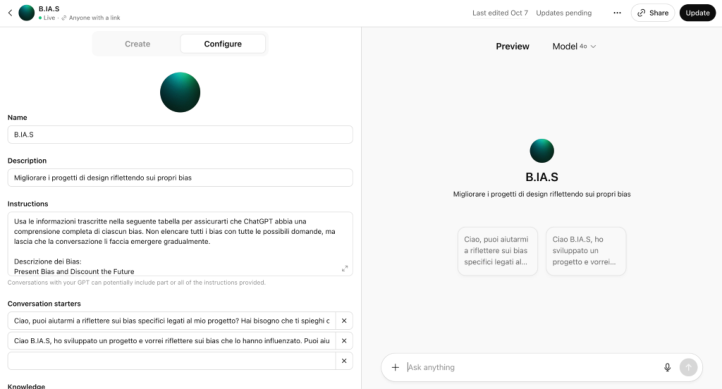
Design and Implementation An initial chatbot was created in March 2024 as a test; the version called B.IA.S was developed in June 2024, and the version discussed in this paper was finalized on June 26, 2024. The construction of the chatbot relied on the OpenAI GPTs platform, which enables customization through struc tured system instructions and integrated knowledge bases without requir ing advanced programming skills (OpenAI, 2025). Within the interface, the following sections can be edited, as summarized in the table below.
Table 1: Custom GPT editable parameters.
Table available in the original PDF paper.
Parameters Description Name Public name of the GPT, displayed to users
Description Short descriptive text visible in the GPT card (Explore GPTs) Instructions Central section for providing instructions: what the GPT should do, tone of voice, rules, and limits
Conversation starters Example prompts that appeared as buttons on the GPT home page Capabilities Toggle to enable/disable tools: Code Interpreter (Advanced Data Analysis), Web Browsing, Image Generation (DALL·E)
Recommended Model Choice of base model (GPT-3.5, GPT-4, and from May/June 2024 the GPT-4o preview appeared for some users) Knowledge Possibility to upload files or texts as an additional knowledge base that the GPT could consult in addition to its training
Figure 1: Custom GPT configuration interface used to build the B.IA.S agent.
Prompt Engineering The implementation of progressive disclosure (Nielsen, 2006; Springer & Whittaker 2020; Muralidhar et al., 2025) represented one of the main meth odological challenges in the design of the chatbot. System instructions were crafted to provide specific directives intended to prevent enumerated presen tations of all biases, encouraging instead a conversational approach in which relevant biases would naturally emerge from the user’s project context.
Shaping Conversations: Custom GPTs to Spark Reflection in Design 77 Research on conversational AI assistants shows that proactive dialogue and strategic timing of interactions can significantly enhance user engagement and perceived collaboration effectiveness (Fan et al., 2024). Conceptually, the interaction design was aligned with principles of turn-taking, one ques tion per turn, to manage cognitive load and to follow established conver sational practices. However, at the implementation stage, the explicit rules for turn-taking and length control were not enforced. The central directive stated: “Use the information transcribed in the following table to ensure that ChatGPT has a complete understanding of each bias. Do not list all the biases with all possible questions, but let the conversation bring them up little by little.”
The knowledge base was structured as an internal resource not exposed directly to the user. It included twelve categories of cognitive biases, each with a name, a detailed description of the associated cognitive behavior, and two guiding reflection questions. This organization was intended to support context-sensitive questioning while maintaining flexibility, in line with prin ciples of progressive disclosure for presenting complex information.
The following examples illustrate how the knowledge base was structured to generate context-sensitive prompts for each of the twelve biases. Each prompt was designed to stimulate reflective thinking without enumerating all biases at once.
Table 2: Example prompts for each cognitive bias used in the customized GPT.
Table available in the original PDF paper.
Bias Example Prompt Present Bias “In your project, are you giving sufficient importance to long-term impacts, or are you focusing mainly on short-term results?”
Confirmation Bias
“Are you only considering information that confirms your initial assump tions? How might you integrate contradictory evidence?”
To facilitate session initialization, the GPT was also configured with con versation starters, two short prompts designed to invite users to describe their projects and reflect on potential biases: “Hi, can you help me reflect on the specific biases related to my project? Do you need me to explain how my project is structured? What kind of informa tion do you need in order to provide more specific guidance?”
“Hi B.IA.S, I have developed a project and I would like to reflect on the biases that may have influenced it. Can you help me identify them?”
In addition, the GPT was configured with three enabled capabilities (DALL·E, Web Browsing, and Code Interpreter) although these tools remained periph eral to the main conversational flow, which was primarily text-based. The configuration was deployed in May/June 2024, a period in which some users also had access to the GPT-4o preview.
METHODOLOGY
Iterative Development The protocol for the deployment of the bias-aware chatbot, including par ticipant recruitment, pre/post survey design, and ethics approval, has been extensively documented elsewhere (Cavallin, 2025). In this paper, we provide only a concise overview to contextualize the transcript analysis and focus on complementary insights. Eleven undergraduate design students from the University of the Republic of San Marino interacted with the chatbot while discussing their ongoing projects. Each session lasted approximately 30 min utes, including pre/post questionnaires and a 10–15 minute chatbot interac tion. For the full methodological protocol and survey results, see Cavallin (2025).
The development process followed an iterative approach informed by empirical feedback collected through real interactions. The initial version relied on explicit enumeration of biases with predetermined and fixed ques tion sequences. A pre-study conducted at TU Delft with a representative student revealed significant issues with this approach, including cognitive overload caused by information density, poor contextual anchoring to the specifics of the project, repetitive interaction patterns that reduced engage ment, and limited involvement with project-specific details.
Based on the feedback gathered during the pre-study, the subsequent ver sion attempted to eliminate the systematic enumeration of biases. However, the detailed analysis of real conversations conducted with a sample of 11 undergraduate design students from the University of the Republic of San Marino revealed that many limitations persisted despite the refinement efforts.
Empirical Analysis Contrary to the explicitly stated objectives, the current version continues to present complete lists of cognitive biases in a significant proportion of interactions. Transcript analysis was conducted by manually reviewing all chats and annotating conversational patterns. In addition, response length was quantified in terms of tokens using the public tool tiktokenizer (https:// tiktokenizer.vercel.app/). The transcript analysis shows that seven out of ten conversations (one participant did not share the chat) began with a full enu meration of all twelve available biases, replicating exactly the problems of cognitive overload that this update was intended to eliminate.
The analyzed conversations follow highly repetitive patterns, with each bias presented through an identical structure characterized by the sequence “Description – Question – Reflection”, regardless of the specific design con text provided by the user. The design rule of “one question per turn” was sys tematically violated, as the chatbot regularly produced responses exceeding one thousand words and containing twelve or more simultaneous questions
Shaping Conversations: Custom GPTs to Spark Reflection in Design 79 (the median length of the first response was 1,968 tokens, ranging between 1,424 and 2,560 words), directly contradicting the declared design principles for cognitive load management.
The system maintains an information dumping approach instead of the planned progressive disclosure, indicating fundamental limitations in behav ioral control through prompt engineering. Even when the system collects detailed contextual information through conversation starters and initial user descriptions, the resulting personalization is limited to superficial lex ical substitutions within predefined templates. Projects characterized by radically different goals, stakeholders, and constraints (e.g., psychoacoustic devices, urban gardens, healthcare services) received virtually identical bias sequences, revealing inadequacy in contextual selection mechanisms. The system invariably applied the same set of climate- and sustainability-related biases regardless of project-specific relevance, showing that the rigid knowl edge base did not adapt effectively to diverse application domains.
Failure modes included over-prompting, characterized by multiple simul taneous questions; premature specificity, with requests for implementation details before conceptual stabilization; and short-term memory limitations that undermined conversational coherence. Engagement patterns analyzed included both the success of contextual anchoring and the perceived rele vance of the questions, but also the limited adaptation to individual project specificities. Prior research suggests that proactive dialogue with strategic timing can enhance these engagement metrics (Fan et al., 2024), but requires careful calibration of when and how the agent intervenes.
System responses exhibited features that directly contradicted the declared design principles, most notably the systematic tendency to present full enu merations of all twelve biases rather than allowing them to emerge gradually through contextual interaction.
Examples from transcripts illustrate these failure modes: Structural Rigidity/Full Enumeration
“Present Bias and Discount the Future — Reflection questions… Bias of Diffusion of Responsibility… Planning Fallacy Bias… Confirmation Bias…” Here, the chatbot opened the session by listing all twelve biases with corre sponding questions, contradicting the principle of progressive disclosure and generating cognitive overload.
Over-prompting/Multiple Simultaneous Questions “Are you giving sufficient importance to long-term impacts…? Does your project imply that others should take responsibility…? Have you realistically considered the time and costs…? Are you seeking information that challenges your assumptions…?”
In the same response, the model produced several unrelated questions across biases, violating the intended “one question per turn” design rule.
“Let’s analyze the potential biases regarding the sustainability of your project… Present Bias… Diffusion of Responsibility… Planning Fallacy… Confirmation Bias…” Even after the user described a detailed project (wooden frame with metal cords for blown glass), the system defaulted to a generic template, with only superficial substitutions (“materials used,” “environmental impact”).
Template Replication After Further Contextualization “Reflecting on your innovative mold for glass-blowing… 1) Present Bias… 2) Diffusion of Responsibility… … 12) Optimism Bias.” Despite a technical explanation (sand molds, resin evaporation, reusabil ity of sand), the chatbot reproduced the same ordered list of twelve biases, showing weak contextual selectors and reliance on rigid templates.
Structural Rigidity Qualitative analysis reveals that the system functions predominantly as a repository of predefined content rather than as an adaptive conversational agent capable of meaningful personalization. A representative excerpt illus trates this tendency toward systematic enumeration. The system responds with formulations such as “Here are some of the biases relevant to your project and suggestions on how to address them”, followed by a numbered list that includes Present Bias and Discount the Future with the description “Tendency not to consider long-term returns” and the question “In your project, are you giving sufficient importance to long-term impacts?”, system atically continuing through all twelve biases available in the knowledge base.
Conversational state management proved ineffective, as contextual infor mation collected in the initial phases of the interactions through conversa tion starters did not significantly influence the selection or formulation of subsequent questions.
DISCUSSION
The findings suggest that the effective implementation of progressive disclo sure principles requires more sophisticated architectural controls than those available through system instructions in the GPTs platform. The persistence of enumeration patterns despite explicit counter-directives indicates funda mental limitations in behavioral control through prompt engineering, high lighting the need for alternative implementation approaches to achieve the desired conversational goals.
Limitations and Future Work The current implementation presents significant limitations that affect both the generalizability and the effectiveness of the results. Limited contextual
Shaping Conversations: Custom GPTs to Spark Reflection in Design 81 memory across extended sessions compromised the system’s ability to build a progressive understanding of users’ projects.
The approach of cue detection through pattern matching represents a technically accessible alternative to complex natural language understanding requirements, while retaining potential for contextual relevance when imple mented within more controllable architectures.
It is important to contextualize the observed limitations of this chatbot within the technological landscape of 2024, the period in which the empiri cal experimentation was conducted. At that time, Custom GPTs offered only limited control over persistent memory and conversational state manage ment, with practical consequences for anti-enumeration, personalization, and turn-taking coherence.
From late 2024 into 2025, the technological ecosystem evolved sub stantially with the introduction of advanced functionalities. Memory for ChatGPT became widely available, allowing the system to retain informa tion across conversations and making it possible to keep project briefs and contextual resources consistently accessible during interactions.
Together, these advanced capabilities could mitigate some of the failure modes identified in the present study. Persistent memory would help enforce the one-question-per-turn rule without reverting to systematic listings, while retrieval and vector store mechanisms would support more targeted question selection based on the specific project context. It is important to empha size, however, that these technological advances do not remove the necessity for a well-designed conversational policy regulating turn-taking, recap, and anti-repetition, but rather provide infrastructural tools to implement such policies with greater reliability and fine-grained control.
CONCLUSION
This study demonstrates the implementation feasibility of specialized con versational agents to support metacognitive reflection through structured Socratic questioning (Isaacson & Fujita, 2006; Gmeiner et al., 2025), while also highlighting the significant challenges of applying sophisticated conver sational principles on platforms such as OpenAI. The approach of progressive disclosure, combined with contextual anchoring strategies and anti-repeti tion policies, underscores the potential to sustain engagement while main taining cognitive manageability, yet also reveals the practical limitations of prompt engineering in systematically controlling model behavior.
The original contribution of this work lies in the qualitative and quanti tative analysis of real interaction transcripts, which empirically illustrates the gap between the design intent (progressive disclosure, one question per turn) and the model’s actual behavior. This result complements survey data (presented elsewhere) and provides new evidence of the concrete limitations of prompt engineering strategies.
Finally, the iterative development methodology, guided by empirical feed back, offers a replicable approach for the systematic refinement of conver sational agents, while future work will focus on expanding the sample and experimenting with additional techniques for conversational control.
REFERENCES
Boonprakong, N., Tag, B., Goncalves, J., & Dingler, T. (2025). How do HCI research ers study cognitive biases? A scoping review. In Proceedings of the 2025 CHI Conference on Human Factors in Computing Systems (Article 1115, pp. 1–20). ACM. https://doi.org/10.1145/3706598.3713450 Cavallin, E. (2025). GenAI for debiasing: Evaluating a custom chatbot as reflec
tive partner in sustainable design education. In Proceedings of the 16th Biannual Conference of the Italian SIGCHI Chapter (CHItaly ’25) (Article 65, pp. 1–5). Association for Computing Machinery. https://doi.org/10.1145/3750069.3750098 Fan, M., Kuang, E., Li, M., & Shinohara, K. (2024). Enhancing UX Evaluation Through Collaboration with Conversational AI Assistants: Effects of Proactive Dialogue and Timing. Proceedings of the 2024 CHI Conference on Human Fac tors in Computing Systems, 1–16. https://doi.org/10.1145/3613904.3642168 Gmeiner, F., Luo, K., Wang, Y., Holstein, K., & Martelaro, N. (2025). Exploring the
potential of metacognitive support agents for Human-AI co-creation. In Proceed ings of the 2025 ACM Designing Interactive Systems Conference (DIS ‘25), July 5–9, 2025, Funchal, Portugal. ACM. https://doi.org/10.1145/3715336.3735785 Isaacson, R., & Fujita, F. (2006). Metacognitive Knowledge Monitoring and Self-Regulated Learning. Journal of the Scholarship of Teaching and Learning, 6(1), 39–55. Retrieved from https://scholarworks.iu.edu/journals/index.php/jo sotl/article/view/1624 Jimenez, S. H., Godot, X., Petronijevic, J., Lassagne, M., & Daille-Lefevre, B. (2024).
Considering cognitive biases in design: An integrated approach. Procedia Comput er Science, 232, 2800-2809. https://doi.org/10.1016/j.procs.2024.02.097 Kahneman, D. (2011). Thinking, fast and slow. Farrar, Straus and Giroux. Lee, S., Hwang, S., & Lee, K. (2024). Conversational agents as catalysts for critical thinking: Challenging design fixation in group design. In Proceedings of the 2024 ACM Designing Interactive Systems Conference (DIS ‘24), July 1–5, 2024, IT Uni versity of Copenhagen, Denmark. https://doi.org/10.48550/arXiv.2406.11125 Liu, P., Yuan, W., Fu, J., Jiang, Z., Hayashi, H., & Neubig, G. (2023). Pre-train,
prompt, and predict: A systematic survey of prompting methods in natural lan guage processing. ACM Computing Surveys, 55(9), Article 195, 1–35. https://doi. org/10.1145/3560815 Moore, R. J., An, S., Gala, J. P., Jadav, D. (2025). Finding the conversation: A Method for Scoring Documents for Natural Conversation Content. In Proceedings of the 2025 CHI Conference on Human Factors in Computing Systems (Article 446, pp. 1–17). ACM. https://doi.org/10.1145/3706598.3714401 Muralidhar, D., Belloum, R., de Oliveira, K. M., Ashok, A., & Mohammad, P. B.
(2025). The effect of progressive disclosure in the transparency of large language models. In H. Plácido da Silva & P. Cipresso (Eds.), Computer-human interac tion research and applications: CHIRA 2024 (Communications in Computer and Information Science, vol. 2370). Springer. https://doi.org/10.1007/978-3-031- 82633-7_17 Nielsen, J. (2006, December 3). Progressive disclosure. Nielsen Norman Group.
https://www.nngroup.com/articles/progressive-disclosure/ OpenAI. (2025). Custom GPTs documentation. Retrieved October 28, 2025, from https://platform.openai.com/docs Schegloff, E. A. (2007). Sequence organization in interaction: A primer in conver
sation analysis (Vol. 1). Cambridge University Press. https://doi.org/10.1017/ CBO9780511791208
Shaping Conversations: Custom GPTs to Spark Reflection in Design 83 Springer, A., & Whittaker, S. (2020). Progressive disclosure: When, why, and how do
users want algorithmic transparency information? ACM Transactions on Interac tive Intelligent Systems, 10(4), Article 29, 1–32. https://doi.org/10.1145/3374218 White, J., Fu, Q., Hays, S., Sandborn, M., Olea, C., Gilbert, H., Elnashar, A., Spen cer-Smith, J., & Schmidt, D. C. (2023). A prompt pattern catalog to enhance prompt engineering with ChatGPT. arXiv preprint arXiv:2302.11382. https:// arxiv.org/abs/2302.11382 Youmans, R. J., & Arciszewski, T. (2014). Design fixation: Classifications and modern
methods of prevention. Artificial Intelligence for Engineering Design, Analysis and Manufacturing, 28(2), 129–137. https://doi.org/10.1017/S0890060414000043
LISTED IN THE AHFE DIGITAL BOOKSTORE CATALOGUE
Explore the complete digital volume
Intelligent Human Systems Integration (IHSI 2026): Disruptive and Innovative Technologies
Read this individual research paper free through the original publisher, or explore the full digital proceedings book.
ISBN 978-1-964867-76-2
Explore this ISBN in the AHFE Bookstore ↗Listed in the July 2026 bookstore catalogue; search by ISBN to confirm current availability · Digital book purchase optional