Zhixian Zhu, Yu Zhang, Yufei Wang, Haoyang Zheng (2026). Understanding the Formation Mechanisms of Fatigued Driving among Heavy-Duty Truck Drivers: A Mixed-Methods Study from a Human Factors Perspective. In: Advances in Human Factors of Transportation. AHFE Open Access, vol. 224, pp. 487–497. https://doi.org/10.54941/ahfe1007877
Heavy truck drivers operate under sustained high workload and tight delivery deadlines, making fatigue-related driving a persistent road-safety risk. Prior studies have emphasized crash outcomes or fatigue-detection technologies, yet provide limited explanation of why drivers continue to drive while fatigued and how multiple pressures jointly shape such behavior. This study models the mechanism of fatigued driving among heavy truck drivers and derives implications for human-centered intelligent cockpit interventions using a two-stage mixed-methods design. First, 30 semi-structured interviews were analyzed thematically to identify key determinants and construct a qualitative model. Second, a survey of 110 Chinese heavy truck drivers was conducted to test the model using structural equation modeling, with variables including time pressure, economic pressure, inadequate in-cab facilities, trip demands, self-perception bias, and fatigued driving behavior. Results show that time pressure is the strongest positive predictor of fatigued driving, substantially increasing the likelihood of continuing to operate a vehicle while fatigued. Self-perception bias also positively predicts fatigued driving, indicating that underestimating fatigue risk and overestimating one’s capability are important psychological drivers. Transport distance exhibits a negative association, suggesting potential self-regulation or experiential adaptation on longer trips. No significant moderating effects were observed, but the overall model supports a multi-factor pathway shaped by task stressors and subjective cognition. Based on these findings, we propose two cockpit directions for fatigue management: mitigating cognitive bias through driver-state monitoring with timely feedback, and alleviating time-pressure structures via schedule support and information assistance. This work provides empirical evidence on behavioral mechanisms underlying fatigued driving and informs intelligent cockpit design and broader transport safety interventions.
Road freight transport is essential to modern supply chains, and long-haul heavy-duty truck drivers are exposed to chronic occupational stressors such as long working hours, irregular schedules, and insufficient rest. These Received March 7, 2026; Revised April 12, 2026; Accepted April 26, 2026; Available online July 20, 2026
conditions make driver fatigue a persistent safety concern and increase the likelihood of risky driving behaviors and traffic incidents (Ren et al., 2023).
Existing research on truck-driver fatigue has made substantial progress in fatigue detection and monitoring using behavioral, physiological, and in-vehicle data (Sahayadhas et al., 2012). However, beyond identifying fatigue states, there remains a limited understanding of the behavioral and psychological mechanisms that lead drivers to continue driving while fatigued (Jiang et al., 2017). In practice, fatigue-related decisions are often shaped by multiple interacting pressures (e.g., time pressure, economic incentives, workload, and organizational constraints) and by drivers’ cognitive appraisals and risk perceptions. A mechanism-based explanation is needed to inform more effective interventions and system designs.
To address this gap, this study adopts a mixed-method approach to model and validate the determinants of continuous fatigued driving among long- haul truck drivers. First, semi-structured interviews are conducted to elicit key influencing factors and to construct an initial conceptual framework. Second, a questionnaire study is used to quantitatively test the hypothesized relationships using structural equation modeling and regression analyses, including main effects and potential moderating effects. The study aims to (1) identify a parsimonious set of factors associated with continuous fatigued driving, (2) clarify the causal pathways and the roles of cognitive biases/ psychological processes, and (3) derive actionable implications for fatigue- risk mitigation and human-centered in-cab support in long-haul trucking.
LITERATURE REVIEW
Fatigued driving among heavy-duty truck drivers has been widely recognized as a persistent safety issue, closely tied to occupational stressors, work organization, and crash involvement (Amoadu et al., 2024; Jin, 2024; Ren, 2021; Schmidbauer et al., 2025; Useche et al., 2021). Evidence suggests that fatigue often functions as a key pathway linking job stress to occupational crash risk (Useche et al., 2021), while broader psychosocial work factors (e.g., work intensity, scheduling constraints, and job embeddedness) shape drivers’ well-being and safety-relevant outcomes (Amoadu et al., 2024; Schmidbauer et al., 2025). In China, precarious employment conditions and constrained job quality may amplify fatigue-related vulnerability (Jin, 2024), and recent empirical work on heavy-duty commercial truck drivers further documents notable fatigue levels and associated influencing factors in contemporary freight operations (Zhang et al., 2024). Beyond general workload, studies also highlight that income uncertainty and self-employment arrangements can interact with fatigue exposure and crash risk, including evidence from self- employed truck drivers using fatigue data and predictive modeling (Soliani et al., 2025). Together, this literature supports a multi-pressure perspective, in which structural job demands and economic constraints jointly shape fatigue exposure and fatigue-related decisions (Amoadu et al., 2024; Jin, 2024; Ren, 2021; Useche et al., 2021).
Understanding the Formation Mechanisms 489 A second stream quantifies fatigue prevalence and its contribution to safety outcomes. Major crash causation investigations and safety reports have repeatedly identified fatigue and drowsiness as relevant contributors to large-truck crashes and broader road-safety risk (Higgins et al., 2017; National Transportation Safety Board 1995; Starnes, 2006). In European road transport, regulatory and systemic perspectives emphasize that fatigue is intertwined with scheduling, compliance constraints, and broader road-safety governance, with policy and labor-oriented reports documenting fatigue as a continuing concern (Arenas, 2022; Mayorov et al., 2023; Vitols and Voss, 2021). In addition, risk amplification can occur through behavioral coping strategies and occupational context: for example, psychoactive drug use among truck drivers has been synthesized as a safety-relevant issue that intersects with fatigue and work pressure (Dini et al., 2019), and psychosocial risk can shape transport workers’ decisions under constrained working conditions (Mościcka-Teske et al., 2023). These findings motivate a shift from viewing fatigue purely as a physiological state toward framing fatigued driving as a safety-critical behavior embedded in organizational and socio-economic contexts (Arenas, 2022; Ren, 2021; Useche et al., 2021).
A third stream advances fatigue monitoring and intervention technologies, increasingly positioning the intelligent cockpit as a practical safety hub. Foundational psychophysiological work has clarified mechanisms and measurement approaches for driver fatigue (Lal and Craig, 2001), and more recent studies demonstrate fatigue/drowsiness detection using physiological indices such as HRV and EDA (Jiao et al., 2023) and multimodal fusion combining physiological and vision cues (Peng et al., 2024; Picot et al., 2011). Vision-based and deep-learning approaches have further improved real-time detection performance in applied settings (Zhao et al., 2020), while comprehensive reviews summarize advances in fatigue/distraction detection and algorithmic trends (Fu et al., 2024). On the intervention side, controlled and field-oriented evidence suggests that real-time in-vehicle feedback can improve alertness and perceived driving performance (Aidman et al., 2015), and that combining in-cab feedback with external/enterprise management mechanisms can strengthen fatigue-risk management in commercial operations (Fitzharris et al., 2017). For truck-specific contexts, recent reviews synthesize monitoring technologies and their links to safety and driving behavior (Fonseca and Ferreira, 2025). Emerging intelligent- cockpit research further expands cockpit capability toward higher-level intent prediction and integrated assistance (Chen et al., 2024), which aligns with intervention concepts beyond simple alarms. Despite these advances, existing studies often remain fragmented across (i) fatigue-state detection, (ii) feedback/intervention effectiveness, and (iii) work-context mechanisms that explain why drivers continue to drive while fatigued (Fu et al., 2024; Ren, 2021; Useche et al., 2021). This gap motivates integrative mechanism modeling that links objective task/cab conditions with subjective pressures and cognitive tendencies, thereby supporting human-centered cockpit strategies for fatigue-risk mitigation.
METHOD AND MATERIAL Participants and recruitment. A total of 110 Chinese long-haul heavy-duty truck drivers with valid driving licenses participated in the study. Given the high mobility and limited availability of this population, drivers were recruited using a mixed strategy: on-site intercept recruitment at highway service areas and logistics parks, supplemented by snowball sampling through driver communities on social media. All participants provided informed consent prior to participation.
Semi-structured interviews and qualitative analysis. To identify context- specific determinants and refine the conceptual model, 30 rounds of semi- structured interviews were conducted on-site (approximately 15 minutes per interview). Interviews focused on (i) typical work routines and trip demands, (ii) fatigue experiences and self-assessments, (iii) perceived constraints such as time and economic pressure, and (iv) reasons for continuing to drive when fatigued. Interview notes and transcripts were coded using thematic analysis to extract candidate constructs and inform the subsequent questionnaire design.
Measures and variables. Based on prior literature and interview findings, the questionnaire measured transport time–distance demands, inadequate in-cab facilities, time pressure, economic pressure, and self-perception bias, with continuous fatigued driving as the outcome. Items were adapted from established measures in occupational stress, job demands/time pressure, and risk perception research and were rated on a 5-point Likert scale (1 = strongly disagree, 5 = strongly agree). Sample items included “My delivery schedule is very tight” (time pressure) and “I keep driving even when I feel tired” (continuous fatigued driving).
Statistical analysis. Quantitative analyses were conducted using SPSS 27.0 and AMOS 29.0. First, descriptive statistics and Pearson correlations were computed. Second, CFA was performed to assess measurement reliability and validity, followed by SEM (maximum likelihood estimation) to test the hypothesized paths. Finally, multiple and hierarchical regression analyses were conducted as robustness checks and to test moderating effects where applicable.
RESULTS AND DISCUSSION
Descriptive Statistics. Prior research has indicated that drivers with lower educational attainment are more susceptible to unintentional violations and decision-making errors when confronted with complex traffic situations (Mekonnen et al. 2019). In our sample, work–rest patterns suggested pronounced recovery insufficiency: drivers spent an average of 10.80 nights per month in their vehicles (SD = 9.87), and only 12.50% reported taking more than six rest days per month, whereas 21.88% worked year-round without rest days and 33.33% reported only 1–3 days off per month. Such chronic sleep restriction and inadequate recovery may contribute to cumulative fatigue and compromised driving safety.
Understanding the Formation Mechanisms 491 Transport task demands were substantial. Approximately 40.66% of drivers reported one-way trip distances exceeding 1,000 km, including 19.78% exceeding 1,500 km. Regarding task duration, 28.91% indicated that a single transport task typically required more than three days, and 26.51% reported durations of two to three days, implying sustained physical and psychological workload. In terms of operational arrangements, 55.96% of drivers were employed under a company-based model, whereas 44.04% operated through individual digital freight platforms. Drivers in company- based employment typically benefit from relatively stable cargo sources (Wang et al. 2025), whereas platform-based drivers may have greater flexibility in selecting assignments but face platform commission structures and comparatively limited institutional protections.
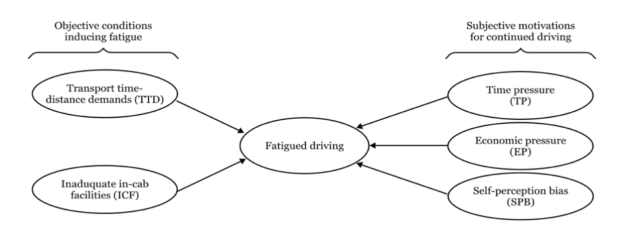
Qualitative Model of Fatigued-Driving Formation. Semi-structured interviews with long-haul truck drivers were thematically coded to develop a qualitative model of fatigued-driving formation. The findings indicate that fatigued driving does not arise from a single cause; instead, it reflects the interaction between fatigue-inducing objective conditions and drivers’ subjective motivations for continuing to drive.
On the objective side, transport time–distance demands and inadequate in-cab facilities increase fatigue exposure. Long-haul trips (often exceeding 1,000 km) contribute to cumulative physical and attentional depletion, and brief intermittent breaks are insufficient for full recovery. Meanwhile, limited ergonomic support and suboptimal resting conditions in the cab (e.g., constrained sleeping space and inadequate shielding from noise/light) accelerate fatigue accumulation. Whether drivers persist under fatigue is further shaped by subjective motivations: time pressure and economic pressure compress rest opportunities through deadlines, penalties, and income-related incentives, while self-perception bias leads some drivers to underestimate fatigue-related risks or overestimate their capability based on prior “successful” experiences. Taken together, the model suggests that objective exposure (task/cab conditions) and motivational drivers (time/ economic pressure and biased self-assessment) jointly promote continued driving despite fatigue.
Figure 1: Proposed qualitative model illustrating the formation mechanisms of continuous fatigued driving.
Correlation Analysis. Pearson correlations among transport time–distance, inadequate in-cab facilities, time pressure, economic pressure, self-perception bias, and fatigued driving are reported (see Table 1). Transport time–distance was negatively correlated with economic pressure (r = −0.225, p < 0.05), whereas inadequate in-cab facilities showed a positive correlation with economic pressure (r = 0.215, p < 0.05), suggesting that economic constraints may co-occur with poorer in-cab conditions and perceived financial strain (see Table 1). Regarding the outcome, fatigued driving was most strongly correlated with time pressure (r = 0.433, p < 0.01), highlighting deadlines as a salient situational driver, and it was also positively associated with self- perception bias (r = 0.280, p < 0.01), indicating that biased self-assessment may increase the likelihood of continuing to drive while fatigued (see Table 1).
Table 1: Pearson correlations among key variables in the fatigued-driving formation model.
Table available in the original PDF paper.
Cab Facility Deficiencies
Time Pressure
Economic Pressure
Fatigued Driving
Transport Time– Distance
Self- Perception Bias
Transport time–distance -- Cab facility deficiencies --0.167 -- Time pressure 0.099 --.198* --
* Correlation is significant at the 0.05 level (two-tailed). ** Correlation is significant at the 0.01 level (two-tailed).
Structural Equation Model. Structural equation modeling (SEM) was conducted to test the hypothesized relationships in the proposed framework, with parameters estimated using the maximum likelihood method in IBM SPSS AMOS. The measurement model was evaluated for structural validity, convergent validity, and discriminant validity prior to interpreting structural paths.
Model Evaluation. Overall model fit was acceptable (see Table 2). Convergent validity was assessed using CR and AVE (see Table 3); most constructs met recommended levels, while self-perception bias showed weaker convergence but was retained for subsequent path testing. Discriminant validity was supported by the Fornell–Larcker criterion (see Table 4).
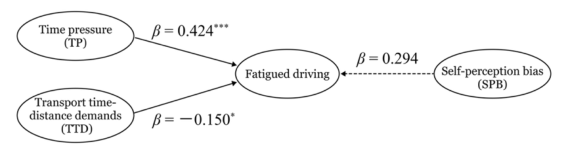
Path Analysis. Standardized path coefficients are summarized (see Fig. 2). Time pressure exerted the strongest positive effect on fatigue-driving behavior (β = 0.424, p < 0.001), underscoring externally imposed deadlines as a critical situational trigger for continued driving under fatigue. Transport time–distance showed a significant negative predictive relationship with fatigue driving (β = –0.150, p = 0.019), which may reflect more strategic planning and self-regulation during longer-haul assignments. The path
Understanding the Formation Mechanisms 493 from self-perception bias to fatigue driving was positive but not statistically significant (β = 0.294, p = 0.103). Given its moderate effect size and the comparatively weaker convergent validity of this construct, the nonsignificant result may partly reflect measurement limitations, suggesting the need for more robust cognitive indicators in future studies.
Table 2: Model fit indices for the structural equation model (SEM).
Table available in the original PDF paper.
χ2/df RMSEA GFI AGFI CFI IFI TLI
1.342 0.056 0.961 0.901 0.970 0.972 0.943
Table 3: Convergent validity and reliability statistics (CR and AVE) for study constructs.
Table available in the original PDF paper.
std. Unstd S.E. t-value P SMC CR AVE
Observed Indicator
Latent Construct
0.449 1.000 0.202 1.041 1.067
TF_2 Transport time–distance TF_1 1.390 3.093 2.678 1.155 0.248 1.932
Table 4: Discriminant validity assessment using the Fornell–Larcker criterion.
Table available in the original PDF paper.
AVE Self-Perception Bias
Transport Time– Distance
Fatigued Driving
Self-perception bias 0.297 0.545 Transport time–distance 1.067 0.131 1.033
Fatigued driving 0.805 0.275 -0.111 0.897
Figure 2: Structural equation model with standardized path coefficients.
Regression Analysis Multiple Linear Regression Analysis. To cross-validate the SEM findings, we conducted a multiple linear regression predicting fatigued driving from
transport time–distance, time pressure, and self-perception bias. The model explained 22.8% of the variance (R² = 0.228), with acceptable residual independence (Durbin–Watson = 1.842) and minimal multicollinearity (VIFs ≈ 1.04) (see Table 5). Time pressure was the strongest predictor (B = 0.322, β = 0.400, p < 0.001), and self-perception bias was also significant (B = 0.221, β = 0.216, p = 0.015), whereas transport time–distance was nonsignificant.
Moderation (Hierarchical Regression) Analysis. Adding the interaction terms did not improve model explanatory power and neither interaction was statistically significant, providing no support for the proposed moderation effects (see Table 6).
Table 5: Multiple linear regression results predicting fatigued driving.
CONCLUSION AND FURTHER WORK This study developed a theoretical model integrating trip demands, driving environment, time pressure, economic pressure, and self-perception bias
Understanding the Formation Mechanisms 495 to explain fatigued driving among heavy-duty truck drivers. Overall, time pressure and self-perception bias emerged as the most robust predictors, jointly increasing the likelihood of continuing to drive while fatigued. In contrast, transport time–distance and economic pressure appeared to exert more indirect influences by shaping drivers’ sleep–rest patterns and the quality of in-cab facilities. Although the hypothesized moderation effects were not supported, the findings collectively highlight the combined roles of external constraints and subjective cognition in fatigue-related driving decisions.
Based on the identified formation mechanisms, intelligent-cockpit interventions can be considered at two complementary levels: mitigating cognitive bias through driver-state monitoring and timely feedback, and alleviating time-pressure-driven risk by supporting more feasible scheduling and route planning. In this transition phase, the intelligent cockpit may serve as a practical node linking technical governance with behavior change toward safer and more human-centered long-haul transport.
Future research should refine measurement scales (particularly cognitive- bias constructs), expand sample size to improve model stability, and conduct cross-regional and cross-cultural comparisons to strengthen external validity.
REFERENCES
Aidman, E., Chadunow, C., Johnson, K., and Reece, J. (2015). Real-time driver drowsiness feedback improves driver alertness and self-reported driving performance. Accident Analysis and Prevention, 81, 8–13. Amoadu, M., Sarfo, J. O., and Ansah, E. W. (2024). Working conditions of commercial
drivers: a scoping review of psychosocial work factors, health outcomes, and interventions. BMC Public Health, 24(1), 2944. Arenas, I. G. P. (2022). The truck driver Sscheduling problem under the european Community social legislation (Doctoral dissertation, Université Clermont Auvergne). Chen, Y., Li, C., Yuan, Q., Li, J., Fan, Y., Ge, X., ... and Zhao, R. (2024). Cockpit-
Llama: Driver Intent Prediction in Intelligent Cockpit via Large Language Model. Sensors, 25(1), 64. Dini, G., Bragazzi, N. L., Montecucco, A., Rahmani, A., and Durando, P. (2019).
Psychoactive drug consumption among truck-drivers: a systematic review of the literature with meta-analysis and meta-regression. Journal of preventive medicine and hygiene, 60(2), E124. Fitzharris, M., Liu, S., Stephens, A. N., and Lenné, M. G. (2017). The relative importance of real-time in-cab and external feedback in managing fatigue in real-world commercial transport operations. Traffic injury prevention, 18(sup1), S71-S78. Fonseca, T. and Ferreira, S. (2025). Monitoring Technologies for Truck Drivers: A
Systematic Review of Safety and Driving Behavior. Applied Sciences, 15(12), 6513. Fu, S., Yang, Z., Ma, Y., Li, Z., Xu, L., and Zhou, H. (2024). Advancements in the intelligent detection of driver fatigue and distraction: A comprehensive review. Applied Sciences, 14(7), 3016. Higgins, J. S., Michael, J., Austin, R., Åkerstedt, T., Van Dongen, H. P., Watson, N., ...
and Rosekind, M. R. (2017). Asleep at the wheel—the road to addressing drowsy driving. Sleep, 40(2), zsx001.
Jiang, K., Ling, F., Feng, Z., Wang, K., and Shao, C. (2017). Why do drivers continue driving while fatigued? An application of the theory of planned behaviour. Transportation Research Part A: Policy and Practice, 98, 141–149. Jiao, Y., Zhang, C., Chen, X., Fu, L., Jiang, C., and Wen, C. (2023). Driver fatigue
detection using measures of heart rate variability and electrodermal activity. IEEE Transactions on Intelligent Transportation Systems, 25(6), 5510–5524. Jin, X. (2024). Precarious truckers: job quality and working conditions of truck drivers in China (Doctoral dissertation, Memorial University of Newfoundland). Lal, S. K. and Craig, A. (2001). A critical review of the psychophysiology of driver
fatigue. Biological psychology, 55(3), 173–194. Mayorov, V. I., Denisenko, V. V., and Solovev, S. G. (2023). A systemic approach to road safety in the EU. Juridicas Cuc, 19(1), 259–278. Mościcka-Teske, A., Sadłowska-Wrzesińska, J., Gajsek, B., and Stachowiak, A.
(2023). Psychosocial risk and work decisions of transport workers: a study. Journal of sustainable development of transport and logistics, 8(2), 113–127. National Transportation Safety Board. (1995). Factors that Affect Fatigue in Heavy Truck Accidents: Analysis. National Transportation Safety Board. Peng, Y., Deng, H., Xiang, G., Wu, X., Yu, X., Li, Y., and Yu, T. (2024). A multi-source
fusion approach for driver fatigue detection using physiological signals and facial image. IEEE Transactions on Intelligent Transportation Systems, 25(11), 16614– 16624. Picot, A., Charbonnier, S., and Caplier, A. (2011). On-line detection of drowsiness using brain and visual information. IEEE Transactions on systems, man, and cybernetics-part A: systems and humans, 42(3), 764–775. Ren, X. (2021, August). Factors associated with fatigue among truck drivers. In 2021
5th international seminar on education, management and social sciences (ISEMSS 2021) (pp. 26–31). Atlantis Press. Ren, X., Pritchard, E., van Vreden, C., Newnam, S., Iles, R., and Xia, T. (2023).
Factors associated with fatigued driving among Australian truck drivers: A cross- sectional study. International journal of environmental research and public health, 20(3), 2732. Sahayadhas, A., Sundaraj, K., and Murugappan, M. (2012). Detecting driver drowsiness based on sensors: a review. Sensors, 12(12), 16937–16953. Schmidbauer, J., Niessen, C., Lubecki-Weschke, N., and Krupp, M. (2025). Staying
in a stressful job? The role of job embeddedness for truck drivers’ well-being and turnover intentions. Journal of Business and Psychology, 40(5), 1189–1208. Soliani, R. D., Lopes, A. V. B., Santiago, F., da Silva, L. B., Emekwuru, N., and Lorena, A. C. (2025). Risk of crashes among self-employed truck drivers: Prevalence evaluation using fatigue data and machine learning prediction models. Journal of Safety Research, 92, 68–80. Starnes, M. (2006). Large-truck crash causation study: An initial overview. National
Center for Statistics and Analysis, National Highway Traffic Safety Administration, US Department of Transportation. Useche, S. A., Alonso, F., Cendales, B., and Llamazares, J. (2021). More than just “stressful”? Testing the mediating role of fatigue on the relationship between job stress and occupational crashes of long-haul truck drivers. Psychology research and behavior management, 1211–1221. Vitols, K. and Voss, E. (2021). Driver fatigue in European road transport. ETF,
European Transport Workers’ Federation.
Understanding the Formation Mechanisms 497 Wang, S., Mack, E. A., Kalani, N., Chang, C. H., and Cotten, S. R. (2025). Workforce
development in the trucking industry: A comprehensive analysis of truck driver training entities. Transport Economics and Management, 3, 23–34. Zhang, J., Wang, S., Chen, S., and Liu, J. (2024). Fatigue status and influencing factors of heavy-duty commercial truck drivers. Journal of Environmental and Occupational Medicine, 789–795. Zhao, Z., Zhou, N., Zhang, L., Yan, H., Xu, Y., and Zhang, Z. (2020). Driver fatigue
detection based on convolutional neural networks using em-CNN. Computational intelligence and neuroscience, 2020(1), 7251280.
LISTED IN THE AHFE DIGITAL BOOKSTORE CATALOGUE
Explore the complete digital volume
Advances in Human Factors of Transportation
Read this individual research paper free through the original publisher, or explore the full digital proceedings book.
ISBN 979-8-950676-00-0
Explore this ISBN in the AHFE Bookstore ↗Listed in the July 2026 bookstore catalogue; search by ISBN to confirm current availability · Digital book purchase optional