Fabian Reimer, Sebastian Cornelje, Jessica Herzig, Line Winkler, Jörn Biedermann, Bjoern Nagel (2026). Understanding ownership effects within the human-centred XR co-design process for aircraft cabin concepts. In: Advances in Human Factors of Transportation. AHFE Open Access, vol. 224, pp. 126–134. https://doi.org/10.54941/ahfe1007840
In user-centred aircraft cabin design, Extended Reality (XR) co-design enables early, immersive user involvement, translating stakeholder needs in real time into novel design concepts. While prior research has focused on technical aspects, social and psychological dynamics, such as ownership effects, remain underexplored across different immersion levels in XR co-design.This study investigates how physical and virtual design elements influence ownership perceptions among aircraft passengers. As part of DLR's EXACT2 hydrogen aircraft project, 72 participants collaboratively designed a cabin space for passengers as additional area besides the own seat using two XR co-design variants: (1) Purely virtual (n = 43), using AR (Meta Quest 3, Gravity Sketch) for 1:20 to 1:1 virtual co-creation; (2) hybrid (n = 29), starting with physical 3D-printed 1:20-scale components before Augmented Reality (AR)-based refinement. Psychological and individual ownership were assessed post-design. Both XR co-design approaches were successfully performed and analysed.
The development of new aircraft cabin concepts presents significant challenges to the aviation industry and research. In the development of novel aircraft cabins and systems, particularly economic and safety-related factors play a special role.
Passenger-specific requirements are a crucial aspect, but they are not directly integrated into the development process. The complexity arises from the wide-ranging and highly personalised demands of passengers, making comprehensive requirement capture particularly challenging.
External factors such as demographic changes, technological advancements, and post-pandemic effects significantly influence passenger preferences in aircraft travel. As a result, there is a growing need for user-centred methods for capturing these unique and flexible passenger requirements and transferring this knowledge into new concepts in the early design stage. Simultaneously, product design is undergoing a clear shift from users as passive recipients to active “designers of their own experiences” (L. Sanders, 2009). Building
Understanding Ownership Effects Within the Human-Centred XR Co-Design 127 on this, user-centred, collaborative methods such as Collaborative Design (co-design) are becoming increasingly important. Co-design refers to a joint design process involving various actors consisting of users, designers, engineers, and researchers, mainly characterised by collaboration, interaction and the creation of positive user experiences (S. Santhosh, 2022). According to Seybold et al., users are also intrinsically motivated to participate in the design process, due to a high motivation to use the product, strengthen their reputation or share experiences (P. Seybold, 2009).
Technological advances in the field of Extended Reality (XR) have been enabling virtual and immersive real-time design processes by diverse user groups for several years now. According to Santosh et al., processes involved in collaborative design carry the risk of low participation, interest and creativity due to poorly managed platforms discouraging the entire innovation (Santhosh, 2022). In response to this, S. Cornelje developed the novel XR co-design approach XR+, a user-centred, multi-stage process for the early design phase of novel aircraft cabin concepts (S.Cornelje, 2023). This approach combines physical and virtual design tools to transfer individual experiences into virtual concepts and to optimise them in real time with intended end users. In the course of follow-up research activities by the German Aerospace Center e.V. (DLR), the application of the method was investigated in further development for different cabin and cabin systems (F.Reimer, et al., 2025). The results demonstrate a need to consider physical and virtual aspects in the course of collaborative process steps. They also underline the relevance of the individual user context and emotional connection as a baseline for collaboratively developed cabin concepts by users (F.Reimer, et al., 2025).
In research, psychological effects such as ownership are playing an increasingly important role as they influence motivation, group dynamics, acceptance and the quality of collaboratively developed results. M. I. Norton investigated the “Ikea method” to show that people value products they have designed themselves more than products designed by experts (M.I.Norton, et al., 2011).
This is an effect that arises from personal effort. A. Juel et al. demonstrated that participatory activities promote the development of ownership (A.Juel, et al., 2023), while Pierce et al. define psychological ownership as a mental state in which individuals perceive an object as their own, regardless of legal ownership. This state arises from control, intimate knowledge and emotional investment in the object, whereby one’s own dedication becomes visible in the result (J.L.Pierce, et al., 2003). The effect of ownership has already been examined in a large number of studies in connection with collaborative design processes. While previous research into these effects on the co-design approach has focused on concept development by individuals with physical prototypes, the following study will focus on the examination of ownership effects in virtual and physical-virtual (hybrid) prototypes by means of a collaborative design process with multiple people. This paper aims to investigate the influence of different ownership effects on the XR co-design process for future aircraft cabin concepts with multiple users. The main question is whether there is a significant difference in how people subjectively evaluate ownership-related factors, such as personal and
psychological aspects, in the two scenarios (virtual vs. hybrid) of the XR co-design approach. The study will also explore the strength and subjective perception of ownership effects in each design approach.
Method
The study was conducted in accordance with the research ethics guidelines of the German Aerospace Center e.V. (DLR). All procedures involving human subjects were approved by the DLR Ethics Office. All participants gave their written consent to participate to the conduct of a VR study and for the use of their data for publications and scientific purposes. The study was conducted over five days in November 2025 among 72 participants. In order to represent as broad a spectrum of passengers as possible, individuals from all age groups (26 female; 46 male) and different professional backgrounds were recruited. Their mean age was 36,89 years (SD = 11,42), ranging between 20 and 59 years. The study was conducted at the DLR in Hamburg. To carry out the study, the test subjects were randomly divided into groups of four.
Procedure & Study Design Four groups participated in the study per day at different time slots. The duration of each experiment was set at 120 minutes. The methodological basis for conducting the study was two different orientations of the XR co-design approach developed by the DRL. The first groups performed an identical task using a purely virtual XR co-design approach. The following groups performed the same task, but worked on it using a hybrid XR co-design approach, in combination of physical and virtual design elements. The experimental design schedule for both approaches is listed below (Table 1). At the beginning of the study, all participants introduced themselves and described their positive and negative experiences in the aircraft cabin based on their last flight.
Table 1: Schedule of both XR co-design approaches.
Table available in the original PDF paper.
Time Virtual Hybrid 20 Minutes Introduction & Context
30 Minutes Virtual and collaborative AR Cabin Design in 1:20 scale
Physical and collaborative cabin design in 1:20 scale
10 Minutes Presentation of results
30 Minutes Virtual and collaborative AR Cabin Design in 1:1scale
Virtual and collaborative Cabin Design in 1:1 scale
10 Minutes Presentation of results
20 Minutes Questionnaire
This was followed by a discussion, a description of the task and a quick tutorial with the XR design tool. The groups were asked to design a new and alternative space to the personal seat (third space) for a future aircraft that could be freely used by passengers at cruising altitude. The entrance area of a hydrogen-powered concept aircraft from the DLR EXACT 2 project was used as a basis for this. The entrance area was intentionally left free and was
Understanding Ownership Effects Within the Human-Centred XR Co-Design 129 available to the test subjects for the conceptual design of a concept based on their own experiences and needs.
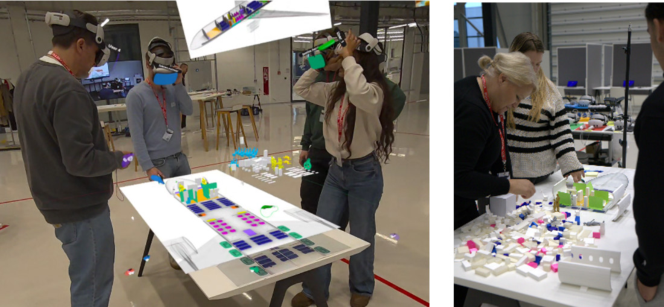
Figure 1 shows the first round of both XR co-design approaches for the virtual option including virtual design elements and the hybrid approach with physical design elements in a 1:20 scale.
Figure 1: Exemplary XR co-design sessions for virtual (left) and hybrid (right) 1:20 concept design.
After the first design part, the study facilitators transferred the cabin concept for all groups into a 1:1 virtual concept as a baseline for the second round and concept optimisation. The additional integration into a basic airframe design was used to create a better impression of the room, scale and spatial effects of the concept. The commercial XR design tool Gravity Sketch was used for the collaborative development of virtual models. Meta Quest 3 glasses were provided to all participants as hardware. Since the majority of the test subjects had little to no experience with XR tools, augmented reality (AR) was chosen for the virtual tasks.
AR is a technology that overlays digital information or virtual objects onto the real environment in real time to enhance the perception of reality.
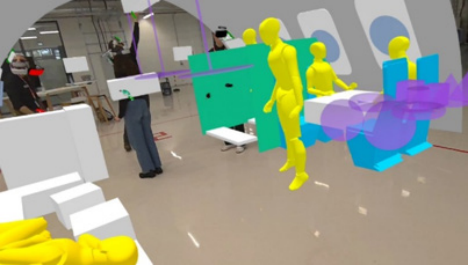
In addition, AR was chosen to prevent possible motion sickness effects, especially among inexperienced users. An example of a group working in the virtual 1:1 model can be seen in Figure 2.
Figure 2: Photo of test subjects in a 1:1 collaborative cabin design session for hybrid and virtual approach.
Data Collection & Validation The reliability of the methodology was enhanced by a preliminary pilot study with n=4 participants. This pre-study ensured that the experimental setup was robust and that the data collection process yielded consistent results, thereby minimising systemic errors. All experiments, along with the resulting concepts and solutions, were recorded and documented using photographs, with written consent from the participants. After completion of the task, subjective test subject data were collected individually from all test subjects by means of a questionnaire. In addition to demographic data on name, age, occupation and gender, data on the level of experience with virtual reality and the frequency of air travel were also collected. To collect data on ownership, the focus was set on questions about individual ownership and psychological ownership. In the context of individual ownership, the questions focused on evaluating the individual and subjective identification with one’s own role as a designer in the collaborative design process and the result.
The items for individual ownership were adapted in the questionnaire based on the validated scales of (M.I.Norton, et al., 2011) and (J.L.Pierce, et al., 2003) so that individual perception, competence, commitment and emotional attachment could be assessed by the test subjects. For data on psychological ownership, the validated standard scale of Van Dyne et al. (2004) (8) (J.L.Pierce, 2004) was used and adapted. Compared to individual ownership, the assessment of psychological ownership went one step further, targeting the subjective feeling of ownership and focusing on the emotional attachment to the result. Each item presented was rated by the test subjects on a seven-point Likert scale from “strongly disagree” to “strongly agree”. The overall results as comparative boxplot diagrams can be viewed in the picture below. The individual items and their coding are listed below: Individual Ownership (IO):
- I like the developed concept. (IndOwn_Q1) - I´ve put much effort into building the concept. (IndOwn_Q2) - I would consider myself a do-it-yourself person. (IndOwn_Q3) - I perceive myself competent to complete the assembly task. (IndOwn_Q4) Psychological Ownership (POS):
- This is my concept. (PsyOwn_Q1) - I feel the concept belongs to me. (PsyOwn_Q2) - Although I do not legally own this concept, I have the feeling that it is “mine”. (PsyOwn_Q3)
RESULTS
To investigate the differences in the subjective assessment of individual and psychological ownership between the hybrid and purely virtual XR co-design methodology, a two-tailed Welch’s t-test for independent samples
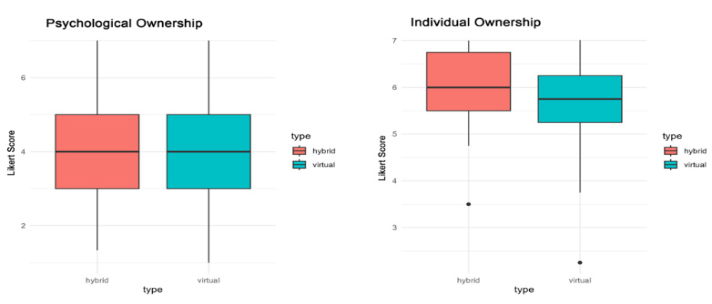
Understanding Ownership Effects Within the Human-Centred XR Co-Design 131 was performed. The comparison between the individual ownership results of the virtual XR co-design experimental group (M = 5.709, SD = 0.86, n = 43) and the comparison group with the hybrid XR co-design variant did not reveal any statistically significant difference (M = 5.991, SD = 0.82, n = 29), t (61) = 1.4, p = .166. The Welch t-test also revealed no significant difference in psychological ownership between the results of the groups in the virtual (M = 3.876 , SD = 1.55 , n = 43) and hybrid XR co-design approaches (M = 4.131, SD = 1.31, n = 29), t (66) = 0.84, p = .404. Figure 1 shows the distribution of individual ownership (left) and psychological ownership (right) for both comparison groups.
Figure 3 shows the Likert scores for the individual and psychological ownership comparing the hybrid and virtual scenario.
Figure 3: Boxplot diagrams for Individual (left) and psychological ownership (right) scores.
The distribution of subjective individual ownership measurement data shows minor differences between the hybrid and virtual approaches. The median of the hybrid group is at a comparable level to that of the virtual group, indicating a similar central tendency. However, the hybrid group shows a notably wider spread of values, indicating greater variability in the subjective assessments. Outliers are present in both scenarios, but are more evident in the virtual approach. Overall, both box plots display a similar pattern in terms of distribution and spread, with no clear deviations from the general structure. A similar trend can be observed in the graphical representations of psychological ownership, where the spread of values in both comparison scenarios is largely consistent, as reflected in the similar positioning of central values. The median is also almost identical in both groups, indicating a similar central tendency. Furthermore, both representations show no outliers for either approach and a comparable distribution of the dispersion.
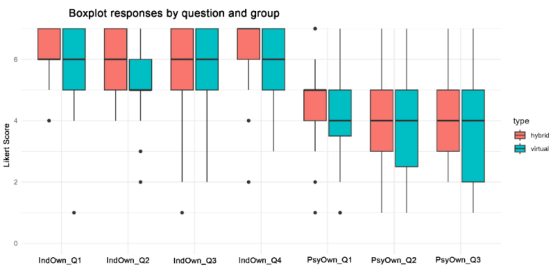
The following Figure 4 illustrates the results for all items of individual and psychological ownership in a direct comparison between the hybrid (red) and virtual (green) approaches.
Figure 4: Comparison of results by question and group.
It is clear that the interquartile ranges for the items in individual ownership are qualitatively in the positive range. Only the fourth item (IndOwn_Q4: “I perceive myself competent to complete the assembly task.”) shows a wide downward spread. For the results for psychological ownership, it is clear that the interquartile ranges and median positions are similar, especially for items 2 and 3. The medians of all items are at a value of 4 (“Neutral”). The exception is item 1 (PsyOwn_Q1: “This is my concept”), which is slightly higher at a value of 5 (“I agree”). In general, the positions of the quartiles and the medians of the results for individual ownership indicate a slightly higher level of agreement compared to the results for psychological ownership. Since a direct comparison between individual and psychological ownership is not the central focus of the study, a more detailed examination and interpretation of possible differences is not undertaken. Nevertheless, the graph may suggest a difference between the two factors.
CONCLUSION
This paper presents a comparative study and the evaluation of data collected on individual and psychological ownership in the context of different XR co-design approaches. With regard to the scientific question, no significant differences between the hybrid and virtual XR co-design approaches could be found for either individual or psychological ownership. In general, the average values and interquartile ranges for the factor of individual ownership show increased approval ratings for both approaches. The high approval here may indicate that individual identification with one’s own role as an actor or creator of a concept is possible regardless of the level of immersion in the course of the design methodology. This provides a reason to assume that future research activities can focus more on purely virtual XR co-design processes by passengers without negatively influencing the emotional connection of the designers to the product. Cost-intensive physical components and the time- consuming transfer of physical concepts into the virtual environment could be neglected, thereby optimising the XR co-design approach.
Understanding Ownership Effects Within the Human-Centred XR Co-Design 133 For scientific and industrial aviation research, the results of this study additionally provide a potential basis for collaborative and immersive design processes for novel aircraft cabin concepts. Passengers without design experience are able to collaboratively develop concepts based on their experiences and establish a personal connection to the design, regardless of the level of immersion. In an economic context, follow-up research activities could address the question of how XR co-design approaches can be used specifically in the development process to strengthen customers’ emotional connection to future products. In addition, follow-up research activities should investigate the influence of ownership on the acceptance of collaboratively developed and novel aircraft cabin concepts.
In essence, ownership factors have been investigated and analysed in the context of a comparative XR co-design study conducted for the first time. These could be identified individually by the test subjects, regardless of the design approach.
Consequently, the findings of the study give reason to believe that promoting a stronger emotional connection between users and their environment through ownership or other factors can contribute to meeting passenger requirements in a more targeted and effective manner in the future.
ACKNOWLEDGMENT
The authors would like to express sincere gratitude to all employees of the Institute of System Architectures in Aeronautics in Hamburg, who contributed in the organisation and performance of the study. Thanks for your feedback, logistics, organisational, and technical assistance, which cleared the path for us to successfully perform the study.
REFERENCES
A.Juel, L.L Berring, A.Erlangsen, E.R.Larsen, N.Buus Sense of psychological ownershio in co-design process: A case study [Report]. - doi:10.1111/hex.13886 : Health Expect, 2023. F.Reimer, M.Fuchs, J.Herzig, S.Cornelje, J.Biedermann, B.Nagel Investigating the
Flexible Hydrogen Aircraft System Interface Design using the XR Co-Design Approach [Report]. - Florence, Italy : 34th ICAS Conference, 2025. J.L.Pierce, T.Kostova and K.T.Dirks The State of Psychological Ownership: Integrating and Extending a Century of Research [Journal] // Review of General Psychologym, Volume 7 Issue 1. - 2003. - pp. 84-107; https://doi.org/10.1037/1089-2680.7.1.84. J.L.Pierce L.Van Dyne & Psychological ownership and feelings of posession: three
field studies predicting employee attitudes and organizational citizenship behavior [Journal]. - [s.l.] : John Wiley & Sons, Ltd., 2004. - Journal of Organizational Behavior : Vols. 25, 439–459. L.Sanders Exploring co-creation on a large scale-Designing for new healthcare environments [Report]. - Delft, NL : TU Delft-Faculty of Industrial Design Engineering, 2009. M.I.Norton, D.Mochon and D.Ariely The “IKEA Effect”: When Labor Leads to
Love [Report]. - Boston, USA : Harvard Business School, 2011. P.Seybold Outside innovation - How your customers will Co-Design your company´s future [Book]. - [s.l.] : Harper business, 2009.
S.Cornelje Mixing Realities: Combining Extended and Physical Reality in Co-Creative Design for the Galley of the Flying-V. - Delft, Netherlands/Hamburg, Germany : TU Delft, 2023. S.Santhosh Developing a Methdology for Co-creation using Extended Reality
Technologies [Report]. - DOI 10.1109/ISMAR-Adjunct57072.2022.00207 : IEEE International Symposium on Mixed and Augmented Reality Adjunct (ISMAR-Adjunct), 2022.
LISTED IN THE AHFE DIGITAL BOOKSTORE CATALOGUE
Explore the complete digital volume
Advances in Human Factors of Transportation
Read this individual research paper free through the original publisher, or explore the full digital proceedings book.
ISBN 979-8-950676-00-0
Explore this ISBN in the AHFE Bookstore ↗Listed in the July 2026 bookstore catalogue; search by ISBN to confirm current availability · Digital book purchase optional