Ivana Moerland-Masic, Fabian Reimer, Peter Weiand, Thomas Weber, Thomas-Mathias Bock, Frank Meller, Bjoern Nagel (2022). Advanced Air Mobility: Cabin of the Future Rescue Helicopters. In: Human Factors in Transportation. AHFE Open Access, vol. 60, pp. 576–583. https://doi.org/10.54941/ahfe1002492
In the summer of 2019, the Bertelsmann-Foundation caused quite some commotion in the medical world in Germany. Their study on the density of the hospitals and clinics in Germany showed that the current amount of 1900 could be reduced to 600. Even if it was considered too extreme, it did stir a change. There is a plan to gradually reduce the number of hospitals down to 1200, making the hospitals and clinics better equipped to treat a broad variety of medical issues. This has as a direct consequence that those hospitals will not be equally accessible for the entire population. People living in rural areas might end up having more than 30 minutes journey to the nearest hospital, in best case scenario when the traffic is light. As the current primary rescue helicopters are not equipped for the near future missions, there is a need for an air vehicle that will cover the requirements posed by as well the changes in the medical system as the patients.On the other side, the cities are growing bigger, causing traffic density to increase as well. Time that an ambulance needs to reach the place of medical emergency varies per city, and steadily increases over the years, due to the ever-growing traffic. Current Medical Personnel Deployment (aerial) Vehicle are off the shelf smaller helicopters, often still too big for its intended purpose. In January 2020, a new project within German Aerospace Center has started, bearing the name Chaser, as a means of answering to above challenge. Its goal is developing two different aerial vehicles with a bespoke cabin design. As the cabin is an integral part of the vehicles, its design is considered equally important to other components and will be developed parallel to the vehicle development. In order to ensure that the cabin is well fitting the needs of its users, a user centered approach will be applied according to the Design Thinking Method. There are three distinctive sorts of users in this case: medical personnel, vehicle operators and the patients. The current and future needs and desires of all three groups shall be considered through means of co-design, a method that will provide an insight in what users actually need. Considering the complexity of the vehicle, a close cooperation with other design disciplines, such as flight performance, structures and aerodynamics is required. This paper will show the mission definition of the two vehicles, the method used to gather and analyze the required data, the trend analysis as well as forth flowing requirements. The results of the co-design workshop series, expert in-depth interviews and user journey maps will be shown, as well as an example of possible design outcome. To wrap up, an outlook into the future project work will be depicted, including the conceptual design solutions for the posed challenges.
In the summer of 2019, the Bertelsmann-Foundation caused quite some com- motion in the medical world in Germany. Their study on the density of the hospitals and clinics in Germany showed that the current amount of 1900 could be reduced to 600 (1). Even if it was considered too extreme, it did stir a change. There is a plan to gradually reduce the number of hospitals down to 1200, making the hospitals and clinics better equipped to treat a broad vari- ety of medical issues. This has as a direct consequence that those hospitals will not be equally accessible for the entire population and the disposability of emergency physicians will also decrease. People living in rural areas might end up having more than 30 minutes journey to the nearest hospital, in best case scenario when the traffic is light. As the current primary rescue helico- pters are not yet equipped for the near future missions, there is a need for an air vehicle that will cover the requirements posed by as well the chan- ges in the medical system as the patients. On the other side, the cities are growing bigger, causing traffic density to increase as well. Time that an ambu- lance needs to reach the place of medical emergency varies per city as well as with the density of the rural area, and steadily increases over the years,
Advanced Air Mobility: The Cabin of the Future Rescue Helicopters 577
due to the ever-growing traffic (2) Current Medical Personnel Deployment (aerial) Vehicle are off the shelf smaller helicopters, often still too big for its intended purpose. In January 2021, a new project within German Aero- space Center has started, bearing the name Chaser, as a means of answering to above challenge. Its goal is developing two different aerial vehicles with a bespoke cabin design. These two vehicles are to form a well-fitting aerial system, complementing each other on the future missions. As the cabin is an integral part of the vehicles, its design is considered equally important to other components and will be developed parallel to the vehicle vehicle’s exter- nal configuration. In order to ensure that the cabin is well fitting the needs of its users, a user centered approach will be applied according to the Design Thinking Method (3), combined with the Delft Design Approach (4). There are three distinctive sorts of users in this case: medical personnel, vehicle ope- rators and the patients. The current and future needs and desires of all three groups shall be considered through means of co-design, a method that will provide an insight in what users actually need. Considering the complexity of the vehicle, a close cooperation with other design disciplines, such as aerody- namics, flight performance, structures and systems is required. This paper will primarily show the scenario of the primary rescue helicopter, the method used to gather and analyze the required data, the trend analysis as well as forth flowing requirements. The results of the co-design workshop series and expert in-depth interviews will be shown, as well as an example of possible design outcome. To wrap up, an outlook into the future project work will be depicted, including the conceptual design solutions for the posed challenges.
THE METHOD(S) OF CHOICE: ANALYZE & EMPATHIZE To design a bespoke cabin solution for a medical helicopter is a complex challenge, including not only different stakeholders, but also a set of requi- rements very different to what one is used to when designing a passenger aircraft cabin. For example, passengers are actually ( trauma, stroke and heart attack) patients, and their comfort is measured in a dissimilar way. Patients safety, accessibility to provide needed care as well as quick, hygienic and stable transport are one of the key aspects of this environment. In addi- tion, providing the medical personnel with an ergonomic and safe workplace enhances the patient’s chance of survival. Closing the loop are the people ope- rating the vehicle, pilots and the co-pilots. Their task is mainly to operate the vehicle in the most efficient and safe way, to ensure the safety and comfort of all passengers. These three distinctive groups are covering the end-users as stakeholders. So, two quite dissimilar aspects of the design challenge are to be distinguished here: designing for the end-users on one hand and designing according to the requirements set up by the upper layer of the stakeholders on the other. In order to deal with a multifaceted task such as this one, a suitable design method needed to be established. Prior application of Design Thinking Method proved to be quite successful (5), but it would only cover the user side of the challenge. In order to understand the context in which the vehicle and its cabin should operate, Delft Design Approach (DDA) (4) was used. To make sure the cabin benefits from the both approaches, the methods
Figure 1: Parallel between DDA and DTM.
Figure available in the original PDF paper.
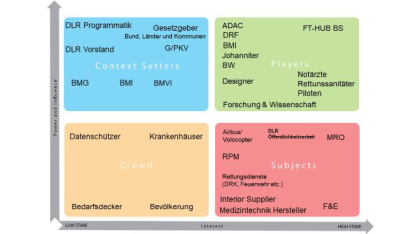
Figure 2: Stakeholder analysis in a power-interest matrix.
have been combined into a single strategy, starting with the analysis stage as described by DDA and continuing with the usual stages of Design Thinking Method (FIGURE 1).
CONTEXT ANALYSIS One of the first steps in the DDA analysis stage is to determine the stakehol- ders, of which three have previously been named. However, those are not the only stakeholders influencing the course of the project. To establish a com- plete overview and to distinguish the stakeholders who directly matter in this case, a power-interest grid has been used. In the (FIGURE 2) the overview of the final stakeholders can be seen. The stakeholders that have direct influence on the project have been identified in the upper right corner of the grid. The influence of the other stakeholders should not be irreversibly discarded, how- ever, due to the project constraints, primary focus will be on the stakeholders with direct influence.
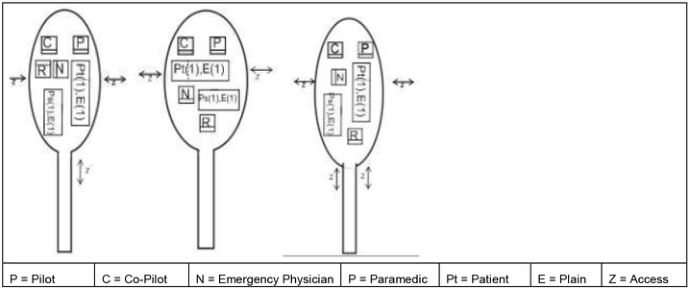
In December 2020, a German Aerospace Center project called TRIAD has ended, resulting in a conceptual design of an emergency rescue helicopter, with similar mission. By analyzing the legal, demographical and medical evo- lution in Germany, the scenario for HEMS (Helicopter Emergency Medical Service) systems could be defines, including the design reference mission. The results also provided the outer boundaries for the maximum volume, rough dimensions and required systems for the new cabin in CHASER (FIGURE 3).
This has its argumentation in the aerodynamic and structural performance of the vehicle (6). The vehicle is aimed to be hybrid driven, if the techno- logy allows it. This means that the maximum operational weight as well as
Advanced Air Mobility: The Cabin of the Future Rescue Helicopters 579
Figure 3: Outer boundaries for the Max Volume as determined in TRIAD project.
the size of the vehicle have to be limited, in order to make it efficient and effective. When executing the trend analysis, different changes in the imme- diate surrounding were noticed. First, as already mentioned, the tendency in Germany to significantly lower the number of hospitals and concentrate the competencies into centers is a drastic change affecting the infrastructure of the rescue chain on many levels. In general, there is a tendency to be capable to transport two patients from one emergency site. In addition, the pandemic intensified this issue, there is a slight leaning towards rural life. 34% of Ger- mans would rather see themselves living rurally, additional 27% in a small town. Most of those people are families with children (7). That, combined with the previous trend, results in a need for swift and effective patient tran- sport. However, German population is aging, resulting in more elderly people who need intensive medical care more often than the younger generation (8). Those people often live alone as couples, what in case of medical emergency frequently means that both have to be taken along (e.g. wife with a broken hip, husband dementing and uncapable of staying alone). In another example a sick child will almost always be accompanied by a parent. A direct conse- quence of those scenarios is that in addition to the normal crew and patient, a place for a second patient is required. This is strengthened by the families living rurally. These three leading trends have set the context for the design of the cabin of the primary rescue helicopter.
EMPATHIZE PHASE According to the Stanford School of Design, “Empathy is the centerpiece of human-centered design” (3). In order to design a product with users’ best interest at heart, it is vital to understand the intended user. In this case, there are three distinguished groups that are end-users of the vehicle’s cockpit and cabin. First and foremost, there are (trauma, stroke and heart attack) pati- ents, who are passive users at best. This group cannot be narrowed down to age, gender or size, as emergency medical transport covers all cases. The com- fort of this group is however extremely important, as additional stress from
being transported while in trauma or critically ill can cause serious deteriora- tion in patients’ condition (9). The second user group is the medical personnel in charge of the patient’s condition and well-being while transported. Their comfort reflects in an ergonomically sound and effective working environ- ment. The ability to do their jobs properly is directly affecting the condition of the patient. The last group are the pilots and the co-pilots of the vehicle, the operations personnel. While in practice completely disconnected from the rest of the crew (10), their job is to safely and swiftly transport the crew to the patient and the patient with the crew to the emergency health care cen- ter. Comfort in this case means ability to safely and efficiently operate the vehicle for the entire duration of the mission. In order to understand each of the three user groups, close contact is needed. In the case of operations personnel, this was made possible by the ADAC Hamburg. Research team was invited to observe the activities of the primary rescue team for a day, as well as to execute an in-depth interview with the pilot. During the obse- rvations, it became very clear that the crew benefits from a clear structure and a well-defined plan of action. Certain checklists have to be followed in predetermined order, to ensure a safe take off procedure. Each crew member has an own checklist to follow. From a pilots’ perspective, two most impor- tant issues were limited sight when landing and light/noise disturbance from the back of the cabin, both issues especially complicating the operations at dusk. When it comes to the patients, they are less approachable user group, especially under the current pandemic circumstances. Therefore, a series of expert interviews has been conducted with Thomas Weber, (Dr. rer.medic. Dipl.Ing. Team Leader Telemedicine and Telematics at DLR and member of the ADAC NRH Traffic and Technik Board). Through these interviews several important aspects came to light. Patients transported by means of emergency medical transport are most often extreme cases; sometimes with heavy trauma’s (due to a traffic accident for example). Most of the time, the patients are (lightly) sedated to ensure the safe and stable transport (10). Due to the intensive noise, there is no direct communication possible with the patient; a physical touch such as holding a hand is the only possibility of reassuring the patient. In addition, due to heavy vibrations and extremely enclosed space, no medical treatment is possible. If an IV is required or the patient has to be resuscitated, the vehicle has to land. The last user group whose insights are necessary for a complete overview are the medical person- nel. Their insights were also gained from in-depth interviews, as observation was not a possibility due to the pandemic reasons on one hand and privacy of the patients on the other. The focus of their work is solely on the stabilizing a trauma patient, ensuring a safe flight and monitoring the vitals in flight. They rely on their environment to be extremely clean and easily cleanable, efficient, ergonomic and minimalistic; to avoid complications and possible mistakes.
DEFINE PHASE After gathering all the necessary data in the Analysis and Empathize phase, a clear focus is required to be able to provide the users with the most effective
Advanced Air Mobility: The Cabin of the Future Rescue Helicopters 581
Table 1. Initial insights gained during the initial design process.
Table available in the original PDF paper.
Insight Origin Previous projects Reduce the cross-section to ensure low drag with high flight performance
Pilots insights
Cockpit must provide better line of sight, night vision support required Bigger side doors needed for side loading Cabin closed off from the cockpit for separation in a contaminated environment.
Medical personnel insight Expert interviews Increase the cabin cross-section to give the medical crew as much space as possible
Medical personnel insight
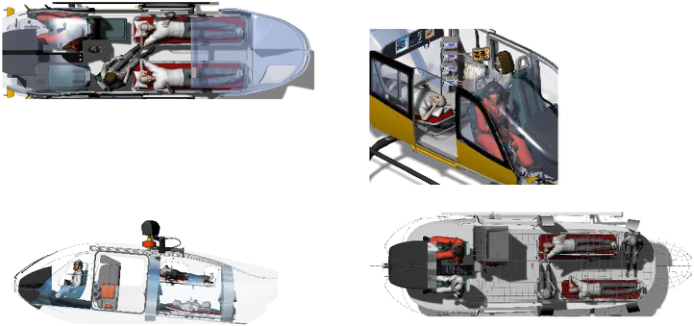
Figure 4: Initial ideas from the spaciousness study.
and efficient product. This phase is critical to the design process, as it results in the clear envisioning of the problem that needs to be solved (3). In a com- plex matter such as this one, a focus is easily lost in details. Therefore, this phase will provide a decision on which aspects of this design challenge will be considered. The TABLE 1 provides an overview of some of the insights gained during the first phases of the design process.
A transition from define phase to the ideate phase is a natural process, where the creativity is sparked by the data gathered in the first phases. To be able to guide the creativity burst in the direction set out by the define phase, the next step in the project will be to execute the so-called “How- Might-We…” workshop, where each of the requirements will be solved individually and later on used as a building block to create a complete cabin solution.
IDEATE PHASE Although the Define phase is still ongoing, some design studies on the spa- ciousness of the cabin and how to deal with limited space and accessibility to the patients and the equipment during the flight have been performed.
FIGURE 4 is showing a small grasp from these studies. In the upper row, the EC 135 was taken as an example, being the helicopter currently often used for this purpose. It is clear from the models that it is rather impossible to transport two patients, a full crew and the necessary medical equipment. In the lower row, the EC 145/BKK 117 is taken as an example. Here, it is obvi- ous that there is ample space for the required load. The question that arises in this case is however, will the vehicle become too heavy for the intended engine. These studies will continue in the course of the project, where the ideal size, space and weight of the cabin will be found by means of iteration between different involved disciplines.
CONCLUSION
To design the cabin of an emergency rotorcraft in its complex operation envi- ronment the two methods, the Design Thinking Method and the Delft Design Approach, have been combined in a single approach. The results exhibited some complex contexts that help to proceed from the define to ideate phase. One of the notable outcomes is the Stakeholder analysis, which can be used as baseline for the future designs of next generation rescue rotorcrafts. In addition, define phase provided very clear insights on what needs to change in the future rescue rotorcraft cabins. From the analysis done, it appears that the off the shelf helicopters will not be able to answer to the needs of the development in the emergency medicine. New vehicles are indeed needed, where bespoke solutions for the future scenarios are developed. These will be presented during the conference.
As the define phase is not fully complete yet, this is a work status. Refining the components and more complex cabin space studies are still running. The next steps are to finish the define phase with the “How-Might-We” worksh- ops, create a database of partial solutions and from there on to build up the complete cabin solution(s).
ACKNOWLEDGMENT
The authors would like to express their gratitude to the ADAC Christof Hansa in Hamburg, and their pilot, Marcus Daniels, for their time and offered expertise on the matter.
Due to the space constraints, some details on the research have been left out. In case of interest, please contact the main author.
REFERENCES
Böken, Jan. (2019) Neuordnung der Krankenhau-Landschaft, Eine bessere Versorgung ist nur mit weniger Kliniken möglich, ISSN: 2364-4788, Gütersloh: Bertelsmann Stiftung Nr.02. Bevölkerung: Demographischer Wandel www.destatis.de, accessed on 18.01.2022 Bevölkerungsstand: Amtliche Einwohnerzahl in Deutschland, www.destatis.de, accessed on 20.01.2022. Cabral et al. (2018) Response time in the emergency services. Systematic review, Acta
Cirurgica Brasileiera.
Advanced Air Mobility: The Cabin of the Future Rescue Helicopters 583
Hasso Plattner Institute of Design (Stanford University). (2010) An introduction to design thinking: Process guide. Moerland-Masic et al. (2021) Post-Pandemic Flight: Establishing the Mission of the
Aircraft Cabin of the Future from a Passenger’s Point of View. (2021) AHFE TRIAD Project internal report, DLR. Transcript of the interview with the rescue helicopter pilot, Mr. Marcus Daniels. Van Booijen, A., et al. (2017) Delft Design guide, Amsterdam: BIS publishers. Wedel, S. Critical Care Transport Standards, (2016) ACCT.
LISTED IN THE AHFE DIGITAL BOOKSTORE CATALOGUE
Explore the complete digital volume
Human Factors in Transportation
Read this individual research paper free through the original publisher, or explore the full digital proceedings book.
ISBN 978-1-958651-36-0
Explore this ISBN in the AHFE Bookstore ↗Listed in the July 2026 bookstore catalogue; search by ISBN to confirm current availability · Digital book purchase optional