Kyungjoo Cha, Ecem Ince (2026). Envisioning Uncertain Futures: A Structured Framework for Speculative Co-design Workshops. In: Human Factors and Ergonomics In Design. AHFE Open Access, vol. 210, pp. 20–32. https://doi.org/10.54941/ahfe1007422
While speculative design is increasingly used to envision uncertain futures, there is a lack of facilitation guidance on how to systematically prepare and structure co-design workshops to support participant imagination and the envisioning process. This study addresses this gap by detailing a systematic approach to speculative co-design. This study employed a qualitative, observational case study involving five speculative co-design workshops with 20 participants in the automotive field. Through the application of a six-stage workshop process that utilised embodied and improvisational techniques, we investigated how participants' engagement could be enhanced, and rich qualitative data could be generated. Through inductive observations of the workshops and thematic analysis of the workshop content, we identified three core facilitation components that enable imaginative envisioning of uncertain futures: 1) narrative setting, 2) enactment cue and 3) empowerment dynamics. The findings formalise the components into the Action Wheel as a methodological guide. This research presents a replicable methodological facilitating guide that provides a starting point for researchers and practitioners to enable participants to engage with uncertain futures in speculative design contexts.
In such a dynamic technological environment, it has become essential to understand and anticipate how people would interact with future technologies. Many approaches have been implemented in a collaborative design process to understand the uncertain future and human interaction (Harrington and Dillahunt, 2021). Participants’ active engagement in the process has been considered a crucial factor influencing design implications and outcomes, ultimately shaping future design artefacts. However, encouraging participants to actively envision and engage with the unpredictable future has always been challenging. Particularly in the autonomous vehicles (AVs) design context, there are fundamental complexities and constraints in physical abilities to simulate all possible future driving environments and the inherent uncertainty of the AV era. Unlike a single product or digital service with predictable usage, AVs present high uncertainty and complexity due to a lack of real-life user experience.
Envisioning Uncertain Futures: A Structured Framework for Speculative 21 Given these challenges both in AV and co-design contexts, there is little guidance on how to effectively structure speculative co-design workshops in the AV context, and help facilitate participants’ engagement in a collaborative design session. Existing studies have often focused on developing or testing technological prototypes, yet systematic insights into how workshop facilitation can support participants’ imaginative engagement with uncertain futures remain scarce (Hussain and Zeadally, 2018). Therefore, this study was initiated to identify and articulate key elements of workshop structuring that can enhance participant engagement and envisioning of the future AV. We examined a series of co-design sessions as a case study in which people gathered remotely to speculate, play and generate ideas about future interactions within an AV context to gain methodological insights. We first explore the relevant context of co-design and envisioning methods in automotive contexts. We then detail the workshop design, procedures, and findings, including the types of rich data it generates. Finally, we discuss methodological implications of the Action Wheel based on observational findings.
Envisioning Methods for an Autonomous Vehicle (AV) In the AV context, envisioning methods have often relied on high-fidelity simulations such as VR-based prototyping and immersive testbeds, which are effective for evaluation in the mid or later stages of design. Low-fidelity techniques such as Wizard of Oz simulations (Davis et al., 2007) or minimal stage-based mock-ups (Pettersson and Karlsson, 2015) have also been used to elicit user visions in earlier phases. More recently, immersive participatory tools such as AV-Sketch (Asha, 2024) and enactment approaches with older adults (Gluck et al., 2020) illustrate how participatory methods can surface rich perspectives on AV futures. While these studies demonstrate the diversity of tools available for AV design, they largely focus on technological fidelity or specific user groups. What remains underexplored is how to structure speculative co-design workshops themselves, that is, the facilitation strategies and activity designs that enable participants to imagine uncertain AV futures in a systematic and transferable manner. Hence, addressing this gap motivates the present study.
Speculative Enactments Speculative design encourages explorations of future possibilities through storytelling, fiction and speculation, benefits shaping future technologies and sparking ideas through fresh perspectives. In the design process, speculation can be adopted through enactment techniques, which have been considered an appropriate technique for future inquiry in the form of simulating future use situations (Brandt and Grunnet, 2000). It enhances the capacity of designers and researchers to collaborate and “create a shared focus” of a future design. In an AV context, this approach has been used to explore design interaction preferences (Gluck et al., 2020), future driving experiences (Pettersson and Karlsson, 2015), and application concepts and their interactions.
22 Cha and Ince Roleplaying, as one of the enactment techniques, is critical for exploring potential future changes with the new technology, for future inquiry, with its practicality and ability to create and initiate cohesion (Medler and Magerko, 2010). It is flexible, lightly constrained, and conducive to imaginative and shared modes of thinking, and constructing enactment is an important part of speculative design.
Speculative Narrative Similarly, narrative is an essential part of speculative design and is influential in future imagination. When a narrative is formed with a story and characters, it supports participants’ urge to imagine desirable futures (Dindler and Iversen, 2007), which leads to enhancing the level of participant engagement with the future world (Jarva, 2014).
Substantial studies have been conducted that prove emotion as a beneficial facilitator to improve participant engagement in the design process. Branco et al., (2017) showed a personalised approach to co-design where affective value-added artefacts are beneficial to create engagement. Kouprie and Visser (2009) formed a structure for benefiting from empathy as an emotion in ideation workshops to understand user experiences. Characters’ emotions in narratives have become a more central role as a mediator or a trigger for initiating communication and producing richer experiences (Cha, 2019).
METHODOLOGY
Research Design and the Six Steps of the Speculative Workshop Process This study focused on the facilitation of a series of co-design sessions that brought participants together to speculate, explore, and collaboratively generate ideas about potential future human interactions in an AV. A qualitative, observational case study approach was adopted to investigate how speculative co-design workshops can be effectively structured.
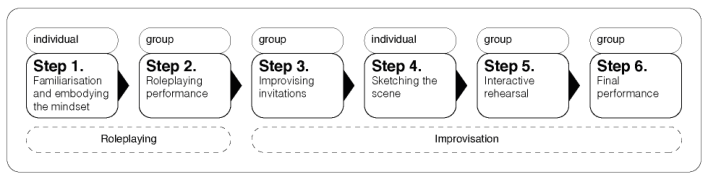
To maximise participants’ engagement and imaginative thinking, some generic constructs for helping design facilitation (Mosely et al., 2021) were considered. They were not limited to a specific industry or context but were designed to help any co-design facilitator consider key points when outlining a co-design session. The six sequential steps of the co-design session were purposefully designed for envisioning the automotive context (Figure 1). The mixed embodied methods were used to maximise creativity in the idea exploration stage and future envisioning (Acheampong et al., 2023). Speculative enactment methods such as roleplaying and improvisation activities were considered to explore future AV experiences, empowering participants to take agency and create their scenarios.
Figure 1: The six steps of the speculative co-design workshop.
Co-design Workshop Preparation and Participant Recruitment Supportive objects and tools, such as ‘translational devices’, can assist collaboration and interaction (Markauskaite and Goodyear, 2017). This study thus adopted various prompts, such as future archetypes and affective design scenarios (Cha, 2019), to help participants imagine and engage with future user interactions. Pre-defined eight archetypes of Gen Z with digitalised AVs drawn from the previous study (Ince et al., 2023) were employed as enactment materials. Eight different affective design scenarios associated with each archetype were also utilised to help envision activities that might happen in a future AV. Each scenario was a narrative reflection of what would happen if this archetype owned an AV and spent time inside it in the future.
Aguirre et al. (2017) identified that contextually designed facilitation tools, such as tailor-made activities, can act as effective prompts to enhance participant engagement and facilitate design talk. Moreover, personalisation has been known to improve enactment, enjoyment of use and autonomy (Oulasvirta and Blom, 2008). The participant’s digital workspace was pre-designed as a personalised space for each participant to maximise their engagement on the digital platform as follows: The digital canvas was divided into columns for each participant to minimise confusion around their workspace. Each participant’s name, assigned archetype and affective scenario were placed at the top. Each workspace was organised by the sequence of workshop activities from top to bottom. The workspace provided participants with creative tools and simple functions to add or remove various elements (e.g., text, colourful sticky notes, icons).
Designing dialogue is one of the core activities in a co-design workshop. The session was designed to prompt participants to create new scenes and interactions in an AV by enacting and then expanding ideas through dialogue, including verbal interactions and reciprocal talk. To facilitate inquiry about the unknown future, the guided questions were designed to tap into participants’ emotions, enhancing the depth of their speculations. ‘What if?’ type questions were strategically employed to broaden the scope of participants’ speculations and evoke vivid emotional responses. Example guided questions are as follows: “Imagine you’ve been cast in a new movie, a story about four different characters’ digital life in 2050. You’re one of these characters, and these are the first scenes you’ll perform.” “How would you feel and react to this scenario? Why?” “What aspects of this situation would annoy you the most, and what would bring you the most satisfaction?”
24 Cha and Ince A purposeful sampling strategy was adopted to recruit the most relevant group to perceive the relevant phenomena under study (Campbell et al., 2020). In this study, considering who might be the most powerful choice for a speculative role is essential (Elsden et al., 2017) to maximise the impact of participant engagement in an AV context within a limited research time frame. Thus, the inclusion criteria were established as people with acting and drama backgrounds, including artists and performance artists, who can speak English and are over 18 years old, and can drive. Collaborating with actors was regarded as an efficient way to create speculative characters in rich scenarios that inform the early phase of the design process (Chatting, 2014). Considering actors’ skillset in imagination through the psychological development of the roles (Brandt and Grunnet, 2000), people with acting, drama and performance art backgrounds were purposefully recruited. Also, the participants chosen were Generation Z individuals, as they are potential future consumers for AVs. While this purposeful sampling was methodologically aligned with our enactment-based approach, we acknowledge that this choice limits the external validity of the findings. As Tharp and Tharp (2019) note, speculative design often risks insufficient depth of design discourse or overlooking issues of race, class, and gender. Our study did not directly address these aspects, which may reduce the practical applicability of the findings beyond the performance-oriented cohort. Future work should involve participants with diverse backgrounds and closer alignment with the AV domain.
Nevertheless, to minimise potential bias caused by homogeneous sampling in participants’ trained skills and background, various participants’ geographical locations were considered through multiple channels such as Facebook groups, Discord, Reddit, direct messaging on Instagram, influencers and communities. The recruitment call was open worldwide as long as they met the sampling criteria. Twenty participants (11 female, nine male) from places such as the United States, the United Kingdom, India, Peru, Colombia, Turkey, Germany, Poland, China, and Italy were recruited. The average age was 22 years. The amount of £30 in online vouchers was given to each participant for their time allocation to this study.
Research Procedure The workshops were conducted based on the six-step process (Figure 1), which served as the procedural backbone of our study. The process was designed to systematically guide participants. The first two steps (Step 1. Familiarisation and Step 2. Roleplaying) were designed to motivate solo or group roleplaying activities. Next, solo or group improvisation activities were performed during the last four steps (Step 3–Step 6). Auditory data were recorded and transcribed verbatim for the analysis process. There were five separate workshops in total, with three to five participants in each workshop. Each workshop took approximately 120 minutes. The ethics were approved before any research activity. All of the participants were provided with a participant information form and then agreed to an ethics consent form before the study.
Envisioning Uncertain Futures: A Structured Framework for Speculative 25 Analysis Process
The analysis process was twofold. First, it aimed to understand participants’ imagination towards uncertain futures in AVs through a thematic analysis of the content generated by the participants to provide rich and contextual evidence for our findings. Second, we conducted a reflexive analysis of our observations to conceptualise the core components of the workshop’s success. It was framed to observe what matters in the speculative co-design workshop structure to influence participants’ envisioning process and creativity.
Following the workshops, a thematic analysis of the content produced by the participants was conducted to identify the types of themes and insights that emerged. The purpose of this analysis was to provide concrete evidence of the rich qualitative data that can be generated within the type of workshop setting we designed.
Initially, written and visual data on the digital canvas platform, Mural board, derived from the workshop steps 2 to 6, throughout roleplaying, improvisation, sketching, or reflection activities, were anonymised. Video recordings of all the workshops were transcribed, anonymised, and imported into the qualitative analysis software Atlas.ti. All different types of data were synthesised and analysed using thematic analysis (Braun and Clarke, 2006). All transcribed data were read several times to familiarise and capture initial codes as meaningful units related to the research question. The initial codes were uploaded to shared mural boards and then discussed and checked against raw data in iterative meetings to reconcile differences and reach consensus between the two researchers. 66 codes as meaningful units were derived and clustered into nine sub-themes and given descriptive names. The nine sub-themes were then reviewed again, regrouped into three final themes, and negotiated between two researchers against transcriptions to check whether new themes appeared to improve the reliability of the process.
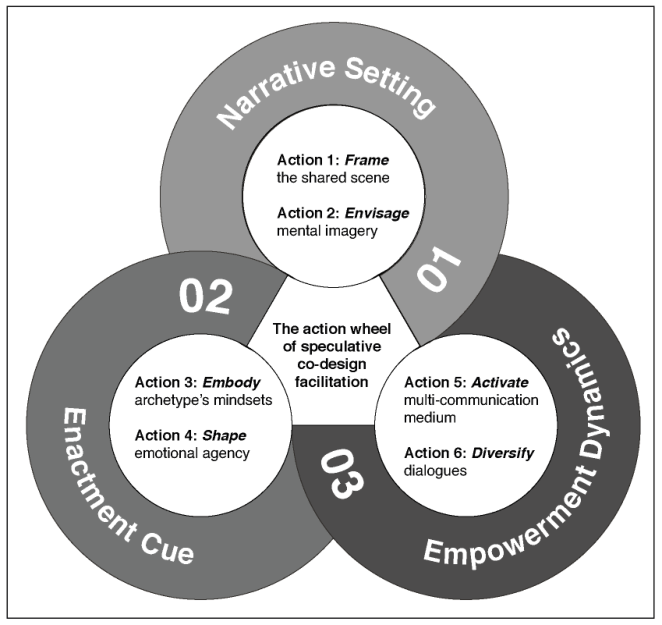
In parallel, each step of the co-design workshop was scrutinised to understand what elements of speculative co-design sessions can influence participants’ engagement and envision the future of AVs. The Action Wheel was not a pre-determined model but rather an emergent structure derived from our in-depth observation. Through an inductive analysis of observation notes, video recordings, and transcribed verbal and visual data, we identified recurring patterns in how participants successfully engaged and generated ideas. These insights led to the conceptualisation of the Action Wheel’s(Figure 2) core structural and behavioural components.
During the thematic analysis, the richness and imaginative nature of the data generated allowed us to identify the themes, which represent participants’ envisioning of future interactions with AVs. The depth and richness of these themes were a direct result of the specific facilitation components formalised in the Action Wheel, which will be detailed in findings, below shows the connection between thematic analysis process, themes, and subthemes.
Theme 1: AVs doing personalised action Sub-themes: i) A car that reflects your personality, lifestyle, ideology, values, and ethical priorities (Example quote: “Activism and sustainability are big things for me, the car would need to be
26 Cha and Ince very transparent about the way that it was created”), ii) A car that recognises your and social circle’s digital self; makes you meet new friends that suits you, iii) A car that recognises you as a unique individual, motivates, inspires and surprises you, iv) A car that provides personalized messages, suggestions, updates perfectly fit for you
Theme 2: AVs being a controllable space Sub-theme example: i) Car as a versatile space to fulfil your desires for a particular reason (Example quote: “I tried to replicate an artist’s studio as best as I could,”), ii) A car that boosts your efficiency for the specific purposes and maximises your life, iii) A car that performs on demand; gives you the freedom and power of controlling
Theme 3: Enablers for AVs Sub-theme example: i) A car that provides a centralised experience where you can sync all your digital presence under easy-to-access tools (Example quote: “Using my phone or something like any other device, work more collaboratively with my car.”), ii) Adjustable and flexible features for a convenient and desirable experience
For instance, the ‘narrative setting’ component played an essential role in enabling participants to embrace a future mindset and envision non-existent scenarios. Participants were able to ‘get into their heads’ by embodying their assigned archetypes, which directly contributed to generating a variety of topics embedded in the themes. As reflected in Theme 1: ‘AVs doing personalised action,’ various lifestyles, desires and perspectives of different archetypes were collected. Furthermore, the ‘enactment cue’ and ‘empowerment dynamics’ acted as a catalyst for amplifying the envisioning process. Throughout the improvisation activities without scripts, participants felt empowered to create their own narratives and interactions. For example, one participant’s sketch of a car as an “artist’s studio” demonstrates how the freedom to improvise led to a versatile space concept.
Most notably, the emphasis on emotional agency was a powerful driver in their immersion. Participants’ emotional reactions and expressions served as a catalyst for generating creative ideas.
“If it’s the weekend, I want to get excited about it. So, there needs to be an option within my car to get me excited about that. So whether that’s some smells or the lighting or something, I get a minibar or something to start my weekend early”. (participant 10) Furthermore, the feeling of boredom in their characters, for instance, led to a future design idea of a ‘virtual reality play area’, which influenced Theme 2 by envisioning a space that addresses emotional needs. Similarly, the feeling of ‘loneliness’ led to the concept of a ‘matchmaker car’, which was an example of Theme 1. This increased excitement and enthusiasm, facilitating more fluid and creative conversations where participants felt empowered to generate new and diverse AV concepts, such as a car that knows and greets their friends, or a car with a space divider to accommodate different mindsets.
FINDINGS The Action Wheel: A Methodological Discovery
The Action Wheel (Figure 2) was developed inductively and grounded in repeated observations from five co-design workshops against the research question: what matters in the speculative co-design workshop structure to help participants’ engagement and envisioning process with future AVs? Through a meticulous review of video footage, transcripts, and researcher notes, we identified a recurring pattern in how participants moved from initial familiarisation to immersion.
Figure 2: The action wheel of speculative co-design facilitation for an autonomous vehicle concept generation.
The Action Wheel formalises this emergent process, providing a structured yet flexible guide for others. Rather than focusing on the technological fidelity of tools, they highlight facilitation strategies from material preparation, the facilitator’s focus, and mixed dialogues in a co-design setting that can be adopted across similar domains. Figure 2 illustrates three key structural elements of a speculative co-design workshop that facilitate the imaginative envisioning process: 1) narrative setting, 2) enactment cue, and 3) empowerment dynamics. In each structural element, two actionable guides are suggested.
Action 1. Frame the shared scene: We found that the use of archetypes was highly effective in framing the shared scene. The archetypes drawn from a previous study (Ince et al., 2023) acted as a bridging tool that helped participants to ‘get into their head’ and set up a narrative world. It was observed that this tool helped participants feel familiar and comfortable with their assigned roles and the speculative scenario, which was essential for their engagement. We did not provide strict dialogue-based scenarios to allow participants more room to get inspired and to improvise their own lines while roleplaying their characters. Participants actively engaged with each other, started creating group cohesion and explored possibilities from different perspectives. Particularly, their group interactions while ‘in character’ allowed them to express their emotions and enthusiasm.
Action 2. Envisage mental imagery: To deepen the narrative, we found that encouraging participants to envisage mental imagery was critical. In our workshops, participants were empowered to improvise and invite other archetypes into their imaginary AV space or even pretend they were with others next to each other. This allowed new speculations within AV to be made. It was observed that participants connected each other’s way in the AV space by creating new moments and invisible objects within their imaginary AV space. Moreover, the use of a digital sketchbook served as a powerful bridging tool as participants easily started translating their abstract ideas and collective dialogues into tangible visual forms, no matter how good they are at drawing. We observed that this reflective and individual activity allowed participants to express their perspectives, which led to richer and detailed future interactions and features within an AV.
This approach aligned with existing literature on how creating a sense of belonging and embracing individual expression through framed spaces and tools can foster engagement (Grisales-Bohórquez et al., 2022). By framing each participant’s working space in a given character and personalising it, we enabled individual self-expression, which was essential for their engagement with future speculation.
Enactment Cue Action 3. Embody archetype’s mindsets: The enactment cue emerged as a key component that allowed participants to delve deeper into their assigned roles. We found that asking participants to embody the archetypes’ mindsets through bodily engagement and immersion was crucial for speculations revealing tacit knowledge. For example, during the first step in the workshop, participants used almost pantomime-like gestures to explore how they might physically act within an AV. This transformative process helped them to fully immerse themselves in the speculative mindset of their archetypes in a future world. They embodied the character’s peculiarities and imagined how they might physically act within an AV. For instance, participant 7 explored different ways to be creative by roleplaying the act of painting in the car, using it as a space to show her art. She used brush strokes, stored her art
Envisioning Uncertain Futures: A Structured Framework for Speculative 29 materials in a convenient place in the car, put her materials down, grabbed them, set up an in-car easel and stepped back and looked at her art. This finding is consistent with previous research highlighting the importance of embodiment and enactment to enhance thinking and creativity (Tay, 2022).
Action 4. Shape emotional agency: Furthermore, we observed that by shaping their emotional agency, participants were able to go beyond the provided scenarios and express their personal needs and desires, acting as a catalyst for generating novel design ideas. Indeed, participants became immersed in their fictional world and uncovered numerous ideas of interactions by expressing emotional reactions to their fictional character. Emotions and emotional reactions to an event can influence our agentive self-awareness in social contexts (Gentsch and Synofzik, 2014) and shape a sense of agency, which creates psychological ownership (Juel et al., 2024). Participants invested themselves in the space and the objects around them, as well as in the speculation. They owned the space and became the archetype, which enriched their engagement with the future. Indeed, participants’ sense of agency and emotions were noticed when they started to take the initiative to move beyond the scenarios and the archetypes.
Empowerment Dynamics Action 5. Activate multi-communication medium: Finally, the empowerment dynamics provided a supportive environment that fostered diverse forms of communication and collaboration. ‘We observed that activating a multi- communication medium, such as sketching, verbal exchanges, and physical enactment, facilitated a more inclusive and richer engagement with the future.’ This multimodal approach enabled participants to express their ideas regardless of their comfort levels or communication styles. Our finding aligns with previous studies (Bietti et al., 2016; Rygh and Clatworthy, 2019) that incorporating various sensory media for communication and sensemaking is an advantage in collaborative design activities.
Action 6. Diversify dialogues: Furthermore, we found that diversifying the dialogue formats from solo work to duo and group interactions was essential. This allowed individual perspectives to be shaped and extended by a variety of communication partners. We observed that participants’ sense of agency was enhanced as they were encouraged to initiate and execute their own speculations, leading to more fluid and creative conversations within the group. As individuals’ perspectives can be shaped, developed, and extended by an individual’s given setting, such as the characteristics of the communication partner (Sanders and Stappers, 2008), structuring diverse formats in a co-design setting is considered essential for amplifying speculations.
Additionally, we found that the facilitator can also influence diversifying dialogues. It has been acknowledged that the facilitator’s role as director significantly influences participants’ engagement with the future (Chatting, 2014; Elsden et al., 2017). In the workshops, the researchers, as facilitators, guided participants through questions, examples and fun prompts while maintaining key objectives and context. The facilitator sometimes got ‘into’ the role, joined the actors, gave examples and acted as they did to clarify the context and expectations of the co-design session.
The primary contribution of this study is the Action Wheel, a methodological guide derived from a systematic observation of a speculative co-design process. This is not a theoretical abstraction but a practical, evidence- based guide that demonstrates how speculative co-design sessions can be effectively structured and maximised to produce rich qualitative data. It is also acknowledged that the Action Wheel was derived from the interpretive nature of the findings, which may be influenced by the positionality of the researcher. Thus, it should be considered as situated knowledge rather than an objective model.
While the study provides insights that can help structure a speculative co-design session where participants envision their interaction with AVs, the study faced some limitations. First, while participants with acting experience were purposefully recruited to strengthen speculative enactments, this choice narrows the external validity of the findings. Future work should test whether the proposed facilitation elements hold with more diverse participant groups, including those without prior performance experience, to further establish its generalisability. Second, while the study contributes methodological guidance for structuring speculative workshops, it emerged from a specific case study, and it did not evaluate how these structures compare to other co-design approaches in terms of outcomes. Each actionable element can be further explored by incorporating different methods, and it can test its transferability by applying it to different domains in future studies.
CONCLUSION
This study addressed the challenge of structuring co-design workshops for speculative futures, an area with little methodological guidance. By examining a case study of five workshops, we identified key facilitation components that enhance participant engagement and support imaginative envisioning. These components were formalised into the Action Wheel, a practical facilitating guide that demonstrates how performative techniques can be effectively integrated into qualitative design research. The components of the Action Wheel provide a starting point for researchers and practitioners to navigate the complexities of speculative co-design and guide participants to engage deeply with uncertain futures and interaction. The thematic findings presented in this paper also support, as detailed evidence, on how the components and actionable guides contributed to generating rich qualitative data.
ACKNOWLEDGEMENTS
The case study presented here was fully funded by the Holistic UX Group, Automotive R&D Division, HMG, Seoul, South Korea. The grant ID is 11855.
CONFLICT OF INTERESTS The authors declare that they have no known competing financial interests or personal relationships that could have appeared to influence the work in this paper.
REFERENCES
Acheampong, R.A., Legacy, C., Kingston, R. and Stone, J. (2023) ‘Imagining urban mobility futures in the era of autonomous vehicles: Insights from participatory visioning and multi-criteria appraisal in the UK and Australia’, Transport Policy, 136 Aguirre, M., Agudelo, N. and Romm, J. (2017) ‘Design facilitation as emerging
practice: Analysing how designers support multi-stakeholder co-creation’, She Ji: The Journal of Design, Economics, and Innovation, 3(3), pp. 198–209. Asha, A.Z., Colley, M., Sultana, S. and Sharlin, E. (2024) ‘Introducing AV-Sketch: an immersive participatory design tool for automated vehicle–passenger interaction’, in Proceedings of the 16th International Conference on Automotive User Interfaces and Interactive Vehicular Applications. New York: ACM, pp. 83–93. Bietti, L.M., Baker, M.J. and Détienne, F. (2016) ‘Joint remembering in collaborative
design: A multimodal approach in the case of a video design studio’, CoDesign, 12(4), Branco, R.M., Quental, J. and Ribeiro, Ó. (2017) ‘Personalised participation: An approach to involve people with dementia and their families in a participatory design project’, CoDesign, 13(2), pp. 127–143. Brandt, E. and Grunnet, C. (2000) ‘Evoking the future: drama and props in user-
centred design’, in Proceedings of the Participatory Design Conference (PDC 2000), pp. 11–20. Braun, V. and Clarke, V. (2006) ‘Using thematic analysis in psychology’, Qualitative Research in Psychology, 3(2), pp. 77–101. Campbell, S. et al. (2020) ‘Purposive sampling: Complex or simple? Research case
examples’, Journal of Research in Nursing, 25(8), pp. 652–661. Cha, K. (2019) Affective scenarios in automotive design: a human-centred approach towards understanding of emotional experience. PhD thesis. Brunel University London. Chatting, D. (2014) ‘Speculation by improvisation’, in DIS 2014 Workshop on
Human–Computer Improvisation. Davis, R.C., Saponas, T.S., Shilman, M. and Landay, J.A. (2007) ‘SketchWizard: Wizard of Oz prototyping of pen-based user interfaces’, in Proceedings of the 20th Annual ACM Symposium on User Interface Software and Technology. New York: ACM, pp. 119–128. Dindler, C. and Iversen, O.S. (2007) ‘Fictional inquiry: Design collaboration in a
shared narrative space’, CoDesign, 3(4), pp. 213–234. Elsden, C. et al. (2017) ‘On speculative enactments’, in Proceedings of the 2017 CHI Conference on Human Factors in Computing Systems. New York: ACM. Gentsch, A. and Synofzik, M. (2014) ‘Affective coding: The emotional dimension of
agency’, Frontiers in Human Neuroscience, 8, p. 608. Gluck, A., Boateng, K., Huff Jr, E.W. and Brinkley, J. (2020) ‘Putting older adults in the driver seat: Using user enactment to explore the design of a shared autonomous vehicle’, in Proceedings of the 12th International Conference on Automotive User Interfaces and Interactive Vehicular Applications, pp. 291–300. Grisales-Bohórquez, C., Reynolds-Cuéllar, P., Munoz Martinez, G.I. and Sicard
Currea, A. (2022) ‘Participation reimagined: co-design of the self through territory, memory, and dignity’, CoDesign, 18(1), pp. 78–94. Harrington, C.N. and Dillahunt, T.R. (2021) ‘Eliciting tech futures among Black young adults: a case study of remote speculative co-design’, in Proceedings of the 2021 CHI Conference on Human Factors in Computing Systems. Hussain, R. and Zeadally, S. (2018) ‘Autonomous cars: Research results, issues,
and future challenges’, IEEE Communications Surveys & Tutorials, 21(2), pp. 1275–1313.
32 Cha and Ince Ince, E.B., Cha, K. and Cho, J. (2023) ‘An investigation into generation Z’s mindsets
of entertainment in an autonomous vehicle’, Entertainment Computing, 46, p. 100550. Jarva, V. (2014) ‘Introduction to narrative for futures studies’, Journal of Futures Studies, 18(3), pp. 5–26. Juel, A., Berring, L.L., Erlangsen, A., Larsen, E.R. and Buus, N. (2024) ‘Sense of
psychological ownership in co-design processes: a case study’, Health Expectations, 27(1), p. e13886. Kouprie, M. and Visser, F.S. (2009) ‘A framework for empathy in design: Stepping into and out of the user’s life’, Journal of Engineering Design, 20(5), pp. 437–448. Markauskaite, L. and Goodyear, P. (2017) ‘Epistemic fluency and professional
education’, in Innovation, Knowledgeable Action and Actionable Knowledge. Cham: Springer. McVeigh-Schultz, J. et al. (2018) ‘Immersive design fiction: Using VR to prototype speculative interfaces and interaction rituals within a virtual storyworld’, in Proceedings of the 2018 Designing Interactive Systems Conference. New York: ACM, pp. 817–829. Medler, B. and Magerko, B. (2010) ‘The implications of improvisational acting and
role-playing on design methodologies’, in Proceedings of the SIGCHI Conference on Human Factors in Computing Systems. New York: ACM, pp. 483–492. Mosely, G., Markauskaite, L. and Wrigley, C. (2021) ‘Design facilitation: A critical review of conceptualisations and constructs’, Thinking Skills and Creativity, 42, p. 100962. Oulasvirta, A. and Blom, J. (2008) ‘Motivations in personalisation behaviour’,
Interacting with Computers, 20(1), pp. 1–16. Pettersson, I. and Karlsson, I.M. (2015) ‘Setting the stage for autonomous cars: A pilot study of future autonomous driving experiences’, IET Intelligent Transport Systems, 9(7), pp. 694–701. Rygh, K. and Clatworthy, S. (2019) ‘The use of tangible tools as a means to support
co-design during service design innovation projects in healthcare’, in Service Design and Service Thinking in Healthcare and Hospital Management. Cham: Springer. Sanders, E.B.-N. and Stappers, P.J. (2008) ‘Co-creation and the new landscapes of design’, CoDesign, 4(1), pp. 5–18. Tay, C. (2022) ‘Embodied cognition: Enhancing thinking through movement and
gesture’, Impact. Tharp, B.M. and Tharp, S. (2019) Discursive design: Critical, speculative, and alternative things. Cambridge, MA: MIT Press.
LISTED IN THE AHFE DIGITAL BOOKSTORE CATALOGUE
Explore the complete digital volume
Human Factors and Ergonomics In Design
Read this individual research paper free through the original publisher, or explore the full digital proceedings book.
ISBN 978-1-964867-86-1
Explore this ISBN in the AHFE Bookstore ↗Listed in the July 2026 bookstore catalogue; search by ISBN to confirm current availability · Digital book purchase optional