Akira Ito, Ryuei Koh, Rei Takemoto, Shigeki Saito, Yuki Taoka (2026). Investigation of the effect of reflection triggered by psychological uncertainty in a design project. In: Creativity, Innovation and Entrepreneurship. AHFE Open Access, vol. 206, pp. 57–67. https://doi.org/10.54941/ahfe1007383
In design projects, perceiving and responding to uncertainty is vital for success. Uncertainty includes objective informational uncertainty and subjective psychological uncertainty. While psychological uncertainty can foster exploration, it is often overlooked in traditional reflection methods. This study introduces a new reflection approach using psychological uncertainty as a trigger and examines its effect on perception and decision-making. A controlled experiment with 27 students tested three conditions: 1) the group used “hedge words” as linguistic cues for psychological uncertainty; 2) the group self-extracted utterances based on felt uncertainty; and 3) a Control group. This study investigated how psychological uncertainty changes through reflection and influences judgment. Results showed that the group that extracted psychological uncertainty effectively maintained an accurate perception of uncertainty and had a higher rate of recognizing the need for discussion. The group that used “hedge words” was better at calibrating perception by reducing excessive doubt, though its narrow focus led to some informational uncertainty being overlooked. When limited to hedge-word utterances, the group that used “hedge words” demonstrated the highest precision in judgment. The reflection method triggered by psychological uncertainty effectively helps practitioners cope with uncertainty. In addition, developing a more accurate extraction approach for psychological uncertainty could lead to more effective reflection.
In recent years, design projects involving members with diverse expertise and backgrounds have been widely implemented to create creative solutions for complex challenges (Wrigley, Nusem and Straker, 2020; Magistretti et al., 2022). In such projects, there is an expectation for synergistic creativity that transcends individual capabilities, leading to significant interest in how to ensure project success (Kleinsmann and Valkenburg, 2008; Sanders and Stappers, 2008). One of the essential factors determining the success of design activities is the appropriate perception of and response to the “uncertainty” inherent in the process. Previous research has pointed out that design activities are inherently characterized by uncertainty, and the presence of
uncertainty itself is not necessarily a symptom of dysfunction (Kirschenbaum et al., 2014). However, it is also true that if this uncertainty persists over a long period or if appropriate actions are not taken, it can have a negative impact on project outcomes (Mueller, Melwani and Goncalo, 2012; Paletz, Chan and Schunn, 2017).
Generally, uncertainty in design is understood in terms of two dimensions. One is “informational uncertainty,” defined as the objective ambiguity of information (Schunn, 2010). The other is “psychological uncertainty,” defined as a psychological state in which an individual perceives information as incomplete, missing, or ambiguous, regardless of the objective situation (Schunn, 2010; Paletz, Chan and Schunn, 2017). Psychological uncertainty is known to manifest in utterances as “hedge words” such as “maybe” or “possibly,” and investigations from a linguistic perspective have been conducted in several studies (Ball and Christensen, 2009; Ball, Onarheim and Christensen, 2010; Paletz, Chan and Schunn, 2017).
A critical challenge here is the difficulty of achieving correct perception and an appropriate response toward these uncertainties. Since psychological uncertainty can occur independently of the presence of informational uncertainty, there are cases in which psychological anxiety or doubt arises regarding objectively certain information, or conversely, in which uncertain information is overlooked. In an ideal design process, it is expected that psychological uncertainty is appropriately evoked in response to objective informational uncertainty, functioning as a driver for coping behaviors such as further discussion and exploration (Cash and Kreye, 2017). In other words, properly managing psychological uncertainty and linking it to coping behaviors is considered a key contribution to the success of design projects.
To address this challenge, this study focuses on a new approach to reflection. Reflection is defined as “a discussive process of articulating, sharing, and negotiating individual experiences of project issues within project teams to reach a collective understanding of the experienced issues and draw conclusions for further actions” (Hartmann, Vinke-de Kruijf and van Weesep, 2023). In design activities, reflection plays an indispensable role in making sense of past actions and promoting subsequent learning and adaptation (Schön, 1983; West, 2000). However, in existing reflection methods, subtle psychological fluctuations that occur during the process are often overlooked and underutilized.
Therefore, this study proposes a new reflection method that utilizes psychological uncertainty as a trigger and examines its effectiveness. To clarify how the proposed method influences the perception of uncertainty and the judgment of coping actions, this paper sets forth the following two research questions (RQs):
RQ1: How does the subjects’ psychological uncertainty toward information change through reflection?
RQ2: How does the judgment of the necessity to address uncertain information differ depending on the reflection method?
METHOD
Experiment The participants were 27 students, including first-year graduate students in engineering and third-year undergraduate students in fine arts. All participants had design thinking projects experience of developing tangible products. The participants were randomly assigned to three-member teams and asked to design a new travel experience using design thinking.
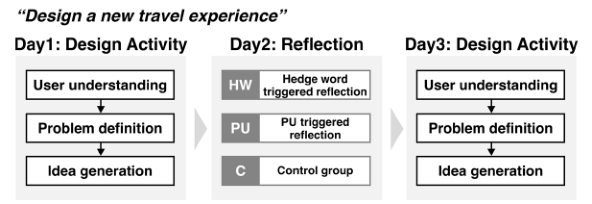
The experimental process is illustrated in Figure 1. The experiment comprised three sessions, each lasting two hours. In the first session, teams conducted design activities; they were provided with user interview scripts and performed tasks from user understanding and problem definition to idea generation. In the second session, reflection was conducted based on the utterance records from the first session. Each experimental group was assigned a different reflection task to further deepen the discussions initiated in the first session. In the third session, teams resumed the design activities. Additional user interview scripts were provided, and participants once again engaged in user understanding, problem definition, and idea generation, similar to the first session. Each session was conducted approximately one week apart.
Figure 1: Procedure of the experiment.
The reflection sessions were conducted under three conditions, with the nine teams divided into groups of three. Two experimental groups were established to perform a reflection method that identifies points for discussion starting from psychological uncertainty. In contrast, a control group was established to perform a reflection method that simply identifies points they wished to discuss (Table 1).
The first group (HW group) used a reflection method based on “hedge words,” linguistic expressions of psychological uncertainty. First, participants were provided with a script in which utterances containing hedge words (e.g., probably, maybe, possibly, think, believe, don’t know (Schunn, 2010); since the experiment was conducted with Japanese speakers, the corresponding Japanese terms were searched) were extracted from the utterance transcripts. Subsequently, each participant was asked to check the utterances based on three criteria: i) whether the utterance was related to the design process (DP), ii) whether they felt uncertainty regarding the
content during reflection, and iii) whether the content should be discussed by the team. Following this, individual results were integrated at the team level, and after prioritizing the discussion topics, the team engaged in a discussion of the content.
The second group (PU group) employed a reflection method starting from psychological uncertainty without using hedge words. First, participants were tasked with extracting utterances from transcripts in which they had personally felt ambiguous, uncertain, or questionable at the time of speaking. Thereafter, using the extracted script, they performed a check based on the same three criteria as the HW group and conducted a discussion based on the integrated team results.
The third group (C group) served as the control, where individual participants were tasked with extracting utterances from the records that they felt required further discussion. These results were then distributed to the individuals, who performed a check based on two criteria: i) whether the utterance was related to the DP, and ii) whether the content should be discussed by the team. Finally, the team integrated the results, prioritized the discussion topics, and conducted a discussion on the content.
Table 1: Reflection conditions and processes.
Table available in the original PDF paper.
Step HW Group PU Group C Group (Control) Initial Extraction Automatic extraction of utterances containing hedge words [Individual] Identification of utterances with psychological uncertainty at the time of speaking [Individual] Identification of utterances felt to require further discussion
Distribution Distribute extracted results to individuals
Distribute extracted results to individuals
Distribute extracted results to individuals
Step 1 [Individual] Judge if the utterance is related to the DP
[Individual] Judge if the utterance is related to the DP
[Individual] Judge if the utterance is related to the DP -
Step 2 [Individual] Judge if uncertainty is felt during reflection
[Individual] Judge if uncertainty is felt during reflection [Individual] Judge if the topic should be discussed
Step 3 [Individual] Judge if the topic should be discussed
[Individual] Judge if the topic should be discussed
Conduct actual team discussion After the experiment concluded, all participants were asked to identify points in the design activity records where they had felt psychological uncertainty at the time of the original utterance. This task was completed by all participants within one month following the experiment.
Investigation of the Effect of Reflection Triggered 61 Data Collection and Analysis
The data handled in this study consist of the team utterance records from the design activities in Session 1, the outcomes of the subjects’ tasks during the reflection in Session 2, and the results of the task performed after the conclusion of the experiment. The reflection outcomes refer to the results of checks conducted by subjects in the two experimental groups on the presence or absence of psychological uncertainty during reflection, as well as those conducted by subjects in all three groups on the necessity of discussion. The analysis targets a dataset in which each utterance record from Session 1 is mapped to: the presence or absence of psychological uncertainty during reflection (for experimental groups), the perceived necessity of discussion regarding the content (for all groups), and the presence or absence of psychological uncertainty at the time of the original utterance.
To determine the presence or absence of informational uncertainty in the utterances, the third author coded the data using a deductive qualitative content analysis approach (Mayring, 2021). Each utterance record was first evaluated to determine if its content allowed for an objective assessment of uncertainty, and subsequently, the presence or absence of informational uncertainty was coded.
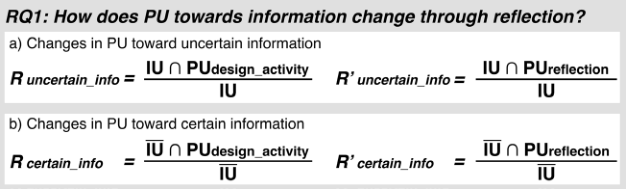
Focusing on the presence of informational uncertainty and the psychological state during activities, this study analyzed utterances from the following four perspectives: First, changes in psychological reactions to uncertain information were examined. Using the total number of utterances containing informational uncertainty as the denominator, we calculated the proportions of utterances where psychological uncertainty was felt at the time of the design activity and those where it was felt during reflection, respectively (Figure 2a). Through this, we evaluated the change in the occurrence rate of psychological uncertainty from the time of activity to the time of reflection. These results were compared between the experimental groups (HW and PU groups).
Second, similar verification was conducted regarding psychological reactions toward certain information. Using the total number of utterances that did not contain informational uncertainty as the denominator, we calculated and compared the proportions of utterances where psychological uncertainty was felt at the time of activity and during reflection (Figure 2b). These results were also compared between the experimental groups (HW and PU groups).
Figure 2: Calculation formulas for evaluating changes in psychological uncertainty (PU) towards uncertain information (𝐼𝑈) and certain information (𝐼𝑈) during design activity and reflection.
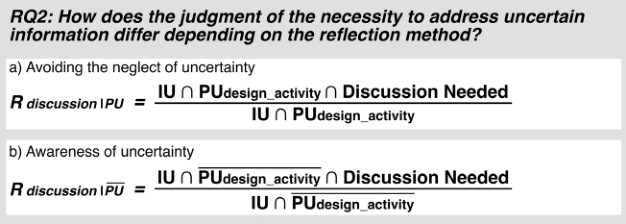
Third, we analyzed the judgment regarding the necessity of discussion in instances where uncertainty was recognized during the activity. Targeting the group of utterances that contained informational uncertainty and were perceived with psychological uncertainty during the activity, we calculated the proportion of utterances judged as requiring discussion (Figure 3a). These results were compared among the experimental groups (HW, PU) and the control group (C).
Fourth, we analyzed new awareness of the necessity of discussion gained through reflection in instances where uncertainty was not recognized during the activity. Targeting the group of utterances that contained informational uncertainty but were not perceived with psychological uncertainty during the activity, we calculated the proportion of utterances subsequently judged as requiring discussion (Figure 3b). These results were compared among the experimental groups (HW, PU) and the control group (C).
Figure 3: Formulas for evaluating the avoidance of neglect based on discussion necessity and the awareness of uncertainty. (PUdesign_activity: psychological uncertainty during design activity, IU: Informational uncertainty).
RESULT
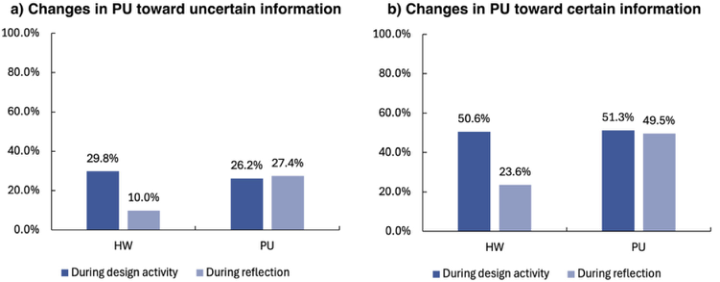
Cognitive Changes Through Reflection: Comparison Across Experimental Groups To clarify the extent to which the subjects “correctly perceived uncertain information as uncertain” through the reflection method applied to the experimental groups, the occurrence rate of psychological uncertainty relative to all utterances containing informational uncertainty was compared between the groups. Figure 4a) shows the psychological uncertainty during the design activity and the psychological uncertainty during reflection for utterances containing informational uncertainty. It was demonstrated that in the HW group, the proportion of “correctly perceiving uncertain information as uncertain” decreased to less than half through reflection. In contrast, the PU group maintained a correct perception at a rate comparable to that during the activity.
How did “psychological uncertainty toward certain information” change based on the reflection method applied? Figure 4b) shows the psychological uncertainty during the design activity and during reflection for utterances that do not contain informational uncertainty. The results indicate that
Investigation of the Effect of Reflection Triggered 63 in the HW group, psychological uncertainty toward certain information significantly decreased through reflection, showing that they were able to perceive it as certain. On the other hand, the PU group showed no significant change, and the psychological uncertainty toward certain information was not resolved.
Figure 4: a) Changes in psychological uncertainty about uncertain information. The figure shows the proportion of cases correctly perceiving information as uncertain. b) Changes in psychological uncertainty toward certain information. The figure shows the proportion of cases where information was incorrectly perceived as uncertain.
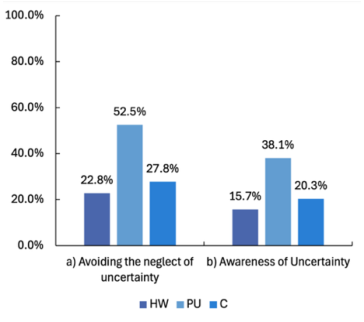
Differences in Willingness to Discuss Uncertain Information To clarify the extent to which the teams attempted to address uncertain information, the judgments regarding the necessity of discussion for utterances with informational uncertainty were analyzed. Figure 5a) shows the rate of avoiding the neglect of uncertainty. That is, it illustrates the proportion of utterances–among those containing informational uncertainty and perceived with psychological uncertainty during the design activity–that were judged as requiring discussion. As shown in the figure, more than half of such instances were addressed in the PU group, whereas the HW and C groups remained around 25%. Figure 5b) shows the rate of new awareness of uncertainty and subsequent judgment to address it. Specifically, it represents the proportion of utterances–among those containing informational uncertainty but not perceived with psychological uncertainty during the design activity–that were judged as requiring discussion. Similar to result a), the PU group showed the highest rate, with 38.1% of cases involving a new awareness of uncertainty and a recognized need for action. In contrast, the rates for the HW and C groups remained at 15.7% and 20.3%, respectively.
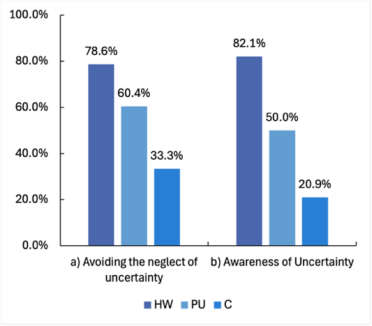
Here, it is suggested that the above results might depend on the volume of information extracted during the reflection. Therefore, Figure 6 shows the proportion of addressing uncertain information limited specifically to utterances containing hedge words. In both a) the avoidance of neglecting uncertainty and b) new awareness of uncertainty, the HW group exhibited a very high proportion. The PU group also showed a high rate, second only to the HW group, while the C group showed no significant change compared to the results not limited to hedge words.
Figure 5: Inter-group comparison of addressing uncertain information.Figure 6: Inter-group comparison of addressing uncertain information limited to utterances containing hedge words.
DISCUSSION
This study compared three groups: an experimental group using a reflection method based on automatically extracted hedge words (HW group), another experimental group using a reflection method based on utterances where participants themselves felt psychological uncertainty (PU group), and a control group (C group). The results revealed that differences in the extraction method for reflection points uniquely influence the persistence or correction of psychological uncertainty and the subsequent judgment of the necessity of discussion.
Regarding changes in psychological uncertainty through reflection, the PU and HW groups showed contrasting results. In the PU group, psychological uncertainty toward uncertain information appropriately persisted; however, there was a tendency for psychological uncertainty toward certain information to remain unresolved after reflection. Conversely, in the HW group, psychological uncertainty toward certain information was resolved,
Investigation of the Effect of Reflection Triggered 65 yet psychological uncertainty toward uncertain information also tended to decrease through the reflection process.
The superiority of the PU group was demonstrated in terms of judging the necessity of discussion for uncertain information through reflection. The analysis showed that, compared to the other groups, the PU group was more effective at a) avoiding the neglect of uncertain information and b) identifying and addressing such information anew. These findings suggest that a reflection method based on the extraction of perceived psychological uncertainty (the PU group) can better facilitate coping with uncertain information than conventional methods (the C group). On the other hand, the reflection method based on automated hedge word extraction (the HW group) showed a slightly lower rate than the conventional method, which may be attributed to the limitations of the extraction process.
However, when the results were limited specifically to utterances containing hedge words, the HW group achieved a higher rate than the other groups in both a) avoiding the neglect of uncertain information and b) identifying and addressing it. This suggests that the HW group promotes appropriate coping behaviors at a high level within its extracted results. Although the HW group faces challenges with extraction precision, the results indicate its potential to effectively prompt appropriate responses to the specific points it successfully identifies.
Implementation Existing reflection practices often emphasize articulating and analyzing past experiences to improve future practice (Ito et al., 2024), typically through retrospective reflection-on-action (Schön, 1983). While such approaches are valuable for sensemaking, they may fail to specify actionable next steps during ongoing design inquiry. In contrast, prior design research suggests that perceptions of uncertainty can serve as a key driver of design activity, triggering information actions, knowledge sharing, and representational work that progressively reduce or reframe uncertainty (Cash and Kreye, 2017, 2018). Building on this view, the proposed reflection method leverages participants’ perceived psychological uncertainty. Specifically, it extracts reflection points based on this uncertainty and prompts teams to articulate what remains uncertain and whether it warrants discussion. This implementation can activate the design process by preventing the oversight of uncertain information and enabling the re-identification of previously unattended uncertainties. Regarding the detection method, while hedge words alone appeared insufficient as a proxy for psychological uncertainty, the automatic extraction of utterances was partially effective. Developing a more precise measure to represent psychological uncertainty beyond hedge words could lead to more effective reflection. Note that this study is situated within the context of Japanese.
Limitations and Future Research This study has two primary limitations. First, our findings rely on experiments conducted with a small sample size within a limited cultural context. Given
that the characteristics of design activities vary across cultures, expanding the sample size and conducting further validation across diverse cultural backgrounds is necessary to establish the generalizability of these results. Future research should involve experiments in other cultural settings. Second, there is a linguistic limitation. In this study, linguistic processing was performed using hedge words specifically in Japanese. Although several studies have examined the use of hedge words in English or Danish (Schunn, 2010; Paletz, Chan and Schunn, 2017), it remains to be determined whether hedge words function similarly across different languages–specifically, whether they can be universally treated as reliable indicators of psychological uncertainty.
CONCLUSION
This study aims to propose a new reflection method triggered by psychological uncertainty and to examine its effectiveness. As a result, we revealed differences between reflection methods in “correct/maintain of perception” and “judgement of discussion needed.” The reflection method triggered by psychological uncertainty maintained an accurate perception of uncertainty and had a higher rate of recognizing the need for discussion. The reflection method based on automatically extracted utterances containing hedge words was better at calibrating perception by reducing excessive doubt, though its narrow focus led to some informational uncertainty being overlooked. These results suggest two things: First, the reflection method triggered by psychological uncertainty effectively promotes practitioners to cope with uncertainty. Second, developing a more accurate extraction approach for psychological uncertainty could lead to more effective reflection.
ACKNOWLEDGMENT
This study is funded by the SECOM Science and Technology Foundation and Tobemaki Scholarship Foundation. This work was also supported by JST SPRING, Japan Grant Number JPMJSP2180. The authors would like to thank the Academy of Super Smart Society, Science Tokyo and Amano Institute of Technology for their financial support.
REFERENCES
Ball, L.J. and Christensen, B.T. (2009) “Analogical reasoning and mental simulation in design: Two strategies linked to uncertainty resolution,” Design studies, 30(2), pp. 169–186. Ball, L.J., Onarheim, B. and Christensen, B.T. (2010) “Design requirements, epistemic
uncertainty and solution development strategies in software design,” Design Studies, 31(6), pp. 567–589. Cash, P. and Kreye, M. (2017) “Uncertainty Driven Action (UDA) model: A foundation for unifying perspectives on design activity,” Design science, 3(e26), p. e26. Cash, P. and Kreye, M. (2018) “Exploring uncertainty perception as a driver of
design activity,” Design studies, 54, pp. 50–79.
Investigation of the Effect of Reflection Triggered 67 Hartmann, A., Vinke-de Kruijf, J. and van Weesep, R. (2023) “Asking the right
questions: The role of reflection for learning in and between projects,” International journal of project management, 41(5), p. 102494. Ito, A. et al. (2024) “Gaps between reflection frameworks and students’ practice: Implications for design education,” Proceedings of the Design Society, 4, pp. 2865–2874. Kirschenbaum, S.S. et al. (2014) “Visualizing uncertainty: The impact on performance:
The impact on performance,” Human Factors, 56(3), pp. 509–520. Kleinsmann, M. and Valkenburg, R. (2008) “Barriers and enablers for creating shared understanding in co-design projects,” Design studies, 29(4), pp. 369–386. Magistretti, S. et al. (2022) “Framing the multifaceted nature of design thinking in
addressing different innovation purposes,” Long range planning, 55(5), p. 102163. Mayring, P. (2021) “Qualitative content analysis : A step-by-step guide,” Qualitative Content Analysis, pp. 1–100. Mueller, J.S., Melwani, S. and Goncalo, J.A. (2012) “The bias against creativity:
why people desire but reject creative ideas: Why people desire but reject creative ideas,” Psychological Science, 23(1), pp. 13–17. Paletz, S.B.F., Chan, J. and Schunn, C.D. (2017) “The dynamics of micro-conflicts and uncertainty in successful and unsuccessful design teams,” Design studies, 50, pp. 39–69. Sanders, E.B.-N. and Stappers, P.J. (2008) “Co-creation and the new landscapes of
design,” CoDesign, 4(1), pp. 5–18. Schön, D.A. (1983) The reflective practitioner: How professionals think in action.
London, England: Basic Books. Schunn, C.D. (2010) “From uncertainly exact to certainly vague,” in Psychology of Learning and Motivation. Elsevier (The psychology of learning and motivation), pp. 227–252. West, M. (2000) “Reflexivity, revolution and innovation in work teams,” 5, pp. 1–29. Wrigley, C., Nusem, E. and Straker, K. (2020) “Implementing design thinking:
Understanding organizational conditions,” California Management Review, 62(2), pp. 125–143.
LISTED IN THE AHFE DIGITAL BOOKSTORE CATALOGUE
Explore the complete digital volume
Creativity, Innovation and Entrepreneurship
Read this individual research paper free through the original publisher, or explore the full digital proceedings book.
ISBN 978-1-964867-82-3
Explore this ISBN in the AHFE Bookstore ↗Listed in the July 2026 bookstore catalogue; search by ISBN to confirm current availability · Digital book purchase optional