Nobuo Kanai, Yuriko Sawatani (2026). Co-Creating Institutions in Space: How Patient Capital and Entrepreneurial Action Shape New Markets. In: Creativity, Innovation and Entrepreneurship. AHFE Open Access, vol. 206, pp. 39–49. https://doi.org/10.54941/ahfe1007381
This study examines how new institutions and markets can be created in deep-tech domains characterized by extreme uncertainty. We focus on the interaction between government venture capital (GVC), as an institutional instrument for implementing public patient capital, and entrepreneurs. While prior research has accumulated insights on the functions and institutional design of GVCs and on entrepreneurs' activities and decision-making processes separately, theoretical examination focusing on their interaction remains limited. In particular, it remains unclear how the underlying behavioral logics of each—predictive and planned causation as investor logic versus means-driven and improvisational effectuation as entrepreneur logic—can be effectively integrated in practice. To address this question, we conducted a theory-informed case study of the collaboration between Astroscale, a Japanese space startup, and the Innovation Network Corporation of Japan (INCJ), a GVC. Drawing on interviews, archival sources, and comparative surveys, the analysis identifies four mechanisms of interaction that enabled institutional co-creation such as strategic dialogue, staged financing with flexible evaluation, hybrid governance through public–private syndication, and narrative translation aligned with policy frameworks. These mechanisms transformed uncertainty into institutional meaning, advancing Astroscale from a technology venture into an institutional actor. The study contributes to entrepreneurship and innovation policy research by reframing patient capital as an active institutional translator and situating effectuation within broader processes of institutional emergence in frontier markets.
Deep-tech domains such as space, climate technology, and advanced biomedicine are characterized by extreme uncertainty across technological feasibility, market demand, and institutional infrastructure. In these contexts, private capital alone—often driven by short-term returns—is insufficient (Lerner & Nanda, 2020). In these nascent markets, private capital tends to hesitate, making state involvement essential to startup survival and commercialization (Arora, Fosfuri & Roende, 2022).
In response, the concept of the “entrepreneurial state” has gained prominence, leading governments to deploy long-term, risk-tolerant “patient Received January 28, 2026; Revised April 8, 2026; Accepted April 27, 2026; Available online July 20, 2026
40 Kanai and Sawatani capital” through mission-oriented investments (Mazzucato, 2013, 2018; Kattel & Mazzucato, 2018). Within this context, government venture capital (GVC) has emerged as a key institutional instrument for implementing patient capital (Berger, Dechezleptrtre & Fadic, 2024).
Meanwhile, entrepreneurs operating in such environments are frequently driven by effectuation—means-driven, non-predictive logic for action and decision making under uncertainty—rather than causation as the dominant logic underlying conventional strategic planning (Sarasvathy, 2001, 2008). In contrast, traditional venture capital typically relies on causational governance mechanisms such as milestone-based evaluation and business plan scrutiny (Gorman & Sahlman, 1989). While patient capital and entrepreneurs are theoretically grounded in contrasting logics, empirical reality shows that state investors and effectual entrepreneurs often collaborate successfully to create new markets and institutions. Existing theories, however, have not adequately explained how these incompatible logics can be reconciled in practice.
This study addresses this gap by asking: How do government venture capitalists and effectual entrepreneurs interact under conditions of institutional void to co-create new institutions and markets?
We investigate this question through an in-depth case study of a Japanese space startup, Astroscale, and its collaboration with the Innovation Network Corporation of Japan (INCJ), a state-backed venture capital fund. We theorize how patient capital functions not merely as funding, but as an institutional mediator that translates between entrepreneurial and governmental logics, enabling institutional co-creation in frontier domains.
THEORETICAL BACKGROUND Patient Capital and Entrepreneurial State
Recent scholarship reframes the state not as a passive corrector of market failures, but as an entrepreneurial actor that actively shapes markets through mission-oriented investment. Patient capital plays a critical role in deep-tech sectors where uncertainty and long-term horizons deter private investment (Mazzucato, 2013, 2018). This shift reflects a broader movement toward reimagining public-private partnerships as dynamic, co-evolutionary relationship (Larsson, 2022). It is also notable that entrepreneurial action often initiates the formation of institutional logic in institutional voids (Sarasvathy, 2022).
GVC as Implementing Institution GVC implements patient capital by prioritizing strategic, social, and institutional returns over purely financial gains, making long-term commitments in high-risk, uncertain domains (Colombo, Cumming & Vismara, 2016). Implemented through GVCs, patient capital absorbs risk, provides legitimacy, and catalyzes private capital participation (Guerini & Quas, 2016; Lerner & Watson, 2008). However, GVC performance varies
Co-Creating Institutions in Space 41 widely, depending on governance design, flexibility, and engagement with entrepreneurs (Berger et al., 2024; Cumming, 2007; Gorman & Sahlman, 1989; Lerner, 2022).
Effectuation Under Institutional Uncertainty Effectuation theory explains entrepreneurial action under Knightian uncertainty as means-driven, experimental, and relational. Entrepreneurs co-create opportunities through stakeholder engagement rather than predictive planning (Sarasvathy, 2001,2008; Read, Sarasvathy, Dew, Wiltbank, & Ohlsson, 2009). While effectuation has primarily been studied as an individual decision-making logic, its role in institutional emergence and interaction with public actors remains underexplored.
Research Gap Although both patient capital and entrepreneurs are central to innovation under uncertainty, their interaction has received limited theoretical attention. This study bridges effectuation theory, mission-oriented policy, and institutional theory by examining how divergent logics are translated and provisionally aligned through sustained interaction.
RESEARCH DESIGN AND METHOD Research Design
This study adopts an exploratory, theory-oriented case study design to examine how the institutionally distinct behavioural logics of GVC and entrepreneurs become aligned through interaction and contribute to new institutional formation.
The primary case is Astroscale, founded in 2013 to address space debris removal—a domain lacking clear markets, customers, or regulation. Since its Series B round, Astroscale has collaborated closely with INCJ, transitioning from a financing relationship to institutional co-creation. Data were collected through triangulation of semi-structured interviews with the founder and INCJ investment officers, policy and industry documents, firm disclosures, and comparative surveys with two additional INCJ-backed space startups. The analysis follows an abductive process, iteratively linking empirical observations with theoretical refinement.
Method
For data analysis, we employed Reflexive Thematic Analysis (Braun & Clarke, 2006, 2019), which is well suited to examining meaning-making processes under conditions of institutional uncertainty. Rather than relying solely on data-driven coding, our analysis emphasizes a reflexive, iterative movement between empirical materials and theoretical frameworks, enabling the reconstruction of underlying structures of meaning.
Consistent with our theoretical view that institutions and markets are generated through practice rather than given ex ante, the analysis focused
42 Kanai and Sawatani on how meanings, expectations, and evaluative criteria were constructed and translated through interaction. To ensure analytical rigor, codes and themes were iteratively refined through triangulation across multiple data sources— including interviews, policy and industry documents, and comparative surveys—and through ongoing engagement with relevant literature.
Drawing on abductive reasoning, we developed an analytical framework structured around four core themes that capture the mechanisms of institutional co-creation embedded in the interaction between GVCs and entrepreneurs.
Analytical Framework This study examines a phenomenon that challenges conventional assumptions: the convergence of two theoretically incompatible behavioral logics—state-driven, plan-oriented support and entrepreneur-led, emergent, means-driven practice. To make sense of this surprising collaboration, we construct a dynamic analytical framework that integrates insights from prior research on effectuation theory, mission-oriented policy, and the institutional design of GVC. The framework consists of the following four interrelated components;
Uncertainty typology. We identify three distinct forms of uncertainties: technological uncertainty (feasibility and verification), market uncertainty (undefined demand and pricing mechanisms), and institutional uncertainty (lack of rules, roles, and incentives). These uncertainties serve as preconditions for both entrepreneurial action and state support, shaping the forms of coordination and alignment required.
Complementarity of logics. GVCs, accountable to public missions and legitimacy requirements, operate through causation-based governance that emphasizes planning, milestone evaluation, and measurable outcomes. Entrepreneurs, particularly in unregulated and nascent domains, act on available means, constructing goals and meanings through iterative stakeholder interaction—a logic characteristic of effectuation. Rather than framing these logics as inherently oppositional, our framework highlights how they may be brought into temporary alignment through specific practices.
Mechanisms of interaction. Based on empirical observation and theoretical synthesis, we identify key mechanisms that facilitate the translation between entrepreneurial and governmental logics.
Outcome evaluation. Instead of relying on conventional financial metrics, we assess outcomes through their institutional and societal dimensions. Drawing on mission-evaluation criteria proposed by Kattel and Mazzucato (2018), we develop three evaluative dimensions: Mission Fit—alignment with broader societal goals, Adaptive Capacity—flexibility in learning and reconfiguration, and Market Shaping Impact—the ability to influence market norms, rules, and institutional design.
This framework with these dimensions allow us to capture institutional and normative shifts. It is a discovery-oriented structure, designed to theorize the process through which institutional co-creation emerges from the interaction between actors with divergent logics.
Co-Creating Institutions in Space 43 Research Flow
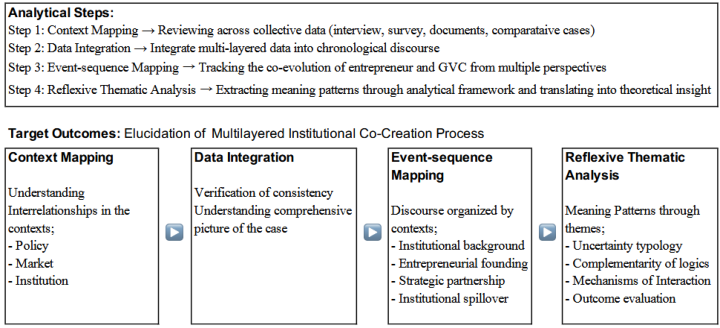
The research process is summarized as follows (Figure 1). The process starts from data collection and followed by four steps of analysis. Analytical steps involve conducting preliminary analysis on collective data with context mapping, integrating and organizing these into a chronological case story, further structuring them into multi-perspective contexts through event sequence mapping, and then extracting meaning patterns through analytical framework and translating into theoretical insight.
Figure 1: Research flow.
CASE OVERVIEW Astroscale entered a prototypical institutional void, facing simultaneous technological, market, and regulatory uncertainty. Rather than pursuing predictive planning, its founder adopted an effectual approach, mobilizing personal networks, existing technological capabilities, and stakeholder dialogue to construct a viable vision of orbital debris removal as a societal and commercial problem.
INCJ’s initial engagement occurred despite the absence of a defined market or regulatory framework. Through intensive strategic dialogue (“kabeuchi” or “wall-practice”), INCJ challenged Astroscale’s hypotheses regarding potential customers, incentives, and governance, while gradually reframing its own evaluative criteria to accommodate institutional emergence rather than near-term returns.
INCJ structured its investment as staged financing with flexible milestones, treating setbacks—including a failed early satellite demonstration—not as disqualifying failures but as learning opportunities. Over successive funding rounds, INCJ also facilitated syndication with private investors, using its public legitimacy to crowd in private capital. The relationship evolved into a strategic partnership that jointly shaped regulatory discourse, public procurement schemes, and market norms for debris removal.
ANALYSIS Our analysis identifies four interrelated dimensions that explain how institutional co-creation occurred through the interaction between actors with divergent logics.
Types of Uncertainty Astroscale confronted triple-layered uncertainty: technological feasibility, market viability, and institutional absence. Rather than eliminating uncertainty ex ante, the entrepreneur and GVC engaged in shared sensemaking, reframing uncertainty as an object of institutional design.
A hybrid of entrepreneurial trial- and-error and investor- driven milestone-based management enabled the stepwise reduction of uncertainty.
Structured technology demonstrations within affordable- loss limits; intended to conduct earlier and learn quicker even from failures.
Milestone-based management for staged risk assessment and funding, while initially assessed that Japan’s existing technological assets could address the risks.
Market Uncertainty
Created future markets by envisioning institutional demand rather than assuming the existence of a present market.
Constructed a hypothetical public- interests narrative in the absence of customers; established business alliances with major satellite operators.
Assessed the significance of solving a societal problem and the potential for long-term market formation when deciding to invest; engaged private investors to form funding commitments - syndication.
Institutional Uncertainty
Actively engaged in shaping international rules through lobbying; worked to secure long-term procurement from government.
Designated the space industry as a priority investment area; committed to supporting space industry development; acted as an institutional intermediary connecting startups to government and public sector.
“Institutional co-creation”: the startup, with GVC support, advanced technical validation and commercialization, introducing institutions such as mission-oriented projects with long-term government procurement.
Complementarity of Logics Effectuation and causation, though theoretically incompatible, proved complementary in practice. Effectuation enabled adaptive experimentation and stakeholder mobilization, while causation-based governance provided discipline, accountability, and institutional credibility. Their interaction generated productive tension rather than conflict.
Table 2: Analytical perspective: Complementarity of logics.
Causation: investment metrics, staged financing, legitimacy checks. Supported the refinement of the business plan and introduced milestone management to assure funding commitments from private investors.
Effectuation: Bird-in- Hand, Affordable Loss, Crazy Quilt etc. drove technical demonstration, business development and lobbying with entrepreneurial logic. Simultaneously Astroscale accepted causation-based management in planning and fundraising to gain investor support.
Entrepreneur’s creative practices were institutionally translated by GVC, making them accountable and legitimate to investors and the public sector. INCJ governed Astroscale’s activities applying Causation, while Astroscale drove entrepreneurial actions utilizing Effectuation.
Mechanisms of Interaction We identify four key mechanisms that translated and aligned divergent logics:
1. Strategic dialogue (kabeuchi) that refined entrepreneurial narratives into institutionally legible forms; 2. Adaptive staged financing that balanced experimentation with public accountability; 3. Hybrid governance combining GVC, private VC, and corporate partners; 4. Narrative translation connecting entrepreneurial visions to policy and procurement frameworks.
Table 3: Analytical perspective: Mechanisms of interaction.
Table available in the original PDF paper.
Analytical Element
Astroscale (Entrepreneur)
INCJ (GVC) Interaction & Institutional Implications The process of mutual translation built institutional visibility.
Strategic Dialogue (“Wall- Practice”)
Presented hypotheses on space debris measures, societal problem framing, and the founder’s vision.
Refined plans based on investor logic, assessing technical validity, societal significance, and commercialization potential; verified policy alignment.
Staged Investment & Adaptive Funding
Discipline for entrepreneurial actions. An investment structure linked to the learning process and dynamics rather than solely to visible outcomes.
Secured funding aligned with progress in technical validation and commercialization; shared milestone recognition with investors.
Provided stage-based funding with flexibility in evaluation; despite missing milestones due to satellite launch failure, provided additional funding based on progress in resolving prior issues and learning from failure.
Co-structured funding to balance public and market objectives; Astroscale was directed toward both public and commercial goals under multi- stakeholder governance.
Pursued strategic investments to realize policy objectives while operating independently; formed syndication with private investors and corporations to jointly govern portfolio companies as the lead investor.
Maintained autonomy while engaging with diverse stakeholders— government VC, private investors, strategic corporate partners, domestic and international government agencies, and global satellite operators.
Narrative Alignment
Institutional legitimation through sensemaking.
Framed space debris issues as a shared global challenge and advanced a discourse legitimizing commercialization.
Recognized the space debris issue as a societal challenge and adopted Astroscale as an investment target; translated the issue into a policy framework for Japan’s space industry promotion and environmental problem- solving.
Institutional Outcomes The collaboration produced outcomes beyond firm growth, including alignment with national missions, enhanced adaptive capacity, and market- shaping impact. Astroscale influenced public procurement design, reframed debris removal as a legitimate industry category, and contributed to emerging global norms of orbital sustainability.
Strategic investment aligned with fostering innovation and solving societal challenges via startup support; consistent with government space industry promotion policies.
Mission-driven investment by JAXA/ Government was implemented, enhanced institutional credibility of space debris removal.
Achieved the progress for commercialization of a public mission—space debris removal—as a startup venture.
Overcome satellite launch failure, learned from it, and advanced technical demonstrations.
Organizational learning and resilience by both entrepreneurs and investors allowed for long-term adaptation.
INCJ adapted Astroscale for its strategic investments outside targeted areas; made flexible decisions away from rigidity of milestone-based governance; instead, measured progress by ability to adopt, learn and maintain relevance in uncertain domain.
Market- Shaping Impact
Enhanced reputation supporting institutional and market formation; assisted Astroscale in refining business plans and fundraising, increased its market credibility.
Institutionally driven market creation by private companies spilled over into policy domain. Progress in technology demonstration and commercialization drove the realization of government procurement and mission-oriented projects.
Contributed to international standardization and policy integration; leveraging the technological progress, formed alliances with satellite operators, pursued active lobbying, secured long-term public procurement.
Institutional Outcomes INCJ’s engagement with Astroscale operated as an institutional intermediary for national missions. Acting as a mediator, INCJ supported Astroscale’s transition from technology venture to institutional actor, jointly shaping emerging rules and markets. Its approach integrated interaction mechanisms and supported for institutional development, while aligning with the role of GVC as a provider of patient capital. Upon the findings from this study, we assessed INCJ’s GVC scheme as an innovation system from policy design perspective (Mazzucato, 2015). The results are shown in the following Table 5.
Table 5: Four principles of policy design.
Table available in the original PDF paper.
Principle Description INCJ as GVC Scheme Directionality The policy explicitly targets specific societal challenges.
While INCJ as a GVC sets explicit strategic return goals such as solving social issues, creating new added value, and realizing innovation, it operates autonomously in selecting specific priority investment areas targeting specific societal challenges.
(Continued)
Table 5: Continued.
Table available in the original PDF paper.
Principle Description INCJ as GVC Scheme Public Value Co-Creation Emphasis on creating social value as well as market value.
INCJ’s mission is to pursue strategic return goals such as solving social issues, creating new added value, and realizing innovation, while required to maintain financial return.
Redesign of Public–Private Risk Sharing
Public funds are positioned as “investments,” with mechanisms for returns on results.
INCJ holds equity stakes in its investments and shares business value proportional to those stakes. Financial returns are realized through exits as returns on business value growth – typically through IPO or M&A.
Institutional Learning
Moving away from fixed designs toward “learning-capable institutional design.”
Diversification of portfolio under a GVC scheme tolerates failure, while enabling to access broader learning opportunities. Furthermore, the learning outcomes from investments in individual cases (even in failure cases) can be adopted to other investment cases.
DISCUSSION AND CONTRIBUTIONS This study advances three main theoretical contributions. First, it reconceptualizes patient capital as an institutional mediator that translates between entrepreneurial action and state logic, rather than as a passive funding source. Second, it extends effectuation theory by embedding it within institutional contexts, showing how effectual action contributes to institutional emergence. Third, it reframes institutional formation as a negotiated, dialogical process that unfolds through interaction under uncertainty.
Practically, the findings suggest that effective public innovation governance in frontier domains requires relational and adaptive mechanisms—such as strategic dialogue and flexible milestones—rather than rigid ex ante evaluation. Entrepreneurs, in turn, must develop the capacity to translate effectual visions into institutionally resonant narratives.
CONCLUSION
The Astroscale–INCJ case demonstrates that in institutional voids, institutions are not prerequisites for action but outcomes of it. Institutional co-creation emerges through translation, alignment, and sustained interaction between entrepreneurs and the state. By theorizing this process, the study offers a framework for understanding how new markets and institutions are constructed at the frontier of innovation.
REFERENCES
Arora, A., Fosfuri, A., & Roende, T. (2022). Caught In the middle: The bias against startup innovation with technical and commercial challenges. NBER Working Paper Series, 29654. Berger, M., Dechezleptrtre, A., & Fadic, M. 2024. What is the role of Government
Venture Capital for innovation-driven entrepreneurship? OECD Science, Technology and Industry Working Papers, https://dx.doi.org/10.1787/6430069e-en Braun, V. and Clarke, V. (2006). Using thematic analysis in psychology. Qualitative Research in Psychology, 3(2), 77–101. Braun, V. and Clarke, V. (2019). Reflecting on reflexive thematic analysis. In
Qualitative Research in Sport, Exercise and Health, Vol. 11, Issue 4,. 589–597. Colombo, M. G., Cumming, D. J., & Vismara, S. 2016. Governmental venture capital for innovative young firms. Journal of Technology Transfer, 41(1), 10–24. Cumming, D. 2007. Government policy towards entrepreneurial finance: Innovation
investment funds. Journal of Business Venturing, 22(2), 193–235. Gorman, M., & Sahlman, W. A. 1989. What do venture capitalists do? Journal of Business Venturing, 4, 231–248. Guerini, M. and A. Quas 2016, Governmental venture capital in Europe: Screening
and certification, Journal of Business Venturing, Vol. 31, pp. 175–195. Kattel, R., & Mazzucato, M. 2018. Mission-oriented innovation policy and dynamic capabilities in the public sector. Industrial and Corporate Change, 27(5), 787–801. Lerner, J., & Watson, B. 2008. The public venture capital challenge: The Australian
case. Venture Capital, 10(1), 1–20. Lerner, J., & Nanda, R. 2021. Venture Capital’s Role in Financing Innovation: What We Know and How Much We Still Need to Learn. Harvard Business School. Lerner, J. 2022. Government Incentives for Entrepreneurship. Innovation and Public
Policy (A. Goolsbee & B. Jones, Eds.). University of Chicago Press, 213–235 Larsson, J. P. 2022. Innovation without entrepreneurship: The pipe dream of missionoriented innovation policy. Questioning the Entrepreneurial State, International Studies in Entrepreneurship, 53, 77–91. Mazzucato, M. 2013. The Entrepreneurial state: Debunking public vs. private sector
myths. London: Anthem Press (Kindle Edition). Mazzucato, M. 2015. Innovation systems: From fixing market failures to creating markets. Revista Do Serviço Público, 66(4), 627–640. Mazzucato, M. 2018. Mission-oriented innovation policies: Challenges and
opportunities. Industrial and Corporate Change, 27(5), 803–815. Read, S., Sarasvathy, S. D., Dew, N., Wiltbank, R., & Ohlsson, A. V. 2009. Effectual entrepreneurial expertise: Existence and bounds. Frontiers of Entrepreneurship Research, 29(4). Sarasvathy, S. D. 2001. Causation and effectuation: Toward a theoretical shift from
economic inevitability to entrepreneurial contingency. Academy of Management Review, 26(2), 243–263. Sarasvathy, S. D. 2008. Effectuation: Elements of entrepreneurial expertise. Edward Elgar Publishing. Sarasvathy, S. D. 2022. An effectual analysis of markets and states. Questioning the
Entrepreneurial State, International Studies in Entrepreneurship, 53, 37–55.
LISTED IN THE AHFE DIGITAL BOOKSTORE CATALOGUE
Explore the complete digital volume
Creativity, Innovation and Entrepreneurship
Read this individual research paper free through the original publisher, or explore the full digital proceedings book.
ISBN 978-1-964867-82-3
Explore this ISBN in the AHFE Bookstore ↗Listed in the July 2026 bookstore catalogue; search by ISBN to confirm current availability · Digital book purchase optional