Yuriko Sawatani, Nobuo Kanai (2023). New human engagement-first governance approach in craft startups. In: The Human Side of Service Engineering. AHFE Open Access, vol. 108, pp. 67–77. https://doi.org/10.54941/ahfe1003108
The research finds a new relationship with customers through crowdfunding in the case of BrewDog, a craft startup. Originally, the concept of craft was regarded as a primitive form of manufacturing that was passing away. However, the Arts and Crafts Movement, started by Morris and others (1892) against the Industrial Revolution, was an attempt to rediscover the potential of human beings themselves. By rethinking the purpose of life as an anti-capitalist movement and analyzing craft startups, where symbolism, aesthetic qualities, and entrepreneurial identity are important elements, we found a customer profile as a future-creating partner that transcends the traditional relationship enabled by the crowdfunding mechanism.
The concept of handwork or craft has generally been viewed as primitive manufacturing. However, craft is being reconceptualized in contemporary society as an alternative approach with new governance models that prio- ritize human involvement in work and organizational relationships. In fact, the value proposition of a typical craft beer does not simply refer to the old concept of craft as a form of operation of a small brewery, but seems to be strongly aware of its message as an alternative value based on the new craft concept.
In a time when mass production and mass consumption have become the norm, the emergence of craft beer has the potential to shake up this value system. By analyzing the case of BrewDog, this study finds one approach to the dilemma of craft startups, namely, whether entrepreneurs as craftsmen should adhere to artisanal values and resist growth or embrace growth. As a research query, how is market expansion possible without losing Identity? and aims to make up for this shortfall through discussion. We will analyze BrewDog’s efforts in terms of its corporate culture, which is centered on PUNK, which represents a rebellious spirit, its external messages, which are also based on that corporate spirit, and its communication, which is social in nature. As a result, we find alternative values as a new governance model based on a new concept of craft.
In the following, following a literature review of related areas, the metho- dology of the study and the results of the analysis are presented. Finally, we provide a discussion and conclusions.
RELATED LITERATURE REVIEW Peculiarities of Craft Startups
With growth opportunities in the craft business in sight, it has been suggested that craft startups face a difficult dilemma (Solomon & Mathias, 2020). That is, the conflict is whether the entrepreneur as a craftsman resists growth by adhering to craft values or embraces growth. Many artisanal entrepreneurs value handcrafting over mass production, maintaining independence over receiving outside funding or management support, connecting with the com- munity over expanding the size of the business, and value creation over profit maximization. Entrepreneurs who adhere to craftsman values and resist gro- wth see embracing growth as exclusion or deviation from the craftsman community, and they profess to not grow. On the other hand, while craft startups hold values that conflict with growth, as seen in the case of craft beer, not only is the market share of the craft category growing, but many of the craft startups that make up these categories are also achieving high growth.
Solomon & Mathias (2020) explain this contradictory situation by the two different sub-identities of artisanal entrepreneurs. Artisanal entrepre- neurs view themselves through a “who we are not”identity, which is opposed to the existence of existing firms in the mass market. In this case, artisanal entrepreneurs view their decision to grow as a challenge to their artisanal characteristics. On the other hand, artisanal entrepreneurs may view “we” in a broader sense, including numerous stakeholders (customers, suppliers, employees, and even the local community) as “who we are” (relational iden- tity). In this case, they may embrace growth decisions as an opportunity to further serve and support their stakeholders. Depending on whether a deci- sion about growth involves confrontational or relational thinking, one may take action to resist growth or to embrace growth.
Crowdfunding Crowdfunding is a digital financing activity, such as lending or fundraising, carried out online. It consists of various debt models such as loans, equity models such as stocks, and non-investment models such as donations that allow individuals, businesses, and other entities to raise funds through online digital marketplaces. These crowdfunding activities are also defined as alter- native financing because they occur outside of the existing banking system and traditional capital markets such as stock and bond markets. Note that the U.S. was the largest domestic crowdfunding market by region in 2020 with $73.62 billion, accounting for 65% of the global market. It was fol- lowed by the United Kingdom ($12.64 billion) and Europe excluding the United Kingdom ($10.12 billion). By scheme, the debt model accounts for
New Human Engagement-First Governance Approach in Craft Startups 69
about 90%, while the equity model accounts for just over 1% (Zhang, et al., 2017; Ziegler, et al., 2021).
Entrepreneurs as Relationship Creators Effectuation theory has its roots in Sarasvathy’s work on the decision making of skilled entrepreneurs (Sarasvathy, 2001, 2008). Sarasvathy (2001, 2008) proposes five decision-making principles that distinguish between “effectua- tion,” the logic of entrepreneurs who can make decisions under uncertainty, and “causation,” the logic of managers who operate in a predictable and less uncertain context.
First, the means-oriented principle relates to the means available to entre- preneurs, such as knowledge acquired through education and industry expe- rience, one’s identity, and personal relationships and networks. Decision makers who adopt effectual logic start from the questions “Who am I?”, “What do I know?”, and “Who do I know?” and create something new from these existing means. Second, the affordable loss principle addresses the tendency of skilled entrepreneurs to move forward affordably. In effe- ctuation decisions, they consider the downside risk of failure and try to limit risk by making small, incremental bets. Third, the crazy quilt principle concerns establishing partnerships and obtaining commitment from stakeh- olders. Establishing alliances and negotiating stakeholder commitments adds new tools and shapes the goals of the venture. Fourth, leverage continge- ncies principle addresses unforeseen events and contingencies. An iterative process for effective decision-making can turn surprises into sources of oppor- tunity. And finally, the principle of non-predictive control concerns the entrepreneur’s attitude toward the future. Effectuation relates to emergent or non-predictive strategic planning and assumes that the uncertainty inherent in the business context requires entrepreneurial behavior to control and actively shape the future. This study is a research query: How is market expansion possible without losing Identity? and aims to make up for this shortfall.
RESEARCH METHOD This study will employ a two-stage approach that complement each other. In the first phase, we will conduct a case study of BrewDog, a craft beer startup that has emerged in the North East craft beer industry, gained global reco- gnition, and achieved sales that exceed those of other craft brewers. We will obtain information about BrewDog from a variety of sources, including the Web, books, news articles, reports, and papers, in an effort to understand BrewDog’s decision-making process from their own perspective. We accom- plish this through a case study of a constructed organization (Yin, 2014). Multiple streams of data are used in this case build to paint a picture of an outstanding company (Cunningham & Barclay, 2020). Secondary sources used in this case study include academic and business analysis, data from BrewDog’s online publications, and other media commentary; excerpts from James Watt’s autobiographical business guide are used to portray BrewDog’s entrepreneurial intentions.
70 Sawatani and Kanai
The second phase of this study analyzes the positioning of BrewDog and its actors from the theoretical framework of Effectuation, with a particular focus on Crazy Quilt. Relationship building with investors, customers, and others will be investigated to determine the impact that BrewDog’s success has had on them.
Brewdog BrewDog was founded in Scotland in 2007 as a craft beer startup by James Watt and Martin Dickie (and their dog Bracken). With a mission to “inspire more people to have the same passion for great craft beer as we do”, they have become a leading craft beer brand with their bold style and uncompromising quality. The company brews a wide variety of revolutionary beers, from its flagship Headliner series, including the Punk IPA, to the Amplified series, which is a beer with 11 times the alcohol content.
The Founding of the Company BrewDog’s founding and subsequent process of seizing growth opportuni- ties is an example of a startup by an effectual entrepreneur. James Watt, the would-be founder, had given up on his own legal career and resigned his posi- tion as an in-house lawyer to return to his family home, where he worked in the fishing industry, even becoming the captain of a trawler in the North Atlantic. His longtime friend and co-founder, Martin Dickey, had followed his dream of becoming a beer brewer and had taken a job with a major bre- wing company. Watt said, “Our passion for beer had been with us for a long time, and in 2004, we jumped on the bandwagon and started brewing our own beer. (Watt, 2016)”
In 2007, the two founders and their dog started the business with a small capital (£10,000 of their own money and a £30,000 bank loan).
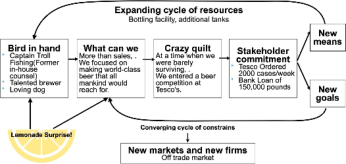
“In the early days of the start-up, we focused less on sales and more on making world-class beer that all mankind would reach for. The start-up period was actually tough. You will experience repeated rejection, pain, and frustration. (Watt, 2016)” While they continued to struggle in sales despite their efforts, he main- tained his confidence in his product and his belief that its value would be discovered. Through social media and other online channels, they aimed to clearly communicate their mission to potential customers and share their pas- sion for brewing beer from the daily brewing process. They also steadily contacted influencers and others in the online craft beer enthusiast commu- nity and asked them to taste samples. Thus, for the first year or so after the company’s founding, he moved into his parents’ house to save money, slept in the brewery, and worked hard, but sales were far short of break-even, and he continued to cash out of his initial business capital.
An Opportunity to Leap Forward “In early 2008, when I was barely surviving, I entered a Tesco beer competi- tion. (Watt, 2016)” He was so busy with his daily work that he had forgotten
New Human Engagement-First Governance Approach in Craft Startups 71
that he had entered the competition when he received a notice that he had won first to fourth place in the competition. He immediately went to Tesco’s headquarters, where he was told that BrewDog’s beer would be sold throu- ghout the UK through Tesco stores, and that 2,000 cases per week would be ordered. However, at the time, there were only two employees and they were bottling by hand, so they had to prepare for an order of 2,000 cases per week in four months.
He put together a plan, went to the bank that had lent him the start-up capital, and applied for an additional loan of 150,000 pounds to add bottling equipment and tanks. Negotiations with the bank were difficult, as the com- pany had not yet repaid the initial business loan, and all financial institutions were becoming more cautious due to the looming global financial crisis. In the end, however, the necessary financing was obtained, the brewery equi- pment managed to take shape, and deliveries to Tesco began. Tesco decided to take on the new challenge of selling craft beer in supermarkets.
Building a Venture Identity In this way, BrewDog saw tremendous growth opportunities in its early years. However, the key factors that have enabled BrewDog to become one of the leading global craft beer companies are that it has successfully built a strong brand and a loyal customer community by establishing its own venture iden- tity, along with its brewing technology. BrewDog’s success in building a strong brand and loyal customer community was a key factor in the company’s success.
BrewDog is built on a foundation of PUNK spirit. Our mission is to break old customs and stereotypes and create a new beer culture of our own voli- tion. BrewDog’s mission is to create a new beer culture by our own will, breaking down old customs and stereotypes. The company was founded in 2007 with the aim of creating a craft beer category in the UK market, which at the time was limited to “mass-produced factory lagers” or “stale and fun- damentally uninteresting ales (James Watt, co-founder of BrewDog). (Watt, 2016)” If one word were to describe BrewDog’s corporate culture, the word “PUNK” would be the best way to describe it. The word “PUNK” is still strongly associated with the punk rock style and culture that became a social phenomenon in the 1970s. However, the essence of PUNK that BrewDog seeks to embody is its rebellious spirit.
PUNK: a culture popular among young people, especially in the late 1970s, involving opposition to authority expressed through shocking behavior, clothes, and hair, and fast, loud music (Cambridge Dictionary) BrewDog’s rebellious spirit lies in the fact that it has reversed such a radical image of PUNK to make a strong impression on consumers and establish its own brand. BrewDog’s anti-establishment stance highlighted the existence of craft beer as a competitor to mass-produced beer and clarified its position as a small brewer standing up to the big operators.
72 Sawatani and Kanai
While BrewDog’s anti-establishment stance and provocative marketing has led to many conflicts, BrewDog has rapidly gained recognition through these radical and provocative marketing efforts. They have also been able to cle- arly communicate their mission to potential customers through social media and other online outlets, and share their passion for making beer from the daily brewing process. As a result, BrewDog has developed a loyal customer community that shares its “revolution.”
The Challenge of Scaling Up In 2008, in only its second year of operation, BrewDog became the largest independent brewery in Scotland. The next stage of growth required fina- ncing. At the time, the company was already close to its maximum credit limit with several banks and needed to raise capital in the form of equity. In the case of a typical start-up, when a company moves from the initial start-up phase to a new growth phase, it is considered to receive investment from VC firms. In such cases, shares are allocated to the VC based on the corporate value evaluation and the amount of investment, and the VC has a certain amount of influence over the management. VCs as shareholders tend to seek profit-oriented management decisions and strategies for rapid expansion of management scale that will lead to an increase in corporate value. This is because VCs as investors seek exit opportunities, such as going public or sel- ling the company to another company (a major operator), in order to recover their invested capital. This can be an identity crisis for BrewDog.
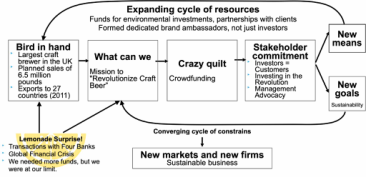
“We believe the best way to further the growth of BrewDog is to ask you, the people who enjoy our beers, to be involved in BrewDog’s future. (Watt, 2016)” In 2009, BrewDog began crowdfunding using an equity model rather than a rewards-based model to raise funds for its rapid growth. This required the company to comply with detailed disclosure requirements as a PLC. The company named its crowdfunded equity offering “Equity for Punks” and offered a variety of benefits to shareholders, including discounts, invitations to the annual meeting and exclusive pre-sales of new products and access to a shareholders-only website where they could voice their opinions about the company’s operations (BrewDog, 2010; 2022). Although BrewDog’s shares are not listed and cannot be traded on the stock market, there have been four opportunities to buy and sell shares through auctions held by a company that specializes in trading private company shares.
BrewDog formed new partnerships with its customers and built a stronger community through this crowdfunding. Through equity ownership, a new relationship was established that transcended inherent conflicts and shared interests, including management, employees, customers, and suppliers. In August 2020, BrewDog announced that it had become the world’s first “car- bon negative brewery” (i.e., absorbing more CO2 than it emits and double offsetting what it cannot reduce, i.e., removing twice as much carbon from the atmosphere as it emits).
New Human Engagement-First Governance Approach in Craft Startups 73
Analysis Through the Theoretical Effectuation Model We will analyze how the entrepreneur’s commitment, identity, and scale-up dilemma unique to craft startups are addressed by comparing the startups at inception to those at scale-up. We will then discuss the compatibility found in BrewDog and why it is possible. The results will be discussed.
The decision making at the time of founding was based on the identity of wanting to make good beer by Birds in hand of the effectuation theory and what they could do. From that activity, they received an order from Tesco, obtained a loan from the bank, and expanded Crazy Kilt. It also expan- ded from on-license business in English-style pubs, which are considered the target of the craft beer business, to the canned beer market in supermar- kets where Tesco committed themselves as the self-selected involved party. This depicts the growth process usually seen in startups: obtaining funding, increasing production, and expanding channels.
On the other hand, the scale-up phase is characterized by the inclusion of customers, rather than specialized financial organizations, as actors for obtaining funds. As a means of achieving this, equity-based crowdfunding was utilized. The crowdfunding scheme recruited participants through its own website targeting their royal customers to be funders. We note here that the choice of crowdfunding scheme and platform was not dependent on the choice of the crowdfunder, but rather on the “customer community” as the funding provider, in practical terms. Furthermore, recent equity offe- rings have included sustainability activities as “Punk for Future” as a target, expanding beyond just the food and beverage industry. Below are the results of the analysis based on the theoretical framework of effectuation during the start-up phase (Figure 1) and the scale-up phase (Figure 2).
DISCUSSIONS Effectual entrepreneurs build relationships with other actors based on their entrepreneurial identity from “Who I am,” “What I know,” and “Whom I know. The craft startup BrewDog, the subject of this study, was not just a business as a way to make money, but the embodiment of an identity that overlaps with their very lives. They avoided a crisis by actively inviting enthusiastic customers to become shareholders in a craft startup dilemma: whether to pursue growth or to retain independence as an identity. In other words, one key to market expansion without losing Identity was to build new relationships with customers.
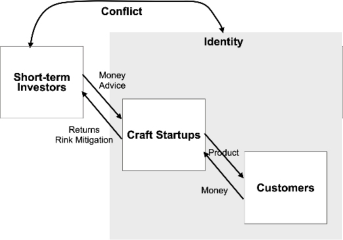
If we organize the relationships with actors in terms of business and iden- tity specific to craft startups, the traditional business partners, such as equity investments, loans, and endowments, have limited interest in the identity of craft startups. Loans are key to building a relationship, whether or not they have value as a business transaction, whereas equity investments expect a bet- ter future return in exchange for some business advice. On the other hand, for Punk Equity holders who are passionate customers, sympathy for the founder’s identity can be a factor for investment, rather than business invo- lvement. Involvement in the management of the company through its shares suggests a greater interest in the development of future products (Table 1).
In the following, we will look at the relationship between BrewDog and its customers as funders, managers, and also as co-creators of the future (Figure 3).
BrewDog’s share capital consists of A, B, and C shares with equal voting and profit appropriation rights. As BrewDog’s current shareholders, 59% of the A share of common stock held by the founder and others, 19% of the B share of common stock, which is the “Equity for Punks” held by the punk shareholders, and 22% of the C share of preferred stock (BrewDog,
Table 1. Role of actors and their involvement in the market and management.
Table available in the original PDF paper.
Role of Actors Customer Business Partners Actors Customer PunkEquity Customers Equity Investors Dead Lender Non- investment Donors
Not interested
Not interested
Not interested
market Products Purchase Product enthusiast, Ourchase No relationship
Not interested
Financial returns
Advice for future returns
Financial transacti- ons
Co-creation for product improve- ment Interest as an invester
Not interested
Not interested
management Identity Empathy Commitment to the founder, Great relevance to own life No relationship
Risk miti- gation
Not interested
Controllabi- lity
Co-creation with the founder
Advice, Risk mitigatioin
New Human Engagement-First Governance Approach in Craft Startups 75
Figure 3: Craft startups’ business and identity dilemma and its solution at BrewDog.
2021). The C shares have a liquidation preference under certain conditions and are owned by TSG Consumer, which supports BrewDog’s independe- nce, global expansion, and management (TSG Consumer, 2007). While the founders have full control over management decisions, the founders are com- mitted to using the intentions of the punk shareholders to guide management. In particular, they have strengthened their commitment to sustainable mana- gement following Equity for Punks Tomorrow, a crowdfunding campaign that raised funds by pledging to invest in sustainable management sustaina- bility initiatives. The breakthrough in BrewDog’s governance was converting customers into business partners through crowdfunding, allowing a commu- nity of customers to become business partners and create the future together. This model shows that maintaining entrepreneurial identity and expanding business are not necessarily insoluble dilemmas, and the future of customer communities as business partners, who create the future together by sharing an identity, should not be overlooked.
CONCLUSION AND FUTURE RESEARCH This study found new customer relationships through crowdfunding in the case of BrewDog, a craft startup. Originally, the concept of craft was regarded as a primitive form of manufacturing that was passing away. However, the Arts and Crafts Movement, started by Morris and others (1892) against the Industrial Revolution, was an attempt to rediscover the potential of human beings themselves. As an anti-capitalist movement, it rethought the purpose of life, and by analyzing craft startups, where symbolism, aesthetic quali- ties, and entrepreneurial identity are important elements, it found a customer profile as a future-creating partner that transcended traditional relationships.
Effectual entrepreneurs build relationships with other actors based on their entrepreneurial identity from “Who I am,” “What I know,” and “Whom I know. The craft startup BrewDog, the subject of this study, was not just a business as a way to make money, but the embodiment of an identity that overlaps with their very lives. They avoided a crisis by actively inviting enthusiastic customers to become shareholders in a craft startup dilemma: whether to pursue growth or to retain independence as an identity. In other
76 Sawatani and Kanai
words, one key to market expansion without losing Identity was to build new relationships with customers.
REFERENCES
Andrews, C. (2020). Most popular beer brands in America dominated by Anheuser- Busch, Molson Coors, Wall Street Available at https://www.usatoday.com/story /money/2020/03/18/the-most-popular-beer-brands-in-america/111416118/ Asset Match (2022). Infrormation Avilable at https://www.assetmatch.com/app/Our
Companies/CompanyProfile?companyId=1428 Banks, M. (2010). Craft labour and creative industries. International Journal of Cultural Policy, 16(3), 305–321. Belleflamme, P., Lambert, T., & Schwienbacher, A. (2013). Individual crowdfunding
practices. Venture Capital, 15(4), 313–333. https://doi.org/10.1080/13691066. 2013.785151 Belleflamme, P., Lambert, T., & Schwienbacher, A. (2014). Crowdfunding: Tapping the right crowd. Journal of Business Venturing, 29(5), 585–609. https://doi.org/ 10.1016/j.jbusvent.2013.07.003 Braudel, F. (1996). “The Mediterranean and the Mediterranean World in the Age of
Philip II” (Berkeley: University of California Press) BrewDog, (2010). Equity for Punks. Available at https://blog.brewdog.com/blog/eq uity-for-punks BrewDog, (2021). Annual Report and Accounts for the year ending 2021. Availa-
ble at https://downloads.ctfassets.net/ezd6as8gi91c/3SVcsYtfxVUHi7EdJARA3r /7d64db1f87fb108c9b00a7bd6c2d57e8/BrewDog_2021_Accounts_Doc.pdf BrewDog, (2022). Equity for Punks Tomorrow Benefits. Available at https://www.br ewdog.com/uk/efp-update Cattani, G., Dunbar, R. L., & Shapira, Z. 2017. How commitment to craftsmanship
leads to unique value: Steinway & Sons’ differentiation strategy. Strategy Science, 2:13–38. Cambridge Dictionary Available at https://dictionary.cambridge.org/dictionary/engl ish/punk Clemons EK, Gao GG and Hitt LM (2006). When online reviews meet hyperdiffe-
rentiation: A study of the craft beer industry. Journal of Management Information Systems 23(2): 149–171. Collins, L & Baeck, P. (2014). Understanding Alternative Finance: The UK Alternatice Finance Industry Report 2014. Nesta Website: https: //www.nesta.org.uk/report/understanding-alternative-finance-the-uk-alternative- finance-industry-report-2014/ Cunningham, J., & Barclay, S. (2020). Craft beer sector collaboration in North East Scotland: The role of individual success. International Journal of Entrepreneurship and Innovation, 21(4), 263–274. https://doi.org/10.1177/1465750320921296 Featherstone, M. (2007). Consumer culture and postmodernism (2nd ed.). London:
Sage. Fox Miller, C. (2017). The contemporary geographies of craft-based manufacturing.
Geography Compass, 11(4), 1–13. https://doi.org/10.1111/gec3.12311 Hodson, R. 1996. Dignity in the workplace under participative management: Alienation and freedom revisited. American Sociological Review, 61: 719–738. Khaire, M. 2014. Fashioning an industry: Socio-cognitive processes in the constru-
ction of worth of a new industry. Organization Studies, 35: 41–74. Kieser, A. (1989). Organizational, Institutional, and Societa; Evolution: Medieval Craft Guilds and the Genesis of Formal Organizations. 34(4), 540–564.
New Human Engagement-First Governance Approach in Craft Startups 77
Korica, M., & Bazin, Y. 2019. Fashion and Organization Studies: Exploring conceptual paradoxes and empirical opportunities. Organization Studies, 40: 1481–1497. Luckman, S. (2013a). Precarious labour then and now: The british arts and crafts
movement and cultural work revisited. In Theorizing Cultural Work: Labour, Continuity and Change in the Cultural and Creative Industries (pp. 19–29). https: //doi.org/10.4324/9780203519912 Luckman, S. (2013b). The aura of the analogue in a digital age: Women’s crafts, creative markets and home-based labour after Etsy. Cultural Studies Review, 19(1), 249–270. Luckman, S. (2015). Craft and the creative economy. Basingstoke: Palgrave
Macmillan. Piore, M. J., & Sabel, C. F. 1984. The second industrial divide: Possibilities for prosperity. New York, NY: Basic Books. Portman Group, (2008). Decisions Punk IPA. Portman Group Website: https://www.
portmangroup.org.uk/punk-ipa/ Rindova, V., Dalpiaz, E., & Ravasi, D. 2011. A cultural quest: A study of organizational use of new cultural resources in strategy formation. Organization Science, 22: 413–431. Ross, A. (2004). Made in Italy: The trouble with craft capitalism. Antipode, 36(2),
209–216. https://doi.org/10.1111/j.1467-8330.2004.00401.x Ruskin, J. (1849). The seven lamps of architecture. London: Smith, Elder and Co. Scott, A. J. (1996). The craft, fashion, and cultural-products industries of Los Angeles: Competitive dynamics and policy dilemmas in a multisectoral image- producing complex. Annals of the Association of American Geographers, 86(2), 306–323. https://doi.org/10.1111/j.1467-8306.1996.tb01755.x Solomon, S. J., & Mathias, B. D. (2020). The artisans’ dilemma: Artisan entre-
preneurship and the challenge of firm growth. Journal of Business Venturing, 35(5). Watt, J. (2016). Business for Punks: Break All the Rules--the BrewDog Way. Portfolio Penguin. Zhang, B., Ziegler, T., Garvey, K., Ridler, S., Burton, J. & Yerolemou, N. (2017).
Entrenching Innovation - The 4th UK Alternative Finance Industry Report. Avai- lable at SSRN: https://ssrn.com/abstract=3084570 or https://dx.doi.org/10.2139/ ssrn.3084570 Ziegler, T., Shneor, R., Wenzlaff, K., Suresh, K., Paes, F., Mammadova, L., Wanga, C., Kekre, N., Mutinda, S., Wang, B., Closs, C., Zhang, B., Forbes, H., Soki, E., & Knaup, N. (2021). Yin RK (2014) Case Study Research: Design and Methods. 5th ed. London: Sage
Publications.
LISTED IN THE AHFE DIGITAL BOOKSTORE CATALOGUE
Explore the complete digital volume
The Human Side of Service Engineering
Read this individual research paper free through the original publisher, or explore the full digital proceedings book.
ISBN 978-1-958651-84-1
Explore this ISBN in the AHFE Bookstore ↗Listed in the July 2026 bookstore catalogue; search by ISBN to confirm current availability · Digital book purchase optional