Merve Mamacı, Nuran Bayram Arli, Serpil Aytac, Sera Öykü Bora, Sahamet Bulbul (2026). The Mediating Role of Emotional Intelligence in the Relationship Between Light Triad Personality Traits and Entrepreneurial Tendency Among University Students. In: Human Factors, Business Management and Society. AHFE Open Access, vol. 215, pp. 24–34. https://doi.org/10.54941/ahfe1007582
Publisher statistics will load when you open Metrics.
AHFE OPEN ACCESS OPEN ACCESS CONFERENCE PROCEEDINGS PAPER
The Mediating Role of Emotional Intelligence in the Relationship Between Light Triad Personality Traits and Entrepreneurial Tendency Among University Students
Entrepreneurship is highly critical for countries’ development, economic growth, competitiveness, and the creation of new employment opportunities. A review of the literature indicates that personality traits have frequently been investigated as key antecedents of entrepreneurial tendencies. However, studies conducted within the framework of Light Triad personality traits remain limited. The present study aims to test the mediating role of emotional intelligence in the relationship between Light Triad personality traits and entrepreneurial tendencies. The data were obtained from 213 undergraduate students enrolled in foundation universities in Istanbul, Türkiye. The study was conducted using a quantitative research design and a survey method. The measurement instruments included the Light Triad Scale, the Wong and Law Emotional Intelligence Scale (WLEIS), and the Entrepreneurship Scale for University Students. The proposed mediation model was tested through mediation analysis, and indirect effects were evaluated using bias-corrected percentile bootstrapping with 5,000 resamples. The findings revealed that the Light Triad does not have a significant direct effect on entrepreneurial tendencies; however, it exerts a significant indirect effect through emotional intelligence, indicating a full mediation structure. Specifically, Light Triad traits are positively correlated with emotional intelligence, which in turn strongly predicts entrepreneurial orientation. Moreover, the proposed model explains approximately 45% of the variance in entrepreneurial tendency (R² = 0.45), demonstrating a moderate to strong explanatory power. Overall, this study indicates that entrepreneurial tendencies are explained not by the direct effects of personality traits but rather through emotional intelligence, which can be conceptualized as an individual psychological resource.
Recent studies show a strong theoretical connection between entrepreneurship and economic growth, emphasizing entrepreneurs as key agents of change
The Mediating Role of Emotional Intelligence in the Relationship Between Light Triad 25 who contribute to national development through new products, methods, and market structures (Smith, 2010). As widely noted, Turkish economy has given long lasting signals of being stuck in inability to boost national income above a particular threshold (Kargı, 2025). Youth unemployment, which reached up to 25.2% in 2019 (Işık, 2022) and it may have consequences such as loss of future income, and increased criminal activities (Satrovic & Muslija, 2020). These findings reveal the necessity of increasing entrepreneurial activities and taking steps to promote youth employment in order to ensure healthy economic development in Turkey (Balcı, 2025; Barber, 2007). Thus, investigatng psychological resources which can explain entrepreneurship orientation by directing personality traits plays a critical role (Chatterjee & Das, 2015).
According to literature, there are a number of psychological precursors of entrepreneurship such as generalized self-efficacy, need for achievement, and risk-taking behavior (Brandstätter, 2011). Also, traditional personality models, such as the Big Five, have been extensively investigated about entrepreneurship (Irengün, 2014). Besides, recent studies show that there is an increasing focus on the Dark and Light Triad traits. As it is known Dark Triad traits - narcissism, Machiavellianism, and psychopathy - is correlated with “dark entrepreneurship,” characterized by malevolence, self-promotion, and emotional coldness (Cooke, 2020). Furthermore, narcissistic founders are often adept at articulating bold visions and attracting funding due to their supreme confidence (Ermiş et al., 2024). Machiavellianism involves strategic manipulation and a cynical view of human nature (Alowais & Suliman, 2025). Individuals with psychopathic traits may not experience the paralyzing anxiety that others might feel during a financial crisis (Kraus et al., 2020).
The Light Triad concept proposed by Kaufman, Yaden, Hyde, and Tsukayama (2019) and expressed as consisting of Faith in Humanity (believing that people are essentially good), Humanism (valuing the dignity and worth of each individual), and Kantianism (approaching people as ends in themselves rather than as means). The Light Triad, refers to an individual’s loving and benevolent orientation toward others, in contrast to the Dark Triad personality traits (Lukić & Živanović, 2021). Studies have showed that the Light Triad is not merely about being a “good” or “virtuous” individual; but also being able to show prosocial behaviors (Branson et al., 2022), being open to new experiences (Kaufman et al., 2019), and having entrepreneurial intention (Polatcı & Yeloğlu, 2021).
When Kantianism is examined, it is emphasized as a perspective that rejects a profit-oriented mindset and adopts the principle of respecting human beings at all costs (Bowie, 2002). Humanism, on the other hand, is described as a characteristic that can contribute to the improvement of organizational performance by promoting a culture that embraces all individuals within the organization and enables creativity to emerge in the workplace (Blázquez Puerta et al., 2022). Faith in Humanity, is related with trust. Entrepreneurs’ trust in their internal and external stakeholders, may help reducing the need for expensive monitoring and bureaucratic processes as well as rigid legal regulations (Coughlan, 2021). Research shows that individuals cannot be classified as purely dark or light; rather, these traits can come together within
the same individual (Kaletta & Reuther, 2021). Nevertheless, empirical studies about related with Light Triad personality traits and entrepreneurial tendencies among university students remains limited.
Besides the Light and Dark Triads, emotional intelligence may be a key factor in shaping entrepreneurial tendencies. Emotional Intelligence refers to self-efficacy, emotion management, and emotional perspective, which are essential for confident individuals to be successful (Bandura, 1997). Students with higher emotional intelligence tend to demonstrate greater vulnerability and creativity in entrepreneurial activities (Zampetakis et al., 2009; Uçar et al., 2022). Individuals who have higher degrees of Emotional Intelligence may able to cope with uncertainty by transforming it into an opportunity rather than perceiving it as a threat, which is beneficial (Zampetakis et al., 2009). Also in workplaces emotionally intelligent entrepreneurs are able to regulate their own behavior, emphasize other employees’ emotions (Cross & Travaglione, 2003). Studies also show that Emotional Intelligence may help to establish positive relations with other people, which are highly related to Kantianism, Humanism, and Faith in Humanity (Kaufman et al., 2019). As considered in the study by Kaufman et al. (2019), it is seen that individuals who possess Light Triad traits might be more predisposed to higher Emotional Intelligence, naturally. Conversely, when the literature is examined, it is seen that most of the research on Light Triad and Emotional Intelligence roles is still examined from a theoretical perspective and remains limited. The relationships may not only appear directly but may also emerge as additional psychological mechanisms.
From a theoretical perspective, the relationship between personality traits and entrepreneurial tendency can be better understood through Trait Activation Theory and Social Cognitive Theory. Trait Activation Theory suggests that personality traits do not automatically translate into behavior unless they are activated by relevant situational or psychological mechanisms (Tett & Burnett, 2003). In order to manifest entrepreneurial tendencies, morally and prosocially motivated personality traits may necessitate specific cognitive and emotional capabilities. Likewise, Social Cognitive Theory emphasizes the role of self-regulatory processes and emotional capabilities in shaping behavior under conditions of uncertainty (Bandura, 1986). Together, these perspectives suggest that emotional intelligence may function as a critical psychological mechanism through which moral personality traits influence entrepreneurial tendency.
METHOD
Participants The target population of this study consisted of undergraduate students enrolled at a foundation (private) university in Istanbul. Convenience sampling was used to collect data using a questionnaire that included measurement scales and demographic information. The questionnaires were administered online via Google Forms. The survey instrument used in the study was approved by the Fenerbahçe University Social and Human
The Mediating Role of Emotional Intelligence in the Relationship Between Light Triad 27 Sciences Research Ethics Committee (2025/5-7) held on 05.05.2025. A total of 213 undergraduate students participated in the study, 69% of whom were female.
Table 1: Demographic characteristics.
Table available in the original PDF paper.
Frequency %
Gender Female 147 69.0
Male 66 31.0 Grade
1 89 41.8
2 66 31.0
3 42 19.7
4 16 7.5
Working status Working 42 19.7
Not working 171 80.3 Own personal income
Yes 64 30.0 No 149 70.0
In terms of academic year, 41.8% of participants were in first grade, 80.3% were not working, and 70.0% stated that they had no personal income.
MEASUREMENT TOOLS In the study, demographic information form and three different scales were used: Light Triad personality traits, Emotional Intelligence, and Entrepreneurship.
Light Triad Personality Traits: To measure students’ personality traits, the Light Triad Scale developed by Kaufman, Yaden, Hyde, and Tsukayama (2019) and adapted into Turkish by Tekeş and Bıçaksız (2021) was used. The scale consists of three subdimensions, Humanism, Faith in Humanity, and Kantianism each measured by four items. Items are rated on a five- point Likert scale ranging from 1 (strongly disagree) to 5 (strongly agree), with higher scores indicating higher levels of Light Triad traits. Both subscale scores and an overall composite score can be calculated, with higher scores reflecting stronger prosocial and ethical personality characteristics.
Emotional Intelligence: The Wong and Law Emotional Intelligence Scale (WLEIS), developed by Wong and Law (2002) and adapted into Turkish by Uslu (2019), was used to measure students’ emotional intelligence. The scale consists of 16 items designed to assess the four dimensions of emotional intelligence: assessing one’s own emotions, assessing others’ emotions, using emotions, and regulating emotions. Each dimension is represented by four
items. Items are rated on a five-point Likert scale ranging from 1 (strongly disagree) to 5 (strongly agree). High scores on the scale indicate high levels of emotional intelligence.
Entrepreneurship: The Entrepreneurship Scale for University Students, developed by Yılmaz and Sünbül (2009), has been used to measure students’ entrepreneurial tendencies. The scale consists of items reflecting fundamental entrepreneurial characteristics such as initiative, risk-taking, innovation, and self-confidence. The scale consists of 36 items presented in a five-point Likert-type format ranging from 1 (never) to 5 (very often). Higher scores indicate higher entrepreneurial tendencies.
Table 2 presents the means, standard deviations, and internal consistency coefficients (Cronbach’s alpha and McDonald’s omega) for the Light Triad, emotional intelligence, and entrepreneurial tendency scales.
Table 2: Descriptive statistics and reliability coefficients of the study variables.
Entrepreneurship 3.75 0.54 .95 .95 As shown in Table 2, all measurement tools demonstrated acceptable levels of internal consistency. The Light Triad Scale yielded acceptable reliability coefficients (Cronbach’s α = .75; McDonald’s ω = .75) and demonstrated sufficient internal consistency. The Emotional Intelligence Scale (WLEIS) exhibited strong reliability (α = .84; ω = .84), while the Entrepreneurship Scale demonstrated excellent internal consistency (α = .95; ω = .95). Overall, these results suggest that the measurement instruments used in the study are reliable and appropriate for subsequent analyses.
Analysis The data were analyzed using mediation analysis to test the proposed model, which aims to examine the indirect effect of the Light Triad on entrepreneurial tendencies through emotional intelligence. The mediating role of emotional intelligence was tested using Hayes’ PROCESS Model 4 approach via JASP 18.3.0 software. To estimate the confidence intervals of direct and indirect effects, the 5,000 resampled bias-corrected percentile bootstrap method, recommended for its robustness and statistical power in mediation analyses, was applied. Standardized path coefficients were reported to allow for a clearer interpretation of the relationships between variables; statistical significance was assessed based on 95% confidence intervals and p-values. The explanatory power of the model was examined using the coefficient of determination (R²).
RESULTS
This section presents findings from a mediation analysis examining the relationship between the Big Five personality traits and entrepreneurial tendency within a model that includes emotional intelligence as a mediating
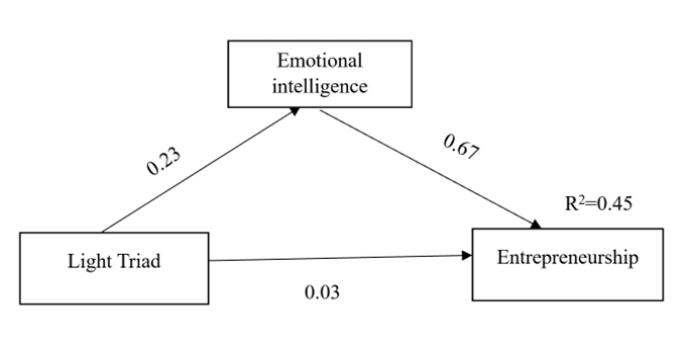
The Mediating Role of Emotional Intelligence in the Relationship Between Light Triad 29 variable. The proposed model was tested using standardized path coefficients, and confidence intervals were obtained through bias-corrected percentile bootstrapping with 5,000 resamples. Table 2 reports the standardized path coefficients for the mediation model, while Tables 3 and 4 present the direct, indirect, and total effects. Figure 1 illustrates the estimated mediation model along with the standardized coefficients and the explained variance in entrepreneurship.
Figure 1: Results of the mediation model linking the Light Triad, emotional intelligence, and entrepreneurship.
This study examines the mediating role of emotional intelligence in the relationship between the Light Triad personality traits and entrepreneurial tendency. The results of the mediation model are first presented by evaluating the direct relationships among the variables. As reported in Table 2, the direct effect of the Light Triad on entrepreneurship is not statistically significant (β = 0.03, p = 0.961). This finding indicates that the prosocial and morally oriented characteristics represented by the Light Triad are insufficient to directly explain entrepreneurial behavior on their own. In contrast, the results presented in Table 3 show that the relationship between the Light Triad and emotional intelligence is positive and statistically significant (β = 0.232, p < 0.001). Moreover, emotional intelligence has a strong and statistically significant effect on entrepreneurship (β = 0.671, p < 0.001). These findings suggest that emotional competencies constitute one of the key determinants of entrepreneurial tendency. The results of the mediation analysis are presented in Table 4. The findings demonstrate that the indirect effect of the Light Triad on entrepreneurship through emotional intelligence is statistically significant (β = 0.156, p < 0.001; 95% CI [0.058, 0.262]). In contrast, the non-significant direct effect indicates the presence of a full mediation structure in the model.
The findings of this study show that the relationship between the light triad and entrepreneurship tendency is not directly but through emotional and cognitive capability as emotional intelligence. Outcomes suggests that prosocial and morally based personality characteristics influence entrepreneurial tendencies only when they are combined with emotional and cognitive abilities. As is seen, this finding contradicts with the idea of linear relationship between personality traits and entrepreneurial behavior as stated in literature.
These results can be explained at the theoretical level. According to Trait Activation Theory, attention is drawn to the importance of factors that activate individuals’ personality traits in order for these traits to be translated into observable behaviors (Tett & Burnett, 2003). From this perspective, the full mediating role of emotional intelligence identified in the research findings appears to be theoretically consistent.
In the study conducted by Rauch and Frese (2007), it was found that personality traits may not manifest in the same way across all jobs and contexts; rather, they tend to emerge when appropriate contextual conditions are present. As is well known, entrepreneurship represents a process characterized by uncertainty and relatively intensive social interactions. In this context, emotional intelligence can be considered an emotional and cognitive capacity that provides a foundation for individuals to express their positive attitudes toward others and their personal values. Accordingly, the results of the present study indicate that, even in the absence of a direct situational trigger, personality traits may be translated into behavior indirectly through the presence of an appropriate psychological capacity.
Empirical studies indicate that emotional intelligence is positively related to entrepreneurial attitudes and intentions (Zampetakis et al., 2009), contributes to entrepreneurial tendency and performance through dynamic processes such as proactivity and innovativeness (Peng et al., 2024), and has strong effects on work-related attitudes and behaviors (Miao et al., 2017). Within the framework of affect-based models of entrepreneurship, Baron (2008) states that leadership, social interaction, and the ability to cope with uncertainty are closely related to individuals’ emotional regulation capacities. One of the notable findings of the present study is the strong and positive relationship between emotional intelligence and entrepreneurial tendency. This finding suggests that emotional intelligence can be considered a psychological resource in explaining entrepreneurial tendency and appears to be consistent with previous empirical studies.
The present study is considered to make several contributions to the entrepreneurship literature. First, examining Light Triad personality traits and emotional intelligence within a mediation framework provides empirical evidence putting stress on the importance of ethical attitudes and personal values in explaining entrepreneurial tendencies. This contribution goes beyond the Dark Triad personality traits that have influenced studies on entrepreneurship. Furthermore, the study provides insight into how personality affects entrepreneurial outcomes through emotional and self- regulatory processes by showing that emotional intelligence is a crucial
psychological resource explaining the relationship between ethically oriented personality traits and entrepreneurial tendency.
From an applied standpoint, the results of this study indicate that programs aimed at boosting university students’ entrepreneurial tendencies might not be adequately successful if they just concentrate on encouraging moral principles and prosocial attitudes. Instead, the results shows the importance of developing psychological resources such as emotional intelligence. Training programs developed for university students should be structured to enhance university students’ awareness of their own emotions and to develop and activate their emotion regulation skills when needed and at appropriate times. In this way, it can be suggested that individuals with entrepreneurial tendencies may be able to pursue these orientations in a healthier and more effective way.
The present study has several limitations. First, the study employs a cross- sectional design, which does not allow for causal inferences. In this respect, future research may benefit from examining the proposed relationships using longitudinal and experimental designs. Second, the data were collected from foundation universities in Istanbul, Türkiye, which may limit the generalizability of the findings. Future studies could examine the model across different samples and cultural contexts to further validate and refine the results.
CONCLUSION
In this study the relationship between Light Triad personality traits and entrepreneurial tendency among university students was investigated. Besides, the mediator role of emotional intelligence was tested. Our study shows that Light Triad traits do not directly predict entrepreneurial tendency; rather fully through emotional intelligence. The study underlines the importance of cognitive and emotional skills as essential components of entrepreneurial tendencies. The findings show that emotional intelligence also plays a major role in explaining entrepreneurial tendencies, suggesting that ethical personality qualities alone may not be enough. This study closes a gap in the literature and makes a further contribution by suggesting an idea about strengthening the entrepreneurial tendencies of university students. One important strategy for encouraging entrepreneurial tendencies in university students is to raise their emotional intelligence levels.
REFERENCES
Alowais, A. A., & Suliman, A. (2025). Dark triad in the margins: Narcissism and moral erosion among marginal migrant entrepreneurs. Administrative Sciences, 15(7), Article 257. https://doi.org/10.3390/admsci15070257 Balcı, A. İ. (2025). The analysis of youth unemployment in Türkiye under the impact
of COVID-19 within the framework of unemployment hysteresis and the natural rate of unemployment. Academic Review of Economics and Administrative Sciences, 18(1), 411–430. https://doi.org/10.25287/ohuiibf.1560055 Bandura, A. (1986). Social foundations of thought and action: A social cognitive theory. Prentice-Hall. Bandura, A. (1997), Self-efficacy: The exercise of control, (1st ed.) Freeman & Co.
The Mediating Role of Emotional Intelligence in the Relationship Between Light Triad 33 Barber, H. D. (2007). The importance of entrepreneurship to economic growth, job
creation and wealth creation. Canada-United States Law Journal, 33(1), 25–37. https://scholarlycommons.law.case.edu/cuslj/vol33/iss1/8 Baron, R. A. (2008). The role of affect in the entrepreneurial process. Academy of management Review, 33(2), 328–340. Blázquez Puerta, C. D., Bermúdez-González, G., & Soler García, I. P. (2022). Human
systematic innovation helix: Knowledge management, emotional intelligence and entrepreneurial competency. Sustainability, 14(7), Article 4296. https://doi. org/10.3390/su14074296 Bowie, N. E. (2002). A Kantian approach to business ethics. In T. Donaldson, P.
H. Werhane, & M. Cording (Eds.), Ethical issues in business: A philosophical approach (7th edition., pp. 61–71) Prentice Hall. Brandstätter, H. (2011). Personality aspects of entrepreneurship: A look at five metaanalyses. Personality and Individual Differences, 51(3), 222–230. https://doi. org/10.1016/j.paid.2010.07.007 Branson, M., March, E., & Marrington, J. Z. (2022). Talkin’ bout my generation:
The utility of different age cohorts to predict antisocial behaviour on social media. In T. Machin, C. Brownlow, S. Abel, & J. Gilmour (Eds.), Social media and technology across the lifespan (pp. 27–42).Palgrave Macmillan/Springer Nature. https://doi.org/10.1007/978-3-030-99049-7_3 Chatterjee, N., & Das, N. (2015). Key psychological factors as predictors of entrepreneurial success: A conceptual framework. Academy of Entrepreneurship Journal, 21(1), 102–114. Cooke, P. (2020). Dark entrepreneurship, the ‘Dark Triad’ and its potential ‘Light
Triad’ realization in ‘green entrepreneurship’. Urban Science, 4(4). https://doi. org/10.3390/urbansci4040045 Coughlan, R. (2021, August 31). Trust and trustworthiness in business. Oxford Research Encyclopedia of Business and Management. https://doi.org/10.1093/ acrefore/9780190224851.001.0001/acrefore-9780190224851-e-317 Cross, B. & Travaglione, A. (2003). The untold story: Is the entrepreneur of the
21st century defined by emotional intelligence? The International Journal of Organizational Analysis, 11(3), 221–228, https://doi.org/10.1108/eb028973 Ermiş, S. A., Boyanmış, A. H., Kesilmiş, İ., Toros, T., Oğraş, E. B., Akın, M., Temel, C., Gürkan, A. C., & Öcal, Y. K. (2024). Exploring the influence of Dark Triad and Light Triad traits on sport sciences students. Medicina, 60(8), Article 1269. https://doi.org/10.3390/medicina60081269 Irengün, O. (2014). The effect of the Big Five personality traits on social
entrepreneurship orientation: An empirical study Unpublished Master’s Thesis. Istanbul University, Institute of Social Sciences, Istanbul. Işık, V. (2022). Recommendation of active employment policy based on entrepreneurship and social innovation: Social entrepreneurship support model for youth in Turkey. Istanbul Business Research, 51(2), 517–533. https://doi. org/10.26650/ibr.2022.51.871670 Kaletta, J., & Reuther, K. (2021, November). Dark triad versus light triad: A
comparison and analysis in the context of agile leadership. In Proceedings of the European Conference on Management, Leadership & Governance (pp. 241–249). Kargı, B. (2025). Evidence of Turkey falling into the middle income trap. The Pakistan Development Review, 63(3), 383–398. https://doi.org/10.30541/ v63i3pp.383-398 Kaufman, S. B., Yaden, D. B., Hyde, E., & Tsukayama, E. (2019). The light vs.
dark triad of personality: Contrasting two very different profiles of human nature. Frontiers in psychology, 10, https://doi.org/10.3389/fpsyg.2019.00467
Kraus, S., Traunmüller, V., Kailer, N., & Tiberius, V. (2020). The dark triad in entrepreneurship research — A systematic literature review. Journal of Enterprising Culture, 28(04), 353–373. https://doi.org/10.1142/S0218495820500156 Lukić, P., & Živanović, M. (2021). Shedding light on the Light Triad: Further evidence
on structural, construct, and predictive validity of the Light Triad. Personality and Individual Differences, 178, 110876. https://doi.org/10.1016/j.paid.2021.110876 Miao, C., Humphrey, R. H., & Qian, S. (2017). A meta-analysis of emotional intelligence and work attitudes. Journal of occupational and organizational psychology, 90(2), 177–202. Peng, H. T., Yang, M., & Zhou, C. (2024). How does entrepreneurial orientation
affect the relationship between emotional intelligence and entrepreneurial performance? Based on the study of meta-analysis and structural equation model. Current Psychology, 43(39), 30655–30676. Polatcı, S., & Yeloğlu, H. O. (2021). Karanlık ve Aydınlık Kişilik özelliklerinin girişimcilik niyeti üzerindeki etkisinin incelenmesi. Journal of Organizational Behavior Review, 3(1), 73–87. Rauch, A., & Frese, M. (2007). Let’s put the person back into entrepreneurship
research: A meta-analysis on the relationship between business owners’ personality traits, business creation, and success. European Journal of work and organizational psychology, 16(4), 353–385. Satrovic, E., & Muslija, A. (2020). Youth unemployment and energy consumption in OECD countries. Journal of Youth Research, 8(20), 20–35. Smith, D. (2010). The role of entrepreneurship in economic growth. Undergraduate
Economic Review, 6(1), Article 7 https://digitalcommons.iwu.edu/uer/vol6/iss1/7 Tekeş, B., & Bıçaksız, P. (2021). Aydınlık üçlü (light triad) ölçeğinin psikometrik özelliklerinin değerlendirilmesi. AYNA Klinik Psikoloji Dergisi, 8(3), 535–556. Tett, R. P., & Burnett, D. D. (2003). A personality trait-based interactionist model of
job performance. Journal of Applied psychology, 88(3), 500. Uçar, Y. B., Güney, S., Metin Orta, İ., & Metin Camgöz, S. (2022). Z kuşağının girişimcilik eğilimlerinde duygusal zekâ ve yaratıcılığın rolü. Girişimcilik ve İnovasyon Yönetimi Dergisi, 11(2), 1–29. https://doi.org/10.15659/jeim.11.2.002 Uslu, E. (2019). Doğrudan pazarlama çalışanlarında duygusal zekâ, performans algısı,
motivasyon ilişkisi: Ankara ili çağrı merkezi çalışanları örneği. Yayımlanmamış Doktora tezi, Kırıkkale Üniversitesi, Sosyal Bilimler Enstitüsü, İşletme Ana Bilim Dalı, Kırıkkale. Wong, C. S., & Law, K. S. (2002). The effects of leader and follower emotional intelligence on performance and attitude: An exploratory study. The Leadership Quarterly 13 (2002) 243–274. Yılmaz, E., & Sünbül, A. M. (2009). Üniversite öğrencilerine yönelik girişimcilik
ölçeğinin geliştirilmesi. Selçuk Üniversitesi Sosyal Bilimler Enstitüsü Dergisi, (21), 195–203. Zampetakis, L. A., Kafetsios, K., Bouranta, N., Dewett, T., & Moustakis, V. S. (2009).
On the relationship between emotional intelligence and entrepreneurial attitudes and intentions. International Journal of Entrepreneurial Behaviour & Research, 15(6), 595–618. https://doi.org/10.1108/13552550910995452
LISTED IN THE AHFE DIGITAL BOOKSTORE CATALOGUE
Explore the complete digital volume
Human Factors, Business Management and Society
Read this individual research paper free through the original publisher, or explore the full digital proceedings book.
ISBN 978-1-964867-91-5
Explore this ISBN in the AHFE Bookstore ↗Listed in the July 2026 bookstore catalogue; search by ISBN to confirm current availability · Digital book purchase optional