Alihan Pasin, Erdal Şen, Serpil Aytac (2026). The “As-If” Leadership Model: A Conceptualization and Scale Development Study. In: Human Factors, Business Management and Society. AHFE Open Access, vol. 215, pp. 15–23. https://doi.org/10.54941/ahfe1007581
This study was conducted to conceptualize the notion of “As-If Leadership” which, despite being frequently observed as a practical phenomenon in leadership literature, has yet to be systematically defined in terms of its theoretical framework and empirical boundaries, and to develop a scientific tool to measure this construct. The research is based on the behavioural patterns of managers who occupy leadership positions but lack the competence, self-awareness, and responsibility required for this role; managers who use leadership solely as a symbolic representation, status, and image tool. In the first phase of the study, designed using a mixed research design, the theoretical dimensions of the concept were constructed through thematic analysis and in-depth interviews conducted on 430 academic publications in the leadership literature. In the second phase, Exploratory and Confirmatory Factor Analyses were applied to data collected from 671 employees working in different sectors across Turkey. The findings confirmed that the “As-If leadership” structure exhibits a unique pattern consisting of a combination of high leadership aspiration, low leadership skills, and low self-awareness. The developed 32-item scale has been added to the literature with a high Cronbach's Alpha reliability coefficient of 0.892 and strong validity values. The study reveals that this profile differs from dark types such as narcissistic or destructive leadership, triggering mechanisms of “passive destruction” and “unintentional harm” that develop independently of intent. Consequently, the research fills a critical gap in both theoretical and practical fields by emphasizing that candidate selection and development processes should focus not only on motivational desires but also on the balance of skills and awareness.
Leadership is defined as one of the most observed yet least understood phenomena on earth (Burns, 1978). Despite decades of extensive discussion in management literature, no single agreed-upon definition has been reached regarding the scope and boundaries of the concept. Despite thousands of studies on leadership and billions of dollars spent on training programs in Received February 6, 2026; Revised April 1, 2026; Accepted April 21, 2026; Available online July 20, 2026
organizations, the desired success has not been achieved in practice; on the contrary, employee dissatisfaction with their leaders has increased (Pfeffer, 2015; Robinson et al., 2008). Current studies and reports reveal that the gap between leaders’ positional presence and their capabilities is widening; the existence of managers who occupy leadership positions but fail to lead has become an organizational problem.
In contemporary organizations, management principles and leadership behaviours are increasingly tending to become an “organizational façade” (Abrahamson and Baumard, 2008). In this context, leadership practices focus more on rhetoric than substance, representation than responsibility, and visibility production than direction. This situation, in which leadership moves away from being a relational and transformative action and becomes a performance in which meaning is imitated, gives rise to the phenomenon of “As-If Leadership.” Leadership as if is defined as an individual symbolically occupying a leadership position but failing to competently fulfil the requirements of that role, using leadership merely as a tool for appearance and perception management. Leaders with this profile act as if they are making decisions rather than actually making them and pretend to provide direction rather than actually doing so (Alvesson and Spicer, 2012).
A review of the literature reveals that leadership failures are often explained under the heading of “dark leadership,” through concepts such as narcissism, Machiavellianism, or toxicity, which reflect “malicious intent” and tendencies toward active harm (Einarsen et al., 2007; Krasikova et al., 2013). However, current approaches do not sufficiently discuss how leadership, independent of intent, can become formal and superficial due to a lack of awareness and competence. Kellerman (2004) emphasizes that bad leadership can stem not only from moral corruption but also from incompetence and insensitivity. This study evaluates leadership not through moral intentions but through the resulting effects and outcomes; it addresses patterns of “passive destruction” that emerge unintentionally as an analytical problem.
Modern organizations tend to reward profiles that are weak in substance but strong in stage performance, driven by their pursuit of institutional isomorphism and legitimacy (DiMaggio and Powell, 1983; Meyer and Rowan, 1977). In leadership selection processes, individuals who are perceived as confident, outgoing, and charismatic are appointed to leadership positions regardless of their actual leadership competencies, giving rise to the “paradox of incompetent managers” (Chamorro-Premuzic, 2019; Hogan and Kaiser, 2005). In this context, “As-If Leadership” emerges not so much as an individual weakness but as a structural outcome, and leadership feeds on the imbalance between competence, awareness, and aspiration.
This study aims to define the phenomenon of “As-If Leadership” which is empirically recognized in the literature but whose theoretical and measurement foundations have not been systematically established. The research argues that leadership is not merely a personality trait or a position; it is a multi- layered structure based on the dynamic balance between Leadership Skills, Leadership Awareness, and Leadership Aspiration (Day and Dragoni, 2015; Hannah et al., 2011). The developed model and measurement tool aim
The “As-If” Leadership Model: A Conceptualization and Scale Development Study 17 to make visible the distinction between holding a leadership position and exercising leadership and to provide an analytical basis for the organizational weakness caused by “unintentional incompetence.”
THE “AS-IF” LEADERSHIP MODEL The “As If Leadership” model was created to analyze the situation where leadership has changed from being a process of making an impact to a status- based symbolic performance and to explain the ontological gap between the functional reality of leadership and its formal representation. This model contends that leadership is a multifaceted structure based on the dynamic balance between Leadership Awareness and Leadership Aspiration, rather than a static personality trait, drawing on Goffman’s (1959) “impression management” and Abrahamson and Baumard’s (2008) “organizational façade” theories (Sen and Pasin, 2025). The underlying premise of the approach is that asymmetry among these three factors hinders people from internalizing the leadership role, making it nothing more than a “role- playing” exercise (Alvesson and Spicer, 2012).
The first parameter constituting the model’s operating mechanism, Leadership Skills, encompasses technical, relational, and conceptual competencies based on Katz’s (1955) classification. The lack of these competencies causes the leader to focus on formal representation rather than producing organizational value (Mumford et al., 2000). The second and most original component, Leadership Awareness, refers to the leader’s capacity to read their own capacity (Self-Awareness), power dynamics (Organizational Awareness), and contextual norms (Social Awareness) (Goleman, 1998; Carden et al., 2021). Lack of awareness triggers the Dunning-Kruger effect, which prevents leaders from recognizing their own inadequacies, leading them to perceive themselves as more competent than they actually are (Kruger and Dunning, 1999). The third component, Leadership Aspiration, is an individual’s internal motivation to take on a leadership role (Chan and Drasgow, 2001); however, the model suggests that high desire, unsupported by skill and awareness, creates the “paradox of being a manager despite being incompetent” and is the primary fuel for “pretending” behaviour (Hogan and Kaiser, 2005).
This framework positions Dark Leadership (narcissism, Machiavellianism, toxicity) not as an internal component of the model but as an external “threshold variable” when explaining leadership failure (Paulhus and Williams, 2002; Şen and Pasin, 2025). The model explains the phenomenon of “As-If Leadership” through unintentional incompetence and passive destruction mechanisms (Kellerman, 2004), while distinguishing dark leadership as an active and intentional process of harm (Einarsen et al., 2007). In this vein, the model classifies individuals under Ideal, Aspiring, Reluctant, and As-If Leadership profiles based on their scores on the parameters in question, placing the tension between “being” and “appearing” as a leader on an analytical footing.
Table 1: The profiles of the proposed model (Şen and Pasin, 2025).
Table available in the original PDF paper.
Model / Dimension Leadership Competencies
Leadership Awareness
Leadership Aspiration
Dark Leadership Traits Ideal Leadership Q4 Q4 Q4 Q1-Q2
The dynamic interaction between the parameters that form the basis of the study—leadership skills, awareness, and aspiration—reveals five fundamental leadership profiles. The first of these, Ideal Leadership, represents the most competent group, scoring at the highest level (Q4) across all dimensions of the model and exercising leadership with both technical skills and high awareness (Şen and Pasin, 2025). The second group, Aspiring Leadership, describes individuals who have a high desire for leadership but whose skill and awareness levels remain at an intermediate level (Q2-Q3), indicating they are open to development but have not yet reached ideal competence; Reluctant Leadership profile refers to hidden potential where individuals possess the necessary competence and awareness (Q2-Q3) but have a low desire for leadership (Q1) and avoid leadership roles due to risk perception or preference (Aycan et al., 2024).
The “As If Leadership” profile, which forms the focus of the model, describes a situation where the desire for leadership is high (Q4) but the skills and awareness to support this desire remain low (Q1), and leadership is displayed as a symbolic “window-dressing performance” rather than a functional process (Abrahamson and Baumard, 2008). This profile is ontologically distinct from Dark Leadership, which is positioned as a separate control variable in the model; indeed, dark leadership involves a “deliberate and active” process of harm through traits such as narcissism and Machiavellianism, independent of skill level (Paulhus and Williams, 2002), As-If Leadership relies on an illusion of competence that operates through mechanisms of “unintentional incompetence” and “passive destruction” (Kellerman, 2004).
METHODOLOGY AND RESULTS This study employs a mixed-method research design combining qualitative and quantitative methods to conceptualize the phenomenon of “As-If Leadership” and establish a measurable framework. The process was conducted in two main phases: conceptual grounding and scale development. In the first phase of the research, 430 sources in the leadership literature were subjected to thematic analysis using MAXQDA 2020 software. As a result of this analysis, the themes of leadership skill, leadership awareness, leadership aspiration, and dark leadership, along with their sub-dimensions, were identified to form the theoretical framework of the model. In the second phase, following DeVellis’ (2017) scale development steps, an item pool was created, and three consecutive pilot studies were conducted for psychometric
The “As-If” Leadership Model: A Conceptualization and Scale Development Study 19 testing. In this context, following the first pilot study with 62 participants, which tested face validity and item comprehensibility, the second pilot study with 410 participants was conducted for content validity and exploratory factor analysis, and the third pilot study with 390 participants was completed to test construct validity and profile differentiation.
The population for the final field application conducted to validate the model consisted of individuals working under a manager in the public and private sectors in Turkey. Data were collected using online and face-to-face surveys employing convenience and purposive sampling methods. After data cleaning, analyses were conducted on 671 participants who provided complete and valid responses. An examination of the demographic distribution of participants revealed that 57.5% were male and 42.5% were female; 68% worked in the private sector and 32% in public institutions. It was also determined that the educational level of the sample was predominantly at the undergraduate and graduate levels. For measurement, the As-If Leadership Scale was employed, which was developed and validated by the researchers within the scope of the doctoral dissertation from which this study is derived. While the original scale was constructed in Turkish, English translations of the items are presented in Appendix. Rated on a 7-point Likert-type scale, the instrument consists of 32 items distributed across four dimensions: leadership skills (technical, relational, and conceptual), leadership awareness (self, organizational, and social), leadership aspiration, and dark leadership (positioned as a hierarchical threshold variable). In the measurement strategy, an observer-report method was adopted based on the premise that leadership awareness manifests through observable actions. Consequently, the ‘Leadership Awareness’ dimension assesses not the leader’s private cognition, but the ‘perceived awareness’ displayed through behavioural indicators. The scale’s overall reliability coefficient (Cronbach’s Alpha) was calculated as .892, while the reliability of the sub-dimensions ranged from .852 to .944, demonstrating high internal consistency.
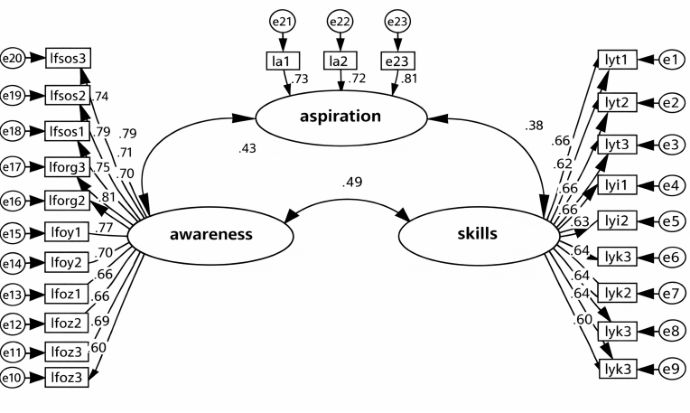
Figure 1: Confirmatory Factor Analysis (CFA) path diagram of the As-If leadership scale.
The scale’s construct validity was tested using Exploratory and Confirmatory Factor Analyses, confirming that the model fit the data perfectly (χ²/df = 1.196; RMSEA = .017; CFI = .995). It is important to emphasize that the ‘Dark Leadership’ dimension functions as a hierarchical threshold variable within the model. The model posits that the presence of high-level dark traits (at Q3-Q4 levels) acts as an overriding factor, ontologically nullifying other positive characteristics. Therefore, individuals exceeding this threshold were directly classified as ‘Dark Leaders’ and intentionally excluded from the Latent Profile Analysis to ensure the homogeneity of the phenomenological clusters. To determine the leadership typologies, which was the main objective of the study, Latent Profile Analysis (LPA) was applied to divide individuals into homogeneous subgroups based on their leadership skill, awareness, and desire scores. As a result of the analysis, a 4-class structure that provided the best separation according to statistical fit indices (AIC, BIC, and Entropy values) was accepted. As a result of this analysis, the following profiles were empirically identified: the “As-If Leader” with low skills and awareness but high desire, the “Aspiring Leader” and “Reluctant Leader” with moderate characteristics, and the “Ideal Leader” with high scores across all dimensions.
Table 2: Leadership profiles based on latent profile analysis results.
This study has conceptualized and empirically validated the phenomenon of ‘As-If’ Leadership, exhibited by individuals who occupy leadership positions but lack the competence and awareness required by the role. The developed scale and analyses demonstrated that leadership is not merely a matter of position or aspiration; rather, high aspiration unsupported by skill and awareness transforms leadership from a functional process into a mere act of managerial window-dressing.
The findings reveal that this profile diverges from malicious Dark Leadership through a mechanism of ‘unintentional incompetence’ and ‘passive destruction,’ thereby damaging organizational functioning while remaining clearly distinct from ideal leadership profiles.
Regarding future research, testing the universality of the model in contexts dominated by different cultural variables, such as power distance and individualism, will be critical for understanding the cultural roots of ‘acting as-if’ behaviour. Furthermore, examining the impact of this leadership typology on organizational outcomes—such as organizational silence, loss of trust, or employee burnout—will more clearly illuminate the institutional cost of leadership vulnerability.
REFERENCES
Abrahamson, E., & Baumard, P. (2008). What lies behind organizational façades and how organizational façades lie. R. Greenwood, C. Oliver, K. Sahlin ve R. Suddaby (Ed.), The SAGE handbook of organizational institutionalism içinde (s. 437–460). London: SAGE Publications. Alvesson, M., ve Spicer, A. (2012). Critical Leadership Studies: The Case For
Critical Performativity. Human Relations, 65(3), 367–390. https://doi. org/10.1177/0018726711430555 Aycan, Z., Özbilgin, M., Moralıgil, B., & Epitropaki, O. (2024). Reluctance to lead: Conceptualization and contextualization. European Management Journal, 42, 437–444. Burns, J. M. (1978). Leadership. New York, NY: Harper & Row. Carden, J., Jones, R. J., & Passmore, J. (2022). Defining self-awareness in the context
of adult development: A systematic literature review. Journal of Management Education, 46(1), 140–177. Chamorro-Premuzic, T. (2019). Why do so many incompetent men become leaders?
(And how to fix it). Boston, MA: Harvard Business Review Press. Day, D. V., Harrison, M. M., & Halpin, S. M. (2009). An integrative approach to leader development: Connecting adult development, identity, and expertise. New York, NY: Routledge. DeVellis, R. F. (2017). Scale development: Theory and applications (4. bs.). Thousand
Oaks, CA: SAGE Publications. DiMaggio, P.J. and Powell, W.W. (1983) The Iron Cage Revisited: Institutional Isomorphism and Collective Rationality in Organizational Fields. American Sociological Review, 48, 147–160. https://doi.org/10.2307/2095101 Einarsen, S., Aasland, M. S., & Skogstad, A. (2007). Destructive leadership behaviour:
A definition and conceptual model. The Leadership Quarterly, 18(3), 207–216. Goffman, E. (1959). The presentation of self in everyday life. New York, NY: Anchor Books. Goleman, D. (1998). Working with emotional intelligence. New York, NY: Bantam
Books. Goleman, D. (2021). Emotional intelligence: Why it can matter more than IQ. New York, NY: Bantam Books. Hannah, S., Avolio, B., ve Walumbwa, F. (2011). Relationships between Authentic
Leadership, Moral Courage, and Ethical and Pro-Social Behaviors. Business Ethics Quarterly,21,555–578. https://doi.org/10.5840/beq201121436 Hogan, R., & Kaiser, R. B. (2005). What we know about leadership. Review of General Psychology, 9(2), 169–180. https://doi.org/10.1037/1089-2680.9.2.169 Katz, R. L. (1955). Skills of an effective administrator. Harvard Business Review,
33(1), 33–42. Kellerman, B. (2004). Bad leadership: What it is, how it happens, why it matters.
Boston, MA: Harvard Business Review Press. Krasikova, D. V., Green, S. G., & LeBreton, J. M. (2013). Destructive leadership: A theoretical review, integration, and future research agenda. Journal of Management, 39(5), 1308–1338. Kruger, J., & Dunning, D. (1999). Unskilled and unaware of it: How difficulties in
recognizing one’s own incompetence lead to inflated self-assessments. Journal of Personality and Social Psychology, 77(6), 1121–1134. Lawshe, C. H. (1975). A quantitative approach to content validity. Personnel Psychology, 28(4), 563–575. Meyer, J. W., & Rowan, B. (1977). Institutionalized organizations: Formal structure
as myth and ceremony. American Journal of Sociology, 83(2), 340–363.
Mumford, M. D., Zaccaro, S. J., Harding, F. D., Jacobs, T. O., & Fleishman, E. A.
(2000). Leadership skills for a changing world: Solving complex social problems. The Leadership Quarterly, 11(1), 11–35. Paulhus, D. L., & Williams, K. M. (2002). The Dark Triad of personality: Narcissism, Machiavellianism, and psychopathy. Journal of Research in Personality, 36(6), 556–563. Pfeffer, J. (2015). Leadership BS: Fixing workplaces and careers one truth at a time.
New York, NY: Harper Business. Şen, E., & Pasin, A. (2025). Liderlik farkındalığı: Mış gibi liderlik modeli çerçevesinde kavramsal bir yaklaşım. Business, Economics and Management Research Journal, 8(3), 256-269. https://doi.org/10.58308/bemarej.1757479.
Appendix
Items of the As-If Leadership Scale Item Statement Item Code
TecSk1 My manager demonstrates mastery of technical terminology relevant to the job.
Leadership Skills TecSk2 My manager develops functional solutions to work-related technical problems.
TecSk3 My manager effectively utilizes technical knowledge in business processes.
PerSk1 My manager establishes a communication climate where different ideas can be freely expressed.
PerSk2 My manager uses open, respectful, and constructive language in communication with team members.
PerSk3 My manager attentively listens to the views and suggestions of team members.
ConSk1 My manager bases their decisions on logical and rational grounds.
ConSk2 My manager incorporates potential future problems into decision-making processes.
ConSk3 My manager evaluates the long-term organizational impact of their decisions.
SA1 My manager is aware of their own strengths and weaknesses.
Leadership Awareness SA2 My manager recognizes the influence of their emotions on their decisions.
SA3 My manager is aware of situations where they fall short or lack competence.
SA4 My manager expresses confidence in fulfilling leadership tasks.
SA5 My manager perceives themselves as competent in leadership roles.
OrgA1 My manager is aware of the boundaries of authority and responsibility within the organization.
OrgA2 My manager is aware of both written and unwritten organizational rules.
OrgA3 My manager is aware of which behaviours are accepted or disapproved of within the organization.
SocA1 My manager is aware of societal expectations regarding leaders.
SocA2 My manager is aware of how societal values shape leadership styles.
SocA3 My manager shapes their leadership style in accordance with societal value judgments.
ASP1 My manager possesses a strong desire to lead.
Leadership Aspiration ASP2 My manager is determined to assume and maintain leadership roles.
ASP3 It is highly important for my manager to hold leadership positions.
(Continued)
The “As-If” Leadership Model: A Conceptualization and Scale Development Study 23 Appendix: Continued.
Item Statement
Item Code Toc1 My manager can occasionally be hurtful/offensive towards employees.
Dark Leadership Toc2 My manager exhibits an intolerant approach towards team members’ errors.
Toc3 My manager adopts a harsh and abrasive communication style that demoralizes the team.
Mac1 My manager does not hesitate to manipulate people to achieve their goals.
Mac2 My manager may distort the truth for personal gain.
Mac3 My manager may discriminate among team members to consolidate power.
Nar1 My manager presents collective successes as solely their own contribution.
Nar2 My manager perceives criticism as a personal attack.
Nar3 My manager constantly expects praise and admiration.
LISTED IN THE AHFE DIGITAL BOOKSTORE CATALOGUE
Explore the complete digital volume
Human Factors, Business Management and Society
Read this individual research paper free through the original publisher, or explore the full digital proceedings book.
ISBN 978-1-964867-91-5
Explore this ISBN in the AHFE Bookstore ↗Listed in the July 2026 bookstore catalogue; search by ISBN to confirm current availability · Digital book purchase optional