Serpil Aytac, Hüsre Gizem Akalp, Nurettin Yamankaradeniz, Nuran Bayram Arlı (2026). Human-Centered Safety and Ergonomic Design for Women in High-Risk Industrial Occupations: A Systematic Review within Intelligent Systems Context. In: Intelligent Human Systems Integration (IHSI 2026): Disruptive and Innovative Technologies. AHFE Open Access, vol. 200, pp. 432–443. https://doi.org/10.54941/ahfe1007102
Women’s participation in high-risk sectors such as mining, construction, transportation, and healthcare continues to increase, yet industrial safety and ergonomics remain dominated by gender-neutral design assumptions. This systematic review synthesizes evidence on physical, psychosocial, and organizational challenges faced by women in hazardous environments through a human-cantered systems lens. Following PRISMA 2020 guidelines, 24 peer-reviewed studies (2010–2025) from Scopus, Web of Science, and PubMed were analyzed. The literature highlights exposure to musculoskeletal disorders (MSDs), PPE mismatch, postural load, and inequitable access to safety resources. Thematic analysis reveals that ergonomic inequalities intersect with exclusion from safety training and organizational barriers in risk management. Findings underscore the need for interdisciplinary approaches integrating ergonomics, intelligent systems, and gender studies to enable safer and more inclusive workplaces for women in high-risk occupations.
Women’s increasing participation in high-risk industrial occupations represents a major workforce shift. Although sectors such as mining, construction, transportation, and industrial manufacturing have begun incorporating women due to labor demands and equality policies, tools, workstations, and smart safety systems remain aligned with male anthropometry (Read et al., 2022). Gender-neutral OHS frameworks overlook disparities in risk exposure, musculoskeletal strain, and PPE compatibility (Laberge et al., 2020).
Women frequently perform repetitive and cognitively low-control tasks that increase ergonomic load, and encounter equipment incompatible with their physical capacities. These mismatches elevate MSD risk and fatigue, while psychosocial conditions—exclusion from safety communication, limited decision-making, stigmatization—further increase vulnerability Received October 28, 2025; Revised December 22, 2025; Accepted January 6, 2026; Available online February 1, 2026
Human-Centered Safety and Ergonomic Design for Women 433 (Kallur et al., 2021). Social pressures to conceal discomfort disrupt hazard reporting and delay corrective action.
Intelligent systems such as wearable sensors, cyber-physical monitoring, computer-vision posture analysis, adaptive PPE, and AI-based workload estimation have the potential to improve ergonomics. However, male- centered datasets risk reproducing gender biases. Within the Human–System Integration domain, understanding how gender influences worker–technology– organization interactions is essential. This study systematically reviews women-specific ergonomic and safety risks in high-risk occupations and discusses how human-centered smart systems can support inclusive design.
GENDER, ERGONOMICS, AND HUMAN–MACHINE SYSTEM INTERACTION IN HIGH-RISK INDUSTRIAL OCCUPATIONS Although women’s employment in hazardous sectors has increased, industrial systems still reflect male physiological norms (Laberge et al., 2020). Tools, machines, workstations, and PPE often fail to match women’s anthropometric profiles, contributing to postural deviation, MSDs, and reduced performance (Ishwarya et al., 2021). Poor PPE fit—oversized gloves, loose harnesses, improperly sealed respirators—impairs both safety and task performance (Read et al., 2022; Kallur et al., 2021). Women construction workers report dissatisfaction with PPE and mobility constraints, leading to increased tripping and falls (Onyebeke et al., 2016). In mining, inadequate respirator fit heightens exposure to dust and gases (Hall et al., 2024).
Psychosocial and organizational conditions compound these risks. Women often face job insecurity, exclusion from informal communication, and limited participation in safety decision-making (Laberge et al., 2020). Masculinity norms such as endurance discourage reporting of ergonomic discomfort (Read et al., 2022). Consequently, vulnerabilities remain invisible and safety systems lose adaptive capacity.
Despite being assigned “lighter” tasks, women experience equal or higher MSD risk due to repetitive motions, fine motor workloads, and monotony. Gendered exposure patterns persist: women face repetitive tasks, psychosocial pressure, and certain chemical exposures, while men encounter heavier loads and acute hazards (Biswas et al., 2021). Thus, gender cannot be treated as a demographic variable but as a driver of risk structure. Laberge et al. (2020) advocate integrating biological and social determinants, while Read et al. (2022) call for revising ergonomics methodologies to generate equitable outcomes. Underrepresentation of women in OSH research and lack of gender-disaggregated data limit evidence-based solutions.
Smart safety technologies—real-time posture monitoring, sensor-integrated PPE, digital twins, AI-based ergonomic assessment—offer potential but reproduce inequities when built on nonrepresentative datasets. Genuine human-centered integration requires gender-sensitive design principles across all stages of development and implementation.
METHOD
This study conducts a systematic review and qualitative synthesis of ergonomic and safety issues experienced by women in high-risk industrial
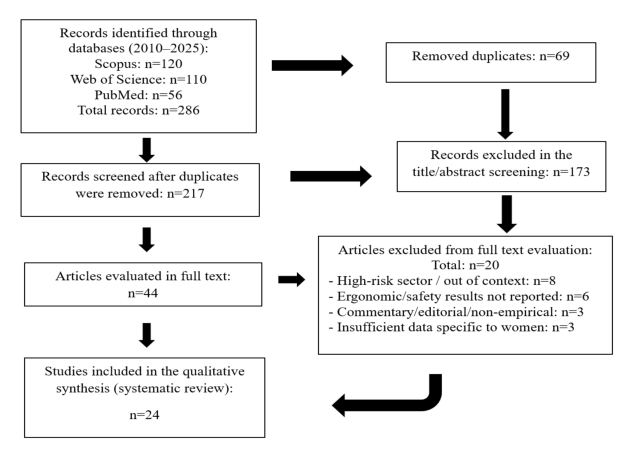
settings. Following PRISMA 2020 guidelines, peer-reviewed studies from Scopus, Web of Science, and PubMed (2010–2025) were retrieved using keywords related to women workers, high-risk sectors, occupational safety, MSDs, PPE, and risk perception. Of 286 records, studies lacking ergonomic or safety outcomes, empirical evidence, or women-specific data were excluded, resulting in 24 eligible publications. The process is summarized in Figure 1.
Figure 1: Flow chart of the study selection.
Thematic content analysis was applied to identify recurrent patterns. Three major themes emerged: (1) biomechanical and anthropometric mismatches, (2) psychosocial and organizational stressors, and (3) systemic inequities in safety management. These themes were interpreted through a human-centered systems framework emphasizing gender-sensitive ergonomic integration in OSH practices.
RESULTS
A total of 24 studies were included in this systematic review. These encompass primary empirical research on ergonomic and safety experiences of women in high-risk sectors, as well as systematic/narrative reviews, meta-analyses, and theoretical frameworks addressing gender and occupational health/ safety (OHS).
Sectors and contexts: Construction emerges as a key field due to PPE fit and musculoskeletal disorders. Onyebeke et al. (2016) and Oo and Lim (2023) examined PPE access and satisfaction among women construction workers, while Paramasivam et al. (2024), Reddy et al. (2016), and Ishwarya et al. (2021) reported high MSD prevalence and postural risks. In mining, studies by Eiter et al. (2023), Arthur and Busia (2022), Hall et al. (2024), Heimann et al. (2023), and Shaikh et al. (2022) describe respiratory hazards,
Human-Centered Safety and Ergonomic Design for Women 435 PPE shortages, and gendered job divisions. Agricultural settings show repetitive and physically demanding tasks, anthropometric mismatches, and limited rest periods (Mishra et al., 2024). In garment manufacturing, static postures and repetitive upper limb movements increase MSD symptoms among sewing machine operators (Öztürk & Esin, 2011). Healthcare and laboratory environments similarly exhibit risks related to prolonged standing and unsuitable workstation design (Fikre et al., 2024).
Cross-sectoral evidence: Broader analyses connect sector-specific findings to general gendered risk structures. Studies such as Matuszewska (2025), Unverzagt et al. (2024), Biswas et al. (2021, 2022), Lee (2025), Santoro (2022), Bolghanabadi et al. (2024), and Cattani and Rizza (2024) examine MSD, psychosocial stress, accident risk, and mental health across multiple sectors, offering both contextual depth and comparative insight.
Research designs: Methodological heterogeneity is notable. Field-based studies provide detailed indicators of day-to-day exposure through focus groups, surveys, ergonomic observational tools (REBA, RULA), medical assessments, or official datasets (Onyebeke et al., 2016; Oo & Lim, 2023; Paramasivam et al., 2024; Reddy et al., 2016; Ishwarya et al., 2021; Öztürk & Esin, 2011; Hall et al., 2024; Arthur & Busia, 2022; Cattani & Rizza, 2024; Migliore et al., 2021). Systematic and narrative reviews, including those by Eiter et al. (2023), Mishra et al. (2024), Unverzagt et al. (2024), Biswas et al. (2021, 2022), Shaikh et al. (2022), and Bolghanabadi et al. (2024), identify recurrent risk patterns, gaps, and methodological limitations.
Theoretical and methodological contributions: Theoretical works clarify how gender can be systematically integrated into ergonomics and OHS. Conti (2023) and Forssberg et al. (2022) develop gender-sensitive OHS approaches, while Santoro (2022) provides an intersectional view of physical, biological, ergonomic, and psychosocial risks. These studies inform concepts such as gender-responsive risk assessment, gender mainstreaming, and systemic vision, linking micro-level field findings with broader framework.
Geographical distribution and sample characteristics: Country context shapes women’s exposure in high-risk occupations. In high-income settings, women experience persistent PPE mismatch, MSD, and psychosocial stress despite advanced OHS systems (Onyebeke et al., 2016; Oo & Lim, 2023; Hall et al., 2024; Cattani & Rizza, 2024; Matuszewska, 2025; Unverzagt et al., 2024). Studies from middle- and low-income contexts show intensified risks from limited resources, weak ergonomics regulation, and precarious work (Paramasivam et al., 2024; Reddy et al., 2016; Ishwarya et al., 2021; Öztürk & Esin, 2011; Fikre et al., 2024; Arthur-Holmes & Busia, 2022). Sample sizes range from small qualitative groups (Onyebeke et al.) to large datasets (Cattani & Rizza), providing both depth and generalizability.
Time span and thematic focus: Studies span 2011–2025, with growth after 2020, and cluster around five domains: MSD and physical workload; PPE and anthropometric inequality; psychosocial stress and work–family conflict; gendered task allocation and organizational exclusion; and gender-blind OHS policies. These align with the review’s core themes of biomechanical/ anthropometric mismatch, psychosocial-organizational stressors, and systemic design inequities.
Continued
PPE is designed according to male
anthropometry; women’s views are not taken
into account, resulting in feelings of exclusion
and avoidance of PPE use
Women are a minority in a male-dominated
work environment; women-specific OSH
research and data collection are inadequate.
“Unisex” PPE is actually made to measure for
men; women’s needs are not adequately reflected
in the design and supply processes.
Gender-specific machine learning framework
(GS-ML-MSD2F) is recommended; women have
a significantly higher risk of MSDs
Work-family conflict, mobbing, and emotional
burden are emphasized among women; the need
for gender-sensitive OHS is highlighted.
Many studies underreport gender disparities;
gender-blind approach in OSH research is being
criticized
The physical workload and ergonomic
challenges of women workers are emphasized;
although gender differences are not fully
analysed, women are considered a vulnerable
group.
Outputs Gender Dimension / Notes
PPE/PPE incompatibility; oversize
and inappropriate design of
gloves, harnesses, boots and
outerwear; perception of safety
culture
Women’s ergonomic, physical
and social risk exposure in
mining; gaps in OSH practices
PPE satisfaction (low satisfaction
in functional, aesthetic,
ergonomic dimensions)
MSD prevalence (60% in
women); increased risk with
shoulder and back pain, improper
posture and long working hours
Differences in physical,
biological, ergonomic and
psychosocial risks; higher MSD
and psychosocial risks in women
Differential exposure patterns
to chemical, ergonomic, and
psychosocial hazards by gender
Prevalence of musculoskeletal
health problems; MSD associated
with heavy physical work and
improper ergonomics
Source Main Ergonomic / OHS
23 female construction
workers
Secondary analysis
of studies on women
miners
Women workers in the
Australian construction
industry
250 female + 250 male
rebar workers
Literature on female
and male employees
Occupational exposure
studies for the period
2009–2019
Construction workers
(men and women)
Design Sample / Data
(focus group
interviews)
Narrative
compilation
survey study
Quantitative
comparative
study
Narrative
compilation
Scoping review
/ systematic
screening
quantitative
study
Mining
(general)
(rebar
workers)
Multiple
sectors
(overall
employment)
sectors
Context Sectors Research
USA construction Qualitative study
/ literature
India Construction
Europe
Table 1: Summary of included studies.
Table available in the original PDF paper.
No Author(s- – Year Country
1 Onyebeke et al.,
2 Eiter et al., 2023 Various countries
3 Oo & Lim, 2023 Australia Construction Quantitative
4 Paramasivam et al.,
5 Santoro et al., 2022 Mainly Italy /
6 Biswas et al., 2021 Various countries Multiple
7 Reddy et al., 2016 India construction Cross-sectional
17 Hall et al., 2024 USA Coal mining Observational/
18 Heimann ve ark.,
19 Ishwarya et al.,
Differences in physical capacity, anthropometric
discrepancy, and psychosocial stress combine to
create higher risk in female miners.
Shift workload, work intensity and task rotation
often lead to women working in repetitive and
low-control jobs, increasing their risk of neck,
shoulder and back pain.
Inappropriate use of equipment and protective
clothing increases risk of injury in women;
gender differences highlighted
Call for gender mainstreaming and gender-
responsive risk assessment; emphasis is placed
on the need to consider gender as a structural
category
Workstations are not suitable for women’s
anthropometry; lack of ergonomic arrangement
increases biomechanical loading in women
Outputs Gender Dimension / Notes
Repetitive motion, heavy lifting,
vibration, long shifts are key
factors in the development of
MSD.
Gender differences in exposure
to psychosocial and ergonomic
factors and work-related health
issues in the workplace
Women experience more
psychosocial stress and MSD;
men experience more physical
trauma
Integrating gender into systematic
OSH research (why and how)
Widespread pain in the neck,
shoulder, back, and waist regions;
static sitting, repetitive upper
extremity movements, continuous
pedal use
Source Main Ergonomic / OHS
factors in mining
9,749 women and
10,374 men working
in different work
organization models
Secondary analysis
of work accident and
occupational injury
studies
OSH literature and
research practices
Female sewing machine
operators
Design Sample / Data
Quantitative
study
Systematic
review
Conceptual/
methodological
article
Cross-sectional
survey +
observational
ergonomic
analysis
Various
business
organizations
sectors
research
sewing
machine
operators
Context Sectors Research
/ Europe in
particular
Various countries General OHS
Türkiye Garment/
Table 1: Continued.
Table available in the original PDF paper.
No Author(s- – Year Country
20 Shaikh et al., 2022 Various countries Mining Compilation Studies on MSD risk
21 Migliore et al. 2021 Various countries
22 Biswas, at al. 2022 Various countries Multiple
23 Forssberg at al.
24 Öztürk & Esin,
Theme 1: Biomechanical and Anthropometric Mismatches Work systems designed around male bodies create ergonomic disadvantage for women. PPE fit is the clearest case: women face oversized gloves, boots, and harnesses that impair mobility and increase risk (Onyebeke et al., 2016; Oo & Lim, 2023). In mining, limited PPE access and inappropriate sizing drive fatigue and non-use (Arthur & Busia, 2022; Hall et al., 2024). Agriculture and garment production show similar effects through tool and workstation mismatch (Mishra et al., 2024; Öztürk & Esin, 2011).
MSD prevalence is strongly linked to postural strain and repetitive tasks. High-risk groups are reported in construction, rebar work, laboratories, and manufacturing (Paramasivam et al., 2024; Reddy et al., 2016; Ishwarya et al., 2021; Fikre et al., 2024; Öztürk & Esin, 2011). Long-term data show elevated rates of chronic conditions such as hip osteoarthritis (Unverzagt et al., 2024) and dual exposure profiles (Matuszewska, 2025). Organizational factors—shift burden, task rotation, and gender bias—amplify biomechanical risk (Shaikh et al., 2022; Migliore et al., 2021).
Theme 2: Psychosocial and Organizational Stressors Ergonomic inequalities are reinforced by work organization and culture. Women are concentrated in low-status or supportive roles, excluded from technical positions and safety decision-making (Eiter et al., 2023; Heimann et al., 2023; Arthur-Holmes & Busia, 2022). This translates into unequal access to safety information, PPE, and training.
Psychosocial burdens—role conflict, burnout, emotional stress—are consistently higher among women (Cattani & Rizza, 2024; Santoro, 2022). Low control, repetitive tasks, and poor social support correlate with pain, fatigue, sleep problems, and turnover intentions (Bolghanabadi et al., 2024; Hall et al., 2024). The “double burden” of paid and domestic work intensifies risks in labor-intensive roles (Migliore et al., 2021; Santoro, 2022; Biswas et al., 2022; Shaikh et al., 2022).
Theme 3: Systemic Design Inequalities and Risk Governance Women’s ergonomic and safety challenges in high-risk occupations are shaped not only by equipment and workstation design, but by systemic risk governance that reproduces male norms; “gender-neutral” OHS practices obscure women’s exposures, as shown by Biswas et al. (2021), who identify significant gender differences in chemical, ergonomic, and psychosocial risks that are often unreported, and by Lee (2025), who notes that women are concentrated in repetitive and static tasks while men are assigned heavy or chemical-intensive roles, yet design standards are derived from male samples; psychosocial burdens such as work–family conflict and chronic stress identified by Santoro (2022) and Bolghanabadi et al. (2024) remain largely absent from institutional risk assessments; recent frameworks call for structural integration of gender, with Forssberg et al. (2022) advocating gender mainstreaming and gender-responsive risk assessment and Conti (2023) showing how OHS historically assumes the male worker as “default,”
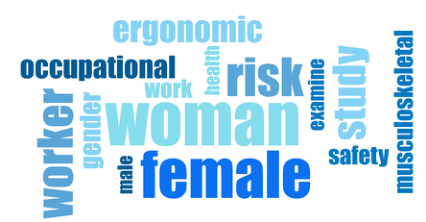
Human-Centered Safety and Ergonomic Design for Women 441 framing women’s ergonomic problems as deviations; systemic exclusion reinforces risks, as women are marginalized from technical roles and decision- making in mining (Eiter et al., 2023; Heimann et al., 2023) and face limited PPE access and training (Arthur-Holmes & Busia, 2022), while gender-biased safety cultures and work–life imbalance increase MSD prevalence (Shaikh et al., 2022); although human-centered smart systems such as wearable sensors and AI-supported ergonomics could make women’s workload profiles visible, the absence of gender-disaggregated data risks reproducing gender-blind patterns (Biswas et al., 2021; Lee, 2025; Forssberg et al., 2022; Conti, 2023), and the prominence of concepts like “woman, worker, risk, musculoskeletal, ergonomic” in Figure 2 confirms that inequalities in women’s workplace safety and ergonomics constitute a recurrent and central theme in the literature.
Figure 2: Word cloud representing the most used words.
CONCLUSION
Women’s ergonomic and safety disadvantages in high-risk occupations arise from systemic design and gender-blind work organization rather than individual deficits, as repetitive motion, static posture, and PPE mismatch intersect with psychosocial exclusion and labor segmentation (Biswas et al., 2021; Santoro, 2022; Bolghanabadi et al., 2024). The historical reliance on the “male norm” in OHS standards constrains evidence production and policy development, underscoring the need for gender-sensitive risk assessment as a core design principle rather than an ethical add-on (Forssberg et al., 2022; Russo et al., 2025). Although smart systems, wearable sensors, and adaptive PPE can reveal gendered exposure profiles, technologies built on gender-blind datasets risk reproducing existing inequalities (Biswas et al., 2021). Sustainable safety performance therefore requires structural reforms that institutionalize gender-sensitive data practices, ergonomic design, and inclusive governance mechanisms.
REFERENCES
Arthur-Holmes, F., & Busia, K. A. (2022). Safety concerns and occupational health hazards of women in artisanal and small-scale mining in Ghana. The Extractive Industries and Society, 10, 101079. https://doi.org/10.1016/j.exis.2022.101079
Biswas, A., Harbin, S., Irvin, E., Johnston, H., Begum, M., Tiong, M., Apedaile, D., Koehoorn, M., & Smith, P. M. (2021). Sex and gender differences in occupational hazard exposures: A scoping review of the recent literature. Current Environmental Health Reports, 8(4), 267–280. https://doi.org/10.1007/s40572-021-00330-8 Biswas A, Harbin S, Irvin E, et al. (2022). Differences between men and women
in their risk of work injury and disability: A systematic review. American J Ind Medicine. 65(7). https://doi.org/10.1002/ajim.23364 Bolghanabadi, S., Haghighi, A., & Jahangiri, M. (2024). Insights into women’s occupational health and safety: A decade in review of primary-data studies. Safety, 10(2), 47. https://doi.org/10.3390/safety10020047 Cattani, L., Rizza R,. (2024). Occupational Gender Segregation and Mental Health
among Professionals: Women’s Risk Exposure in Five Micro Classes, Social Sciences, 13(2), 92. https://doi.org/10.3390/socsci13020092 Conti, P. (2023). Gender in occupational safety and health: The systemic vision of social sciences. Italian Journal of Gender-Specific Medicine, 9(1), 45–54. https:// doi.org/10.32074/2612-8411.IJ-GSM-2023-01 Eiter, B. M., Dugdale, Z. J., Robinson, T., Nixon, C. T., Lawson, H., Halldin, C. N., &
Stazick, C. (2023). Occupational safety and health of women in mining. Journal of Women’s Health, 32(4), 388-395. https://doi.org/10.1089/jwh.2023.0034 Fikre, D., Hawulte Ayele, B., Sime, A., Tebeje, F., & Weldegebreal, F. (2024). Prevalence of work-related musculoskeletal disorders and ergonomic risk practice among medical laboratory professionals at health facilities of eastern Ethiopia. Frontiers in Public Health, 12, 1443217. https://doi.org/10.3389/fpubh.2024.1443217 Forssberg, K. S., Vänje, A., & Parding, K. (2022). Bringing in gender perspectives
on systematic occupational safety and health management. Safety science, 152, 105776. https://doi.org/10.1016/j.ssci.2022.10 Hall Noemi B., Nirmala T. Myers, Laura E. Reynolds, David J. Blackley, and A. Scott Laney (2024) Women in Coal Mining—Radiographic Findings of Women Participants in the Coal Workers’ Health Surveillance Program 1970– 2022, Journal of Women’s Health, 33:9, 1219–1223. https://doi.org/10.1089/ jwh.2024.0140 Heimann, S. Johansson K., Franklin W.T. (2023). Gender in industrial mine work and
organizations: A review. of an expanding research field, The Extractive Industries and Society, 16. https://doi.org/10.1016/j.exis.2023.101371 Ishwarya, G. K. A., Rajkumar, D. (2021). Analysis of ergonomic risk factors in the construction industry. Materials Today: Proceedings, 37(2), 2415–2418. https:// doi.org/10.1016/j.matpr.2020.08.269 Kallur, S., Hasalkar, S., Mahalakshmi, C. & Kumari, S. (2021). Ergonomic Stress
and Musculoskeletal Disorders Among Women in Rural Building Construction Industry. S. Di Bucchianico & B. Silva (ed.), Convergence of Ergonomics and Design Proceedings of Aced Seanes 2020, pp.299-318 https://doi. org/10.1007/978-3-030-63335-6_31 Laberge, M., Caroly, S., Riel, J., & Messing, K. (2020). Considering Sex and Gender in Ergonomics: Exploring the Hows and Whys. Applied Ergonomics. 85: 103039.; https://doi.org/10.1016/j.apergo.2019.103039, Epub 2020 9 Ocak. PMID: 31929027. Lee G, Messing K, Lee W, et al. (2025). Gender differences in occupational hazard
exposures within the same occupation: A nationally representative analysis in South Korea, Scandinavian Journal of Work, Environment & Health. 51(2):111– 118 https://doi.org/10.5271/sjweh.4204 Matuszewska, M., Rypicz, Ł., Witczak, I., & Kołcz, A. (2025). The Occupational Dimension of Musculoskeletal Disorders: A Comparison of Healthcare Workers and Administrative Staff Using the NMQ-E Tool. Journal of Clinical Medicine, 14(17), 6187. https://doi.org/10.3390/jcm14176187
Human-Centered Safety and Ergonomic Design for Women 443 Migliore MC, Ricceri F, Lazzarato F, d’Errico A. (2021) Impact of different work
organizational models on gender differences in exposure to psychosocial and ergonomic hazards at work and in mental and physical health. Int Arch Occup Environ Health. 94(8):1889-1904. https://doi.org/10.1007/s00420-021-01720-z Mishra, S., Bhagat, D., & Borah, S. (2024). Ergonomic studies on occupational health of women workers involved in agricultural industries: A systematic review. Research on World Agricultural Economy, 5(4), 110–127. https://doi. org/10.36956/rwae.v5i4.1207 Onyebeke, L. C., Papazaharias, D. M., Freund, A., Dropkin, J., McCann, M.,
Sanchez, S. H., Hashim, D., Meyer, J. D., Lucchini, R. G., & Zuckerman, N. C. (2016). Access to properly fitting personal protective equipment for female construction workers. American Journal of Industrial Medicine, 59(11), 1032– 1040. https://doi.org/10.1002/ajim.22624 Oo, B. L., & Lim, B. T. H. (2023). Women workforce’s satisfaction with personal protective equipment: A case of the Australian construction industry. Buildings, 13(4), 959. https://doi.org/10.3390/buildings13040959 Öztürk, N., & Esin, M. N. (2011). Investigation of musculoskeletal symptoms
and ergonomic risk factors among female sewing machine operators in Turkey. International Journal of Industrial Ergonomics, 41(6), 585–591 (scopus) https:// doi.org/10.1016/j.ergon.2011.07.001 Paramasivam, S. K., Mani, K., & Paneerselvam, B. (2024). Unveiling gender-based musculoskeletal disorders in the construction industry: A comprehensive analysis. Buildings, 14(4), 1169. https://doi.org/10.3390/buildings14041169 Read, G. J. M., Madeira-Revell, K. M. A., Parnell, K. J., Lockton,
D., & Salmon, P. M. (2022). Using human factors and ergonomics methods to challenge the status quo: Designing for gender equitable research outcomes, Applied Ergonomics, 99, 103634. https://doi.org/10.1016/j.apergo.2021.103634 Reddy, G. M. M., Yasobant, S., Kumar, S., & Joshi, A. (2016). Musculoskeletal morbidity among construction workers: A cross-sectional study in India. Indian Journal of Occupational and Environmental Medicine, 20(3), 144–148. https:// doi.org/10.4103/0019-5278.203134 Russo, A. C., Russo, R. A. L., Stellin, M. R. M., & de Eston, S. M. (2025). Gendered
dimensions of mental health in High-Risk occupations: A systematic review of the mining and extractive sectors. The Extractive Industries and Society, 24, 101710. https://doi.org/10.1016/j.exis.2025.101710 Santoro, P. E., Borrelli, I., Gualano, M. R., Amantea, C., Tumminello, A., Daniele, A., ... & Moscato, U. (2022). Occupational hazards and gender differences: a narrative review. Journal of Sex-and Gender-Specific Medicine, 8(3), 154-162. https://doi. org/10.1723/3927.39110 Shaikh, A. M., Strawderman L, Jose B., Burch R, Warren S., Taylor C, Ball J,
Freeman C., Chander H., (2022). Causative and risk factors of musculoskeletal disorders in the mining sector: An overview. International Journal of Industrial Ergonomics, 92, 103381. https://doi.org/10.1016/j.ergon.2022.103381 Unverzagt, S., Bergmann, A., Denny, K., Frese, T., Hirpa, S., & Weyer, J. (2024).
Physically demanding occupations among females and sex-related differences to develop osteoarthritis of the hip: A systematic review and meta-analysis. Journal of Occupational Medicine and Toxicology, 19, 14. https://doi.org/10.1186/ s12995-024-00415-8
LISTED IN THE AHFE DIGITAL BOOKSTORE CATALOGUE
Explore the complete digital volume
Intelligent Human Systems Integration (IHSI 2026): Disruptive and Innovative Technologies
Read this individual research paper free through the original publisher, or explore the full digital proceedings book.
ISBN 978-1-964867-76-2
Explore this ISBN in the AHFE Bookstore ↗Listed in the July 2026 bookstore catalogue; search by ISBN to confirm current availability · Digital book purchase optional