Serpil Aytac, Hüsre Gizem Akalp, Özlem Kaya, Gulsen Çetin Aydın (2026). Holistic Assessment of Ergonomic and Psychosocial Risks in Remote and Hybrid Working Models. In: Social and Occupational Ergonomics. AHFE Open Access, vol. 228, pp. 49–58. https://doi.org/10.54941/ahfe1007935
This study analyzes the psychosocial and ergonomic impacts of remote and hybrid work models, which have gained prevalence due to the rapid digitalization following the pandemic, within a multidimensional framework. The research specifically investigates the interrelations among cognitive workload, ergonomic risk level, job satisfaction, and burnout within the cohort of white-collar workers. The study's sample comprises 50 employees from an international Information Technology (IT) firm located in Istanbul. Twenty-five of the participants work from home all the time, and 25 work in a hybrid model. The data collection process used the NASA Task Load Index (NASA-TLX), the Rapid Office Stress Assessment (ROSA), the Job Satisfaction Scale, and the Maslach Burnout Inventory. The results show that the average cognitive workload is high, at 60.5 out of 100. Researchers found that remote workers had higher mental demands, while hybrid workers had higher physical demands. The ROSA test found that 42% of the people who took it were in the high ergonomic risk group. Long periods of sitting, not enough lumbar support, and the wrong height for the monitor were the most common ergonomic issues. In general, people are moderately happy with their jobs (M = 3.42/5). It was found that hybrid workers were much happier with their jobs than remote workers. But the levels of burnout can be anywhere from moderate to high. It was found that people who work from home are more emotionally drained, while people who work in both settings feel more accomplished. Thirty-four percent of the people who took part were found to be at high risk of burnout. The findings indicate that cognitive workload and ergonomic hazards in digital workplaces significantly influence job satisfaction and burnout. The remote work model can make people more mentally and emotionally tired because they are alone and their work and personal lives are not clearly defined. On the other hand, the hybrid model can make people happier at work and feel more accomplished because they can interact with others and get help from their organization. The Ergonomics 4.0 approach to digital work design needs to include all three types of elements: cognitive, physical, and psychosocial. The results are also in line with the WHO (2021) and ILO (2020) guidelines, which stress how important it is to include psychosocial risk management in systems for occupational health and safety.
The COVID-19 pandemic sped up the process of digitalization around the world and made remote and hybrid work models more common. This has caused big changes in the way work is structured and organized. These new ways of working have changed not only where people work, but also how much work they think they have to do, how comfortable they are at work, how satisfied they are with their jobs, and how likely they are to burn out. The removal of restrictions in physical office settings has introduced flexibility, yet it has also introduced various risk factors, including heightened cognitive demands, psychological fatigue, and inappropriate work arrangements.
Digital transformation has made work processes faster and easier to get to, which has greatly increased productivity. However, it has also changed the way that employees feel mentally and physically burdened. The growing number of tasks that require screens has made new psychosocial risk areas more important. These include the expectation of always being online, attention deficits, less social interaction, and digital stress. These things have a big effect on how happy, motivated, and healthy employees are overall.
Many studies in the literature emphasize the impact of perceived workload (Hart and Staveland, 1988), ergonomic risks (McAtamney and Corlett, 1993), job satisfaction (Brayfield and Rothe, 1951; Judge et al., 1998), and burnout (Maslach and Jackson, 1981) on employees’ physical and psychological health. Nevertheless, empirical studies that comprehensively examine these variables within the framework of digital work, especially in the Turkish context, seem to be scarce.
This study seeks to investigate the interrelations among perceived cognitive workload, ergonomic risk factors, job satisfaction, and burnout in digital work environments from a comprehensive standpoint. This research conducts a comparative analysis of the cognitive workload perceptions, ergonomic risk levels, job satisfaction, and burnout levels of individuals engaged in remote and hybrid work models within the same institution. The study examines both physical and psychosocial dimensions within a unified analytical framework, aiming to enhance the development of digital ergonomics applications and formulate policy recommendations for human- centered digital work design.
METHOD
Research Design This study was structured as a cross-sectional and descriptive investigation to elucidate the impacts of remote and hybrid working arrangements on employees’ cognitive workload, ergonomic risk exposure, job satisfaction, and perceived burnout. The study used a quantitative research method, which included both self-report scales and ergonomic assessments based on observation. By using both survey data and field observations, the researchers were able to get a better picture of the physical and mental health risks that come with working in digital environments.
Holistic Assessment of Ergonomic and Psychosocial Risks in Remote 51 Participants
The study included a group of 50 white-collar workers who worked for an international IT company in Istanbul. There are 197 people who work for the company, and most of them work in a hybrid work model.
To make sure the sample was balanced, the study included a total of 50 people: 25 remote workers and 25 hybrid model workers.
Table 1. Characteristics of the participants.
Table available in the original PDF paper.
Model of Work n Average Age Sex (M/F) Hours of Screen Time Each Day Far away 25 34.2 11 / 14 8.6
Hybrid 25 35.1 10 / 15 7.9 Note. F stands for female and M stands for male.
In this study, purposive sampling method is used, which is a non-probability method that lets researchers choose participants who best represent the subject being studied. In organizational research and field studies in the field of ergonomics, this method is often the best choice. Everyone who took part in the study did so willingly, and everyone who did so gave their informed consent before data collection began.
Data Collection Procedure The company’s Human Resources department assisted in planning and executing the data collection process. Survey forms were sent to all participants who would be using the measurement tools via an online system. This ensured that everyone answered the survey in the same way and that remote workers could participate in the work under the same conditions as others. In addition to the survey applications, participants’ workspaces were video-recorded for observational ergonomic assessments. This method was chosen to support the data with more objective ergonomic findings and to make the assessment more robust.
Measures Perceived Cognitive Workload: Perceived cognitive workload was assessed utilizing the NASA Task Load Index (NASA-TLX) formulated by Hart and Staveland (1988). Researchers in ergonomics and human factors often choose the NASA-TLX as a multi-dimensional measurement tool because it has been shown to be valid and reliable. The main goal is to find out how much work people think they have to do when they do a task based on their own evaluations. There are six parts to the scale: mental demand, physical demand, temporal demand, performance perception, effort expended, and frustration level. Each dimension gets a score between 0 and 100. A higher score means that the workload in that dimension is higher. To get the total workload score, you add up the scores from the sub-dimensions and divide by the number of sub-dimensions. The NASA-TLX was used to measure how much work the participants thought they had to do right after they finished their digital tasks in this study.
Ergonomic Risk Assessment: The Rapid Office Stress Assessment Tool (ROSA), created by McAtamney and Corlett in 1993, was used to look at ergonomic risk levels in the workplace. ROSA is an observation-based assessment method that looks for posture problems and risks that come with using equipment, especially in an office setting where computers are used. It looks at things like the chair’s features, the monitor’s position, how the keyboard and mouse are used, and how the person is sitting to find possible ergonomic risks. The total scores from the method are put into three groups based on risk level: low risk (scores of 1 to 3), medium risk (scores of 4 to 5), and high risk (scores of 6 and above). This study used ROSA assessments by looking at participants’ self-reports and video recordings of their work environments.
Job Satisfaction: A five-item, five-point Likert-type job satisfaction scale was used to measure job satisfaction. The scale was created by Brayfield and Rothe in 1951 and later revised and shortened by Judge, Locke, Durham, and Kluger in 1998. Keser and Öngen Bilir (2016) adapted the scale into Turkish and checked its validity and reliability. Higher scores on the scale indicate higher job satisfaction.
Burnout: The Maslach Burnout Inventory (MBI), which was created by Maslach and Jackson in 1981 and translated into Turkish by Ergin in 1992, was used to measure how burned out the participants were. There are three subscales in the inventory: emotional exhaustion, depersonalization, and personal accomplishment. The person is more likely to be burned out if they score high on the emotional exhaustion and depersonalization subscales. On the other hand, low scores on the personal accomplishment subscale mean that people think they are more burned out.
Research Questions and Data Analysis This study aimed to address the following questions:
1. Does the perceived cognitive workload influence employees’ job satisfaction and burnout rates? 2. What are the most common ergonomic risks for people who work from home or in a hybrid setting? 3. Is the rise in perceived cognitive workload linked to the rise in ergonomic risk levels? 4. Are there substantial disparities between remote and hybrid workers regarding cognitive workload, ergonomic hazards, job satisfaction, and burnout factors?
We used the Statistical Package for the Social Sciences (SPSS) 26.0 program to look at the data we collected for the study. Initially, descriptive statistics were computed to ascertain frequency and percentage distributions. After that, an independent samples t-test was used to find possible differences between groups of remote and hybrid workers. All analyses used a significance level of p < 0.05.
RESULTS
Cognitive Workload (NASA-TLX) Outcomes The analysis of the NASA Taskload Index (NASA-TLX) results indicated that participants predominantly reported a significant level of perceived cognitive workload (Mean = 60.50, Standard Deviation = 9.80). Among the sub-dimensions, mental demand (Mean = 72.40), effort (Mean = 74.50), and temporal demand (Mean = 66.20) all had very high mean scores. On the other hand, the mean score for physical demand was only 28.70, which is pretty low. This fits with the fact that most digital work tasks are done on screens and while sitting down.
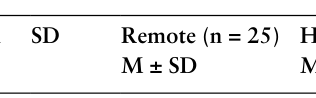
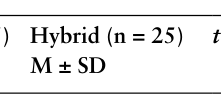
Table 2: NASA-TLX descriptive statistics and comparisons between groups (independent samples t test, N = 50).
Table available in the original PDF paper.
t p
Dimension Overall Mean
Equation reproduced from the original PDF.Equation reproduced from the original PDF.
Total Point 60.50 9.80 61.10 ± 9.20 59.80 ± 10.40 1.00 .320 *p < .05.
The independent sample t-test showed that remote workers had much higher mental demand than hybrid workers (t = 2.11, p < 0.05). On the other hand, hybrid workers had a lot more physical demand (t = −2.43, p < 0.05). There were no statistically significant differences between the two groups in terms of temporal demand, performance, effort, frustration, or total workload scores (p > 0.05).
These results indicate that the perpetual accessibility and cognitively demanding digital tasks inherent in remote work elevate the mental workload. Conversely, in a hybrid work model, physical movement, commuting, and engagement with a tangible office environment may lead to increased physical demands. In both work models, the cognitive workload was high overall, but the type of workload changed depending on the work arrangement.
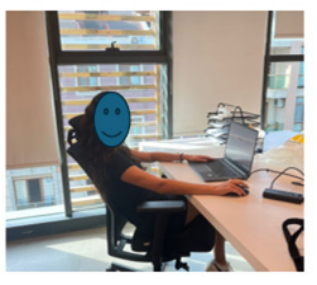
Results of the Ergonomic Risk Assessment The Rapid Office Strain Assessment (ROSA) method was used as a standardized observational tool to systematically evaluate workstation components, such as employees’ sitting posture, lumbar support, monitor position, and overall desk layout. This was done to support and validate ergonomic risk classification. Along with numerical scores, participants’
representative workstation images show common ergonomic setups anxd risk factors that were found through analysis. These sample images were shared without names to make the assessment process more open and to show visually common ergonomic problems that lead to high ROSA scores.
Figure 1. Standard workstation photographic perspectives employed in ROSA evaluation.
According to ROSA analyses, 84% of the people who took part were put in the moderate or high ergonomic risk groups. The most common ergonomic issues were sitting for too long (72%), not having enough lumbar support (60%), and having the monitor at the wrong height or angle (54%). Remote workers were more likely to have high ergonomic risk levels (52%), probably because their home offices weren’t set up well for work.
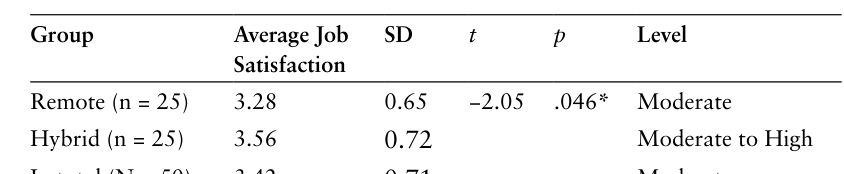
Job Satisfaction Results Job satisfaction findings demonstrated a moderate overall level of job satisfaction (M = 3.42 out of 5). Hybrid employees reported significantly higher job satisfaction compared to remote employees (p < .05). Overall, participants indicated that they were neither completely satisfied nor completely dissatisfied with their jobs.
An independent samples t-test was performed to compare job satisfaction scores between remote and hybrid employees. The results showed that the two groups were different in a statistically significant way (t = −2.05, p < .05). Employees who worked in both the office and remotely were happier with their jobs (M = 3.56, SD = 0.72) than those who worked only remotely (M = 3.28, SD = 0.65). The average level of job satisfaction for everyone in the sample was moderate (M = 3.42, SD = 0.71).
Table 3: Comparing Job satisfaction scores of remote and hybrid employees (independent samples t test).
Table available in the original PDF paper.
SD t p Level
Equation reproduced from the original PDF.
*p < .05.
Holistic Assessment of Ergonomic and Psychosocial Risks in Remote 55 Results of Burnout
The burnout analysis showed that about 34% of the people who took part were at a high risk of burnout. Remote employees experienced greater emotional exhaustion, whereas hybrid employees demonstrated a markedly elevated sense of personal achievement.
Table 4: Comparing burnout scores between remote and hybrid workers (Independent samples t test).
Table available in the original PDF paper.
t p Interpretation
Equation reproduced from the original PDF.Equation reproduced from the original PDF.
Emotional Exhaustion
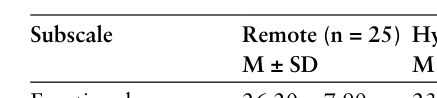
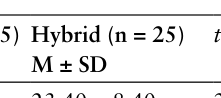
26.20 ± 7.90 23.40 ± 8.40 2.01 0.049* Remote workers were much more emotionally drained.
Depersonalization 10.30 ± 4.20 8.90 ± 3.90 1.32 0.095 Not a big difference; the trend shows that remote workers are more likely to feel depersonalized.
Personal Accomplishment
26.10 ± 6.70 28.70 ± 6.20 −2.11 0.041* Hybrid employees said they felt much more accomplished in their personal lives.
*p < .05.
Overall Comparison Evaluation A comparative analysis was conducted on 50 white-collar employees working from home or using a hybrid work model within the same company, using four measurement tools (NASA-TLX, ROSA, Job Satisfaction Scale, and Maslach Burnout Inventory). Table 5 shows a summary of the results.
Table 5: A summary of the comparison of different measurement tools.
Table available in the original PDF paper.
Hybrid Employees
Measure Overall Results People Who Work From Home NASA-TLX High mental workload and time pressure Higher mental workload Higher physical demand
ROSA 42% high ergonomic risk; many ergonomic problems
More often, ergonomic issues at home and at work
Office ergonomics more protective
Job Satisfaction
Moderate level (3.42/5); 44% very satisfied Lower job satisfaction Higher job satisfaction MBI– Burnout Moderate to high burnout; 34% at risk Higher burnout; lower personal accomplishment Higher personal accomplishment
DISCUSSION AND CONCLUSION A comprehensive analysis of ROSA and NASA-TLX results indicates a significant interplay between ergonomic and cognitive risk factors in digital work settings. High ROSA scores show that workstations don’t fit well, which puts more strain on the musculoskeletal system. High NASA-TLX scores for mental demand and effort show that cognitive fatigue and psychological stress are higher. These findings indicate that ergonomic risks in digital work settings go beyond just physical discomfort; they also affect mental health and social factors, which hurts employees’ overall health.
The results show that the cognitive workload is very high (Mean = 60.50). Remote workers said they had to think about a lot more things, while hybrid workers said they had to do a lot more physical work (p < 0.05). ROSA results showed that 42% of the people who took part were at high ergonomic risk, and remote workers were more likely to have ergonomic problems. The average job satisfaction was 3.42, which is moderate. Hybrid workers were much happier with their jobs than remote workers (p < 0.05). People who worked from home were more likely to feel emotionally drained, while people who worked in both settings said they felt more accomplished. In particular, 34% of the people who took part were found to be at a high risk of burnout.
These findings indicate that perpetual digital accessibility, cognitively taxing responsibilities, and suboptimal home office ergonomics exacerbate mental workload and emotional fatigue in remote work settings. On the other hand, hybrid work is a better option because it combines flexibility with support from the organization. This makes people happier with their jobs and feel like they have accomplished something, even though it requires a little more physical effort.
This study shows that remote and hybrid work models have different effects on the ergonomic and psychosocial risks that employees face. There was a link between higher cognitive workload and higher levels of burnout and lower job satisfaction (p < .01). There was also a link between higher ergonomic risk and higher cognitive workload. These results show that we need integrated risk management strategies that take into account both the ergonomic and psychosocial aspects of digital work.
The results show that workers in digital work environments face not only physical and mental demands but also big psychosocial risks when it comes to health and safety at work. This result is in line with international guidelines that say that occupational health should be looked at in both physical and mental health terms. So, to encourage sustainable digital work systems, businesses should have ergonomic interventions, strategies for balancing workloads, and ways to help employees with their mental health.
In short, the hybrid work model seems to be better for job satisfaction and preventing burnout than fully remote work. However, both models still have big problems with workload and ergonomic risks. So, to improve employee well-being and organizational performance, it is important to design digital work with people in mind, plan workloads that are balanced, and use integrated occupational health and safety strategies.
Holistic Assessment of Ergonomic and Psychosocial Risks in Remote 57 Practical Implications
Based on what was found, some useful suggestions can be made, such as:
Workspaces should be set up to fit each person’s body type, and workers should get training on how to use them correctly.
Companies should give their remote workers the ergonomic tools they need, like adjustable chairs, laptop stands, and external keyboards and mice.
For people who work from home and in the office, regular ergonomics checks should be done, with a focus on adjusting screen height and seating arrangements.
To make things easier for your brain, you could try prioritizing tasks, shortening task cycles, taking regular breaks, and having shorter meetings.
Digital focus tools and training on how to manage your time better can also help people who work from home.
Also, structured online interactions and psychological well-being programs like stress management, mindfulness, and appreciation practices can help reduce burnout and make people happier at work.
Limitations There are a few problems with this study. The sample size was small and only included one company in the Information Technology (IT) sector, which makes it hard to apply the findings to other situations. The cross-sectional design doesn’t let you make causal inferences. Even though observational ergonomic assessments were done, using self-report measures may have caused response bias. Also, the study only looked at white-collar workers.
More Research in the Future Future studies should use bigger and more varied samples from a wider range of industries and types of organizations. Longitudinal designs are suggested to enhance the comprehension of causal relationships among cognitive workload, ergonomic risks, and psychosocial outcomes. Adding objective measures like posture monitoring or signs of physiological stress will make future research stronger. There also needs to be more research that looks at how well ergonomic and psychosocial support programs work in remote and hybrid work settings.
ACKNOWLEDGMENT
The authors would like to thank everyone who took part in this study.
REFERENCES
Brayfield, A. H., & Rothe, H. F. (1951). An index of job satisfaction. Journal of Applied Psychology, 35(5), 307–311. https://doi.org/10.1037/h0055617 Ergin, C. (1992). Doktor ve hemşirelerde tükenmişlik ve Maslach Tükenmişlik
Ölçeği’nin uyarlanması. VII. Ulusal Psikoloji Kongresi Bilimsel Çalışmaları, (Burnout in medical doctors and nurses and the adaptation of the Maslach Burnout Scale. Scientific Studies of the VII National Psychology Congress). proceeding book. pp. 143–154. Hart, S. G., & Staveland, L. E. (1988). Development of NASA-TLX (Task Load Index): Results of empirical and theoretical research. In P. A. Hancock & N. Meshkati (Eds.), Human Mental Workload (pp. 139–183). North Holland. ILO. (2020). Managing work-related psychosocial risks during the COVID-19
pandemic. International Labour Organization. Judge, T. A., Locke, E. A., Durham, C. C., & Kluger, A. N. (1998). Dispositional effects on job and life satisfaction: The role of core evaluations. Journal of Applied Psychology, 83(1), 17–34. https://doi.org/10.1037/0021-9010.83.1.17 Keser, A., & Öngen Bilir, B. (2016). İş tatmini kısa formu: Geçerlik ve güvenirlik
çalışması. Çalışma ve Toplum Dergisi (Job satisfaction short form: Validity and reliability study. Journal of Work and Society)., 49(4), 1749–1766. Maslach, C., & Jackson, S. E. (1981). The measurement of experienced burnout.
Journal of Occupational Behavior, 2(2), 99–113. https://doi.org/10.1002/ job.4030020205 McAtamney, L., & Corlett, E. N. (1993). RULA: A survey method for the investigation of work-related upper limb disorders. Applied Ergonomics, 24(2), 91–99. https:// doi.org/10.1016/0003-6870(93)90080-S WHO. (2021). Mental health at work: Policy brief. World Health Organization.
LISTED IN THE AHFE DIGITAL BOOKSTORE CATALOGUE
Explore the complete digital volume
Social and Occupational Ergonomics
Read this individual research paper free through the original publisher, or explore the full digital proceedings book.
ISBN 979-8-950676-04-8
Explore this ISBN in the AHFE Bookstore ↗Listed in the July 2026 bookstore catalogue; search by ISBN to confirm current availability · Digital book purchase optional