Noriko OKABE (2026). Trust Repair in the Organizations: Interaction of Role Conflict and Positive Emotions. In: Social and Occupational Ergonomics. AHFE Open Access, vol. 228, pp. 1–9. https://doi.org/10.54941/ahfe1007929
This study investigates how the emotional dimensions of customer service employees influence the erosion of organizational trust, especially when those employees experience role conflict in shifting industry conditions. An online survey was conducted with 319 customer service employees across the USA. The results reveal that when customer service employees perceive role conflict, their trust in their employer tends to decrease. Additionally, emotional factors — namely self-monitoring and surface acting — serve to buffer or restore this declining trust. In demanding, competitive work environments, constructive emotional behaviours can help customer service employees navigate stress more effectively. Ultimately, employees who demonstrate strong emotional competence contribute to a more cohesive and principled workplace while strengthening the organization's competitive edge by efficiently executing its strategies.
The quality of customer service employees plays a critical role in determining market success and financial performance. To succeed in the increasing competition, service organizations should pursue a competitive advantage. Organizations are facing mounting pressure to adapt quickly, fundamentally reshaping the nature of employment. The marketplace itself has shifted dramatically, with advances in technology leading IT, AI, and automation to take over tasks once handled by human workers. Amid fierce competition, many companies have found it necessary to restructure their organizations and rethink how they manage their workforce. The long- standing arrangement in which employees traded loyalty and hard work for job security can no longer be taken for granted; the roles workers are expected to play are evolving, and both employers and employees are re-examining the terms and expectations of their working relationship. This study investigates whether the emotional intelligence of customer service employees can help buffer or restore weakened organizational trust, particularly in situations where employees experience role conflict amid shifting industry conditions.
LITERATURE REVIEW AND HYPOTHESES BUILDING Customer Service Employee. While service industries continually strive to boost profits and cut costs, customer service employees remain essential to most organizations, acting as the main point of contact between the company and its customers. The role of emotions among customer service workers, commonly known as “emotional labor,” has been a well-established concept in social and organizational behaviour since Hochschild’s The Managed Heart (1983).
Emotional labor. Emotional labor is the process by which employees are required to regulate their emotions in accordance with rules and expectations set by their organization (Wharton, 2009). Companies are placing growing emphasis on directing and shaping how their staff presents themselves to clients. When employees manage their emotions in this way, it constitutes emotional labor — a practice that organizations exploit for commercial gain (Hochschild, 1983). Put differently, the impressions employees make on customers, and the nature of employee-customer interactions, have come under increasing organizational oversight (Morris & Feldman, 1996).
Emotional display rules. The regulation of emotions for organizational purposes is governed by what scholars have termed display rules (Ekman & Friesen, 1975). Research suggests that these rules guide how employees express their emotions in ways that support the achievement of organizational goals (Diefendorff et al., 2011). As a result, employees are expected to demonstrate positive, appropriate responses while concealing negative emotions when interacting with customers. Put differently, display rules serve as behavioral guidelines for customer-facing employees, defining which emotions are considered appropriate in any given situation.
Emotionally related strategies. In most service organizations, market orientation is primarily carried out by frontline employees (Brown et al., 2002). The advantages of this approach include higher levels of customer satisfaction (Brown & Sulzer-Azaroff, 1994), more favourable assessments of service quality (Pugh, 2001), and a greater likelihood that customers will return and refer others (Tsai, 2001).
Affective delivery. Affective delivery is defined as the expression of emotionally appropriate responses by employees during service interactions (Ashforth & Humphrey, 1993). Those working in customer service are generally expected to project positive emotional states, including warmth and friendliness. Research has shown that the way employees convey these emotions can have a meaningful impact on customer responses (Tsai, 2001).
Surface acting. Surface acting is an emotional regulation strategy in which employees alter their outward expressions and behaviours while their internal feelings remain unchanged (Grandey, 2003). This approach demands deliberate effort to suppress authentic emotions and project situationally appropriate ones, a process that can give rise to emotional dissonance (Hochschild, 1983).
Trust Repair in the Organization: Interaction of Role Conflict and Positive Emotions 3 Deep acting. Another emotional strategy, deep acting, involves genuinely evoking and expressing authentic emotions (Grandy et al., 2015), which reflects a positive disposition toward the organization (Rafaeli et al., 1987). The goal, in turn, is to appear sincere to those being served.
Role Theory and Trust in Organization. According to role theory, a mismatch between what is expected of an individual and what the organization demands leads employees to experience stress, erode trust in their employer, feel dissatisfied, and underperform compared to situations where such conflicting expectations are absent (Kahn et al., 1964; Rizzo et al., 1970). Given that organizations function as role systems (Katz & Kahn, 1978) built on the interplay among their members, role conflict is expected to adversely affect organizational outcomes (Tubre & Collins, 2000).
Trust plays a fundamental role in effective management, governance, and social systems (Donaldson, 2001). Scholars across multiple fields — including economics, sociology, and psychology — have examined trust from various perspectives, leading to a range of definitions. For the purposes of this study, trust is defined, drawing on Rousseau et al. (1998), through a multidisciplinary lens: trust is the willingness to be vulnerable based on positive expectations about another’s actions. The study further examines how emotion shapes trust. Given recent shifts in the industrial climate, the author argues that customer service employees may experience role conflict, leading to the following direct effect hypotheses: Hypothesis 1: Role conflict (RC) perceived by customer service employees is negatively related to trust toward the employer.
Self-Monitoring. According to Snyder et al. (1986), self-monitoring refers to the extent to which individuals observe, regulate, and modify their behaviour in response to others’ social cues. Fundamentally, self-monitoring “relates to status-oriented impression management motives” (Gangestad & Snyder, 2000). Those who score highly in self-monitoring tend to be socially driven, with a pronounced need to cultivate a favourable image in others’ eyes. Because the impression they make carries considerable psychological weight, high self-monitors are constantly in interaction with their surroundings. They persistently read social situations and adjust their behaviour accordingly. As a result, high self-monitors are inclined to pursue behaviours that enhance their social acceptance and standing (Gangestad & Snyder, 2000).
Moderating effects. A moderator variable defines the specific circumstances under which a predictor variable affects a dependent variable (Baron & Kenny, 1986). Such a variable can either amplify or diminish the relationship between a predictor and a dependent variable, or even shift it from positive to negative direction, or vice versa (Lindley & Walker, 1993). Based on this, the following hypotheses regarding moderating effects are proposed:
4 Okabe Hypothesis 2: The interaction between self-monitoring (SM) and surface acting (SA) moderates the relationship between role conflict (RC) and trust toward the employer.
Hypothesis 3: The interaction between self-monitoring (SM) and role conflict (RC) moderates the relationship between role conflict (RC) and trust toward the employer.
METHODS
Participants and procedures. Online questionnaires were distributed to 319 customer service employees across the USA. All variables were measured using a 5-point Likert-type scale.
Data Analysis. As one of the most widely used measures of scale reliability (Streiner, 2003), Cronbach’s α was computed alongside descriptive statistics and intercorrelations (Table 1). Hierarchical regression analyses (Table 2) were then performed to examine the study hypotheses, including the direct effects of the antecedents (RC) on the outcome variable (trust toward the employer) and the moderating effects on the antecedent–outcome relationships.
RESULTS
Descriptive statistics, reliability estimates, and intercorrelations are reported in Table 1. All measures used in this study showed strong internal consistency, with Cronbach’s alpha values ranging from 0.70 to 0.89, which fall within the acceptable threshold established in prior literature (Tavakol & Dennick, 2011). Hypothesis 1 posited that customer service employees who perceive role conflict (RC) will exhibit lower levels of trust in their employer. This prediction was confirmed, as Table 1 reveals a significant negative relationship between RC and employer trust (r = –.35, p < .001). The results of the hierarchical regression analyses are summarized in Table 2, which further demonstrates that RC negatively predicts trust (β = −.25, p < .001), providing support for Hypothesis 1.
Table 2 presents the summary of hierarchical regression analyses. Table 2 (step 1) also shows that RC is negatively related to trust (β = –.25, p < .001), supporting Hypothesis 1.
For hypothesis 2, the author suggested that the combined effect of Self- Monitoring (SM) and Surface Acting (SA) moderates the relationship between role conflict (RC) and trust in the employer. According to Baron and Kenny (1986), the moderating effect is confirmed when the interaction term is statistically significant. As shown in Table 2, introducing the interaction term (Self-Monitoring × Surface Acting) in step 2 (Study 1) yielded a significant result [F (9, 309) = 13.281, p < .001, ∆R² = .015], thereby providing support for Hypothesis 2.
Mean S.D. α 1 2 3 4 5 6 7 8 9 10
Table 1: Descriptive statistics, reliability, and intercorrelation.
Study 1 Predictor: Role Conflict (RC) Outcome: Trust
Study 2 Predictor: Role Conflict (RC) Outcome: Trust (Step1) (Step2) (Step1) (Step2)
Step 1 (Control Variables)
–.05 .05 –.15** –.25*** .10* .29*** –.24*** .09*
–.03 .04 –.16** –.25*** .09* .27*** –.35*** .08
–.04 .05 –.15** –.25*** .10* .29*** –.24*** .09*
–.03 .04 –.16** –.36*** .10* .27*** –.23*** .09*
Gender Tenure Age Role Conflict (RC) Self-Monitoring (SM) Affective Delivery (AD) Surface Acting (SA) Deep Acting (DA) Step 2: Study 1 (Interaction 1) 13.785*** .243 Self-Monitoring × SA F R2 ΔR2
.20** 13.281*** .258 .015
Step 2: Study 2 (Interaction 2)
13.785*** .243
Self-Monitoring × RC F R2 ΔR2
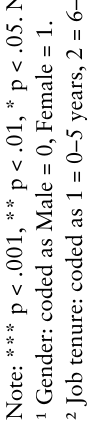
.18** 13.116*** .255 .012 Standardized regression coefficients are reported. *** p < .001. ** p < .01. * p < .05.
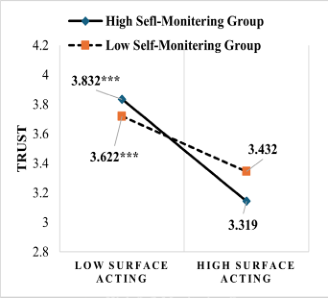
Figure 1: Interaction of self-monitoring and surface acting (H2).
The interaction plots of Surface Acting (SA) and Self-Monitoring (MO) with respect to trust are illustrated in Figure 1. The findings reveal that under low Surface Acting conditions in the workplace, employees with high self- monitoring tendencies report greater trust recovery (3.832, p < 0.001) than those with low self-monitoring (3.622, p < 0.001). These findings suggest that employees who are highly self-monitoring may be better equipped to mitigate or reverse the decline in trust in environments where surface acting is less prevalent. As a result, Hypothesis 2 receives partial support.
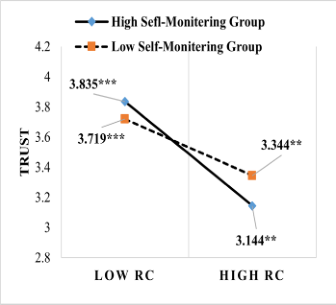
Trust Repair in the Organization: Interaction of Role Conflict and Positive Emotions 7 Regarding hypothesis 3, the author proposed that the interaction of Self- Monitoring (SM) and Role Conflict (RC) moderates the relationship between role conflict (RC) and trust toward the employer. Table 2 (Study 2) presents that, when the interaction (Self-Monitoring × Role Conflict) is inserted into the equation in step 2 (Study 2), the interaction is significant [F (9, 309) = 13.116, p < .001, ∆R² = .012], supporting Hypothesis 3. Figure 2 presents the interaction plots of Self-Monitoring (MO) and Role Conflict (RC) on trust. This result indicates that highly self-monitoring employees may be able to mitigate or repair the decline in workplace trust, regardless of the level of perceived role conflict. Consequently, Hypothesis 3 is supported.
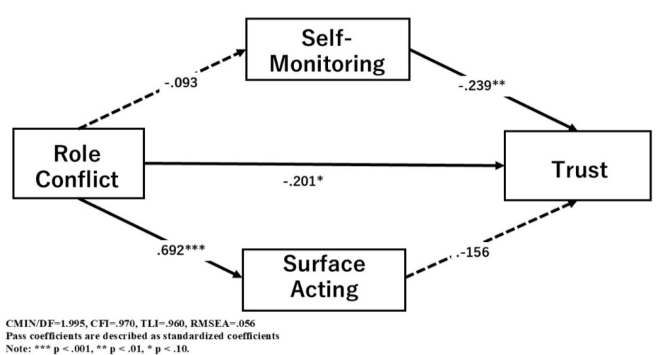
Figure 2: Interaction of self-monitoring and role conflict (H3).Figure 3: Multi-mediation model of interactions among role conflict, self-monitoring and surface acting effect on trust.
Covariance structure analysis (SEM) was used to evaluate hypothesized influences among unmeasured latent and observed variables. Figure 3 presents the multi-mediation model, in which interactions among Role
8 Okabe Conflict (RC), Surface Acting (SA), and Self-Monitoring (SM) mediate the effect of trust. Solid arrows indicate significant paths, and dashed arrows indicate nonsignificant paths (*** p < .001, ** p < .01, * p < .10). Pass coefficients are described as standardized coefficients. CMIN/DF = 1.995, CFI = .970, TLI = .960, RMSEA = .056. In this study, the author used IBM SPSS Statistics and AMOS.
DISCUSSION AND IMPLICATION The service industry workforce has been steadily expanding. Rivalry across many service sectors has grown increasingly fierce, driving organizations toward cost-cutting measures, workforce reductions, and early retirement incentives. At the same time, advances in information technology, artificial intelligence, and automation are taking over tasks once handled by human workers. This shift is gradually redefining employees’ expectations, potentially leading to role conflict. Yet customer service staff remains a critical link between companies and the people they serve. This study’s findings suggest that when customer service employees perceive role conflict, their trust in their employer tends to decline.
Additionally, emotion-related factors, especially self-monitoring and surface acting, help mitigate or restore eroding trust. In a demanding business environment, constructive emotional behaviours among customer service employees can enable them to collaborate effectively even under pressure. Lastly, employees with strong emotional competence promote cohesion and ethical conduct within an organization, strengthening its competitive edge by executing strategies effectively and operating more efficiently.
LIMITATION AND SUGGESTION FOR RESEARCH One limitation of this study is its cross-sectional design, which relies on self- reported data from customer service employees. Additionally, the study’s exclusive focus on this group limits the extent to which its findings can be applied. Future research could explore how emotional labour interacts with other factors across various human service organizations, especially among professionals whose roles require it. This suggests that similar investigations would be valuable in different contexts around the world.
ACKNOWLEDGMENT
This research was supported by JSPS KAKENHI Grant Number (24K16423).
REFERENCES
Ashforth, B. E., & Humphrey, R. H. (1993). Emotional labour in service roles: The influence of identity. Academy of Management Review, 18: 88–115. Baron, R. M., & Kenny, D. A. (1986). The moderator–mediator variable distinction in
social psychological research: Conceptual, strategic, and statistical considerations. Journal of personality and social psychology, 51(6), 1173.
Trust Repair in the Organization: Interaction of Role Conflict and Positive Emotions 9 Brown, T. J., Mowen, D., Donavan, T., & Licata, J. W. (2002). The customer
orientation of service workers: Personality trait effects on self-and supervisor performance ratings. Journal of Marketing Research, 39(1): 110–119. Brown, C. S, & Sulzer-Azaroff, B. (1994). An assessment of the relationship between customer satisfaction and service friendliness. Journal of Organizational Behavior Management, 14(2): 55–76. Diefendorff, J. M., Erickson, R. J., Grandey, A. A., & Dahling, J. J. (2011). Emotional
display rules as work unit norms: a multilevel analysis of emotional labour among nurses. Journal of occupational health psychology, 16(2), 170. Donaldson, T. (2001). The ethical wealth of nations. Journal of Business Ethics, 31(1), 25–36. Ekman, P. & Friesen, W.V. (1975). Unmasking the face: A guide to recognizing
emotions from facial cues. Englewood Cliffs, NJ: Prentice Hall. Gangestad, S. W., & Snyder, M. (2000). Self-monitoring: Appraisal and reappraisal. Psychological bulletin, 126(4), 530. Grandey, A. A., & Gabriel, A. S. (2015). Emotional labour at a crossroads: Where do
we go from here? Annu. Review. Organ. Psychol. Organ. Behavior, 2(1), 323–349. Grandey, A. A. (2003). When “the show must go on”: Surface acting and deep acting as determinants of emotional exhaustion and peer-rated service delivery. Academy of Management Journal, 46(1): 86–96. Hochschild, A. R. (1983). The managed heart: The commercialization of human
feeling. Berkeley, CA: University of California Press. Kahn, R. L., Wolfe, D. M., Quinn, R. P., Snoek, J. D., & Rosenthal, R.A. (1964).
Organizational stress: Studies in role conflict and ambiguity. Wiley & Sons. Katz, D., & Kahn, R. L. (1978). The social psychology of organizations (2nd ed.).
Wiley. Lindley, P., & Walker, S. N. (1993). Theoretical and methodological differentiation of moderation and mediation. Nursing Research, 42(5): 276–279. Morris, J. A., & Feldman, D. C. (1996). The dimensions, antecedents, and consequences
of emotional labor. Academy of Management Review, 21(4) 986–1010. Pugh, S. D. (2001). Service with a smile: Emotional contagion in the service encounter.
Academy of Management Journal, 44(5), 1018–1027. Rafaeli, A., & Sutton, R.I. (1987). Expression of emotion as part of the work role.
Academy of Management Review, 12(1): 23–37. Rizzo, J. R., House, R. J., & Lirtzman, S. I. (1970).: Role conflict and ambiguity in complex organizations. Administrative Science Quarterly, 15(2): 150–163. Rousseau, D. M., Sitkin, S. B., Burt, R. S., & Camerer, C. (1998). Not so different
after all: A cross-disciplinary view of trust. Academy of Management Review, 23(3), 393–404. Snyder, M., & Gangestad, S. (1986). On the nature of self-monitoring: matters of assessment, matters of validity. Journal of personality and social psychology, 51(1), 125. Streiner, D. L. (2003). Starting at the beginning: an introduction to coefficient alpha
and internal consistency. Journal of Personality Assessment, 80(1), 99–103. Tavakol, M., & Dennick, R. (2011). Making sense of Cronbach’s alpha. International journal of medical education, 2, 53. Tsai, W. C. (2001). Determinants and consequences of employee displayed positive
emotions. Journal of Management, 27(4), 497–512. Tubre, T. C., & Collins, J. M. (2000). Jackson and Schuler (1985) revisited: A meta-analysis of the relationships between role ambiguity, role conflict, and job performance. Journal of Management, 26(1), 155–169.
LISTED IN THE AHFE DIGITAL BOOKSTORE CATALOGUE
Explore the complete digital volume
Social and Occupational Ergonomics
Read this individual research paper free through the original publisher, or explore the full digital proceedings book.
ISBN 979-8-950676-04-8
Explore this ISBN in the AHFE Bookstore ↗Listed in the July 2026 bookstore catalogue; search by ISBN to confirm current availability · Digital book purchase optional