Noriko Okabe (2023). Cross-Cultural Analyses Between USA and Japan: Personality, Emotional Strategies, and Job Performance of Customer Service Employees. In: Social and Occupational Ergonomics. AHFE Open Access, vol. 106, pp. 117–127. https://doi.org/10.54941/ahfe1003082
The previous theory suggests that individuals may experience less stress when engaging in activities that are personality congruent. In this research, the author first tries to answer what kind of personality in the Big-five personality model of customer service employees are more or less likely to practice better job performance. And second, this study tries to answer the question of the best emotional strategies, affective delivering, surface acting, and deep acting, to easily practice for the specific type of employees to perform emotion regulation tasks. This study also tries to answer the question of who can best manage their emotions to produce the required emotional expression without appearing insincere or experiencing increased stress. Finally, the author compares the result from the USA and Japanese data to reveal the similarity and differences between the two.
The hospitality and tourism business has been undergoing a severe crisis since the COVID-19 outbreak (Bajram et al., 2021). The pandemic has been especially hard- hit by the airline industry, leading to a steep drop in financial performance and an increase in employee career turnover (Abate et al., 2020). Airline workers have been suffering risks of job instability even before COVID-19. For example, many traditional airlines have reduced costs and changed employment relationships due to deregulation and intensified competition such that LCC carriers (Low-Cost Carriers) entered the mar- ket (Okabe, 2017). Then, airlines worldwide have continued to operate with as few people as possible. In other words, the professional role required of customer service employees such as flight attendants has gradually changed over the past few decades. But with the recent outbreak of COVID-19, orga- nizations face a grand challenge of unparalleled proportions, one that meets them to drive into and directly manage unprecedented territory as they alter their workforce in technical, physical, and socio-psychological ways not seen before (Carneval & Hatak, 2020).
The COVID-19 pandemic has created a particularly challenging envi- ronment for human resource management (HRM) as managers strive to quickly venture to help their workforce adapt to and cope with radical changes occurring in the work and social environment. Remote work often could not replace customer service and human service jobs. Additionally, for most service organizations, individual service workers are direct parti- cipants in implementing the market concept of the organizations. Customer and frontline service employees’ interaction is often a primary determinant of customer satisfaction. Additionally, prior research shows that customer service and human service employees must control and manage their emo- tions, such as anger and sadness (e.g., Cacioppo & Gardner, 1999). Such emotional requirement typically has an integrative goal of showing positive display and hiding negative ones. Emotional regulation induces the employees to meet the socioemotional demand of the jobs, which vary by job category and personality (Brotheridge & Grandey, 2002).
In this research, the author first tries to answer what kind of personality in the Big- five personality model of customer service employees are more or less likely to practice better job performance. And second, what are the best emotional strategies (affective delivering, deep acting, and surface acting) to easily practice for the specific type of employees to perform emotion regula- tion tasks? Finally, the author administered two US and Japanese customer service employee surveys. Then the author compares the result from the US and Japanese data to reveal the similarity and differences between the two.
Literature Review: Theoretical Framework and Hypotheses Big-Five Personality Model
Prior researchers have investigated employee personality and performance (Brown et al., 2002). For example, the big five personalities can refer as fol- lows: (1) extraversion, representing the degree to which a person is outgoing; (2) agreeableness, representing a general warmth of feeling toward others; (3) conscientiousness, representing the degree of orderliness, organization, and precision; (4) emotional stability, representing evenness and steadiness of a person’s general emotional makeup; and (5) openness (or creativity), representing the person’s degree of imagination or originality.
Relationship Between Psychological Contract Violation (PCV) and Job Performance Rousseau (1989) defines the psychological contract violation as an indivi- dual’s belief regarding the terms and conditions of a reciprocal exchange agreement between that focal person and another party. For example, a psychological contract emerges when one party believes a promise of future return for them (e.g., pay for performance). Therefore, an obligation exists to provide future benefits. As beliefs in reciprocal and promised obligations between employee and employer, psychological contracts can, when viola- ted, generate distrust and dissatisfaction (Rousseau, 1989). Furthermore, psychological contracts are much broader than economic and legal contracts
Cross-Cultural Analyses Between USA and Japan 119
and include several perceptual aspects that legal agreements cannot for- mally incorporate. For example, customer service employees might perceive a psychological contract violation in COVID-19. Therefore, the author proposes the following hypothesis. Hypothesis 1: Psychological contract violation (PCV) perceived by the employees is negatively associated with their job performance.
The Basic Moderation Model and Emotional Strategies Affective Delivery Affective delivery or expressing positive emotions in service interaction pro- motes customer satisfaction (Grandey, 2003). Employee affective delivery refers to an employee expressing socially desired feelings during a service transaction (Ashforth et al., 1993). In addition, affective service delivery means friendliness and warmth related to desirable outcomes (Bettencourt et al., 2001). Therefore, the author proposes the following hypothesis. Hypothesis 2: Affective delivering moderates the negative relationship betw- een psychological contract violation (PCV) and job performance.
Deep Acting and Surface Acting Hochschild (1983) observed customer service employees using two types of dramaturgical techniques: deep acting, in which the employees feel the appro- priate emotion in the workplace, and surface acting, in which the employees put on the emotional mask officially expected. Hypothesis 3: Deep acting moderates the negative relationship between psychological contract violation (PCV) and job performance. Hypothesis 4: Surface acting moderates the negative relationship between psychological contract violation (PCV) and job performance.
The Basic Mediation Model and Emotional Strategies Generally, a given variable may function as a mediator to the extent that it accounts for the relation between the predictor and the criterion. Mediators explain how external physical events take on internal psychological signifi- cance (Baron & Kenny, 1986). Hypothesis 5: Affective delivering mediates the negative relationship between psychological contract violation (PCV) and job performance and transforms into the positive one. Hypothesis 6: Deep acting mediates the negative relati- onship between psychological contract violation (PCV) and job performance and transforms into the positive one. Hypothesis 7: Surface acting mediates the negative relationship between psychological contract violation (PCV) and job performance and transforms into the positive one.
METHOD
The author used the live survey application S to administer a web-based que- stionnaire survey of customer service employees and compare Study 1 (USA) and Study 2 (Japan). In testing the hypotheses, the author first measured the
120 Okabe
variables used in this study in the descriptive statistics and correlation. Tables 1 and 2 show the descriptive statistics of the variables used in this study, the correlation analysis, and Cronbach’s alpha coefficient for both Study 1 (USA) and Study 2 (Japan). Next, the author used hierarchical moderated regression to test the hypothesized moderating effect of emotional strategies (affective delivering, deep acting, and surface acting) on job performance. Third, the author tested the mediator effects using path analysis in covariance-based structural equation modeling (SEM).
RESULTS
Direct Effects Hypothesis 1 predicted that PCV perceived by the employees is negatively associated with their job performance. For study 1 (USA), as predicted, cor- relation analysis (Table 1) shows a significant negative correlation between PCV and job performance (r = −.1, p<.01). For study 2 (Japan), as predicted, correlation analysis (Table 2) shows a significant negative correlation betw- een PCV and job performance (r = −.46, p<.001). Concerning the Big-five personality, correlation analyses show significant negative correlations betw- een PCV and almost all aspects of Big-five personalities in both study 1 (USA) and 2 (Japan) except “openness to experience” in study 2. Thus, Hypothesis 1 was partially supported.
Moderating effect (interaction) between PCV and emotional strategies Hypothesis 2 predicted that affective delivering moderates the negative rela- tionship between PCV and job performance. However, the hierarchical moderated regression did not show a significant moderating effect in either study 1 (USA) or study 2 (Japan). Thus Hypothesis 2 was rejected.
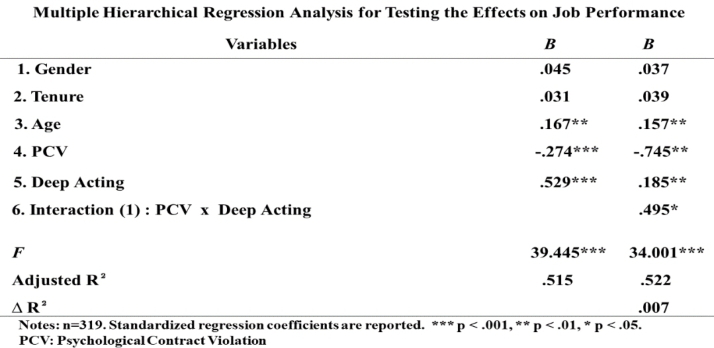
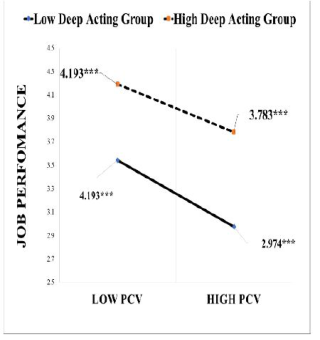
Hypothesis 3 predicted that deep acting moderates the negative rela- tionship between PCV and job performance. The hierarchical moderated regression (Figure 2) showed a significant moderated effect for Study 2 (Japan). Figure 4 shows that in both high and low PCV environments, the high deep acting employees significantly show higher and better job perfor- mance than low deep acting employees in Study 2 (Japan). Conversely, the hierarchical moderated regression did not show a significant moderated effect for Study 1 (USA). Thus Hypothesis 3 was partially supported.
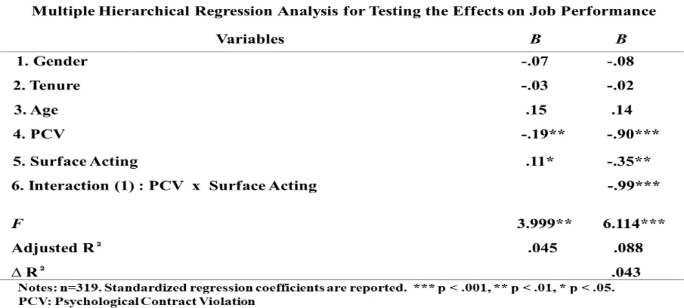
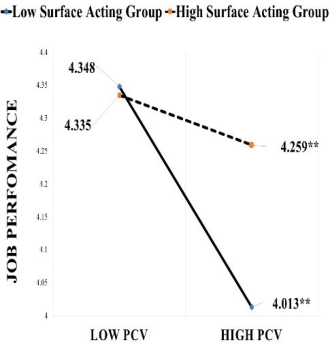
Hypothesis 4 predicted that surface acting moderates the negative rela- tionship between PCV and job performance. The hierarchical moderated regression (Figure 1) showed a significant moderated effect (interaction) for Study 1 (USA). Figure 3 shows that in a high PCV environment, the high surface acting employees significantly show better job performance than low Surface acting employees in Study 1 (USA). Conversely, the hierarchical moderated regression did not show a significant moderated effect for Study 2 (Japan). Thus Hypothesis 4 was partially supported.
Mediator Effects The author tested the mediator effects of emotional strategies (affective delivering, deep acting, and surface acting) of customer service employees
1Gender: coded as Male = 0, Female = 1 2 coded as 1 = 0–5 years, 2 = 6–10 years, 3 = 11–15 years, 4 = 16–20 years, 5 = 21–25 years, 6 = 26–30 years, 7 = more than 30 years. 3 Age : coded as 1 = less than 18 years, 2 = 18–20 years, 3 = 30–44 years, 4 = 45–60 years, 5 = more than 60 years. 4 Reliability represents Cronbach Alpha coefficients. PCV: Psychological Contract Violation.
Table 2. Descriptive statistics and correlations for study 2 (Japan).
Table available in the original PDF paper.
1 Gender1 .54 .50 −
2 Tenure2 2.87 2.06 −.45∗∗∗ −
3 Age3 2.35 .88 −.32∗∗∗ .56∗∗∗ −
Note: ***p < .001, **p <. 01, *p <. 05. N = 182.
1Gender: coded as Male = 0, Female = 1. 2Tenure: coded as 1 = 0–5 years, 2 = 6–10 years, 3 = 11–15 years, 4 = 16–20 years, 5 = 21–25 years, 6 = 26–30 years, 7 = more than 30 years. 3Age: coded as 1 = less than 18 years, 2 = 18–29 years, 3 = 30–44 years, 4 = 45–60 years, 5 = more than 60 years. 4Reliability represents Cronbach Alpha coefficients. PCV: Psychological Contract Violation.
Figure 1: Hierarchical regression: study 1 (USA).Figure 2: Hierarchical regression: study 2 (Japan).
between PCV and job performance may transfer the initially negative relati- onship into a positive one using the structural equation modeling (SEM).
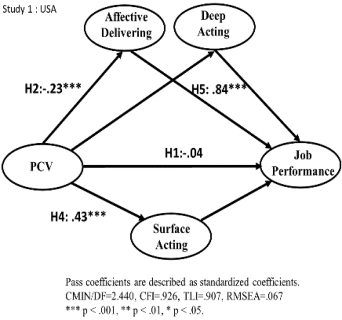
Hypothesis 5 predicted that affective delivering mediates the negative relationship between PCV and job performance and transfers the negative relationship into the positive one. For Study 1 (USA), as Figure 5 shows, structural equation modeling (SEM) show that affective delivering was a significant mediator between PCV and job performance. Furthermore, affe- ctive delivering transferred the negative relationship between PCV and job performance into a positive one. Conversely, SEM did not show a significant mediator effect for Study 2 (Japan). Thus Hypothesis 5 was partially suppor- ted. The goodness-of-fit summary of the SEM model shows χ2/df = 2.440, CFI = .926, TLI = .907, RMSEA = .067.
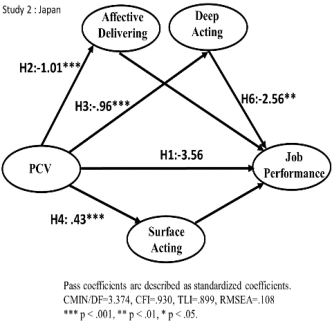
Hypothesis 6 predicted that deep acting mediates the negative relationship between PCV and job performance and transfers into the positive one. For Study 2 (Japan), as Figure 6 shows, SEM results showed deep acting was a significant mediator between PCV and job performance. However, deep
124 Okabe
Figure 3: Moderated effect: study 1.Figure 4: Moderated effect study 2.Figure 5: Mediation model: study 1.
Cross-Cultural Analyses Between USA and Japan 125
Figure 6: Mediation model: study 2.
acting did not transfer the negative relationship between PCV into a positive one for either Study 1 (USA) or Study 2 (Japan). Thus Hypothesis 6 was partially supported. The goodness-of-fit summary of the SEM model shows χ2/df = 3.374, CFI = .930, TLI = .899, RMSEA = .108.
Hypothesis 7 predicted that surface acting moderates the negative relati- onship between PCV and job performance and transfers into the positive one. However, SEM did not show significant moderators for either study 1 (USA) or study 2 (Japan). Thus Hypothesis 7 was rejected.
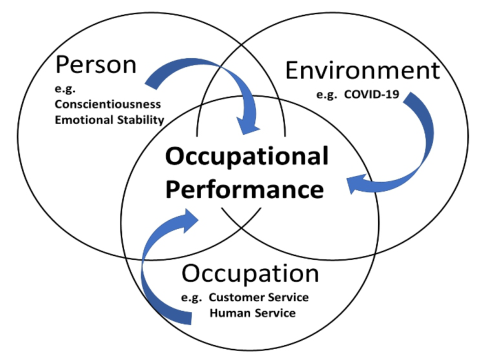
DISCUSSION AND IMPLICATION The previous theory suggests that individuals may experience less stress when engaging in activities that are personality congruent. Moreover, occupati- onal therapy theory, practice, and research have increasingly emphasized the transactional relationship between person, environment, and occupation. Occupational performance results from the dynamic relationship between people, their occupations and roles, and the environments in which they live, work, and play (Law et al., 1996).
In this research, the author first tries to answer what kind of perso- nality in the Big- five personality model of customer service employees are more or less likely to practice better job performance. Then, this study found the common tendencies between the two studies. Concer- ning personalities, in study 1 (USA), employees with higher scores for job performance possess Conscientiousness, Agreeableness, and Emotional stability personalities, respectively. In study 2 (Japan), Conscientiousness, Extraversion, and Emotional stability personalities, respectively. Therefore, for a customer service occupation, a person with Conscientiousness and Emotional stability personality generally would be the best fit for the profession.
And second purpose of this research is to the best emotional strategies (affective delivering, deep acting, and surface acting) to easily practice for the specific type of employees to perform emotion regulation tasks. Then, this study found the different tendencies between the two studies. For example,
126 Okabe
Figure 7: Maximizes fit of person, environment, and occupation.
in study 1 (USA), when the employees perceive PCV in the working environ- ment, the employees using surface acting usually perform better than those using less surface acting. Additionally, in a psychologically tricky environ- ment, employees eventually using affective delivering as an emotional strategy would make better performance. Conversely, in study 2 (Japan), the emplo- yees using deep acting at customer interaction performed better than those using less deep acting. This tendency is very high for Japanese employees; whenever the employees perceive higher or lower PCV in the working envi- ronment, Japanese employees would use deep acting to make better and higher performance.
Person-Environment-Occupation Fit Model assumes that its three major components (person, environment, occupation) interact continually across time and space in ways that increase or diminish their congruence (Law et al., 1996). Figure 6 shows the maximizes fit of person, environment, and occupa- tion model. For example, customer service employees with conscientiousness or emotional stability personality would quickly and efficiently adapt to the working environment. And customer service employees using surface acting or affective delivering as an emotional strategy to adjust to the emotional requirements (USA) and deep acting (Japan) would highly tendency to adapt to a complex environment such as COVID-19.
ACKNOWLEDGMENT
JSPS KAKENHI Grant Number JP19K13800 supports this work.
REFERENCES
Abate, M., Christidis, P. and Purwanto, A. J. (2020) “Government support to airlines in the aftermath of the COVID-19 pandemic,” Journal of air transport management, 89(101931), p. 101931. doi: 10.1016/j.jairtraman.2020.101931.
Cross-Cultural Analyses Between USA and Japan 127
Ashforth, B. E. and Humphrey, R. H. (1993) “Emotional labor in service roles: The influence of identity,” Academy of management review, 18(1), p. 88. doi: 10.2307/258824. Baron, R. M., & Kenny, D. A. (1986). The moderator-mediator variable disti-
nction in social psychological research: Conceptual, strategic, and statistical considerations. Journal of Personality and Social Psychology, 51(6), 1173–1182. https://doi.org/10.1037//0022-3514.51.6.1173. Bajrami, D. D. et al. (2021) “Will we have the same employees in hospitality after all?
The impact of COVID-19 on employees’ work attitudes and turnover intentions,” International Journal of Hospitality Management, 94. Bettencourt, L. A., Gwinner, K. P., & Meuter, M. L. (2001) A comparison of attitude, personality, and knowledge predictors of service-oriented organizational citizenship behaviors, Journal of applied psychology, 86(1), 29. Brotheridge, C. M. and Grandey, A. A. (2002) “Emotional labor and burnout: Com-
paring two perspectives of ‘people work,”’ Journal of vocational behavior, 60(1), pp. 17–39. doi: 10.1006/jvbe.2001.1815. Brown, T. J. et al. (2002) “The customer orientation of service workers: Personality trait effects on self-and supervisor performance ratings,” JMR, Journal of marketing research, 39(1), pp. 110–119. doi: 10.1509/jmkr.39.1.110.18928. Cacioppo, J. T., & Gardner, W. L. (1999) Emotion. Annual review of psychology, 50. Carnevale, J. B., & Hatak, I. (2020) Employee adjustment and well-being in the era
of COVID-19: Implications for human resource management. Journal of business research, 116, 183–187. Grandey, A. A. (2003) “When ‘the show must go on’: Surface acting and deep acting as determinants of emotional exhaustion and peer-rated service delivery,” Academy of Management journal, 46(1), pp. 86–96. doi: 10.2307/30040678. Hochschild Russell, A. (1983) The managed heart: Commercialization of human
feeling. Berkeley: U of California P. Law, M. et al. (1996) “The person-environment-occupation model: A tran- sactive approach to occupational performance,” Canadian journal of occu- pational therapy. Revue canadienne d’ergotherapie, 63(1), pp. 9–23. doi: 10.1177/000841749606300103. Okabe, N. (2017) “Creating of customer loyalty by cabin crew A study of the relation between emotional labor and job performance,” Transportation research procedia, 25, pp. 149–164. doi: 10.1016/j.trpro.2017.05.387. Rousseau, D. M. (1989) “Psychological and implied contracts in organizati-
ons,” Employee responsibilities and rights journal, 2(2), pp. 121–139. doi: 10.1007/bf01384942.
LISTED IN THE AHFE DIGITAL BOOKSTORE CATALOGUE
Explore the complete digital volume
Social and Occupational Ergonomics
Read this individual research paper free through the original publisher, or explore the full digital proceedings book.
ISBN 978-1-958651-82-7
Explore this ISBN in the AHFE Bookstore ↗Listed in the July 2026 bookstore catalogue; search by ISBN to confirm current availability · Digital book purchase optional