Martin Boecker, Emmanuel Darmois (2023). A harmonized multi-lingual terminology for ICT devices and services. In: Social and Occupational Ergonomics. AHFE Open Access, vol. 106, pp. 110–116. https://doi.org/10.54941/ahfe1003081
Users who are unfamiliar with the terminology, technical meaning, or intended functionality of modern mobile ICT (Information and Communications Technology) devices and services may be reluctant to use those devices and services and miss out on their potential benefits. A limited understanding of those devices and services on the users’ part also prevents them from exploiting the true potential of ICT and hinders the uptake and use of services, including those of societal relevance. ETSI Guide EG 203 499 presents an alternative, offering a solution focusing on improving the overall user experience and accessibility through by providing recommendations for a harmonized terminology, covering more than 800 basic, commonly-used ICT features in the 27 European languages, that are the official languages of the European Union (EU) and EFTA, the European Free Trade Area. Technical Committee Human Factors (TC HF) of the European Telecommunication Standards Institute (ETSI) has initiated this ongoing work, to develop a freely-available ETSI document (ETSI Guide EG 203 499, current version of October 2022, a further update to be published in the first half of 2024). The method used for developing the terminologies and examples of the terminologies published in the latest ETSI Guide version are presented. ETSI Guide 203 499 will not only facilitate the use of ICT devices and services for users but may also serve as a reference for harmonized (on a voluntary basis) user interface elements and user manuals to be provided by the industrial ICT actors concerned (e.g. manufacturers).
Harmonized – i.e., agreed-upon – terminologies facilitate comprehension, data exchange, and content production in a wide range of domains, inclu- ding ICT (Information and Communications Technologies). Manufacturers employ terminology management processes and tools in order to identify, store and manage company, customer, or product-specific terminologies that are employed in the development processes, in the user interfaces of products, and in the user documentation, all of which possibly need to be translated into the languages spoken in the target markets (see e.g., Philpotts, 1996). State-of-the-art terminology based on computational and/or artificial intelli- gence are being used in diverse areas such as medicine, (software) engineering, and public-sector services (Bourigault et al., 2001).
A Harmonized Multi-Lingual Terminology for ICT Devices and Services 111
ICT is another area in which users encounter a plethora of terms. The effe- ctive access of all users to ICT depends on the users being able to understand the features (such as the controls and capabilities) of the products and services that are required to operate them. To discover and understand these featu- res, users must first identify and recognize them. Their names (terms, words, labels) are a primary means by which users can recognize and understand them.
If product and service features are poorly named, or if a familiar feature is named differently to the way that users have previously encountered that feature (e.g., on the device of a different manufacturer), they are likely to fail to recognize and understand it. If they fail to recognize and understand those features, they are unlikely to be able to use them effectively. From this follows that users who wish to use ICT effectively will have to identify and then memorize the names of the various product features.
On the contrary, terms that have clear and well-understood meanings will support the users with this initial memorization task. However, if the terms for the same features are different from product to product, users will need to learn that multiple terms that refer to the same underlying feature, and will have to understand which name is used in which product (or, even worse, in different parts of the same product). This additional complexity may dispro- portionally disadvantage elderly users and users with learning or cognitive disabilities who may have impaired memory and comprehension abilities.
While some terms are introduced by manufacturers to designate a new class of features or to distinguish their own features from those found in the products of competitors, most other terms designating device or service fea- tures are not necessarily intended for differentiation (e.g., battery). However, in the absence of a harmonized or recommended terminology, the use of those terms may differ considerably both among device manufacturers and service providers.
The alternative to a wide and confusing plethora of terms encountered by end users is a reasonable degree of harmonization among devices, servi- ces, and application, i.e., in those areas that are not necessarily intended by manufacturers to convey a certain brand feature or image, a harmonized terminology can be employed that helps preventing the following negative effects of an uncontrolled growth of terms:
Increased user difficulties in understanding complex, ambiguous, and inconsistently used terms, leading to unnecessary confusion
Increased efforts in the creation of media for user education (user guides)
Increased costs for user support (hotline calls and call agent training)
Limited feature discovery and unclear user expectations (customers who do not understand certain features may not use them, hence some revenue may be missed)
Limited uptake (users may be reluctant to use a feature as they are not sure whether it has the expected effect or undesired consequences)
Increase of cognitive complexity and subsequent learning effort
Abuse in the use of proprietary terms and lack of consistent use of terms across internal and external product documentation.
112 Boecker and Darmois
The need for a harmonized terminology of device and service features increases as new features and services are being introduced and marketed continuously and as new players enter an already dynamic market. Applica- tions, services, and product features are frequently updated, often without providing an update of the user documentation to the users. In addition, as network operators’ business models change (e.g., fewer subsidized devices lin- ked to fixed service plans), end-user loyalty to network operators and device manufacturers declines.
AN APPROACH FOR HARMONIZING ICT TERMS The Technical Committee Human Factors (TC HF) of the European Tele- communication Standards Institute (ETSI) is conducting work, co-funded by the European Commission and EFTA, the European Free Trade Association, to develop the publicly available ETSI Guide EG 203 499 that addresses the need for harmonized ICT terminologies. Based on a previous ETSI Guide that was limited to telephony terms and to terms in English, it aims at recommen- ding implementation-oriented terms in major European languages, applicable to product UI and user documentation design, also easing knowledge and learning transfer. A first version of the ETSI Guide published in 2019 covered the five languages English, French, German, Italian, and Spanish.
A new version published in October 2022 covers 14 additional langua- ges (Bulgarian, Croatian, Czech, Danish, Dutch, Finnish, Greek, Hungarian, Norwegian, Polish, Portuguese, Romanian, Slovak, and Swedish), namely those spoken by at least five million native speakers in the European Union and EFTA (see e.g., Ethnologue).
The current work will add eight further languages (Estonian, Icelandic, Irish, Latvian, Lithuanian, Maltese, Raeto-Romance, and Slovene), making the terminologies available in all official EU and EFTA languages.
Full details about outcomes and milestones available at: https://portal.ets i.org/xtfs/#/xTF/652.
For this work, a Design-for-All approach was chosen that takes functional limitations of elderly users and those with cognitive, physical, or sensory variations into account.
Intended users of EG 203 499 are those designing, developing, imple- menting, and deploying user interfaces for and interaction with mobile ICT devices, services, and applications.
Intended end users of that ETSI Guide are people who use mobile ICT devi- ces, services, and applications ranging from first time users to experienced users.
The method employed for developing harmonized terminologies consisted of three phases (see Fig. 1):
Phase 1: Identification of objects and activities from a range of functional areas such as telephony and photography
Phase 2: Collection of terms used by major stakeholders, and catego- rizing them into different categories based on their relevance (general terms, messaging services, eHealth services, etc.)
A Harmonized Multi-Lingual Terminology for ICT Devices and Services 113
Figure 1: Methodology used for developing the terminology (see ETSI EG 203 499).
Figure available in the original PDF paper.
Phase 3: Analysis of terms collected and selection of recommended terms.
Phase 1: Identification of Objects and Activities In this first phase, functional areas such as telephony and photography were identified that define the range of functionalities covered by the EG. Those functional areas embrace those functionalities that are most frequently used by many or most users of mobile ICT devices.
For each functional area, relevant objects and activities (i.e., those that are frequently used, and used by most users) were identified and defined. The principles applied in this process were: Objects and activities were selected if they help users
Identify the functionality (i.e., help the user understand what it does)
Access the functionality
Understand the available options related to a functionality
Understand messages displayed in the context of using a functionality (e.g., error feedback).
Objects and activities were not selected if they cover
The content of an application (e.g., “photo”, “take the first exit at the roundabout”) or the style of the interaction
Common terms easily found in a dictionary (e.g., “hotel”)
Common verbal expressions indicating an action taken on an object (e.g., “take a photo”)
Words, acronyms, or abbreviations used in a specific technical sense (e.g., “CCNR”).
Those objects and activities that are relevant for several or all functional areas are treated as basic terms, dealt with in a separate section of the EG.
Phase 2: Collection of Terms For each functional area, the relevant providers (ICT device manufacturers, service providers, and application vendors) were identified, and the terms used by them for the objects and activities of the respective functional area were collected in the languages covered by the EG. For example, providers included in the analysis for the functional area “photography” were the five (at the time of the first release of the EG) resp. four (second release)
114 Boecker and Darmois
most successful mobile device manufacturers, based on their market share in Europe for the product category smart phone.
In most cases, the number of providers had to be limited to four or five to keep the effort for the analysis manageable. The analysis showed that not all functionalities were offered by all (four/five) providers. Functionalities offered by one provider only were not included in the analysis.
Phase 3: Analysis and Selection In the final phase of the work, the terms collected in Phase 2 were reviewed by experts for each language and the terms to be recommended were selected. This included
Checks for consistency between manufacturers (i.e., prevalence of cer- tain terms)
Preference of terms that reflect the language of the end users as opposed to the language of developers
Compliance with linguistic requirements from the five languages cove- red.
Most importantly, localization experts and/or specialists in the linguistics of the respective languages were consulted to support the selection process.
For the third release (currently under development) that is adding the eight remaining languages, a modified methodological approach has to be applied: since the materials (e.g. user guides, web pages, etc.) consulted for the lan- guages covered so far are not available for most of the remaining languages (e.g. Irish, Raeto-Romance, or Maltese), the language experts have to rely on their expertise and best judgement when selecting terms in their respective language.
SCOPE OF THE HARMONIZED TERMINOLOGIES The recommended terms published in the EG are divided into the following domains or categories:
Device-related terminologies
1. General terms 2. Accessibility terms 3. Telephony terms 4. Photography Service- and application-related terminologies
5. General terms 6. Messaging services 7. Media services 8. Societal services and communications 9. Social media services 10. Banking services 11. eHealth services 12. Travel planning
A Harmonized Multi-Lingual Terminology for ICT Devices and Services 115
Figure 2: Example contents of EG 203 499.
13. Navigation 14. Games 15. Searching and browsing 16. Tools / Miscellaneous.
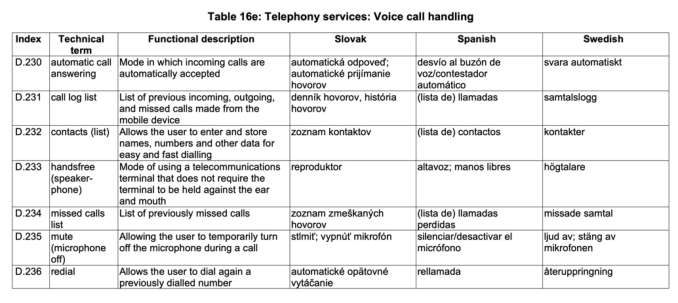
Each of those domains includes subcategories that support the readers in finding the terms they are looking for (e.g., in the case of the domain “Pho- tography”, the subcategories are “Taking Photos”, “Handling Photos”, and “Taking and Handling Videos”).
Fig. 2 shows an example of the contents of the current draft of EG 203 499. For each entry, an index number, a “Technical term” (expected to be understood by implementers), a detailed description of the functionality, and the recommended terms in the languages covered by the EG.
CONCLUSION
The first version of EG 203 499 was well received and an exten- sion of the ETSI Guide to cover further European languages was encouraged. For a second phase, the ETSI Specialist Task Force 604 (https://portal.etsi.org/STF/STFs/STF-HomePages/STF604) has developed a new release covering 14 additional languages (Bulgarian, Croatian, Czech, Danish, Dutch, Finnish, Greek, Hungarian, Norwegian, Polish, Portuguese, Romanian, Slovak, and Swedish), i.e., languages that are spoken in EC/EFTA countries by at least five million native speakers (see e.g., Ethnologue). The corresponding tables of terms have been made available on the ETSI GitLab for free download by the EG users.
This work is carried out applying the methodology described above, with the help of native speakers with the necessary linguistic expertise and accom- panied by a stakeholder group representing inter alia the interests of users with physical or mental impairments as well as those of manufacturers.
The updated version of EG 203 499 is expected to be published in 3rd quarter of 2022.
116 Boecker and Darmois
ACKNOWLEDGMENT
This work has been co-funded by the European Commission (EC) of the European Union (EU) and the European Free Trade Association (EFTA). The current (third) phase of the work is funded and conducted by ETSI.
REFERENCES
Bourigault, D. and Jacquemin, C. and L’Homme, M. C. (2001). Recent Advances in Computational Terminology. Vol. 2 of Natural language processing. J. Benjamins Publishing Company. ETSI DEG 203 499 v1.1.1 (2019-08): Human Factors (HF); User- centredterminology for existing and upcoming ICT devices, services and applications. Philpotts, M. (1996), An introduction to the concepts, benefits and terminology
of product data management. Industrial Management & Data Systems, Vol. 96 No. 4, pp. 11–17. What are the top 200 most spoken languages? Ethnologue.www.ethnologue.
com/guides/ethnologue200. Retrieved 2022-03-02.
LISTED IN THE AHFE DIGITAL BOOKSTORE CATALOGUE
Explore the complete digital volume
Social and Occupational Ergonomics
Read this individual research paper free through the original publisher, or explore the full digital proceedings book.
ISBN 978-1-958651-82-7
Explore this ISBN in the AHFE Bookstore ↗Listed in the July 2026 bookstore catalogue; search by ISBN to confirm current availability · Digital book purchase optional