Information and Communications Technology (ICT) has become central to the life of all citizens in the European Union. A vast range of powerful devices (e.g., mobile phones, smart phones) and services (e.g., media services, societal services) are proposed in order to foster exchanges, provide access to a wealth of information and improve the quality of life. However, the expected benefits – in particular those of societal relevance - materialize only when the features proposed by the devices and services may be easily understood and used by all users, including those with learning and cognitive disabilities. When users are not familiar with a new functionality and its technical background, they may be confused by an obscure and not harmonized terminology. As a result, they may be reluctant to use ICT devices and services and miss their potential benefits.The Design-for-All approach presented is addressing the provision of a harmonized terminology suggesting terms to denote more than 500 basic and commonly used ICT features in 19 European languages with a dual objective. Firstly, it is intended as a referential for the end users, taking into account elderly users as well as those with cognitive, physical, or sensory variations. Secondly, it is offered as a guideline to support the users (in particular, the industrial stakeholders) in the provision of harmonized documentation. The work has been undertaken by the “Human Factors” Technical Committee (TC HF) of the European Telecommunication Standards Institute (ETSI). An ETSI Guide (EG 203 499) has been developed with a two steps approach: a first version has been published in 2019 covering English, French, German, Italian and Spanish; a second version including 14 more languages (Bulgarian, Croatian, Czech, Danish, Dutch, Finnish, Greek, Hungarian, Norwegian, Polish, Portuguese, Romanian, Slovak, and Swedish) is to be published in the first half of 2022. EG 203 499 will address all the languages spoken in the EU by more than 5 million citizens and will be freely available.The proposed poster will outline the benefits of the proposed ETSI Guide and provide examples of the resulting terminologies together with the methodology used for developing them in the ETSI EG.This work is co-funded by the European Commission (EC) of the European Union (EU) and the European Free Trade Association (EFTA) and conducted within ETSI.
THE CHALLENGE OF OBSCURE ICT TERMINOLOGIES Thanks to a vast range of powerful devices (e.g., mobile phones, smart phones) and services (e.g., media services, societal services), Information and Communications Technology (ICT) has become central to the life of all citizens in the European Union fostering exchanges, providing access to a wealth of information and improving the quality of life of a great number of EU citizens.
However, the expected benefits – in particular those of societal relevance - materialize only when the features proposed by the devices and services may be easily understood and used by all users, including those with learning and cognitive disabilities. An effective access of all users depends on their ability to understand the capabilities and master the controls of the features embedded within the products and services that are offered. When users are not familiar with a new functionality and its technical background, they may be confused by an obscure and not harmonized terminology. As a result, they may be reluctant to use ICT devices and services and miss their potential benefits.
A key access to the discovery and understanding of products and services features relies in the ability for the users to identify and recognize them. From this standpoint, the names of these features are a primary mechanism. Terms, words, labels, etc. are essential components: learning ICT will always require identification and memorization of the names. When a feature is poorly named or named differently from the way that a user may have previously encountered it, the risk is that users fail to recognize and understand it, thus making it difficult to use it effectively.
THE BENEFITS OF A HARMONIZED ICT REFERENTIAL A precise, clear and well understood meaning for a term will greatly support memorization. But, on the other hand, when similar features in different products are referred to by different names, users will need to learn multiple terms and will need to understand the context in which a name is used (in different products and, sometimes, in the same – poorly designed - product). Users with learning or cognitive disabilities who have impaired memory and comprehension abilities as well as older users will be disadvantaged.
The good news is that, in a large number of cases, the terms are not referring to features that are intended for differentiation (though some terms are introduced to denote a new class of feature or to distinguish a manufacturer’s features from those offered its competitors). However, the use of the terms ‘not for differentiation’ may differ considerably among manufacturers and service providers, thus making the case for a harmonized referential of recommended terminology for devices, services, and application that counter some of the negative effects of a proliferation of terms by offering:
Simple, unambiguous, and consistently used terms reducing confusion
Simplified efforts in user education (e.g., less complex user guides)
Reduced costs for user support (e.g., hotlines and agent training)
Better uptake and enhanced revenue from simplified feature discovery and clear user expectations supporting the use of new features
Reduced cognitive complexity and subsequent learning effort
Limited use of proprietary terms Considering that new features and services are being introduced and marketed constantly in a very dynamic market, the value of a harmonized terminology of device and service features increases, in particular when applications, services, and product features are frequently updated (often without updating the user documentation).
DEFINING THE SCOPE OF HARMONIZATION Defining a referential for ICT is a challenge in itself, given the breadth of Information and Communication technologies. The work presented here had to take into account a number of factors that have been shaping the scope of the ICT terminology addressed.
History. The work has been based on previous initiatives that had a similar – though less ambitious – purpose, undertaken by the Technical Committee Human Factors (TC HF) of the European Telecommunication Standards Institute (ETSI). An initial realization had been done in a previous ETSI Guide (EG), namely EG 202 132 [1] that was limited to telephony terms and to terms in English. More recently, the freely available ETSI Guide EG 203 499 [2] has addressed, with a support from the European Commission (EC) and the European Free Trade Association (EFTA), the recommendation for terms applicable to product User Interface (UI) and user documentation design in five major European languages (English, French, German, Italian and Spanish).
Coverage of European Languages. An extension of the language support of ETSI Guide (EG) 203 499 has been agreed with the preparation of a new release of the EG covering 14 additional languages (Bulgarian, Croatian, Czech, Danish, Dutch, Finnish, Greek, Hungarian, Norwegian, Polish, Portuguese, Romanian, Slovak, and Swedish), i.e., languages that are spoken in EC/EFTA countries by at least five million native speakers [3].
Technical domains addressed. Though ICT has recently expanded to the Internet of Things (IoT), a new set of technologies that have strong relationship with the users, it has been decided to keep the same focus as in the first version of EG 203 499, namely the devices and services related to mobility. As a result, the recommended terms to be published in the EG are divided into two broad domains and associated subdomains: o Device-related terminologies
Supporting user documentations. An important part of the publicly available documentation that could serve as a basis for terminology recommendations was the one related to the devices. The analysis has taken into account the documentation produced by the main providers of mobile devices with a prior assessment of the main actors that has led to the selection of four industrials (with a list that has changed between the first and the second iteration of EG 203 499).
A METHODOLOGY FOR HARMONIZATION A systematic approach had to be defined to ensure that the work done would be consistent over the large panel of languages involved. The resulting methodology, largely defined for the first (5 languages) iteration of EG 203 499, has been confirmed and refined for the second (19 languages) version.
It takes into account two essential categories of stakeholders that are expected to be primarily served by the development of the ETSI Guide:
End users of EG 203 499 are those who concretely use mobile ICT devices, services, and applications. These users can range from first time / occasional users to (very) experienced / frequent users.
Users of EG 203 499 are those who may benefit from using it during the design, development, implementation, and deployment of features involving interaction, in particular through user interfaces, with mobile ICT devices, services, and applications.
Considering the key role of users, a Design-for-All approach was chosen that takes functional limitations of elderly users and those with cognitive, physical, or sensory variations into account.
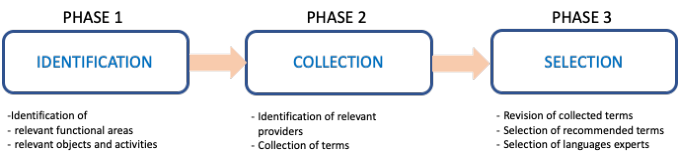
The methodology employed consisted of three phases (see Error! Reference source not found.):
Phase 1: Identification of objects and activities pertaining to a range of functional areas such as telephony or photography.
Phase 2: Collection of terms used by major stakeholders, and further categorized on the basis of their relevance (e.g., general terms, messaging services, eHealth services, etc.).
Phase 3: Analysis of the terms collected, and selection of the terms retained for recommendation.
Figure 1. Methodology for Terminology Definition Phase 1: Identification of objects and activities
In this first phase, the relevant functional areas (e.g., telephony or photography) were defined, covering the functionalities that are most frequently used by many or most users of mobile ICT devices. These areas are actually largely inherited from the first iteration of the EG. They define the range of functionalities covered and serve as the main structure for the EG. The main activity in this phase was to identify, for each functional area, the objects and activities that are relevant, in part because they are frequently used, potentially by many users. In this process, the following approach has been applied: Objects and activities were selected as long as they help users understand a given functionality:
Identification: helping the user understand what it does.
Access: how to be in a position to use the functionality.
Options: understanding the available options.
Messages: understanding displayed messages (e.g., feedback on error). A number of objects and activities were not retained:
Common terms easily found in a dictionary (e.g., “hotel”)
Common verbal expressions indicating an action taken on an object (e.g., “take a photo”)
Objects and activities referring to the content or to the style of an application (e.g., “photo”, “take the first exit at the roundabout”)
Words, acronyms, or abbreviations used in a specific technical sense (e.g., “CCNR”)
Some objects and activities may be relevant for several (or all) functional areas. They are treated as basic terms and dealt with in a separate section of the EG. Phase 2: Collection of Terms Relevant providers were identified such as device manufacturers, service providers, and application vendors. The terms they used for the objects and activities of the respective functional area were collected in all of the 19 languages covered by the EG. As an example, the providers included in the analysis for the “photography” functional area were the five most successful device manufacturers, based on their market share in Europe for the product category smart phone (as mentioned above the list of providers may have evolved between the first and second iteration of the EG).
In most cases, a balance had to be found between the potential number of providers and the need to keep the analysis effort reasonable. A limit of five providers has been set and proved sufficient. A given functionality may not have been offered by all (five) providers and was not included in the analysis if it was offered by only one provider.
Phase 3: Analysis and selection In the final phase, the terms collected in Phase 2 were reviewed and the terms subject to recommendation selected. In order to ensure the greatest possible accuracy of the selection, experts in the linguistics of the respective languages (e.g., localization experts and/or specialists) have been consulted to support the selection process.
The corresponding selection effort included:
Consistency checks between providers (i.e., prevalence of certain terms)
Preference given to terms reflecting the language of end users as opposed to the language of designers and developers
Compliance with linguistic requirements from the 19 languages covered.
The final structure of the EG 203 499 reflects the main domains (device-related terminologies and Service- and application-related terminologies) and the associated subcategories that support the readers in finding the terms they are looking for. As an example, the subcategories associated to “Photography” are “Taking Photos”, “Handling Photos”, and “Taking and Handling Videos”).
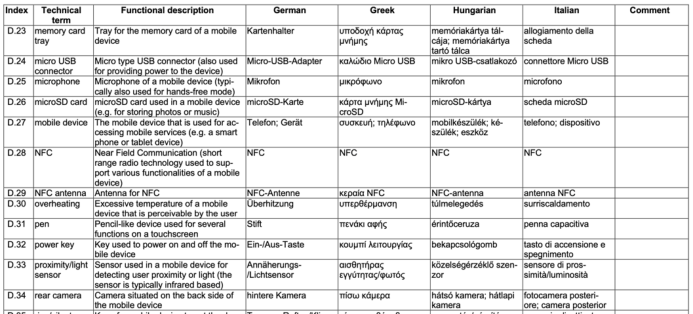
The ETSI Guide includes a large number of tables with the rows presenting the different terms and the columns presenting how these terms are expressed in the EG languages. Fig. 2 shows an example of the contents of the current draft (19 languages) version of EG 203 499.
For each entry, an index number, a “Technical term” (expected to be understood by the ETSI Guide users – as described above), a detailed description (in English), and the recommended terms in up to four languages (in Figure 2, German, Greek, Hungarian, Italian). In selected cases, a comment may be added.
Figure 2. Example of content in the current draft of EG 203 499 (2021-11) MAKING IT HAPPEN
The evolution of ETSI Guide 203 499 from 5 to 19 languages has been undertaken by the ETSI Specialist Task Force 604 (4). It is the last iteration of a document offering a slightly extended technical breath and a deeply extended language support with a new release covering 14 additional languages (Bulgarian, Croatian, Czech, Danish, Dutch, Finnish, Greek, Hungarian, Norwegian, Polish, Portuguese, Romanian, Slovak, and Swedish). The work has been carried out with an improved overall approach. Even if the methodology has remained globally the same between the 5 languages and the 19 languages versions, a great improvement has been gained by adjoining a set of native speakers with a very specific linguistic expertise to the STF team in charge of the development of the ETSI Guide. Overall, the added value of the new iteration is not just in the addition of 14 languages but also with a more precise set of terms, more adapted to the fast evolution of the mobile Information and Communication technologies. Moreover, the new draft of the ETSI Guide has been monitored by a stakeholders group representing a large panel of interests, from manufacturers to users with physical or mental impairments, which has provided a useful feedback to the work of the experts. The updated version of EG 203 499 is expected to be published in the first quarter of 2022. It will be a freely available document that can be used by its intended audience, in particular as a support for a certain convergence of terminologies across the
Human Interaction & Emerging Technologies (IHIET-AI 2022) Artificial Intelligence & Future Applications https://openaccess.cms-conferences.org/#/publications/book/978-1-7923-8989-4 products of the main mobile devices manufacturers that can serve the end-users, especially those with learning and cognitive disabilities. An important component of the human systems integration plan should be a verification and validation process that provides a clear way to evaluate the success of human systems integration. The human systems integration team should develop a test plan that can easily be incorporated into the systems engineering test plan. The effectiveness and performance of the human in the system needs to be validated as part of the overall system. It may seem more attractive to have stand-alone testing for human systems integration to show how the user interacts with controls or displays, how the user performs on a specific task. This methodology can address the performance of the human operator or maintainer with respect to the overall system. The most important thing is to develop a close relationship between human systems integration and systems engineering.
ACKNOWLEDGMENTS
This work is co-funded by the European Commission (EC) of the European Union (EU) and the European Free Trade Association (EFTA) and conducted within ETSI.
REFERENCES
1. ETSI EG 202 132 v1.1.1 (2004-08): “Human Factors (HF); User Interfaces; Guidelines for generic user interface elements for mobile terminals and services”. This reference contains harmonized, English-language terms for areas including UI hardware and software, configuration of services, call features and terminal functionality. Finalized in 2004, it needs updating and expansion to cover features, services, and applications not available at that time and other important languages. 2. ETSI DEG 203 499 v1.1.1 (2019-08): “Human Factors (HF); User-centred terminology for existing and upcoming ICT devices, services and applications”. 3. "What are the top 200 most spoken languages?". Ethnologue. Retrieved 2021- 02-26. 4. ETSI Specialist Task Force 604, https://portal.etsi.org/STF/STFs/STF- HomePages/STF604
Read this individual research paper free through the original publisher, or explore the full digital proceedings book.
ISBN 978-1-7923-8989-4
Explore this ISBN in the AHFE Bookstore ↗Listed in the July 2026 bookstore catalogue; search by ISBN to confirm current availability · Digital book purchase optional