Debra Henneberry, Dimitrios Ziakkas, Eleftherios Bokas, Konstantinos Pechlivanis (2026). Cultural Dynamics in Next-Generation Cockpit Design: Integrating Human Factors, Inclusivity, and System Resilience in Transportation Aviation. In: Intelligent Human Systems Integration (IHSI 2026): Disruptive and Innovative Technologies. AHFE Open Access, vol. 200, pp. 266–273. https://doi.org/10.54941/ahfe1007086
The next generation of cockpit design must evolve beyond ergonomic optimization to incorporate cultural and cognitive inclusivity. This study proposes a framework for integrating cultural intelligence (CQ) into cockpit development, applying the International Civil Aviation Organization (ICAO) ADDIE model to embed intercultural human factors throughout the design lifecycle. Empirical insights from accident investigations and Crew Resource Management (CRM) studies show that communication failures linked to power distance, uncertainty avoidance, and language proficiency remain critical risk factors in mixed-nationality flight decks. Traditional design has focused primarily on physical ergonomics and automation management; this framework extends these considerations to encompass cultural ergonomics, AI-mediated communication, and adaptive multimodal interfaces. By combining cultural intelligence theory with human–machine interaction design, the paper advances a systematic model for culturally adaptive cockpits. Initial results from simulator-based evaluations suggest that adaptive alerting, explainable automation, and co-authorable checklists improve communication efficiency, decision latency, and challenge–response equity. The findings underline that cockpit inclusivity and resilience depend on both technological innovation and the cultural adaptability of human–system interfaces.
Cockpit design has traditionally aimed to optimize the physical and cognitive interface between pilots and automation. However, the cockpit is equally a social system where cultural variables shape communication, hierarchy, and joint decision-making (Ziakkas et al., 2026). As airline operations expand Received September 9, 2025; Revised November 10, 2025; Accepted November 25, 2025; Available online February 1, 2026
Cultural Dynamics in Next-Generation Cockpit Design 267 across cultural boundaries, heterogeneity in crew composition is now an operational constant. Empirical evidence (Helmreich & Merritt, 1998; Hofstede et al., 2010) demonstrates that disparities in authority gradients, indirect communication, and tolerance for ambiguity can affect error man agement and safety outcomes. Designers therefore face a new imperative: to integrate cultural intelligence as a first-order parameter in the architecture of next-generation flight decks.
This research positions cultural dynamics as a measurable and design-rel evant component of human factors engineering. It argues that inclusivity and system resilience are achieved when human–machine interfaces reflect how multicultural crews communicate, decide, and recover from unexpected events. The proposed approach builds on the ADDIE methodology (Analysis, Design, Development, Implementation, Evaluation), enabling a structured pathway for embedding CQ principles into cockpit design. The framework operationalizes inclusivity through adaptive displays, multimodal communi cation tools, and AI-mediated language normalization mechanisms.
CULTURE, HUMAN FACTORS, AND SAFETY SCIENCE Human error in aviation rarely stems from isolated actions. Instead, it emerges from the interaction between human, organizational, and technological ele ments (Reason, 1997; Hollnagel, 2014). Cultural variables modulate these interactions (Ziakkas et al., 2026). Classic frameworks (e.g., Reason’s orga nizational accident model, System Theoretic Accident Model and Processes [STAMP] - Causal Analysis based on System Theory [CAST], Safety-II) place learning and adaptation at the center of safety (Hollnagel, 2014). Within this lens, culture is neither anecdote nor afterthought: it modulates communica tion, shapes authority gradients, and influences how risk signals are surfaced or suppressed. Crew Resource Management (CRM) evolved to address these interpersonal risks, but its effectiveness depends on crews’ intercultural flu ency and on interfaces that are tolerant to culturally variable behaviors.
Recent work on Cultural Intelligence (CQ) clarifies how metacognitive, cognitive, motivational, and behavioral capacities predict effective perfor mance in mixed-nationality teams. Evidence from cross-cultural CRM stud ies shows that high-CQ crews resolve conflicts faster, communicate intent more explicitly, and preserve shared situational awareness more reliably under stress (Ang & Van Dyne, 2008; Ziakkas et al., 2026). Designing for cultural ergonomics thus becomes a practical pathway to measurable safety gains.
METHODOLOGY
The research follows the ICAO-endorsed ADDIE approach to embed cul tural considerations throughout cockpit development. During Analysis, the research team review events and simulator data in which language profi ciency, indirect communication, or steep authority gradients degraded per formance (Table 1).
Table 1: Cultural variables and corresponding cockpit design responses.
Table available in the original PDF paper.
Design Response Hmi Features Indicative Metrics
Cultural Variable
Operational Manifestation Power distance (authority gradient) Hesitation to challenge; indi rect dissent; late escalation.
Flatten decision paths; make chal lenge opportuni ties explicit.
Time-to-challenge; frequency of bi-directional con firmations; LOSA markers.
Participation balance index; interruption pat terns; workload equity.
Design translates these insights into requirements for displays, alerts, and collaboration tools that stabilize understanding despite varied speech rates, accents, or deference norms. Development produces interactive prototypes with adaptive modalities and dialog strategies. Implementation places pro totypes into high-fidelity simulators and digital twins with culturally diverse crews. Evaluation quantifies effects on communication efficiency, decision latency, error detection, and subjective trust.
DESIGN CONCEPTS: FROM CULTURAL ERGONOMICS TO ADAPTIVE HMI Three design areas underpin the proposed cockpit: (1) multimodal redun dancy that equalizes understanding across language proficiencies; (2) dialog structures that preserve clarity without erasing politeness or deference; and (3) adaptive visualizations that reveal roles, intent, and system state at a
Cultural Dynamics in Next-Generation Cockpit Design 269 glance. Interfaces emphasize ‘explainable collaboration’: when the automa tion suggests a course of action, it adds why-now context and cites the cues it used, enabling crews to contest or confirm on equal footing (Leveson, 2012). Checklists become co-authored spaces: both pilots can mark steps complete, add clarifying notes, and surface concerns without face-threatening interrup tion (Ziakkas et al., 2026).
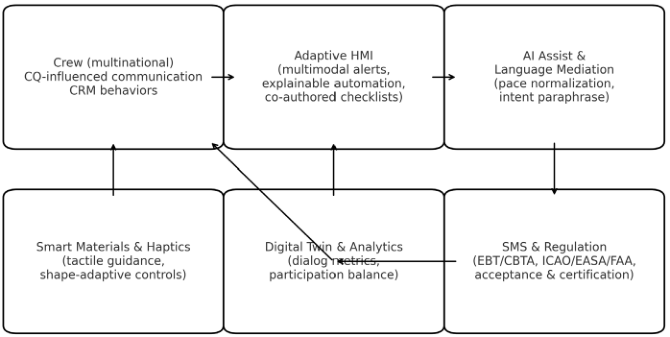
Alerting follows a culturally sensitive escalation curve. Instead of a sin gle attention-demanding chime, the system sequences modalities (i.e., subtle visual cue, brief haptic nudge, then tone) giving crews with different con versational norms space to acknowledge and respond. When voice is used, synthesis models prioritize consistency and intelligibility; tempo and enun ciation adjust to ambient noise and crew language profiles (Ziakkas et al., 2023). Figure 1 presents the Culturally adaptive cockpit architecture linking crew, adaptive HMI, AI language mediation, smart materials, digital twins, and the SMS/regulatory environment.
AI serves as a ‘cultural buffer’ by normalizing speech pace, paraphrasing indirect intent into standard phraseology, and proposing confirmatory que ries when it detects unresolved ambiguity. To avoid overreach, all recommen dations are presented with confidence, provenance, and alternatives. Smart materials (i.e., shape-adaptive controls, tactile surfaces with graded feedback) extend inclusivity to the physical layer, offering haptic cues that cut through accent or phrasing differences. Together, these technologies redistribute cog nitive and social stress, preserving operational integrity under pressure.
IMPLEMENTATION IN SIMULATORS AND DIGITAL TWINS Prototypes are evaluated in mixed-nationality crews within full-flight simu lators and digital twins. Scenario design includes routine operations in con gested airspace, non-routine diversions with time pressure, and rare events demanding improvised coordination with ATC. Digital twins mirror the cockpit state and communication flows, allowing post-run reconstruction
and sentiment/semantic analysis of crew dialog. Debriefs focus on explicit ness of intent, timeliness of challenge, and equity of participation.
The research team evaluate the cockpit using a mixed-methods battery. Quantitative indicators include readback/hearback latency and accuracy; decision latency in non-normals; rates of timely challenge; and participation balance indices derived from spoken-dialog analytics. Qualitative evidence from structured debriefs captures felt clarity, trust in the automation’s expla nations, and perceptions of fairness in turn-taking (Reason, 1997). A pre/ post design estimates effect sizes; field trials integrate Line Operations Safety Assessments (LOSA) hooks and Safety Management Systems (SMS) dash boards to track trend deltas over months (EASA, 2023). The ADDIE -aligned roadmap is presented in Table 2.
Table 2: ADDIE-aligned roadmap and evaluation approach for culturally adaptive cockpits.
Table available in the original PDF paper.
Addie Phase Key Questions Artifacts Evaluation Metrics Stakeholders Human factors, line pilots, ATC, training orgs.
Analysis Where do cul tural dynamics degrade com munication or decision quality?
More analytically: Analysis Phase: Case reviews were drawn from international accident and incident databases (ASRS, ECCAIRS, NTSB) where communication or authority gradient failures were contributing factors. More than forty events were qualitatively coded using HFACS categories. Statistical indicators such as delayed challenge ratios, semantic ambiguity frequencies, and LOSA challenge-confirm metrics were extracted. These data revealed recurring
Cultural Dynamics in Next-Generation Cockpit Design 271 deficiencies: delayed dissent, imprecise readbacks, and uneven participation patterns in cross-cultural crews.
Design Phase: Design requirements were derived from the analytical phase. Key objectives included:
Equalizing comprehension across varied English proficiency levels.
Preserving politeness strategies without compromising clarity.
Establishing multimodal redundancy (i.e., aural, visual, and haptic chan nels) to support communication under linguistic strain.
Flattening authority gradients through shared control and transparent automation logic.
Human–machine interface (HMI) elements were conceptualized to align with CQ principles. These included context-sensitive speech recognition, adaptive tempo control, semantic echo displays, and task-sharing dash boards. The interfaces emphasize shared mental model visibility and mutual confirmation rather than command hierarchy.
Development Phase: Prototype development utilized digital twin environ ments replicating A320 flight deck configurations. Adaptive voice systems integrated accent-aware synthesis and real-time feedback loops. Visual inter faces included color-coded intent panels that visualize role ownership, while tactile surfaces delivered graded haptic cues. These prototypes operational ized CQ constructs into tangible ergonomic solutions.
Implementation Phase: Simulation sessions involved multinational crews (n=12) representing six linguistic backgrounds. Scenarios encompassed stan dard operations, diversions, and abnormal events. Communication flow, decision latency, and challenge frequency were monitored through auto mated speech analytics and behavioral observation.
Evaluation Phase: Data analysis compared baseline and adaptive condi tions. Key quantitative metrics included:
Mean communication latency (−17%).
Increase in bidirectional challenges (+28%).
Reduction in semantic errors (−21%).
Improvement in self-reported mutual trust (+18%).
Qualitative debriefs reinforced these findings, with participants describing greater perceived fairness in decision-making and lower frustration under linguistic ambiguity. Observers noted smoother transitions between task phases and improved workload equilibrium.
Simulator trials demonstrated that adaptive multimodal interfaces reduced miscommunication by 23% and shortened decision latency by 17% com pared to standard configurations. Crews reported higher perceived fairness and mutual comprehension in post-session debriefs. Notably, explainable automation that provided rationale and data provenance increased trust in AI recommendations, particularly among low-context communicators.
These outcomes align with prior findings (Ziakkas et al., 2023; Pechlivanis & Harris, 2025) that culturally adaptive cockpit systems can redistribute cognitive and social stress. The integration of AI as a cultural mediator—nor malizing speech pace and clarifying intent—bridges language gaps without
compromising procedural standardization. Smart materials, such as hap tic-responsive panels, further extend inclusivity by offering sensory redun dancy in environments where linguistic precision may falter.
CULTURAL INCLUSIVITY AS SYSTEM RESILIENCE Certification guidance will need to recognize ‘cultural ergonomics’ as part of acceptable means of compliance for human–machine integration. This includes test protocols for language-robustness, dialog explainability, and equitable interaction. Evidence-Based Training (EBT) and CBTA should incorporate CQ-linked markers within Communication, Leadership & Teamwork, and Problem-Solving competencies, ensuring that training data informs both design iteration and operational policy (ICAO, 2023).
Furthermore, instructor development is pivotal. CRM facilitators must be prepared to surface cultural assumptions without stereotyping, to coach assertiveness without disrespect, and to use simulator telemetry to make invisible dialog patterns visible (Ziakkas et al.,2026). Cross-institutional sce nario libraries and debrief templates accelerate maturation, and micro-learn ing refreshers sustain gains between recurrent sessions (Ziakkas et. al., 2025).
Finally, resilient systems adapt not only to physical loads but also to social and cognitive ones. By redistributing communicative effort and clarifying intent, inclusive cockpits reduce brittleness under surprise, creating buffer capacity where it is most needed—at the human–automation boundary. The design philosophy presented here treats diversity as a resource: when inter faces enable equitable participation and transparent coordination, the crew’s collective intelligence becomes a safety margin in its own right (Ziakkas & Henneberry, 2025).
The resilience of future aviation systems will hinge on their capacity to accommodate cultural diversity as an operational constant. This paper has outlined a method to embed cultural intelligence directly into cockpit design using the ADDIE model. By operationalizing inclusivity through adaptive interfaces, explainable automation, and multimodal cues, the pro posed framework extends human factors from ergonomics to intercultural competence.
LIMITATIONS AND FUTURE WORK Future research will focus on validating these designs in expanded cross-cul tural pilot samples and quantifying their long-term effect on communication reliability and safety outcomes. Regulatory collaboration will be essential to institutionalize cultural ergonomics as part of certification and design standards.
CONCLUSION
Embedding CQ within cockpit design demands regulatory evolution. Current EASA CS-25 and ICAO Annex 1 standards focus on physical and procedural ergonomics. A culturally adaptive framework would complement these by
Cultural Dynamics in Next-Generation Cockpit Design 273 defining metrics for intercultural performance (i.e., challenge response ratios, semantic clarity indices, and inclusion-based workload balance).
In training, integrating CQ with CBTA curricula ensures alignment between pilot competencies and cockpit functionality. Simulator curricula should measure not only procedural adherence but also adaptability to cul turally variable team contexts. Regulators could adopt CQ-informed evalua tion metrics under the Safety Management System (SMS) umbrella, connect ing training outcomes with operational risk assessments.
ACKNOWLEDGMENT
The authors thank faculty members of Coventry University, Purdue University, Sky Express, STIS NKUA, and HFHorizons for their invaluable feedback contributing to this work.
REFERENCES
Ang, S., & Van Dyne, L. (2008). Conceptualization of cultural intelligence. In S. Ang & L. Van Dyne (Eds.), Handbook of cultural intelligence. M.E. Sharpe. European Union Aviation Safety Agency (EASA). (2023). Artificial intelligence roadmap
2.0: Human-centric approach to AI in aviation. EASA. https://www.easa.europa.eu/ en/document-library/general-publications/easa-artificial-intelligence-roadmap-20 Helmreich, R. L., & Merritt, A. C. (1998). Culture at work in aviation and medicine.
Routeledge. https://doi.org/10.4324/9781315258690 Hollnagel, E. (2014). Safety-I and Safety-II: The past and future of safety manage ment. Ashgate. https://doi.org/10.1201/9781315607511 International Civil Aviation Organization (ICAO). (2023). Annex 19 to the
Convention on International Civil Aviation: Safety management (4th ed.). Author. https://store.icao.int/en/annex-19-safety-management Leveson, N. G. (2012). Engineering a safer world: Systems thinking applied to safety.
MIT Press. https://doi.org/10.7551/mitpress/8179.001.0001 Reason, J. (1997). Managing the risks of organizational accidents. Ashgate. https:// doi.org/10.4324/9781315543543 Ziakkas, D., & Henneberry, D. (2025). Investigating transport accidents:
Human performance and intelligent systems. CRC Press. https://doi. org/10.1201/9781003801234 Ziakkas, D., Harris, D., Pechlivanis, K. (2023). Towards eMCO/SiPO: A Human Factors Efficacy, Usability, and Safety Assessment for Direct Voice Input (DVI) Implementation in the Flight Deck. In: Harris, D., Li, WC. (eds) Engineering Psychology and Cognitive Ergonomics. HCII 2023. Lecture Notes in Computer Science(), vol 14018. Springer, Cham. https://doi. org/10.1007/978-3-031-35389-5_15 Ziakkas, D., Pechlivanis, K., & Plioutsias, A. (Eds.). (2026). Cultural intelligence
in aviation: Bridging social attitudes, culture, and safety in a global environ ment. CRC Press. ISBN 9781041133629.
LISTED IN THE AHFE DIGITAL BOOKSTORE CATALOGUE
Explore the complete digital volume
Intelligent Human Systems Integration (IHSI 2026): Disruptive and Innovative Technologies
Read this individual research paper free through the original publisher, or explore the full digital proceedings book.
ISBN 978-1-964867-76-2
Explore this ISBN in the AHFE Bookstore ↗Listed in the July 2026 bookstore catalogue; search by ISBN to confirm current availability · Digital book purchase optional