Dimitrios Ziakkas, Debra Henneberry, Ioanna Lekea (2026). The Role of Ethics and Public Acceptance in Transportation Accident Investigations: The Greek Case Study. In: Intelligent Human Systems Integration (IHSI 2026): Disruptive and Innovative Technologies. AHFE Open Access, vol. 200, pp. 466–474. https://doi.org/10.54941/ahfe1007105
Transportation safety investigations aim not only to identify technical failures but also to understand the broader human and organizational factors that contribute to accidents. In recent years, public acceptance has emerged as a critical determinant of the effectiveness of these investigations. Communities increasingly demand accountability, transparency, and ethical integrity in the processes that follow aviation and transportation accidents. The Greek case study presented here, centered on the War Games Laboratory of the Hellenic Air Force Academy (Department of Aeronautical Sciences, Division of Leadership-Command, Humanities and Physiology), and the National and Kapodistrian University of Athens Science, Technology and Innovation in Society (STIS) Laboratory, examines how ethics and public acceptance interact as fundamental components of accident investigation, prevention, and systemic resilience. The study is part of a broader research hub (2024–2027), in collaboration with Coventry University, Purdue University and Centre for Research and Technology Hellas (CERTH), which explores the role of individual and organizational ethics in shaping safety outcomes across civil and military aviation. Ethical lapses—such as the concealment of errors, tolerance of procedural violations, or pressure to prioritize efficiency over safety—often act as hidden precursors to accidents. Yet without public trust, the findings of investigative bodies risk being disregarded or contested, limiting their impact on future safety improvements. This dual lens of ethics and acceptance situates the human factor not only within operational decision-making but also within the socio-cultural ecosystem in which aviation systems are embedded. Methodologically, the project employs the International Civil Aviation Organization (ICAO) ADDIE approach (Analysis, Design, Development, Implementation, Evaluation) to integrate ethical reflection into the investigative and training cycle. The Analysis phase systematically reviews Greek and international accident reports, highlighting instances where ethical considerations shaped either the causation or the outcome of investigations. The Design and Development phases employ the War Games Laboratory to create immersive simulations of ethically complex accident scenarios. Finally, the Evaluation phase measures changes in ethical awareness, decision-making behavior, and levels of public trust in investigative outcomes. Artificial intelligence (AI) and data analytics allow the detection of hidden ethical vulnerabilities in accident databases, while virtual reality simulations in the War Games Laboratory provide immersive environments for training and reflection. This alignment of ethics with smart, adaptive systems mirrors the role of smart materials in aerospace. By focusing on the Greek case study, this research demonstrates how national institutions can serve as laboratories for integrating ethics and public trust into global aviation safety practices.
Investigations are most effective when technical truth and social legiti macy advance together. In aviation, a robust causal narrative is not enough; authorities also need public confidence that the process is fair, independent, and ethically anchored. The Greek case study examines how professional practice and public trust can be designed to reinforce one another. It draws on systems thinking to situate ethical decision-making within the larger con trol structure of safety management and oversight, recognizing that a culture of transparency and fairness is itself a safety control that reduces ambigu ity, encourages reporting, and accelerates learning (Reason, 1997; Hollnagel, 2014). In such a culture, investigators and operators are partners in learn ing rather than adversaries in blame, and the community is treated as an informed stakeholder rather than an external audience. Greece provides a vivid context for this inquiry. The country’s geography, with hundreds of inhabited islands and complex meteorology, produces operational scenar ios where time pressure, resource constraints, and multi-agency coordina tion interact. Civil and military operations often share airspace and infra structure, and investigative outcomes can attract intense media attention. A strong safety narrative must therefore include explicit commitments to eth ical conduct—clarity about roles and boundaries, protection of confidential sources, and balanced communication with families and the public—so that the technical findings are not undermined by perceived unfairness or opacity (AAIASB, 2006; ICAO, 2023).
This paper articulates a practical pathway for integrating ethics and pub lic acceptance into the investigation lifecycle. It leverages the War Games Laboratory at the Hellenic Air Force Academy to prototype ethically com plex scenarios and the STIS Laboratory at the National and Kapodistrian University of Athens to analyse public narratives and trust dynamics. It also aligns with European regulatory doctrine—specifically European Risk Classification Scheme (ERCS) risk-based oversight and European Union Aviation Safety Agency’s (EASA’s) human-centric AI guidance—so that the model is technically, ethically, and institutionally coherent (EASA, 2023). This paper focuses on the aviation case study – as the railway transportation section will be presented in an upcoming publication.
The Greek aviation ecosystem is characterized by diverse mission sets: scheduled airline operations, seasonal charter peaks, challenges in Air Traffic Control capabilities, medical evacuations, search and rescue, and military training flights. These missions create stressors that are not only technical but also ethical and communicative. For example, the decision to proceed or divert under schedule pressure is not merely a fuel or meteorology calcu lation; it is also a discussion about prudence, accountability, and the justi fication that will later be offered to passengers, managers, and, if necessary, investigators (Airbus, 2024).
Institutionally, Greece maintains investigative and regulatory bodies aligned with International Civil Aviation Organization (ICAO) Annex 13 and Annex 19 provisions, as well as European frameworks for safety oversight. The War Games Laboratory and STIS Laboratory complement these struc tures by enabling pre-emptive learning: war-gaming likely failure pathways, rehearsing transparent communication, and evaluating fairness perceptions before real events test legitimacy. This pre-investigation investment increases the likelihood that when an accident occurs, the investigation can proceed with both technical fluency and public credibility.
The Helios Airways Flight HCY522 accident remains a touchstone for the system-wide nature of aviation safety. It illustrates how design decisions, pro cedural clarity, training, and organizational culture co-produce outcomes, and how public understanding of these interactions affects acceptance of the final report (AAIASB, 2006). By using historical analyses to inform current training, Greek institutions transform painful lessons into structured com petencies—technical, ethical, and communicative—that can be assessed and continuously improved.
METHODOLOGY
The project embeds ethics and public acceptance into the ADDIE (Analysis, Design, Development, Implementation, and Evaluation) cycle so that they are treated as design constraints, not afterthoughts (Table 1). During Analysis, Greek and international reports are reviewed to extract ethical antecedents such as normalization of deviance, confidentiality breaches, scapegoating narratives, and retaliation risks. These antecedents are coded alongside oper ational precursors so that the same event can be understood simultaneously as a technical breakdown and a moral inflection point (BEA, 2012; Leveson, 2012). Aviation Human Factors Analyst application used in the analysis phase (https://chatgpt.com/g/g-67681ccba4908191bd5e8f932258cf4c-avia tion-human-factors-analyst) providing a well-structured repost of each cate gory – theme -sub-theme.
Design translates these insights into requirements for training, investiga tion protocols, and communications. Learning outcomes are specified for moral awareness, judgement, and courage; for transparent and fair commu nication under time pressure; and for regulator–operator coordination that preserves independence while promoting learning. Design constraints include multilingual accessibility, cultural sensitivity, and privacy by design consis tent with European data-protection norms. Development produces virtual reality (VR)-enabled scenarios in the War Games Laboratory that emulate ethically complex accident timelines. Participants face conflicting cues, com peting demands, and ambiguous authority structures. The STIS Laboratory develops complementary analytic tools that map how different communica tion strategies shape public narratives, measuring trust and perceived fair ness across demographic groups in controlled simulations. Implementation deploys the training and engagement modules to pilots, controllers, main tainers, managers, investigators, and regulatory staff, and also convenes moderated forums with community representatives to test transparency protocols. Digital platforms support asynchronous participation, enabling geographically dispersed units to engage with the material and contribute
The Role of Ethics and Public Acceptance in Transportation Accident Investigations 469 reflections that later inform organisational learning. Finally the Evaluation phase uses mixed methods to track change over time and key – safety per formance indicators (K-SPI’s). Quantitative measures include ethical decision quality and intention to speak up in scenario probes, as well as a transpar ency index for investigative communications. Qualitative analysis examines shifts in justification depth, comfort with dissent, and recognition of ethical tension points. At the system level, ERCS distributions and recommendation implementation rates are monitored to capture downstream safety effects (ICAO, 2023; EASA, 2023).
Table 1: Research methodology overview.
Table available in the original PDF paper.
Mitigations
Phase Ethical Stressors Public Accep tance Risks
Indicators/ Evidence
Pre-occurrence (prevention)
Low trust in reg ulators and oper ators; perception of neglect.
Audit gaps; K-SPI imbal ance; reach and comprehension of safety.
Rebalanced KPIs; resourcing trans parency; proac tive engagement campaigns.
Incentive misalignment; under-resourced oversight; weak safety promotion and dialogue.
On-scene & field investigation
Access inequities; selective disclo sure; timeline control subject to media pressure.
Access logs; chain-of-custody strength; cadence and content of factual briefings.
Open evidence protocols; regu lar multilingual updates; trained family liaison.
Suspicion of cover-up; delegit imizing narra tives; secondary victimization of families.
Analysis & drafting
Hindsight bias; premature nar rative closure; scapegoating rather than sys tems analysis.
Polarized reactions; contestation of drafts; erosion of cross-institution al trust.
Diversity of SME inputs; docu mented challenge sessions; Just Culture consis tent language.
War Games Laboratory & STIS: Simulation-Derived Ethical Imsight The War Games Laboratory enables controlled exposure to ethically con sequential decisions. Rather than merely instructing participants about pol icy, scenarios require them to commit to a course of action and to defend it under scrutiny. Participants experience how apparently minor shortcuts compound, how ambiguous commands foster silence, and how conflicting goals shape judgement. These experiences become artefacts for analysis in the STIS Laboratory, which examines narrative evolution across professional and public audiences.
A representative scenario positions a mixed civil–military task force responding to a night-time emergency diversion during weather deteriora tion. Participants must decide whether to continue, divert, or hold, while simultaneously managing communications with air traffic control, opera tions, and local authorities. The scenario includes a media leak, creating a live pressure to disclose information without jeopardizing the investigation. Outcomes are not graded as right or wrong; rather, they are analysed for transparency, fairness, and respect for procedure under uncertainty.
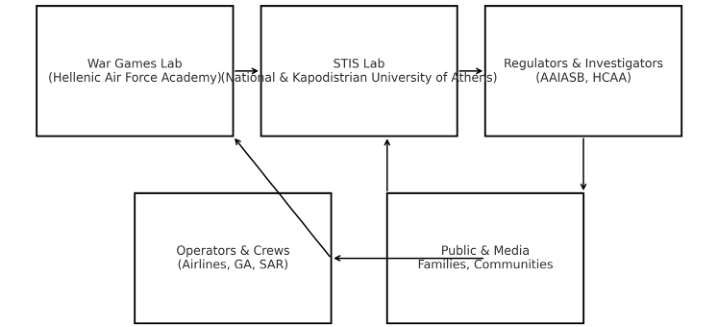
The STIS Laboratory’s methods include sentiment analysis of simulated press releases, comprehension testing for public briefings, and fairness assess ments of accountability statements. These analyses identify communication features that increase trust, such as explicit acknowledgement of uncertainty, clear separation of established fact from hypothesis, and visible commitment to learning rather than blame – following the ethics -acceptance- resilience loop (Figure 1).
Figure 1: The ethics -acceptance – resilience loop presentation.
Emerging Technologies: AI, Data Analytics & Virtual Reality Artificial intelligence (AI)-enabled text and data mining can surface subtle ethical patterns in incident narratives, such as systematic under-reporting around specific operational pressures or repeated ambiguities in responsi bility handovers. Aligned with EASA’s human-centric AI principles, analytic models are required to be explainable and auditable so that training and investigation teams can challenge and refine them (EASA, 2023). Models are documented with provenance and limitations, and outputs are presented as decision aids rather than authorities.
Virtual reality modules simulate time pressure, distraction, and cultur al-linguistic variability, thereby making ethical decision-making an embod ied experience rather than an abstract concept. These modules incorporate realistic voice communications, cockpit or operations centre interfaces, and public-facing messaging sequences. Participants reflect not only on what they chose but on how the situation felt, what cues they attended to, and what they might change in design, training, or policy to make ethical action easier.
The Role of Ethics and Public Acceptance in Transportation Accident Investigations 471 Data governance is treated as an ethical domain in its own right. Training and evaluation data are anonymised, stored with strict access controls, and used under clear consent regimes. This approach aligns with European pri vacy norms and reinforces public confidence that participation in safety learning does not expose individuals to punitive risk.
Evaluation Design & Metrics The evaluation strategy balances rigour with practicality. A pre–post–fol low-up design measures immediate learning and retention. Ethical decision quality is rated using scenario rubrics that parse recognition of moral ten sion, justification depth, and willingness to escalate concerns through for mal channels. The transparency index assesses clarity, cadence, and content of investigative communications through blinded ratings by trained coders from the STIS Laboratory.
To capture system effects, ERCS distributions are monitored for shifts in the frequency and severity of ethics-linked occurrences, and recommenda tion implementation is tracked over time with public dashboards. Qualitative debriefs probe how participants experience power distance, time pressure, and uncertainty, and whether training altered their willingness to speak up or to demand clarity. This triangulation acknowledges that ethical competence is not a single skill but a pattern of behaviour, perception, and institutional support.
Table 2: ADDIE-aligned evaluation framework for ethics and public acceptance.
Policy & Education Implications Policy must make ethics and legitimacy operational. A practical starting point is to define ethics indicators within safety management systems (SMS) that are auditable and as concrete as technical ones. These include cadence and clarity of factual updates during investigations, visibility of non-retaliation commitments, independence of peer review in draft reports, and traceability from recommendations to implemented changes. Integrating these indicators into internal audits and external oversight aligns incentives for transparency with the system’s safety goals (ICAO, 2023).
In Greece, policy can leverage existing strengths: joint civil–military train ing infrastructures, strong academic partners, and an engaged public. A national transparency protocol can specify when and how factual updates are issued, what languages and channels are used, and how uncertainty is communicated without speculation. Such a protocol reduces room for narra tive drift while respecting investigative independence. It also models fairness by institutionalizing high-quality communication with families and commu nities most affected by accidents.
Education policy should treat ethical competence as a learning out come that can be taught, practised, and assessed. At the Hellenic Air Force Academy and partner universities, curricula in leadership and human sci ences can incorporate VR-based simulations and structured debriefs that foreground ethical trade-offs. At Purdue University and Coventry University, similar modules can anchor Competency-Based Training and Assessment (CBTA) syllabi, connecting practical decision-making with reflective justifica tion and policy literacy (Pechlivanis and Ziakkas, 2025). Cross-institutional exchanges would allow instructors to share scenario libraries and assessment rubrics, accelerating maturation of the field.
Finally, policy should consider the ethical implications of AI in investiga tion and training. Model documentation, bias testing, and human-in-the-loop review processes must be mandated, not optional. This ensures that analytic assistance does not replace judgement and that accountability remains legi ble when algorithmic tools shape the sequence and emphasis of investigative activities (EASA, 2023).
DISCUSSION
Ethics and public acceptance form a double helix in the DNA of credible investigation. Each strand strengthens the other; ethics motivates transparent practice, while public acceptance rewards and sustains it. In this configura tion, legitimacy is a measurable system property that can be designed and maintained through training, communication protocols, and oversight. The smart-systems analogy is useful because it makes the moral architecture vis ible: sensors detect stress, structures redistribute load, and the system avoids brittle failure by enabling graceful adaptation (Hollnagel, 2014).
The Greek case illustrates how this architecture can be built deliberately. By placing the War Games Laboratory and STIS Laboratory at the centre of a learning loop, stakeholders practice not only technical response but also ethical and communicative proficiency. Because legitimacy resides in
The Role of Ethics and Public Acceptance in Transportation Accident Investigations 473 perception as well as performance, these rehearsals pay dividends when real events occur, reducing speculation, clarifying roles, and fostering cooperative problem solving.
Some sceptics worry that increased transparency risks prejudicing legal outcomes or compromising proprietary information. The proposed trans parency protocol addresses these concerns by differentiating between fac tual updates and causal analysis, by redacting sensitive details while still acknowledging their existence, and by documenting the reasons for com munication choices. In this way, ethics and prudence are reconciled rather than opposed.
The same logic applies to AI. Properly governed, AI enhances ethical resil ience by surfacing weak signals, structuring complex datasets, and enabling consistent treatment of similar cases. Improperly governed, it can amplify bias or obscure accountability. Human-centric AI policy and practice there fore become part of the moral instrumentation that allows the system to adapt without losing its integrity (EASA, 2023; Dekker, 2019).
Limitation & Future Work This work is a design and validation study rather than a full population rollout. While the evaluation plan triangulates behavioural, communicative, and system metrics, attribution of system-level changes will require multi- year observation and careful control for confounding factors such as traffic levels and media cycles. Future research will extend the scenario corpus to maritime and rail domains, strengthen cross-cultural validation of commu nication materials, and pilot open-data repositories where appropriate to support independent peer review of anonymised findings.
CONCLUSION
Ethics and public acceptance are not auxiliary considerations but structural determinants of whether investigations produce learning and whether that learning translates into safer operations. By treating legitimacy as a design parameter and ethical competence as a trainable skill, the Greek ecosystem offers a replicable model for civil and military aviation. The integration of War Games and STIS capabilities, guided by ADDIE and aligned with inter national policy, provides a concrete path for embedding moral intelligence into the everyday practice of accident investigation.
ACKNOWLEDGMENT
The authors thank faculty members of Coventry University, Purdue University, Hellenic Air Force Academy, STIS NKUA, and HF Horizons for their invalu able feedback contributing to this work.
REFERENCES
Air Accident Investigation and Aviation Safety Board (AAIASB). (2006). Helios Airways Flight HCY522 crash at Grammatiko (Report No. 5/2002). Hellenic Ministry of Transport and Communications. https://www.faa.gov/sites/faa.gov/ files/2022-11/Helios737_AccidentReport.pdf Airbus. (2024). A statistical analysis of commercial aviation accidents 1958–2023.
https://accidentstats.airbus.com/wp-content/uploads/2024/02/20230873_A-Sta tistical-analysis-of-commercial-aviation-accidents-2024-version.pdf Bureau d’Enquêtes et d’Analyses Pour la Sécurité de l’AviationCivile (BEA). 2012.
Final Report on the Accident on 1st June 2009 to the Airbus A330-203 Registered F-GZCP Operated by Air France Flight AF 447 Rio de Janeiro—Paris. Paris: Bureau d’Enquêtes et d’Analyses Pour la Sécurité de l’AviationCivile. Dekker, S. (2019). Foundations of safety science: A century of understanding acci dents and learning. Routledge. https://doi.org/10.4324/9780429270209 European Union Aviation Safety Agency (EASA). (2023). Artificial intelligence road
map 2.0: Human-centric approach to AI in aviation. Cologne, Germany: European Union Aviation Safety Agency. https://www.easa.europa.eu/en/document-library/ general-publications/easa-artificial-intelligence-roadmap-20 Hollnagel, E. (2014). Safety-I and Safety-II: The past and future of safety manage ment. Ashgate. https://doi.org/10.1201/9781315607518 International Civil Aviation Organization (ICAO). (2023). Annex 19 to the
Convention on International Civil Aviation: Safety management (4th ed.). Montreal, Canada: International Civil Aviation Organization. https://store.icao. int/en/annex-19-safety-management Leveson, N. G. (2012). Engineering a safer world: Systems thinking applied to safety. MIT Press. https://doi.org/10.7551/mitpress/8179.001.0001 Pechlivanis, K., & Ziakkas, D. (2025). Prompt engineering in generative AI appli
cations for commercial single pilot operations (SiPO): An emerging com petency. Journal of Air Transport Management, 102,102916. https://doi. org/10.1016/j.jairtraman.2025.102916 Reason, J. (1997). Managing the risks of organizational accidents. Ashgate. Ziakkas, D., & Henneberry, D. (2025). Investigating transport accidents: Human performance and intelligent systems. CRC Press. https://doi. org/10.1201/9781003801234 Ziakkas, D., Plioutsias, A., & Pechlivanis, K. (2022). Artificial Intelligence in the aviation
decision-making process. The transition from extended Minimum Crew Operations to Single Pilot Operations (SiPO). Artificial Intelligence and Social Computing. AHFE (2022) International Conference. AHFE Open Access, vol 28. AHFE International, USA. http://doi.org/10.54941/ahfe1001452.
LISTED IN THE AHFE DIGITAL BOOKSTORE CATALOGUE
Explore the complete digital volume
Intelligent Human Systems Integration (IHSI 2026): Disruptive and Innovative Technologies
Read this individual research paper free through the original publisher, or explore the full digital proceedings book.
ISBN 978-1-964867-76-2
Explore this ISBN in the AHFE Bookstore ↗Listed in the July 2026 bookstore catalogue; search by ISBN to confirm current availability · Digital book purchase optional