Dimitrios Ziakkas, Debra Henneberry, Ioanna Lekea (2026). Ethics as a Human Factor in Flight Safety: Developing a Training Tool for the Prevention of Ethics-Related Aviation Accidents and Critical Incidents. In: Intelligent Human Systems Integration (IHSI 2026): Disruptive and Innovative Technologies. AHFE Open Access, vol. 200, pp. 475–482. https://doi.org/10.54941/ahfe1007106
The integration of emerging technologies with human factors research has reshaped the way aviation safety is understood and managed. While advances in smart materials enhance aircraft resilience by adapting to external pressures and mitigating physical risks, this study argues that the ethical dimension of human performance functions as an equally adaptive safeguard in complex socio-technical systems. By conceptualizing ethics as a human factor, this research explores how inclusive human-system integration requires not only technical robustness but also ethical resilience across individuals, organizations, and regulatory frameworks. Traditional approaches to aviation safety emphasize physiological, psychological, and cognitive dimensions, yet overlook the ethical decisions that underpin operational outcomes. Systematic analysis of aviation accidents reveals recurring ethical deviations—such as concealment of errors, tolerance of procedural violations, or organizational pressures—that directly compromise safety. Like smart materials that redistribute stress to prevent catastrophic failure, ethically resilient systems redistribute responsibility and accountability, ensuring transparency, communication, and procedural adherence. Positioning ethics as a structural layer of resilience connects the material and human dimensions of safety in a unified framework.The research employs a three-phase, mixed-methods methodology. First, accident reports and safety databases are reviewed to identify and classify ethical lapses as causal or contributory factors. Second, a conceptual model is developed that maps the pathways through which individual moral choices and organizational culture interact with technical and procedural constraints to influence safety outcomes. Third, this model informs the design of an interactive digital training tool—an e-learning platform that integrates realistic scenarios, simulations, and reflective exercises. Inclusive human-system design requires not only that aircraft adapt to stresses but also that humans and organizations adapt ethically to pressures of efficiency, hierarchy, and cultural diversity. Smart technologies and ethically resilient human systems create a synergistic model that enhances safety, prevents preventable accidents, and fosters trust in aviation as a global, inclusive enterprise.
Aviation has achieved historically low accident rates, yet preventable events persist when organizations drift toward normalized deviance, when teams are reluctant to speak up, or when poor design and ambiguous rules leave crews without ethically sound options. The aviation ecosystem has long modelled physiological, psychological, and cognitive contributors to error, but less attention has been paid to the ethical substrate of performance— the moment-to-moment judgments about honesty, responsibility, fairness, and courage that shape reporting, coordination, and compliance. Treating ethics as a human factor reframes safety as a moral-technical enterprise: one that depends on robust equipment and procedures, and also on trustworthy, transparent behaviour supported by Just Culture principles and systemic learning.
In this paper, ethics is analysed as an adaptive capability that helps human–system teams maintain control under uncertainty, consistent with systems perspectives on human performance and accident causation. Systems approaches—including Reason’s layers of defence, Rasmussen’s socio-technical hierarchies, Human Factors Analysis and Classification System (HFACS), System Theoretic Accident Model and Processes (STAMP) - Causal Analysis based on System Theory (CAST), and Safety-II—show that accidents emerge from interactions across people, tools, organizations, and regulators (Reason, 1997). Within this view, ethical decisions are not private or incidental; they are shaped by interface design, work-as-done, incentives, and oversight, and they, in turn, influence data integrity, communication, and recovery. Investigations repeatedly surface latent conditions such as ambig uous responsibilities, performance pressure, or inadequate training—condi tions that also drive ethical drift. Integrating ethics with established models connects moral judgement to control structures, feedback loops, and perfor mance variability seen in investigations and safety management.
METHODOLOGY
The presented research follows a three stage methodology, based on Safety II philosophy (Hollnagel, 2014). Phase 1 synthesizes accident and incident reports to identify ethics-relevant precursors and contributory factors (e.g., concealment of errors, tolerance of procedural workarounds, misreporting, or retaliation fears). The review is structured using a hybrid taxonomy aligned with HFACS and STAMP-CAST so that ethical devia tions can be traced through individual acts, team dynamics, supervision, and organizational influences (Ziakkas & Henneberry, 2025).
Phase 2 elaborates a conceptual model of ethical resilience that maps how moral awareness, judgement, motivation, and courage interact with cockpit interfaces, training, and organizational incentives.
Phase 3 translates the model into an interactive training tool (e-learning and scenario-based simulations) piloted in civil and military contexts with pre/post measures of ethical reasoning, speaking-up intentions, and safety behaviour.
Ethics as a Human Factor in Flight Safety 477 The following table (Table 1) presents elements of the selected methodology.
Table 1: Research methodology overview.
Table available in the original PDF paper.
Category Operational Definition
Aviation Examples
Primary Data Sources
Preventive Controls
Concealment/ withholding
Intentional omis sion or alteration of safety-relevant information.
Just Culture policy, non-pu nitive reporting, independent debriefs.
Non-reporting of unstable ap proach; selective cockpit voice recorder recol lection;
Cockpit voice recorder/flight data recorder concordance, aviation safe ty reporting narratives, maintenance logs, European Risk Classification Scheme trend signals.
Workaround normalization
Routine violation of a procedure perceived as effi cient or benign.
Human-centred Standard Oper ating Procedure redesign, explicit risk assessments, with feedback.
Bypassing check list verification; habitual late briefings; Mini mum Equipment List interpreta tion.
Line observa tions, Line-Ori ented Flight Training notes, findings, safety management sys tems occurrence data.
Undue pressure Explicit or implicit incentives that prioritise throughput over prudence.
Gate departure targets overrid ing pressure; rostering beyond fatigue limits.
Mode confusion in automation handover with contradictory cues; alert priori tization conflicts.
Flight data monitoring flags, simulator notes, Human Machine Interface usability tests.
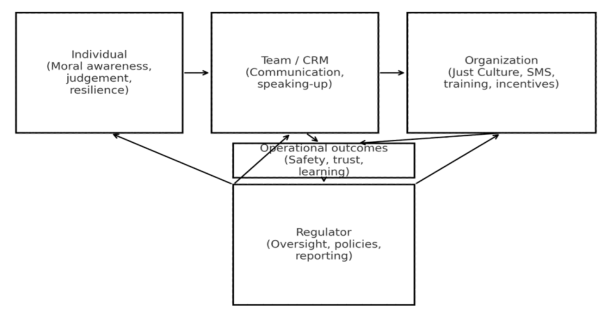
Conceptual Model: The Ethical Resilience Pathways The proposed conceptual model (Figure 1) treats ethics as a distributed capability spanning four coupled levels: individual (moral awareness and judgement under workload), team (communication and speaking-up), orga nization (Just Culture, incentives, training, and Safety Management Systems), and regulator (reporting frameworks, oversight, and harmonised guidance, Airbus, 2024). Information and accountability flow bi-directionally across these levels. When one level is weakened—for example, when an interface obscures system state—other levels compensate by clarifying expectations, managing workload, or creating protected time to think. The model supports traceability from ethical micro-decisions to safety outcomes and back to design and policy levers (AAIASB, 2006).
Figure 1: The conceptual model presentation.
Training Tool Design and Implementation The training tool is an e-learning platform that integrates narrative cases, interactive branching scenarios, Simulated Air Traffic Control Environment (SATCE) - style communication vignettes, and reflective prompts (Ziakkas et al., 2022). The scenarios are derived from anonymised inves tigation narratives and aligned with competency frameworks so that com munication, workload management, and judgement under uncertainty are practised together (BEA, 2012). Features include adaptive feedback, debrief transcripts that contrast work-as-imagined with work-as-done, and prompts for articulating ethical justifications. To encourage transfer, learners anno tate decisions with the policy clauses, Standard Operating Procedures (SOPs) steps, or human factors principles they are invoking; the tool then visualises how choices affect team workload and system margins.
Validation and Evaluation Evaluation uses a pre/post mixed-methods design. Quantitative measures track gains in moral awareness, intention to speak up, risk recognition, and
Ethics as a Human Factor in Flight Safety 479 rule-use under time pressure. Qualitative data from debrief interviews exam ine reasoning quality and barriers to ethical action (e.g., workload, ambigu ity, fear of repercussions). Flight departments and ATC units pilot the tool in recurrent training, with follow-up checks of reporting volume and qual ity, European Risk Classification Scheme (ERCS) risk profiles, and simula tor performance on ethics-inflected Line-Oriented Flying Training (LOFT) scenarios.
Table 2: Evaluation metrics and success criteria for the ethics training tool.
Table available in the original PDF paper.
Dimension Measures and Instruments When Measured Success Criteria Moral awareness & judgement Pre, immediate post, +3 months Multidimensional Ethics Scale short form; scenario-based judgement rubric.
≥0.5 SD improvement sustained; qualitative reasoning shows rich er justification.
POLICY AND EDUCATION IMPLICATIONS Integrating ethical resilience into aviation policy requires a fundamental shift from compliance toward proactive governance that recognizes moral decision-making as a systemic factor in safety performance. International Civil Aviation Organizations’ Annex 19 (4th edition) underscores that Safety Management Systems (SMS) are not only technical but also moral frameworks that depend on trust, fairness, and transparent learning processes (ICAO, 2023). Embedding ethical key performance indicators (KPIs) into SMS audits ensures that accountability and fairness are measured alongside incident rates and risk scores. Regulators such as European Union Aviation Safety Agency (EASA) have begun operationalizing this shift through the European Risk Classification Scheme (ERCS), which now integrates cultural and orga nizational precursors into risk evaluation. Policies that institutionalize moral reasoning—such as ethical audits of decision boards and fair accountability reviews—encourage learning before failures rather than punishment after them. At the organizational level, the integration of Just Culture and ethi cal resilience can be realized through three policy levers: ethical reporting incentives, leadership evaluation tied to transparency, and cross-functional ethics committees that review high-risk operational decisions. Incorporating
these measures into SMS documentation aligns policy, culture, and human performance objectives (Dekker, 2011). The approach mirrors the adaptive properties of smart systems—absorbing pressure through distributed struc tures—where moral load-sharing prevents the isolation or scapegoating of individuals after incidents. The relationship between moral agency and resil ience thus becomes codified within safety policy.
Education policy must support this transformation by embedding ethics into competency frameworks across aviation disciplines. At Purdue University, USA and the Hellenic Air Force Academy, Greece, curricular initiatives now position ethics as a measurable competency within Competency Based Training Assessment (CBTA) frameworks. Scenario-based training rep licates real dilemmas—such as balancing fuel efficiency with environmental responsibility or procedural compliance with operational tempo—prompt ing reflective decision-making under stress. This builds on the SATCE-CBTA- SiPO methodologies demonstrated in prior research (Ziakkas et al., 2022).
In military training environments, ethics is further linked to leadership accountability, emphasizing integrity in command decisions, operational transparency, and respect for international humanitarian obligations. Culturally inclusive ethics education also addresses bias and hierarchy in multinational operations. Training that fosters ethical dialogue across cul tures enhances communication in mixed crews, mitigates misunderstanding, and promotes shared situational awareness (Wiegmann and Shappell, 2017). By equipping personnel to recognize and navigate moral tension points, such programs extend the reach of Just Culture beyond legal compliance into moral competence. Ultimately, ethical education and policy converge on a shared outcome: resilient human-system integration in which decisions are both safe and just.
DISCUSSION
Viewing ethical resilience through the lens of smart systems reframes the human as an intelligent, adaptive material within socio-technical archi tectures. Smart materials prevent structural failure by redistributing load; similarly, ethical systems prevent organizational collapse by redistributing responsibility and reinforcing moral communication. In aviation, this manifests through self-correcting feedback loops that connect cockpit behaviours, team interactions, organizational policies, and regulatory learning cycles. Ethical resilience ensures that weak signals—ambigu ous concerns, subtle doubts, or procedural drift—are not silenced but transformed into actionable intelligence through transparent dialogue. The analogy extends further: as smart materials possess sensors that monitor stress and trigger adaptive responses, ethically mature systems embed sensing mechanisms in their culture—confidential reporting, safety observation pro grams, and reflective debriefs—that detect ethical fatigue before it manifests as operational failure. These adaptive loops parallel the system-theoretic principles of STAMP (Leveson, 2012) and Safety-II, emphasizing the flow of feedback and learning over linear causality.
Ethics as a Human Factor in Flight Safety 481 The integration of AI into this architecture introduces a new dimension: ethical resilience must now account for algorithmic transparency, data integrity, and bias mitigation. EASA’s AI Roadmap 2.0 (2023) calls for ‘explainability’ as a human-centric design imperative, positioning moral traceability as a safety requirement, not a philosophical ideal (EASA, 2023). In this context, human-AI collaboration becomes a co-evolutionary process where both entities learn from each other’s ethical signals. AI sys tems capable of explaining not only what decision is made but why it aligns with safety and fairness principles extend moral cognition into the digital domain. By integrating ethical constraints within machine logic, designers reinforce human agency rather than replace it. This notion res onates with Dekker’s (2019) view that learning and accountability must evolve together if organizations are to remain resilient under complex ity. The aviation sector’s move toward Advanced Air Mobility (AAM) and autonomous operations further elevates ethical resilience to a societal level. Public acceptance of these technologies will hinge not only on reli ability metrics but on perceived fairness, inclusivity, and accountability in automated decision-making. Hence, ethical resilience becomes a strategic enabler of legitimacy—a source of public trust in intelligent transportation systems. Just as fatigue management matured from compliance to science, ethical resilience must evolve from policy statement to operational capa bility. Embedding ethics as a performance variable—measurable, trainable, and reviewable—ensures that the human factor continues to serve as the conscience of smart systems.
CONCLUSION
Ethics, treated as a human factor, provides practical leverage for preventing accidents in complex socio-technical systems. A taxonomy of ethics-related deviations, a pathways model of ethical resilience, and a validated train ing tool together translate moral intent into operational capability. This human-centred approach complements technical robustness, builds inclu sion and trust, and aligns with contemporary investigation methods that seek learning over blame.
ACKNOWLEDGMENT
The authors thank faculty members of Coventry University, Purdue University, Hellenic Air Force Academy, and HF Horizons for their invaluable feedback contributing to this work.
REFERENCES
Air Accident Investigation and Aviation Safety Board (AAIASB). (2006). Helios Airways Flight HCY522 crash at Grammatiko (Report No. 5/2002). Hellenic Ministry of Transport and Communications. https://www.faa.gov/sites/faa.gov/ files/2022-11/Helios737_AccidentReport.pdf
Airbus. (2024). A statistical analysis of commercial aviation accidents 1958–2023.
https://accidentstats.airbus.com/wp-content/uploads/2024/02/20230873_A-Sta tistical-analysis-of-commercial-aviation-accidents-2024-version.pdf Bureau d’Enquêtes et d’Analyses Pour la Sécurité de l’AviationCivile (BEA). 2012.
Final Report on the Accident on 1st June 2009 to the Airbus A330-203 Registered F-GZCP Operated by Air France Flight AF 447 Rio de Janeiro—Paris. Paris: Bureau d’Enquêtes et d’Analyses Pour la Sécurité de l’AviationCivile. Dekker, S. (2011). Drift into failure: From hunting broken components to understand ing complex systems. Ashgate Publishing. https://doi.org/10.4324/9781315578047 Dekker, S. (2019). Foundations of safety science: A century of understanding acci
dents and learning. Routledge. https://doi.org/10.4324/9780429270209 European Union Aviation Safety Agency (EASA). (2023). Artificial intelligence road map 2.0: Human-centric approach to AI in aviation. Cologne, Germany: European Union Aviation Safety Agency. https://www.easa.europa.eu/en/document-library/ general-publications/easa-artificial-intelligence-roadmap-20 Hollnagel, E. (2014). Safety-I and Safety-II: The past and future of safety manage
ment. Ashgate. https://doi.org/10.1201/9781315607518 International Civil Aviation Organization (ICAO). (2023). Annex 19 to the Convention on International Civil Aviation: Safety management (4th ed.). Montreal, Canada: International Civil Aviation Organization. https://store.icao. int/en/annex-19-safety-management Leveson, N. G. (2012). Engineering a safer world: Systems thinking applied to
safety. MIT Press. https://doi.org/10.7551/mitpress/8179.001.0001 Reason, J. (1997). Managing the risks of organizational accidents. Ashgate. Wiegmann, D. A., & Shappell, S. A. (2017). A human error approach to aviation accident analysis: The HFACS (2nd ed.). Routledge. Ziakkas, D., & Henneberry, D. (2025). Investigating transport accidents:
Human performance and intelligent systems. CRC Press. https://doi. org/10.1201/9781003801234 Ziakkas, D., Plioutsias, A., & Pechlivanis, K. (2022). Artificial Intelligence in the aviation decision-making process. The transition from extended Minimum Crew Operations to Single Pilot Operations (SiPO). Artificial Intelligence and Social Computing. AHFE (2022) International Conference. AHFE Open Access, vol. 28. AHFE International, USA. http://doi.org/10.54941/ahfe1001452.
LISTED IN THE AHFE DIGITAL BOOKSTORE CATALOGUE
Explore the complete digital volume
Intelligent Human Systems Integration (IHSI 2026): Disruptive and Innovative Technologies
Read this individual research paper free through the original publisher, or explore the full digital proceedings book.
ISBN 978-1-964867-76-2
Explore this ISBN in the AHFE Bookstore ↗Listed in the July 2026 bookstore catalogue; search by ISBN to confirm current availability · Digital book purchase optional