Eusébio Conceição, Vasco Correia, Maria Inês Conceição, Maria Manuela Lúcio, João Gomes, Hazim Awbi (2022). Design of a Ventilation System Using a Vertical Confluent Multi-jets System. In: Human Interaction & Emerging Technologies (IHIET-AI 2022): Artificial Intelligence & Future Applications. AHFE Open Access, vol. 23. https://doi.org/10.54941/ahfe100848
The design of a ventilation system using a vertical confluent multi-jets system is analyzed in this study. In this work is made not only the design, but also the de-scendent airflow calculation. In the inlet system, the vertical confluents jets sys-tem is made with two horizontal ducts located above the head level. The outlet system is built with six vertical ducts located in the central area above the head level. The design was developed inside an experimental chamber with dimensions of 4.50×2.55×2.50 m3 and was built with an inlet and an outlet systems using ducts with 0.15 m diameter. The vertical ducts are made with consecutive nozzles in both sides of the horizontal main duct. The vertical, longitudinal and transversal airflow fields are evaluated. The results show that this ventilation system furthers the extraction of contaminating human bio-effluents and guarantees low levels of Draught Risk.
One of the ways to promote thermal comfort (see Conceição and Lúcio, 2016) and indoor air quality (see Conceição et al., 1997a) conditions in an occupied area is through the insufflation of air jets in the ventilated space (see Conceição et al., 1997b), promoting air renewal and removal of thermal loads harmful to human comfort.
Insufflation jets higher momentum in comparison to its surrounding fluid medium characterizes air jet flow, according to a room-ventilated system. Differing from other types of fluid, the interaction between the flow of the jet and the boundary layer (known as entrainment), plays a major role in the development of the flow within the jet. In real-world applications, for example, in most mechanically ventilated buildings, jet flow is used for ventilation usually of two types, namely displacement ventilation and mixing ventilation (Awbi, 2004). In Cho et al. (2004), experimental measurements on the diffusion of wall confluent jets have been study. An effective mix of the jet flow is thus crucial before reached the air extraction point in the room. Ineffective air mixes may render some regions of the space improperly ventilated resulting in temperature gradients beyond acceptable rates and causing draughts. According with the work of Knystautas (1964), the static pressure variations measured on a series of jets holes in line differ from the surrounding pressure by less than 0.5%. Studies related to the fundamentals and characteristics of a single jet were carried out by Heskestad (1965) and Miller and Comings (1957), using laboratory resources for this evaluation. On the other hand, measurements in bi-dimensional jets with respect to the obtained flow profile characterizations were carried out in Miller and Comings (1960) and in relation to multiple jets in Corrsin (1944). Tanaka (1969) decided to carry out an original study looking for the interactions between air jets, making several experimental tests with two jets with a parallel circular section, varying the diameter of the holes and the spacing between them, thus allowing to graphically express the profile found in the resulting flow. Momentum flux in jet flow is conserved, for more details see Tanaka (1969). Experiments on the combined flow of dual jets are evaluated in Tanaka (1974). The three zones in profile evolution
Human Interaction & Emerging Technologies (IHIET-AI 2022) Artificial Intelligence & Future Applications https://openaccess.cms-conferences.org/#/publications/book/978-1-7923-8989-4 between the two parallel jets air flow are the Converging region, a merging region and the Combined region, for more details see Lai and Nasr (1998) and Zheng et al. (2016).
In this study, the vertical confluents multi-jets system principle is used (Karimipanah et al., 2000; Cho et al.,2004; Ghahremanian, 2014; Arghand et al., 2015). The system adopted in this work was based on a set of consecutive nozzles, with a 1.8 m of height from the floor level, promoting a descendent confluent wall jet airflow near the sidewalls of the room. This kind of system is suitable for heating and cooling. For example, the work presented by Cho et al. (2004) describes the high cooling loads they managed, namely greater than 40 W/m2 up to 67 W/m2.
In this work, using numerical methodologies, the comfort methodologies are used to promote acceptable thermal comfort and indoor air quality levels (see as example Conceição et al. (2000), for vehicles, and Conceição et al. (2009), for buildings). Different concepts and indexes, such as PMV (Predicted Mean Vote) and PPD (Predicted Percentage of Dissatisfied), were developed in Fanger (1970), and presented in ISO 7730 (2005).
In this work the application of the vertical confluents multi-jets system is done in an experimental space equipped with twelve seated occupants. The numerical model applied in this paper is a coupling between Computer Fluid Dynamics (CFD) and the Human Thermal Response (HTR). The HTR model can evaluate the thermoregulatory, clothing thermal response, the tissue, blood and clothing temperatures distribution (Conceição et al., 2007). The assessment of indoor air quality conditions is made by evaluating of the carbon dioxide concentration (CO2), generated by the occupants in the ventilated space. The integral numerical model, that simulates building thermal response (BTR), evaluates the surfaces temperature distribution, energy consumption and air temperature distribution (Conceição and Lúcio, 2010; Conceição et al., 2010). The CO2 indicator is used and developed in ANSI/ASHRAE Standard 62-1 (2020). To assess the Draught Risk (DR), a model developed in Fanger et al. (1988) and presented in ISO 7730 (2005), was used. To assess the performance of the HVAC system, the Air Distribution Index was applied for uniform environments and for non-uniform environments. In this work, the CFD model evaluates five parameters (air velocity, air temperature, air turbulence intensity, CO2 concentration, DR and the air quality). The validation of the numerical models can be seen in Conceição and Lúcio (2001).
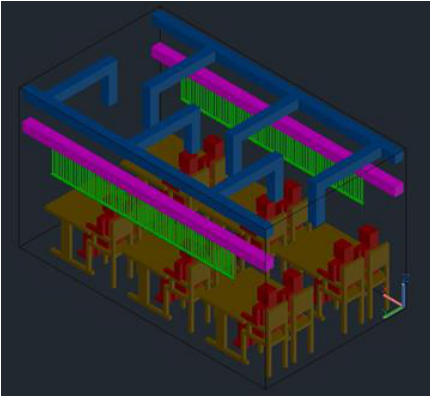
MODELS AND MATERIALS In this work, three numerical models, the Building Thermal Response (BTR), the Computational Fluids Dynamics (CFD), Figure 1, and the Human Thermal Response (HTR) are considered. The last two work in a coupling methodology.
The integral BTR numerical model calculates the temperature of the surrounding
Human Interaction & Emerging Technologies (IHIET-AI 2022) Artificial Intelligence & Future Applications https://openaccess.cms-conferences.org/#/publications/book/978-1-7923-8989-4 surfaces. The differential CFD numerical model evaluates the air velocity, air temperature, air turbulence intensity and CO2 concentration. HTR numerical model calculates the body and clothing temperatures.
Figure 1. Virtual classroom used in the numerical simulation.
This numerical study is done in a virtual chamber (Figure 1). This virtual chamber, which simulates a classroom, is 4.50 m long, 2.55 m wide and 2.5 m high. The virtual chamber is provided with six tables and twelve chairs and is occupied by twelve seated virtual people.
The inlet ventilation system installed in the virtual chamber is founded on a confluent multi-jets system constituted by two horizontal ducts (represented by purple color in Figure 1) equipped with a row of consecutive nozzles (the inlet of the air jets is represented by the green descendent arrows in Figure 1). The ducts are 3.3 m long, 0.125 m in diameter and are placed at 1.8 m above the floor. The exhaust ventilation system is installed in the central zone of the chamber, consisting of six ducts (shown in blue in Figure 1), 0.125 m in diameter, located above the level of the occupants' head.
The numerical simulations were done for a typical winter day characterized by an outdoor air temperature of 0ºC, an average indoor air relative humidity of 50%, an average indoor air temperature of 20ºC and an airflow rate of 0.1167 m3/s.
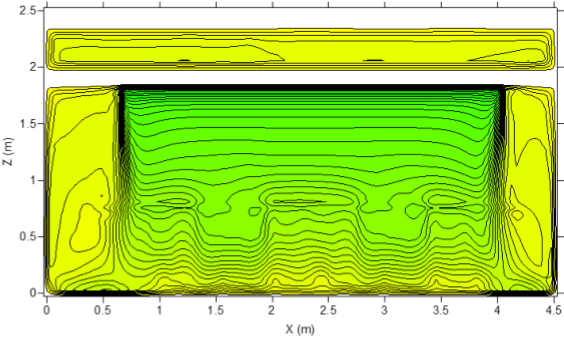
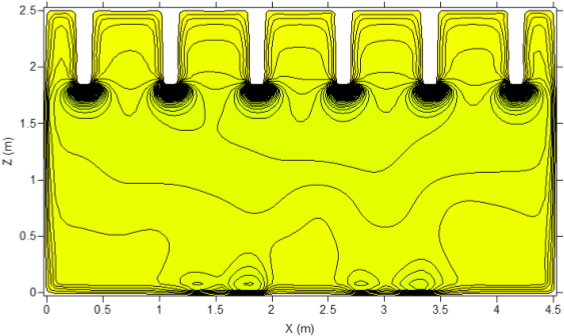
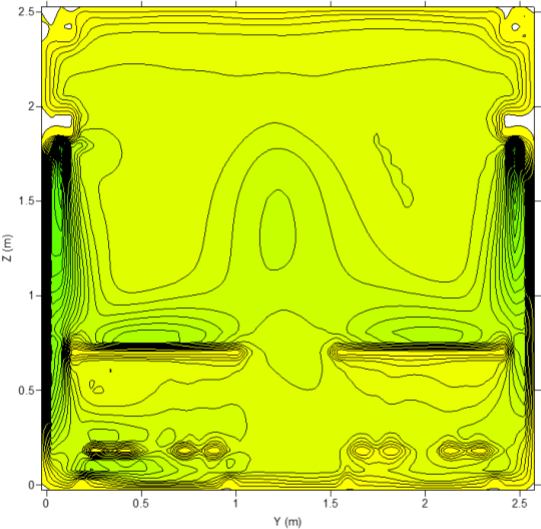
In this section, the air velocity field is evaluated. Figure 2 presents the air velocity field in a vertical plane located at the inlet system in the y-axis direction. Figure 3 shows the air velocity field in a vertical plane located at the outlet system in the y- axis direction. Figure 4 presents the air velocity field in a vertical plane located at the central area in the x-axis direction.
The airflow, promoted by the vertical confluents multi-jets ventilation system, with a descendent airflow in the sidewalls, furthers an ascendant airflow around the occupants. The air velocity is highest at the air intake, floor and air extraction level.
Figure 2. Air velocity field in a vertical plane located at the inlet ventilation system in the y-axis direction.
In the inlet area, the airflow, in general, in the longitudinal plan, shows an influence at the level of the entire floor. The air velocity decreases from air intake level to floor level. In the lateral area, airflow recirculation is observed. The outlet area, with similar air velocity values, ensures an even air outlet airflow along the longitudinal of the virtual. These results are important in order to guarantee a uniform human bioeffluents contaminants extraction.
The transversal air velocity field plan shows the lateral descendent airflow, near the walls, and the airflow deflection, at the floor level. The desk and the occupant show also some interferences in the airflow topology. It is also noted that airflow causes the appearance of turbulent areas on top of the desks, so these should be further away from each other.
Figure 3. Air velocity field in a vertical plane located at the outlet ventilation system in the y-axis direction.Figure 4. Air velocity field in a vertical plane located at the central area in the x-axis direction.
In this article the design of a confluent multi-jet system was presented. The study was carried out in a virtual experimental chamber occupied by twelve virtual mannequins (which simulate people) considering winter conditions.
Downward vertical airflow promotes the spread of airflow across the floor. Occupants and desks cause some obstacles to airflow at floor level. It is also verified that the desks should be further apart in order to avoid the appearance of air recirculation zones at their tops. Outgoing airflow favors upward airflow in the occupied zone.
The highest levels of air velocity are found in the entrance area near the sidewall and in the exit area at occupants' head height. The lowest levels of air velocity are found in the occupied zone.
Therefore, the vertical confluent multi-jet ventilation system designed in this work favors the extraction of contaminating human bio-effluents and guarantees low levels of DR.
ACKNOWLEDGMENTS
The authors would like to acknowledge to the project (SAICT-ALG/39586/2018) from Algarve Regional Operational Program (CRESC Algarve 2020), under the Portugal 2020 Partnership Agreement, through the European Regional Development Fund (ERDF) and the National Science and Technology Foundation (FCT).
REFERENCES
ANSI/ASHRAE Standard 62.1 (2020). Ventilation for Acceptable Indoor Air Quality. Atlanta, GA, USA: American Society of Heating, Refrigerating and Air-Conditioning Engineers. Arghand, T., Karimipanah, T., Awbi, H., Cehelin, M., Larsson, U., Linden, E.
(2015). An experimental investigation of the flow and comfort parameters for under-floor, confluent jets and mixing ventilation systems in an open-plan office. Building and Environment 92, 48-60. Awbi, H. (2004). Ventilation of Buildings. Abingdon-on-Thames, UK: Routledge. Cho, Y., Awbi, H., Karimipanah, T. (2004). “The characteristics of wall confluent jets for ventilated enclosures” proceedings of the 9th International Conference on Air Distribution in Rooms, Coimbra, Portugal. Conceição, E., Silva, M., Viegas, D. (1997a). Air quality inside the passenger
compartment of a bus. Journal of Exposure Analysis and Environmental Epidemiology 7(4), 521-534.
Conceição, E., Silva, M., Viegas, D. (1997b). Airflow around a passenger seated in a bus. HVAC&R Research 3(4), 311-323. Conceição, E., Silva, M., André, J., Viegas, D. (2000). Thermal behaviour
simulation of the passenger compartment of vehicles. International Journal of Vehicle Design 24(4), 372-387. Conceição, E., Lúcio, M. (2001). “Numerical and subjective responses of human thermal sensation”, proceedings of the 6th Portuguese Conference on Biomedical Engineering, Faro, Portugal. Conceição, E., Lúcio, M., Farinho, J. (2007). “Experimental and numerical study of
personalized of ventilation in classrooms desks”, proceedings of the 10th Int. Conference on Air Distribution in Rooms, Helsinki, Finland. Conceição, E., Lúcio, M., Ruano, A., Crispim, E. (2009). Development of a temperature control model used in HVAC systems in school spaces in Mediterranean climate. Building and Environment 44(5), 871-877. Conceição, E., Lúcio, M (2010. Numerical study of the influence of opaque external
trees with pyramidal shape in the thermal behaviour of a school building in summer conditions. Indoor Built and Environment 19, 657-667. Conceição, E., Nunes, A., Gomes, J., Lúcio, M. (2010). Application of a school building thermal response numerical model in the evolution of the adaptive thermal comfort level in the Mediterranean environment. International of Journal Ventilation 9, 287-304. Conceição, E., Lúcio, M. (2016). Numerical simulation of the application of solar
radiant systems, internal airflow and occupants’ presence in the improvement of comfort in winter conditions. Buildings 6(3), 38. Corrsin, S. (1944). Investigation of the behavior of parallel two-dimensional air jets.
NASA-TM-101182 report. Fanger, P. (1970). Thermal comfort: analysis and applications in environmental engineering. Copenhagen, Denmark: Danish Technical Press. Fanger, P., Melikov, A., Hanzawa, H., Ring, J. (1988). Air turbulence and sensation
of draught. Energy and Buildings 12, 21-39. Ghahremanian, S. (2014). Near-field study of multiple interacting jets: Confluent jets. PhD Dissertation, Linköping, Sweden. Heskestad, G. (1965). Hot-wire measurements in a plane turbulent jet. Journal of
Applied Mechanics 32(4), 721-734. ISO 7730 (2005). Ergonomics of the thermal environments – analytical determination and interpretation of thermal comfort using calculation of the PMV and PPD indices and local thermal comfort criteria. Management 3, 615. Karimipanah, T., Sandberg, M. Awbi, H. (2000). “A comparative study of different
air distribution systems in a classroom”, proceedings of the 7th Int. Conference on Air Distribution in Rooms, Reading, UK. Knystautas, R. (1964). The turbulent jet from a series of holes in line. Aeronautical Quaterly 15(1), 1-28. Lai, J., Nasr, A (1998). “Some mean flow characteristics of two parallel plane jets”,
proceedings of the 13th Australasian Fluid Mechanics Conference, Melbourne, Australia. Miller, D., Comings, E. (1957). Static pressure distribution in the free turbulent jet.
Journal of Fluid Mechanics 3(1), 1-16. Miller, D., Comings, E. (1960). Force-momentum fields in a dual-jet flow. Journal of Fluid Mechanics. 7(2), 237-256.
Tanaka, E. (1969). The interference of two-dimensional parallel jets: 1st Report, experiments on dual jet. JSME International Journal, Series B: Fluids and Thermal Engineering 13, 272-280. Tanaka, E. (1974). The interference of two-dimensional parallel jets: 2n Report,
experiments on the combined flow of dual jet. Bull. JSME 17(109), 920-927. Zheng, X., Jian, X., Wei, J., Wenzheng, D. (2016). Numerical and experimental investigation of near-field mixing in parallel dual round jets. International Journal of Aerospace Engineering 2016, 7935101.
Read this individual research paper free through the original publisher, or explore the full digital proceedings book.
ISBN 978-1-7923-8989-4
Explore this ISBN in the AHFE Bookstore ↗Listed in the July 2026 bookstore catalogue; search by ISBN to confirm current availability · Digital book purchase optional