Eusébio Conceição, Maria Inês Conceição, Maria Manuela Lúcio, João Gomes, Hazim Awbi (2023). Application of Double Skin Facade to Improve the Thermal Comfort Level in an Experimental Chamber. In: Human Interaction and Emerging Technologies (IHIET-AI 2023): Artificial Intelligence and Future Applications. AHFE Open Access, vol. 70, pp. 68–76. https://doi.org/10.54941/ahfe1002931
In this work a DSF system (Double Skin Facade) is used to improve the thermal comfort level that the occupants are subjected in an experimental chamber. The DSF system, build with three unities, is equipped in a south facade of the experimental chamber. The study, made in winter conditions, uses the solar radiation to heated the air, injected in the occupied space with 6 people, to improve the thermal comfort conditions. The experimental chamber is build with wood and isolating material. The DSF system is build with two glass façades, equipped with 15 lamellas. This system, subjected to solar radiation, is connected to the interior with a duct system connected with two ventilators. The numerical study consider a software that simulates the building and the DSF thermal response. The numerical model, that considers buildings with complexes topologies, uses energy and mass balance integral equations for the opaque surfaces, transparent surfaces and internal air. The software also considers the solar radiation simulator, the radiative and convective coefficients evaluation, the glass radiative properties and the thermal comfort and internal air quality simulator. In accordance with the obtained results the thermal comfort level, using the PMV (Predicted Mean Vote), during the occupation time, in general, is in accordance with the international standards.
The DSF system is used in this work to control the level of solar radiation and heat the internal air to be transported for occupied spaces.
In the study, the evaluation of thermal comfort level is made. The ther- mal comfort is based on Fanger (Ole Fanger, 1970) model and is used in the PMV index (Predicted Mean Vote). The Predicted Percentage of Dis- satisfied people, PPD index, is also developed in the work by Fanger (Ole Fanger, 1970). The two indexes are correlated with an empirical equation and are developed in accordance with the measurement of environmental variables around the occupants and the parameters of personal occupants. These indexes were used in international standards such as ISO 7730 (ISO, 2005) and ASHRAE 55 (ASHRAE, 2017) to evaluate thermal comfort levels.
Application of Double Skin Facade to Improve the Thermal Comfort Level 69
Some applications of this index and the measurements of the environmen- tal variables can be seen in Conceição et al. (1997) and Conceição et al. (2018). Seen, also, Nico et al. (2015), Ole Fanger and Toftum (2002) and Fabbri (2013).
This numerical study considers a Building Thermal Dynamics Modelling model that simulates the building, in this case an experimental chamber, and the DSF system, see Conceição et al. (2012). The software considers the exter- nal environment conditions, the convective and radiative coefficients and the solar radiation calculated during an entire day. The software calculates also the temperature and contaminants for all spaces and the temperature for all opaque, transparent and indoor bodies. See also other works that worked in passive systems, such as Ignjatovic et al. (2015) and Ulpiani et al. (2017).
The Building Thermal Dynamics Modelling model considers a group of geographical inputs, buildings structure inputs and internal buildings inputs. In the first one is considered the building’s geographic values, in the second one are considered the building geometry and materials, while in the third one is considered the building occupancy and the building ventilation. In the ventilation, the airflow rate (see ASHRAE 62.1 (ASHRAE, 1990) and the air exchange rate (see Conceição et al. (1997)) are used.
The objective of this work is to improve human comfort in an experimen- tal chamber equipped with two or six occupants, three DSF systems and a ventilation system.
MODELS The Building Thermal Dynamics Modelling model is used in this work. This software, developed by the authors in the last few years, calculates the distribution of temperature and contaminants in the building and the DSF system.
In the building, the software calculates the:
Opaque temperature, namely the interior and exterior walls, doors, ceiling, floor, roof, ground, among others;
Transparent temperature, namely, windows, glass doors, glass cover, among others;
Temperature of indoor bodies, namely, interior pillars, internal partitions, furniture and other elements;
Bio effluents and other contaminants concentrations, namely carbon dioxide concentration (produced internally), water vapour (produced internally) concentration and others.
In the DSF, the software calculates the:
Opaque temperature, namely the upper, lower and lateral panels;
Transparent temperature, namely, the frontal glass;
Indoor bodies temperature, namely lamellas, photovoltaic cells and other elements;
Contaminants concentrations, namely, carbon dioxide concentration, water vapour concentration and others (transport from the external environment to the interior environment).
The software also calculates the:
Solar radiation;
Convective and radiative coefficients;
Thermal comfort (using the PMV index);
Indoor air quality (using the carbon dioxide concentration);
Other coefficients and values.
Methodology
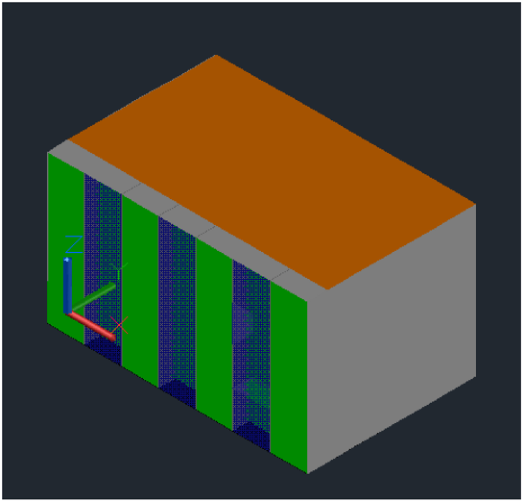
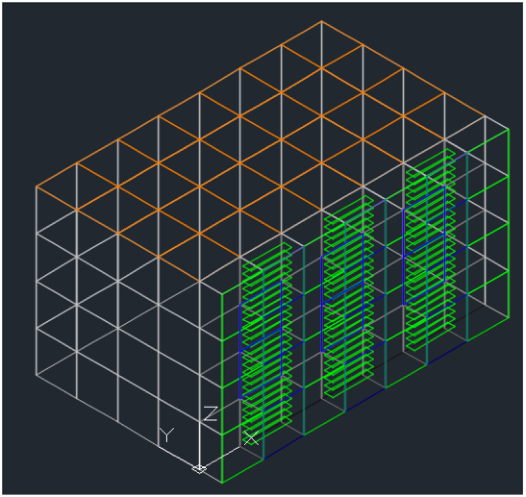
The numerical methodology considers an experimental chamber, equipped with three DSF systems (see Figures 1 and 2). Each DSF system considers 15 lamellas (see Figures 1 and 2).
The experimental chamber was the following dimensions:
4.5 m long;
2.55 m wide;
2.5 m high.
Each DSF system was the following dimensions:
0.6 m long;
0.2 m wide;
2.55 m high.
Each lamella system was the following dimensions:
0.6 m long;
0.12 m wide;
10 mm thick.
Figure 1 shows the realistic DSF, using a South-East view, and Figure 2 are presented a wireframe DSF, using a South-West view.
The simulation, made on a winter typical day, in a Mediterranean-type cli- mate, considers the five previous days. In this simulation, the perfect mixing system is considered.
It was considered two occupations level:
An occupation of 2 people (Case A);
An occupation of 6 people (Case B).
Each occupant has:
An average weight of 70 kg;
An average height of 1.7 m;
An activity level of 1.2 met;
A clothing insulation level of 1.0 clo (typical value in the winter season).
The occupancy cycle used in the simulation is as follows:
Between 8 am and 12 pm and between 2 pm and 6 pm, in Case A, two occupants are considered;
Between 8 am and 12 pm and between 2 pm and 6 pm, in Case B, six occupants are considered;
Application of Double Skin Facade to Improve the Thermal Comfort Level 71
Figure 1: Realistic DSF in South-East view.Figure 2: Wireframe DSF in South-West view.
In the numerical simulation, the airflow rate is obtained experimentally in an experimental setup similar to the one presented in this study. Thus, the airflow rate is measured in each DSF system. When the space is not occupied one air exchange rate is considered.
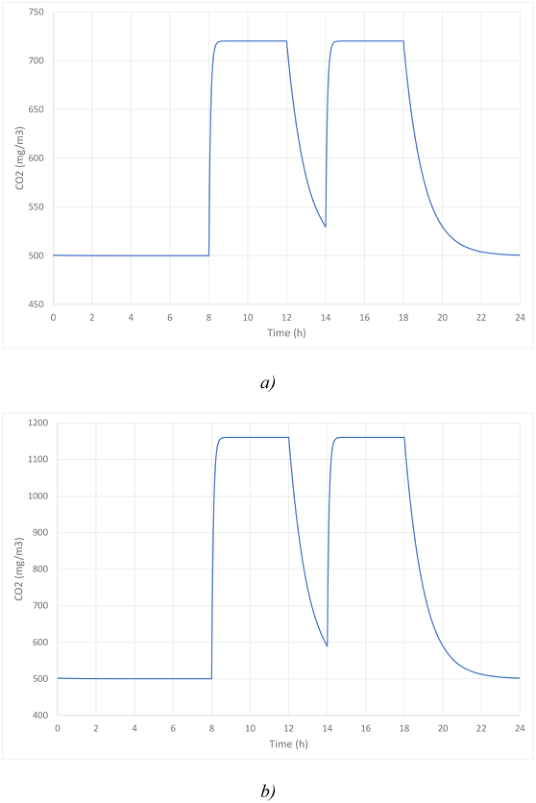
Figure 3: Evolution of carbon dioxide concentration in the occupied space, for an occupation level of two (a) and six (b) persons.
Thus, the airflow rate measured in each DSF system is the following:
First DSF, number 4, has an airflow rate of 0,0446 m3/s;
Second DSF, number 6, has an airflow rate of 0,034 m3/s;
Third DSF, number 8, has an airflow rate of 0,001512 m3/s.
RESULTS AND DISCUSSION
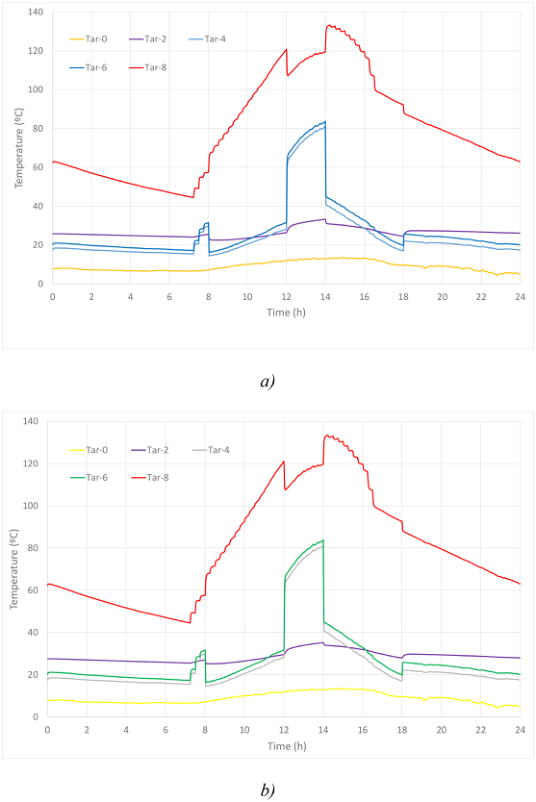
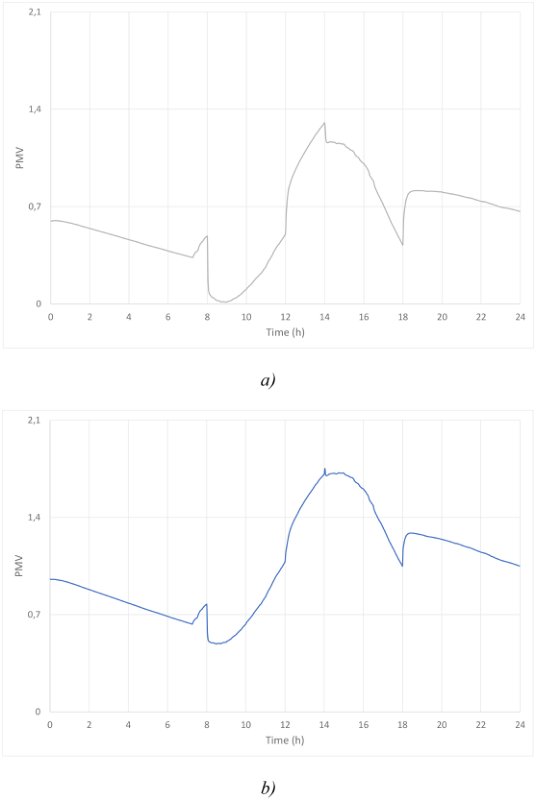
Figure 3 shows the evolution of carbon dioxide concentration in the occu- pied space, for an occupation level of two and six persons. The evolution of air temperature in the occupied space, DSFs and external environment, for an occupation level of two and six persons, is presented in Figure 4. Figure 5 presents an evolution of the PMV index in the occupied space, for an occupa- tion level of two and six persons. Figures a) are associated with an occupation
Application of Double Skin Facade to Improve the Thermal Comfort Level 73
Figure 4: Evolution of air temperature in the occupied space, DSFs and external environment, for an occupation level of two and six persons.
level of two persons and figure b) is associated with an occupation level of six persons.
In all presented figures, the following labelling was considered:
0 – Outdoor Temperature;
2 – Occupied Indoor Temperature;
4 – Internal Temperature of the DSF located at the smallest x coordinate, as presented in Figure 1;
6 – Internal Temperature of the DSF located at the second smallest x coordinate, as presented in Figure 1;
8 – Internal Temperature of the DSF located at the highest x coordinate, as presented in Figure 1.
Figure 5: Evolution of PMV index in the occupied space, for an occupation level of two and six persons.
In accordance with the obtained results, the concentration of carbon dioxide concentration for Case A (two occupants) is lower than the concentration of carbon dioxide concentration for Case B (six occupants). However, the internal air quality is acceptable for the two cases analyzed.
The air temperature inside the DSF system is higher than the occupied air temperature and the occupied air temperature is higher than the exter- nal air temperature. Thus, in accordance with the obtained results, the DSF system increases the external air temperature before being introduced into the occupied space. The air temperature inside the DSF system is higher in DSF subjected to a low airflow rate and lower in DSF subjected to a high airflow rate.
The thermal comfort in Case A, occupied with two persons, is acceptable, during the morning and at the final of the day. However, the thermal comfort
Application of Double Skin Facade to Improve the Thermal Comfort Level 75
in Case B, occupied with six persons, is acceptable only at the beginning of the morning.
CONCLUSION
In this numerical work, the application of three double-skin facades to improve the thermal comfort level in an experimental chamber was made. The experimental chamber is occupied in Case A for 2 persons, while in Case B for 6 persons. Each DSF is equipped with 15 lamellas.
In accordance with the obtained results, the internal air quality is acce- ptable for the two cases analyzed. In accordance with the measuring airflow rate, it is possible to increase the number of occupants numbers.
The air temperature inside the DSF system is higher than the occupied air temperature and the occupied air temperature is higher than the external air temperature. The DSF system can increase the external air temperature before being introduced in the occupied space, to improve the thermal comfort level.
The thermal comfort in Case A, occupied with two persons, is acceptable, during the morning and at the final of the day. However, the thermal comfort in Case B, occupied with six persons, is acceptable only at the beginning of the morning.
In this work, the mixing ventilation system is used. However, in future works, other ventilation systems will be applied. The internal airflow, around the occupants, to evaluate in detail the thermal comfort and air quality, that each occupant is subjected to, will be also analysed.
ACKNOWLEDGMENT
The authors would like to acknowledge this. The authors would like to acknowledge the project (SAICT-ALG/39586/2018) from Algarve Regional Operational Program (CRESC Algarve 2020), under the PORTUGAL 2020 Partnership Agreement, through the European Regional Development Fund (ERDF) and the National Science and Technology Foundation (FCT).
REFERENCES
ASHRAE, “ANSI/ASHRAE Standard 55-2017 : Thermal Environmental Conditions for Human Occupancy,” ASHRAE Inc., 2017. ASHRAE, “ASHRAE Standard 62–1989 Ventilation for Acceptable Indoor Air
Quality,” Am. Soc. Heating, Refrig. Air-Conditioning Eng. Inc., 1990. D. Ignjatovi´c, M. Jovanovi´c Popovi´c, and J. Kavran, “Application of sunspaces in fostering energy efficiency and economical viability of residential buildings in Serbia,” Energy Build., 2015, doi: 10.1016/j.enbuild.2015.02.049. E. Z. E. Conceiçäo, M. C. G. Silva, and D. X. Viegas, “Air quality inside the passenger
compartment of a bus,” J. Expo. Anal. Environ. Epidemiol., vol. 7, no. 4, 1997. E. Z. E. Conceição, C. I. M. Santiago, M. M. J. R. Lúcio, and H. B. Awbi, “Predicting the air quality, thermal comfort and draught risk for a virtual classroom with desk-type personalized ventilation systems,” Buildings, vol. 8, no. 2, 2018, doi: 10.3390/buildings8020035.
E. Z. E. Conceição, J. M. M. Gomes, N. H. Antão, and M. M. J. R. Lúcio, “Application of a developed adaptive model in the evaluation of thermal com- fort in ventilated kindergarten occupied spaces,” Build. Environ., vol. 50, 2012, doi: 10.1016/j.buildenv.2011.10.013. E. Z. E. Conceição, M. C. G. Silva, and D. X. Viegas, “Airflow around a passenger seated in a bus,” HVAC R Res., vol. 3, no. 4, 1997, doi: 10.1080/10789669.1997.10391380. G. Ulpiani, D. Giuliani, A. Romagnoli, and C. di Perna, “Experimental moni-
toring of a sunspace applied to a NZEB mock-up: Assessing and compa- ring the energy benefits of different configurations,” Energy Build., 2017, doi: 10.1016/j.enbuild.2017.04.034. ISO, “ISO 7730: Ergonomics of the thermal environment Analytical determination and interpretation of thermal comfort using calculation of the PMV and PPD indices and local thermal comfort criteria,” Management, 2005, doi: 10.1016/j.soildyn.2004.11.005. K. Fabbri, “Thermal comfort evaluation in kindergarten: PMV and PPD mea-
surement through datalogger and questionnaire,” Build. Environ., 2013, doi: 10.1016/j.buildenv.2013.07.002. M. A. Nico, S. Liuzzi, and P. Stefanizzi, “Evaluation of thermal comfort in university classrooms through objective approach and subjective preference analysis,” Appl. Ergon., 2015, doi: 10.1016/j.apergo.2014.11.013. P. Ole Fanger and J. Toftum, “Extension of the PMV model to non-air-conditioned
buildings in warm climates,” 2002, doi: 10.1016/S0378-7788(02)00003-8. P. Ole Fanger, “Thermal comfort. Analysis and applications in environmental engineering.,” Copenhagen Danish Tech. Press, 1970.
LISTED IN THE AHFE DIGITAL BOOKSTORE CATALOGUE
Explore the complete digital volume
Human Interaction and Emerging Technologies (IHIET-AI 2023): Artificial Intelligence and Future Applications
Read this individual research paper free through the original publisher, or explore the full digital proceedings book.
ISBN 978-1-958651-46-9
Explore this ISBN in the AHFE Bookstore ↗Listed in the July 2026 bookstore catalogue; search by ISBN to confirm current availability · Digital book purchase optional