Emmanuel Darmois, Martin Boecker (2023). Standardisation in support of accessibility for mobility users in Europe. In: Human Systems Engineering and Design (IHSED 2023): Future Trends and Applications. AHFE Open Access, vol. 112, pp. 264–271. https://doi.org/10.54941/ahfe1004137
Information and Communications Technologies (ICT) are playing an ever-increasing role in everyone's lives, specially thanks to vast range of ICT devices and services which create a lot of opportunities for end-users (access to huge amounts of information, fostered people interaction, …), thereby improving their quality of life. In this context, the role of mobility-related devices (e.g., smartphones) and their use with services (e.g., payment, public services) is key for enabling efficient and secure end-user interaction.Two approaches can support this goal, regarding terminology and language coverage. On the one hand, from the end-user point of view, discovering and understanding the services offered by ICT should not become a challenge, with different device manufacturers and service providers using a divergent set of terms to denominate identical devices and service features: a remedy for diverging denominations of features could be harmonized and user-centered ICT terminologies, facilitating feature recognition by all users, including those with cognitive impairments. On the other hand, harmonized terminologies should be able to support diverse languages, such as those spoken in European Union, in a consistent manner.ETSI, the European Telecommunication Standards Institute, is the home of global telecommunications standards such as 3G, LTE, 5G, and DECT, and its Technical Committee Human Factors is publishing standards documents that aim at increasing the usability and accessibility of ICT. ETSI has developed and published a consistent approach for such harmonized ICT terminologies materializing in a number of publicly and freely standardisation documents.Several ETSI Specifications (ES) have been developed over time. ETSI ES 202 076 is addressing a minimum set of spoken commands required to control the generic and common functions of ICT devices and services that use speaker-independent speech recognition. The related commands have been specified for all the official languages of the European Union (EU) and the European Free Trade Association (EFTA). A similar language range is available for the ETSI ES 202 130 which specifies the minimum repertoires and assignments of graphic (letter, digit and special) characters to standard 12-key telephone keypads and specifies their ordering for ICT devices with telephony functionality.Currently, ETSI is developing a harmonized terminology -- published as ETSI Guide EG 203 499 -- covering commonly used, basic ICT features of current and upcoming ICT devices (4 groups, e.g., telephony and photography), services and applications (12 groups, e.g., banking and navigation) focusing on mobile contexts of use. The result is a multilingual terminology supporting over 800 terms.The work has been undertaken in three steps by subsequent ETSI Specialist Tasks Forces with a broadening language support, from 5 languages in the first version up to a coverage of all the official languages of EU and EFTA in the last version to be published in May 2024. The proposed paper will outline the expected benefits of using standardisation in this end-user mobility context, present the methodologies applied and provide examples of the resulting terminologies. It will also discuss the adoption of these specifications and how they support their intended users, i.e., the industry actors (e.g., manufacturers, service providers).
Standardisation in Support of Accessibility for Mobility Users in Europe 265
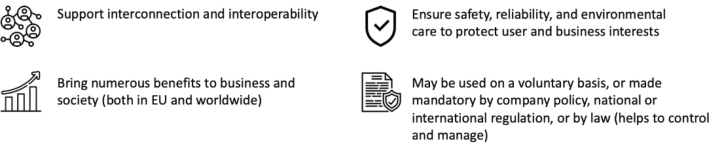
particularly true for Information and Communication Technology (ICT) sys- tems whose vast majority could not simply operate without the common agreement between a plethora of actors on a set of standards. The bene- fits of standardisation, as illustrated in Figure 1, are manifold. For ICT, this goes beyond technical interoperability which is generally seen as the major benefit. Standardisation is also addressing key aspects such as environmental protection, safety.
However, two other aspects are less visible but equally important. Firstly, standardisation addresses a variety of Human Factor issues, such as usability and accessibility that have a strong impact on the life of end users and citizens. Secondly, it is providing a set of commonly agreed reference systems, such as vocabularies, definitions and terminologies that allow for very different actors to share a common understanding. Those two aspects are addressed by the three examples presented in this paper.
Figure 1: The expected benefits of standardisation.
ETSI, the European Telecommunication Standardisation Institute, is highly involved in standardisation of the ICT domain at large, and of telecom- munications in particular. ETSI is one of the three European Standards Organisations officially recognised by the European Commission. Amongst its most impactful standards developments is the set of standards for the consecutive generations of mobile networks from GSM to 5G.
ETSI encompasses a large number of Technical Committees dealing with a broad range of technical domains. Its Technical Committee “Human Fac- tors” (TC HF) is centred around ensuring the end user’s perspective in the development of standards. Its main domains of concern are:
Usability: the extent to which a product can be used by specified users to achieve specified goals with effectiveness, efficiency and satisfaction in a specified context of use (as defined by ISO 9241);
Accessibility: the extent to which products, systems, services, environ- ments and facilities can be used by people from a population with the widest range of user needs, characteristics and capabilities, to achieve identified goals in identified contexts of use (ISO 9241).
TC HF has developed a great number of standards regarding Accessibility and Usability. The present paper addresses only a specific part of TC HF’s work, regarding cultural and linguistic standardisation. To this extent, three examples are provided. Two of them describe previously developed ETSI standards (ES) whereas the third one presents in more details an on-going
266 Darmois and Boecker
work aimed at producing an ETSI Guide (EG) which is a Recommendation, not an ETSI Standard.
CULTURAL AND LINGUISTIC STANDARDISATION Overall, the benefits of cultural and linguistic harmonization for the end users materialize with the possibility to learn basic concepts and methods only once and to apply them on a multitude of devices and services, thus requiring minimum handling competence (as is the case for driving any car).
This approach also benefits the manufacturers since no investment is required for non-competitive areas of user experience while keeping the freedom to differentiate in competitive areas.
This was a component of the motivation for the first two examples below: there is no benefit in developing one’s own set of command words since diver- gent sets of commands from different manufacturers and service providers may hamper the uptake of the new technology.
ES 202 130: Character Repertoires, Orderings, Keypad Assignment The consistency of the main elements of the User Interface (UI) across similar devices has been an early concern of standardisation and is illustrated by the work done in ETSI for the development of the ETSI Standard ES 202 130. The main motivation for this work was the observation by manufacturers that there was a lack of consistency in character-keypad assignment between and within products of different manufacturers, thus creating the need to agree on keypad assignment, character repertoires, and sorting orders.
The resulting document (ES 202 130) was meant to cover all relevant Euro- pean languages so as to encourage manufacturers to support (implement) more of the languages addressed. ES 202 130 addresses issues related to an important UI at the time, namely the 12-key keypad. This ETSI standard:
applies to the 12-key keypad provided in hardware form (e.g. as push button keys) or software form (e.g. as soft keys on a visual display) of public or private, fixed or mobile network terminals, and also applies to network-based services accessed through terminal devices.
specifies the minimum repertoires and assignments of graphic (letter, digit and special) characters to standard 12-key telephone keypads and specifies their ordering for ICT devices with telephony functionality.
specifies solutions for both language-independent and language-specific keypad assignments, mapped to the 12-key telephone keypad. The document also provides common and language-specific information on character repertoires and ordering.
The approach taken was to carry the work as an ETSI Specialist Task Force (STF) funded by the European Commission (EC). It has been under- taken in two phases: Phase 1 for the coverage of all official languages of the EU (the European Union) and EFTA (the European Free Trade Association); and Phase 2 covering 79 European languages as well as other languages spo- ken in Europe. During the work, the required linguistic analysis has been undertaken with a confirmation by native language experts.
Standardisation in Support of Accessibility for Mobility Users in Europe 267
ES 202 076: Generic Spoken Command Vocabulary for ICT Overall, the motivation for the development of the ETSI Specification ES 202 076 has been very similar to the one which has presided to the development of ES 202 130: divergent spoken command vocabularies create a hurdle for the uptake of voice-based services; they discourage change of provider/de- vice manufacturer; they impact inter alia people with speech or cognitive impairments.
Here again, the ES was meant to cover all relevant European languages so as to encourage manufacturers to support (implement) more of the languages addressed. This ETSI standard:
specifies a minimum set of spoken commands required to control the generic and common functions of ICT devices and services that use speaker-independent speech recognition.
specifies the necessary and most common vocabularies for voice com- mands to be supported by ICT devices and services.
is applicable to the functions required for user interface navigation, call handling, the control of and navigation in media, and management of device and service settings.
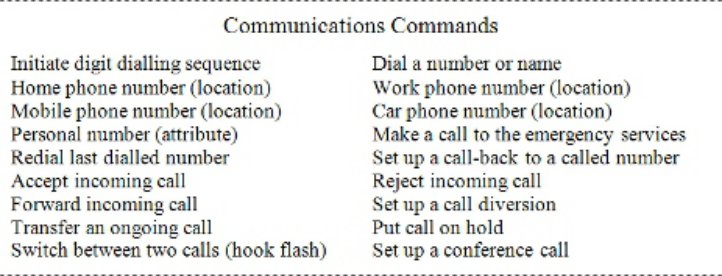
An example of the kind of commands addressed is given in Figure 2. The document also includes basic commands, commands for the control of and navigation in media, and commands for device and service settings.
Figure 2: Example: a subset of the standardised vocal commands.
The approach taken was, similar to ES 203 130, to carry the work as an ETSI Specialist Task Force (STF), funded by the EC, and undertaken in two phases: Phase 1 with the support of five major languages (English, French, German, Italian and Spanish); and Phase 2 with the support of all official languages of the EU and EFTA.
EG 203 499: HARMONISATION OF ICT TERMS Information and Communications Technologies (ICT) is an area in which users encounter a plethora of terms. End-users must be confident that there
268 Darmois and Boecker
is a strong adequation between their understanding of the terms used in one interaction and what was intended by the manufacturers/developers of these information systems (and their user interface).
To effectively access ICT devices and services, end-users must understand the features (e.g., controls and capabilities) that are required to operate them. Their names (terms, words, labels) are a primary means by which users can recognize and understand them.
Poorly named product and service features, or familiar features named differently to the way that users have previously encountered it (e.g., on the device of a different manufacturer), are likely to fail end-user recognition and understanding thus preventing them to be used effectively.
If the terms for the same features are different from product to product, users will need to learn multiple terms that refer to the same underlying fea- ture, and will have to understand which name is used in which product: this may disproportionally disadvantage elderly users and users with learning or cognitive disabilities who may have impaired memory and comprehension abilities.
While some terms are introduced by manufacturers to designate a new class of features or to promote their own features against those found in competitors’ products, most other terms designating device or service features are not necessarily intended for differentiation (e.g., battery). However, in the absence of a harmonized or recommended terminology, the use of those terms may differ considerably both among device manufacturers and service providers.
The alternative to a wide and confusing plethora of terms encountered by end users is a reasonable degree of harmonization among devices, services, and applications. A harmonized terminology can help prevent the negative effects of an uncontrolled growth of terms, and better support continuous market evolution (e.g., new players), frequent feature updates (often not car- ried over in user documentation), or changing business models (e.g., fewer subsidized devices linked to fixed service plans reducing end-user loyalty).
An Approach for Harmonizing ICT Terms ETSI’s Technical Committee “Human Factors” (TC HF) has conducted work to develop the publicly available ETSI Guide EG 203 499 that addresses the need for harmonized ICT terminologies. This ETSI Guide aims at rec- ommending implementation-oriented terms in major European languages, applicable to product User Interface (UI) and user documentation design, thereby easing knowledge and learning transfer.
There are two different potential target people for EG 203 499:
Intended users are those designing, developing, implementing, and deploy- ing user interfaces for and interaction with mobile ICT devices, services, and applications.
Intended end users of that ETSI Guide are people who use mobile ICT devices, services, and applications ranging from first time users to experienced users.
Standardisation in Support of Accessibility for Mobility Users in Europe 269
For this work, a Design-for-All approach was chosen that takes into account functional limitations of elderly users and those with cognitive, physical, or sensory variations.
Developed in three phases (with two already finished), the ETSI Guide will ultimately cover the 27 official languages of the European Union (EU) and the Free Trade Association (EFTA), namely Bulgarian, Croatian, Czech, Dan- ish, Dutch, Estonian, French, Finnish, German, Greek, Hungarian, Icelandic, Irish, Italian, Latvian, Lithuanian, Maltese, Norwegian, Polish, Portuguese, Rhaeto-Romance, Romanian, Slovak, Slovene, Spanish, and Swedish.
The method employed for developing harmonized terminologies consisted of three phases as described below.
Phase 1: Identification of Objects and Activities In this first phase, the identification of functional areas (e.g., telephony or photography) defines the range of functionalities covered by the EG: those functionalities that are most frequently used by many or most users of mobile ICT devices.
For each functional area, relevant objects and activities (i.e., those that are frequently used, and used by most users) were identified and defined. Objects and activities are selected if they help users identify the functionality (i.e., help the user understand what it does), access the functionality, understand the available options related to a functionality, or understand messages displayed in the context of using a functionality (e.g., error feedback).
Phase 2: Collection of Terms For each functional area, relevant providers (ICT device manufacturers, ser- vice providers, and application vendors) have been identified, and the terms they use for the objects and activities of the respective functional area have been collected in the languages covered by the EG. Functionalities offered by one provider only were not included in the analysis.
Phase 3: Analysis and Selection For all languages, localization experts and/or specialists in the linguistics of the respective languages were associated in order to make recommendations regarding the terms to be selected: checks for consistency between manu- facturers (i.e., prevalence of certain terms), preference of terms that reflect the language of the end users as opposed to the language of developers, and compliance with linguistic requirements from the languages covered.
Scope of the Harmonized Terminologies The recommended terms published in the EG are divided into the domains or categories as shown in Table 1.
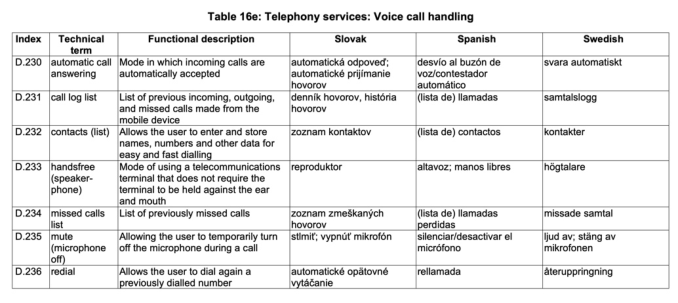
Fig. 3 shows an example of the contents (of the second release) of EG 203 499. For each entry, an index number, a “Technical term” (expected to be understood by implementers), a detailed description of the functionality, and the recommended terms in the languages covered by the EG.
270 Darmois and Boecker
Table 1. Scope of terminology fields.
Table available in the original PDF paper.
Device-related terminologies Service- and application-related terminologies
1. General terms 2. Messaging services 3. Media services 4. Societal services and communications 5. Social media services 6. Banking services 7. eHealth services 8. Travel planning 9. Navigation 10. Games 11. Searching and browsing 12. Tools / Miscellaneous
Figure 3: Example contents of EG 203 499.
Since the second release (October 2022), the corresponding tables of terms have been made available in open source on the ETSI GitLab for free down- load by the EG users (those who will develop user documentation or services User Interfaces). They will be updated with the publication of the third release.
The final (third) release of EG 203 499 is expected to be published in the 2nd quarter of 2024 after the ETSI approval process is completed.
CONCLUSION
For the three examples presented above, similar principles have been applied: a strong motivation towards harmonization, a design approach based on the needs of the end users, a final result supporting the choice for device manu- facturers and service providers of the common solutions they can easily adopt versus those used for differentiation, and the widest possible language cover- age to foster adoption within the entire European Union (and beyond). The
Standardisation in Support of Accessibility for Mobility Users in Europe 271
expectation was to ensure a gradual adoption of the proposed solutions when new devices and systems are developed and deployed in Europe.
So far, the ETSI Guide EG 203 499 has been developed as a Recommen- dation and not as an ETSI Standard. Once the publication of the ETSI Guide is finalized, it is expected that it will gradually be adopted by the target users (as for the ETSI Standards presented above). The possibility that the ETSI Guide be transformed into a standard will be subject to the decision of ETSI Technical Committee Human Factors (TC HF).
ACKNOWLEDGMENT
This work has been co-funded by the European Commission (EC) of the European Union (EU) and the European Free Trade Association (EFTA). The current phase of the work is funded and conducted by ETSI.
REFERENCES
ETSI ES 202 130 v2.1.2 (2007-09): Human Factors (HF); User Interfaces; Character repertoires, orderings and assignments to the 12-key telephone keypad (for European languages and other languages used in Europe). ETSI ES 202 076 v2.1.1 (2009-06): Human Factors (HF);Human Factors (HF); User
Interfaces; Generic spoken command vocabulary for ICT devices and services. ETSI DEG 203 499 v2.1.2 (2022-10): Human Factors (HF); User-centred terminology for existing and upcoming ICT devices, services and applications.
LISTED IN THE AHFE DIGITAL BOOKSTORE CATALOGUE
Explore the complete digital volume
Human Systems Engineering and Design (IHSED 2023): Future Trends and Applications
Read this individual research paper free through the original publisher, or explore the full digital proceedings book.
ISBN 978-1-958651-88-9
Explore this ISBN in the AHFE Bookstore ↗Listed in the July 2026 bookstore catalogue; search by ISBN to confirm current availability · Digital book purchase optional