Elena Angeleska, Jelena Djokikj, Anita Vasileva Ljubotenska, Vasko Changoski (2026). Personalized modifications of vehicle interiors for social inclusion. In: Advances in Human Factors of Transportation. AHFE Open Access, vol. 224, pp. 272–281. https://doi.org/10.54941/ahfe1007855
Limitations in vehicle interior design restrict independent mobility for individuals with hand-related difficulties, reducing accessibility and social inclusion. This study presents a digitally driven methodology for developing personalized and inclusive vehicle interior solutions through the integration of 3D scanning, virtual ergonomics, and additive manufacturing. The research addresses geometric and ergonomic constraints in conventional vehicle interiors and translates user-specific anthropometric and functional requirements into optimized design interventions. The proposed workflow combines design thinking with ethnographic research, reverse engineering, ergonomics, and anthropometry. Following an analysis of existing inclusive solutions, qualitative user study identified task-specific limitations and usability requirements. Specific control elements in the vehicle interior are digitized using structured-light 3D scanning, while user anthropometric data and functional grip parameters are integrated into digital models. These datasets are evaluated in a virtual ergonomics environment to simulate user–vehicle interaction and assess alternative design configurations. Based on simulation outcomes, customized assistive interior components are developed and fabricated using additive manufacturing. The resulting digital-to-physical workflow reduces iteration cycles, development time, and cost while improving functional accuracy and user satisfaction. The methodology is applicable across a wide range of inclusive mobility and product design scenarios.
Certain types of physical limitations can significantly affect the participation of individuals in social and everyday activities, with restricted access to personal transportation being one of the most critical factors. Individuals with experiencing functional challenges use transportation significantly less frequently than others, and more than one-third of these individuals with specific needs are not active drivers (Claypool et al., 2017). Furthermore, research on the travel habits of persons with physical limitations highlights the relationship between the type and extent of limitation and the type of transportation that individuals prefer (Clery et al., 2017). Independent mobility is closely linked to autonomy, social inclusion, and quality of life. However, conventional vehicle interior design is largely based on standardized Received February 20, 2026; Revised March 31, 2026; Accepted April 20, 2026; Available online July 20, 2026
Personalized Modifications of Vehicle Interiors for Social Inclusion 273 user assumptions and often fails to accommodate diverse physical abilities. As a result, individuals with functional challenges encounter numerous ergonomic and functional barriers when using personal vehicles.
These challenges are often intensified by barriers to vehicle ownership and modification. Financial constraints consistently emerge as the most significant barrier, while limited access to clear and reliable information on vehicle modification services further restricts accessibility. Although it is commonly emphasized that access to personal transportation as a means to support employment is the main concern, evidence suggests that persons with specific needs place greater value on the independence, social participation, and recreational opportunities enabled by automobility. These factors are closely linked to improved quality of life and the development of social and human capital, which may also contribute indirectly to employment opportunities (Darcy and Burke, 2018).
Therefore, the focus of this research is the analysis of existing vehicle interior designs and the identification of factors that hinder their use by people with some degree of functional limitations, particularly those with limited hand function or mobility. Understanding these constraints creates opportunities for developing improved ergonomic and inclusive solutions, and for integrating targeted modifications and accessories into vehicle interiors. Such interventions aim to support independent vehicle use while maintaining safety, comfort, and usability.
Personalized modifications to vehicle interiors represent a user-centred approach to inclusive mobility, emphasizing adaptation to individual physical characteristics, capabilities, and preferences rather than reliance on generic solutions. User-centred design is an aspect of an inclusive design approach that is concerned with ensuring equal accessibility and usability for all potential users, relying on inclusive design principles (Larkin et al., 2015), and establishing a level of inclusivity that then dictates the level of usability and user satisfaction. The authors propose three levels of inclusivity (Patrick and Hollenbeck, 2021): (1) providing access for users to feel included; (2) providing the opportunity to participate; and (3) providing the opportunity for users to fully engage in the use of the product and be involved in all operations related to it. Of course, the optimal solution is to provide the highest levels of accessibility that can help vulnerable users have equal opportunities.
To achieve accessibility in vehicles, typical adaptations include assistive aids such as joystick control, modified hand controls, speech recognition, gesture operation interface, pedal adaptations, swivel seats, etc. (Dahuri and Hussain, 2018) and companies do offer accessible vehicles solutions (Braunability, 2026; Tribus, 2026; Paravan, 2026). In some cases, these modifications are guided by consultations with driver rehabilitation specialists who assess user capabilities and recommend appropriate solutions. However, such practices remain limited, and the range of available personalized adaptations is often constrained, costly, or insufficiently integrated into the design process.
At the same time, advances in digital design technologies offer new possibilities for inclusive vehicle interior development. High-resolution three-dimensional (3D) scanning enables accurate digitization of vehicle interiors (Haleem et al., 2022) and user body characteristics, while virtual
ergonomics software allows quantitative evaluation of reachability, posture, and joint comfort within simulated environments (Siemens, 2010). The use of virtual human models in virtual environments, are an inevitable approach when defining the ergonomic features of vehicles and designing with a focus on human needs, helping to define comfortable body positions (Abidi et al. 2013; Aromaa and Väänänen, 2016; Angeleska et al., 2024). Three-dimensional (3D) scanning is becoming an essential tool in modern manufacturing, as it enables accurate verification of product geometry and early detection of design or production issues. By providing precise dimensional data prior to manufacturing, 3D scanning significantly reduces the number of required prototype iterations and development time. Its application across multiple industries supports accurate documentation, rapid measurement of complex components, and effective quality control (Haleem et al., 2022).
Although these technologies are widely used in automotive design for quality control, inspection, customization of interior accessories, and metrology and reverse engineering (Sović et al., 2025), their combined application for systematic, personalized inclusive design remains underexplored.
Moreover, the recent focus is shifted toward recommendations for accessible autonomous vehicle (AV) designs including aspects such as autonomous passenger assistance in terms of effectively securing passengers by automated systems (Golbabaei et al., 2024), suitable design of multimodal communication systems (Ageleska, Lüchtrath, and Pretto, 2024; Xu et al., 2025; Zheng and Ren, 2022), or AI-supported accessibility by high-end technology – AR/VR, brain-computer interaction, etc. (Bastola et al., 2025).
However, despite recent advances, inclusive technological solutions and accessible AV transportation systems remain far from widespread adoption due to high costs and persistent trust-related concerns. In parallel, many fundamental design aspects of conventional vehicles, such as interior layout, ingress and egress, seating configurations, and adjustable control systems, continue to rely on outdated design methodologies that do not adequately address the diverse functional needs of users.
Some research is oriented toward new methods of assisting individuals in the process of matching drivers with appropriate vehicle modification configurations, improving awareness and supporting administrative processes related to special driving licenses (Spoladore et al., 2024). Such examples are not numerous, and the opportunities of modern technologies such as 3D scanning and printing, virtual ergonomic tools, and CAD modelling are not sufficiently utilized in this area.
Therefore, this research addresses this gap by investigating the integration of 3D scanning, virtual ergonomics, and additive manufacturing into a unified, design-driven workflow for developing inclusive vehicle interior solutions. The study is guided by three main points: (1) 3D scanning of both vehicle interiors and users enables rapid generation of personalized inclusive design proposals; (2) virtual ergonomics tools support efficient evaluation and iterative refinement of these solutions; and (3) additive manufacturing enables rapid fabrication of functional prototypes for testing and validation. Together, these methods aim to support a practical, efficient, and scalable approach to personalized vehicle interior design for inclusive mobility.
METHODOLOGY
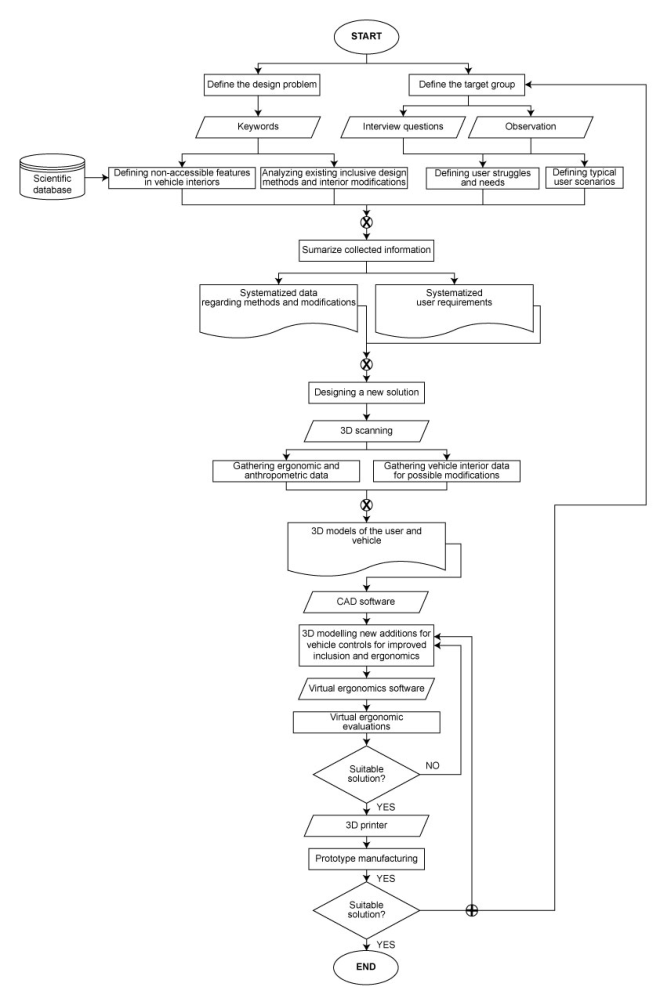
The proposed methodology in this research, for personal modifications of vehicles, follows a structured, design-driven and iterative framework that integrates user research, digital acquisition, virtual evaluation, and physical prototyping to support the development of inclusive vehicle interior solutions (Figure 1).
Figure 1: Methodology framework diagram: Designing personal modifications of vehicle interiors for social inclusion.
The process begins with the definition of the design problem and user group, supported by a review of scientific literature to identify non-accessible vehicle interior features and existing inclusive design and modification approaches. At the same time, qualitative methods including interviews and observations are used to capture user struggles, needs, and typical usage scenarios. The collected information is synthesized into two parallel datasets: systematized knowledge of existing methods and modifications, and structured user requirements. These datasets facilitate the development of new design concepts, which are developed using precise geometric and ergonomic data obtained through 3D scanning of both the user and selected vehicle interior components. The resulting digital models are integrated within a CAD environment to design personalized control adaptations, which are subsequently evaluated using virtual ergonomics software to assess posture comfort. Based on the outcomes of these evaluations, the design is iteratively refined until a suitable solution is achieved. Finalized concepts are fabricated using additive manufacturing to produce functional prototypes, which are physically assessed for fit and usability. If necessary, feedback from prototype evaluation is reintegrated into earlier stages of the process, ensuring continuous refinement. The methodology concludes once an ergonomically validated and user-appropriate solution is achieved, demonstrating a seamless digital-to-physical workflow for inclusive vehicle interior design.
CASE STUDY The proposed methodology is demonstrated and validated through a single case study involving one driver with hand-related functional limitations.
DEFINING USER NEEDS In order to complete the first phase of the process and correctly define the design problem, following a thorough literature review, qualitative methods – observation and interview – were conducted with the research participant, prior to the 3D scanning process. Before the study commenced, the participant was fully informed about the research objectives and procedures and provided written informed consent. The consent process emphasized that all collected data would be used exclusively for research purposes, that participant identity would remain confidential, that no identifiable facial features would be captured, and that all data would be securely stored and accessed only by the research team.
Observation and interviewing were conducted in parallel. During these sessions, the participant described typical hand positions used while driving, identified difficulties encountered when operating vehicle controls, and suggested potential strategies for improvement.
The participant has functional limitations in the left hand, which prevent achieving a full grip on the steering wheel. The vehicle used by the participant is equipped with an automatic transmission, allowing the right hand to remain on the steering wheel rather than being required for gear shifting.
Personalized Modifications of Vehicle Interiors for Social Inclusion 277 As described by the participant, steering is primarily achieved by applying pressure with the lower part of the palm of the left hand while rotating the wheel. This strategy results in limited comfort due to the reduced contact area between the hand and the steering wheel and introduces a constant risk of hand slippage, which may negatively affect driving safety.
The drivers answers to the interview questions (Table 1) also revealed that:
The most uncomfortable movements for the driver are turning left or right because of the grip between the steering wheel and the hand;
The problematic controls for use are behind the steering wheel on the left side or the command stick;
The driver believes that adding an attachment to the steering wheel for the left hand to prevent slipping off the steering wheel would be beneficial.
Table 1: Summary of the collected answers from the interview.
Table available in the original PDF paper.
Question Answer How often do you drive, and what type of vehicle do you usually use (manual, automatic)?
I drive every day (for different activities), so I drive an automatic and have driven with manual transmission.
No.
Have you made any adaptations to your vehicle so far?
Which hand(s) are affected when driving? Left hand.
Which movements or actions with your hand are most difficult or uncomfortable?
The most uncomfortable movements are when I want to turn left of right because of the grip between the steering wheel and my hand.
Which vehicle controls are easiest for you to use?
The easiest controls are all the controls within reach of my right hand and the steering wheel controls.
Which controls are difficult or problematic? The problematic controls for use are behind the steering wheel on the left side or the command stick.
No.
Are there any situations where you feel uncertain when operating controls?
Do you need to change posture or use alternative strategies to operate controls?
Only the left hand when I like to make a signal for left or right or activate high beam or blend light.
No.
Have you developed personal ways or workarounds to manage difficult controls?
If you could change or improve one interior element, what would it be?
Add an attachment to the steering wheel for the left hand as a stop to prevent the hand from slipping off the steering wheel.
Anti-slip hand grip.
What would make driving easier or more comfortable for you?
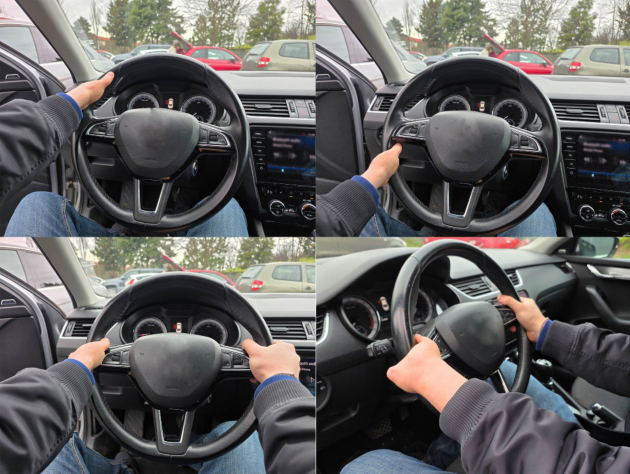
In addition to the interview, observation was done and photographs were taken in the most common position with hands on the steering wheel (Figure 2).
The participant prefers the central hand placement for stability and reach of steering wheel controls, but sometimes turning requires a higher or lower placement of the left hand to achieve suitable contact pressure.
Figure 2: Observation: Typical hand placement on the steering wheel.
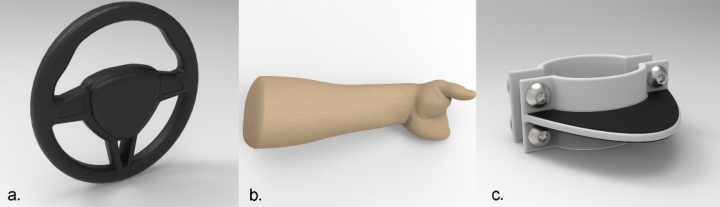
Developing a Personalized Solution The development of the personalized in-vehicle component began with the acquisition of 3D data of the participant’s left hand and the steering wheel. Data collection was performed using a structured-light 3D scanner (Creality Ferret) and processed within SolidWorks. The resulting 3D models captured the precise geometry and dimensions of both the user’s hand and the steering wheel, providing an accurate virtual representation for subsequent design work. These models served as the basis for designing a customized steering wheel attachment intended to improve hand stability and enable non-slip steering control for the driver’s left hand (Figure 3).
Figure 3: 3D models: a. steering wheel used in vehicle with simplified geometry; b. left hand of the participant obtained through 3D scanning; c. 3D model of the steering wheel anti-slip attachment.
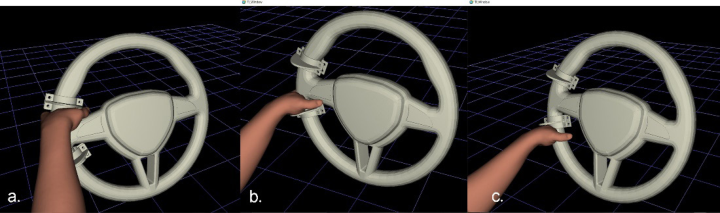
Personalized Modifications of Vehicle Interiors for Social Inclusion 279 Moreover, virtual ergonomics software (Siemens Jack) was used to analyse hand placement on the steering wheel, define the optimal positioning of the steering wheel attachment, and evaluate the proposed design solution. Representative results from the virtual ergonomic analysis are presented in Figure 4. The final design of the in-vehicle component was intentionally kept simple to facilitate rapid manufacturing and installation, while ensuring seamless integration with the existing vehicle interior.
The dimensions of the attachment were carefully optimized to provide the required functional support and reduce the risk of hand slippage, while avoiding excessive size that could interfere with natural arm movements or ergonomic steering postures. The design allows for the installation of either one or two attachments, offering flexibility in hand placement across multiple preferred positions. When a single component is mounted in the upper region of the steering wheel, central hand placement is ideal and access to integrated steering wheel controls is preserved.
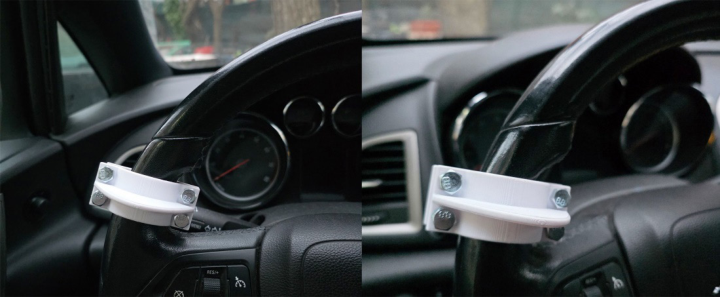
The final model was fabricated via fused deposition modeling to provide a functional prototype for further evaluation (Figure 5).
Figure 4: Virtual ergonomic testing with two attachments: a. upper placement of left hand on steering wheel; b. middle placement of left hand on steering wheel; c. bottom placement of left hand on steering wheel.Figure 5: Attachment prototype 3D printed and mounted.
CONCLUSION
This study presents a design-driven methodology for the development of personalized and inclusive vehicle interior solutions through the integration of 3D scanning, virtual ergonomics, and additive manufacturing. By combining qualitative user research with precise digital acquisition and simulation, the proposed workflow enables the systematic translation of user-specific functional requirements into validated, manufacturable design interventions.
The single case study demonstrated how detailed understanding of individual hand-related functional limitations, supported by 3D scanning of both the user and the vehicle interior, can inform the design of targeted in-vehicle components. The use of virtual ergonomics software allowed early evaluation of ergonomics. Additive manufacturing further supported rapid prototyping and physical assessment, ensuring that design solutions could be efficiently refined and integrated within the existing vehicle interior.
Beyond the specific design outcome, the primary contribution of this work lies in the proposed methodology itself. The workflow is platform-independent, adaptable to different vehicle types and user profiles, and applicable to a wide range of inclusive mobility and product design scenarios. While the study is limited by its single-participant scope, it provides a structured foundation for future research involving larger user groups, additional vehicle systems, and emerging mobility contexts such as shared and autonomous vehicles.
Overall, the results highlight the potential of digitally driven, user-centred design processes to support more inclusive, efficient, and responsive vehicle interior development, contributing to improved accessibility, safety, and user satisfaction.
ACKNOWLEDGMENT
The authors would like to express their sincere gratitude to the research participant for their time, openness, and willingness to share personal experiences throughout the study. The participant’s insights and active involvement were essential to the development, evaluation, and validation of the proposed design methodology and significantly contributed to the quality and relevance of the research outcomes.
REFERENCES
Abidi, M. H., El-Tamimi, A. M., Al-Ahmari, A. M., Darwish, S. M., & Rasheed, M. S. (2013). Virtual ergonomic assessment of first saudi arabian designed car in a semi-immersive environment. Procedia Engineering, 64, 622–631. Ageleska, E., Lüchtrath, L., & Pretto, P. (2024). Evaluation of an autonomous
vehicle user interface for sensory impaired users. Journal of Transportation Technologies, 14(4). Elena, A., Vasko, Č., Blagoja, N., & Anita, V. (2024). 674. Design, analysis, and optimization of the steering column system for an electric street sweeper. Mechanical Engineering–Scientific Journal, 42(1), 5–14. Aromaa, S., & Väänänen, K. (2016). Suitability of virtual prototypes to support
human factors/ergonomics evaluation during the design. Applied ergonomics, 56, 11–18.
Personalized Modifications of Vehicle Interiors for Social Inclusion 281 Bastola, A., Wang, H., Boroujeni, S. P. H., Brinkley, J., Moshayedi, A. J., & Razi, A.
(2025). Driving towards inclusion: A systematic review of ai-powered accessibility enhancements for people with disability in autonomous vehicles. IEEE Access. Braunability Official. (2026). [online] Available at: https://www.braunability.com/us/ en.html (last accessed: 18.02.2026) Claypool, H., Bin-Nun, A., & Gerlach, J. (2017). Self-driving cars: The impact on
people with disabilities. Newton, MA: Ruderman Family Foundation. Clery, E., Kiss, Z., Taylor, E., & Gill, V. (2017). Disabled people’s travel behaviour and attitudes to travel. Department for Transport, Crown copyright. Dahuri, M. K. M., & Hussain, M. N. (2018). The development of adaptive driving
modifications for the disabled vehicle: A review. Journal of Fundamental and Applied Sciences, 10(3S), 754–764. Darcy, S., & Burke, P. F. (2018). On the road again: The barriers and benefits of automobility for people with disability. Transportation research part A: policy and practice, 107, 229–245. Golbabaei, F., Dwyer, J., Gomez, R., Peterson, A., Cocks, K., Bubke, A., & Paz, A.
(2024). Enabling mobility and inclusion: Designing accessible autonomous vehicles for people with disabilities. Cities, 154, 105333. Haleem, A., Javaid, M., Singh, R. P., Rab, S., Suman, R., Kumar, L., & Khan, I. H. (2022).
Exploring the potential of 3D scanning in Industry 4.0: An overview. International Journal of Cognitive Computing in Engineering, 3, 161–171. Larkin, H., Hitch, D., Watchorn, V., & Ang, S. (2015). Working with policy and regulatory factors to implement universal design in the built environment: The Australian experience. International journal of environmental research and public health, 12(7), 8157–8171. Paravan Official. (2026). [online] Available at: https://www.paravan.de/ (last
accessed: 18.02.2026) Patrick, V. M., & Hollenbeck, C. R. (2021). Designing for all: Consumer response to inclusive design. Journal of Consumer Psychology, 31(2), 360–381. Siemens. (2010). Jack User Manual Version 7.0. Siemens Product Lifestyle
management Software Inc., California, USA. Sović, L., Bušić, M., Muminović, A. J., & Trobradović, M. (2025, June). Application of 3D Scanning in the Automotive Industry. In International Symposium on Innovative and Interdisciplinary Applications of Advanced Technologies (pp. 617–633). Cham: Springer Nature Switzerland. Spoladore, D., Mahroo, A., Davalli, A., & Sacco, M. (2024). Reconfiguring
Vehicles for Drivers with Disability: A Knowledge-Based Decision Support System. Electronics, 13(21), 4147. Tribus Official. (2026). [online] Available at: https://www.tribus-group.com/ (last accessed: 18.02.2026) Xu, G., Zaman, M., Vogel, C., Chen, Y., Weisz, L., & Bao, S. (2025, September).
Evaluating Multimodal Interfaces for Visually Impaired Users in Autonomous Ridesharing: A Usability Study. In Proceedings of the Human Factors and Ergonomics Society Annual Meeting (Vol. 69, No. 1, pp. 994–1000). Sage CA: Los Angeles, CA: SAGE Publications. Zheng, Y., & Ren, X. (2022). Developing a multimodal HMI design framework for automotive wellness in autonomous vehicles. Multimodal Technologies and Interaction, 6(9), 84.
LISTED IN THE AHFE DIGITAL BOOKSTORE CATALOGUE
Explore the complete digital volume
Advances in Human Factors of Transportation
Read this individual research paper free through the original publisher, or explore the full digital proceedings book.
ISBN 979-8-950676-00-0
Explore this ISBN in the AHFE Bookstore ↗Listed in the July 2026 bookstore catalogue; search by ISBN to confirm current availability · Digital book purchase optional