Elena Angeleska, Marija Sidorenko, Sofija Sidorenko, Paolo Pretto (2022). Inclusive Autonomous Vehicle Interior Design (IAVID) Platform. In: Design for Inclusion. AHFE Open Access, vol. 45, pp. 54–62. https://doi.org/10.54941/ahfe1001869
Passenger comfort in vehicles is a complex, human-centric segment of the vehicle interior design. Designing an ergonomic vehicle requires incorporating a wide range of interdisciplinary information as an input in the development process. Novel autonomous technologies offer possibilities for achieving increased comfort and safety. Autonomous vehicles (AVs) present an opportunity for redefining the standard design approaches by providing options for improved ergonomics and meeting the needs of a wide range of users, among which are persons with impairments. Persons with impairments are likely to be the early adopters of AVs due to the fact that these vehicles can allow them to travel independently and become more involved in social activities. However, this brings a new challenge for designers who need to combine universal design principles and recommendations for inclusion, in addition to ergonomic principles, vehicle standards and regulations, technological advancements, as well as design trends, in order to provide fully ergonomic, and accessible modern vehicle models. The difficulty of following and including all this trans-disciplinary knowledge in the vehicle development process requires finding a suitable method to systematize the data and simplify their use.This paper aims to propose a platform for inclusive autonomous vehicle interior design (IAVID) which will upgrade the usual design principles in a manner that they can support the creation of ergonomic and inclusive AV interiors. The proposed IAVID platform is based on systems engineering (SE) and model-based systems engineering (MBSE) and is intended for organizing and constantly updating all relevant interdisciplinary information needed as an input in the AV interior development. The constant updating of information can enable continuous recognition of the changing needs and the formulations of new directions to which future research should be aimed at. To achieve this, the proposed platform is composed of separate databases for the design input information from different fields. The information in the databases can be constantly refreshed and linked with the AV interior subsystems (components) in order to define the characteristics that those subsystems need to possess in order to satisfy their main functions. The hierarchy of the AV systems and subsystems at different levels, as well as the functions they need to achieve are generated by applying SE methods. The MBSE methods, on the other hand, are used to represent the proposed platform by model that can easily be understood by programmers and be directly applied in the field of informatics using a suitable programming language.This platform is intended to be used as a tool mainly for industrial designers who often lack expertise in technological and engineering domains of product design and they might have limited knowledge of design for inclusion. The use of the proposed IAVID platform provides a way to bridge the knowledge gaps. All the information provided by the platform can also be available to all the members of the interdisciplinary development team, which as a result will facilitate their communication and strengthen the link between all stakeholders. By doing so, the interdisciplinary collaboration among vehicle development teams can be strengthened.
The design approach in vehicle development is a complex interdisciplinary process that needs to combine the aesthetic features that define the vehicle character and the technical and safety requirements. Vehicle interior crea- tion is a special phase of the design process since the interior space of the vehicles is closely linked with the overall user perception and satisfaction. Research conducted by the “Yanfeng” company, as a part of forming the design strategy for future vehicle concepts, shows that “experiencing the inte- rior is more important than actually owning the car” and users express the need for “security, physical well-being, and quality” (Hendriks et al. 2019). All these characteristics are of ergonomic nature, which explains why ergo- nomic standards and recommendations are included in the earliest vehicle design stages. The combination of the following types of information and ergonomic recommendations helps to improve the vehicle safety and com- fort: standards and regulations (SAE, ISO, BS), anthropometric data, software
tools for 3D modeling and CAD systems, mock-ups and fitting trails, que- stionnaires and interviews for the potential users, user trails and road trails (Happian-Smith, 2002). The last stages of the design process require the inve- stment of more time and resources, but they provide a detailed insight into the real user requirements. Special attention is required for collecting and mee- ting the needs of vulnerable traffic participants, among which are persons with disabilities and the elderly.
Ergonomic specifications generated through research dedicated to this category of users include: anthropometric data of persons with disabilities, the dimensions of the space in which persons with disabilities can move fre- ely, changes in movement and behavior that happen with aging and need to be taken into consideration when designing (such as reduction of sight and hearing abilities, reduction of reflexes and musculoskeletal disorders) etc. (Kumar, 1997). These ergonomic specifications are used in order to pro- vide possibilities for adaptation of standard vehicle models to respond to the special needs or create specially designed inclusive vehicle models. The modifications of vehicles are usually structural and include adding compo- nents, changing the appearance, providing alternative ingress/egress methods, and offering modified vehicle operating controls. However, modifications are typically done for accommodating persons that use wheelchairs or other mobility-aid devices. Some vehicles offer the possibility to be controlled by persons with disabilities provided the person can operate hand controls. However, there are many other individuals with different types of disabilities that have very limited independent traveling options.
Disability segmentations include the following categories: (1) vision impairments (blind or having difficulty seeing), (2) hearing impairments (deaf or having difficulty hearing), (3) cognitive impairments (having difficulty remembering, concentrating or making decisions because of a physical, men- tal or emotional problem), (4) ambulatory impairments (having difficulty walking, moving), as well as self-care and independent living impairment (Kraus et al. 2018). For this broader category, independent use of personal vehicles is impossible, and the use of public transportation is limited due to obstacles in the urban environment and lack of inclusion features in public transportation. Data shows that individuals with disabilities use every mode of transportation less often compared to people with no disabilities and more than a third of individuals with a disability are not active drivers (Claypool et al. 2017). The most critical conditions that affect the possibility of inde- pendent, safe and comfortable travel are vision impairments and quadriplegia (Clery et al. 2017).
The development of autonomous vehicles (AVs) offers a possibility for ove- rcoming the mentioned transportation limitations. Aside from the potential for increasing traffic safety which the companies for AV development pin- point as a primary benefit of autonomous systems, the second important aspect is the chance of enabling independent travel for persons with dif- ferent types of disabilities. Combining the latest technology with universal design principles has the power to offer vehicle models that meet the needs for integration into society and independence identified with persons with disabilities. Therefore, persons with disabilities respond with a great interest
in using a self-driving vehicle meaning they would be the early adopters of AVs since they focus on the benefits of the new autonomous technology (Allu et al. 2017).
Because of all these facts, researchers and developers have been making efforts to design modern vehicles with a human-centric approach. Automated driving has changed the vehicle interior design, according to AV techno- logy innovators and interior-design experts. Recent trends include: redefined seating options with smart-kinetics, biometric monitoring systems, individua- lized environments for each vehicle occupant, and holistically designed smart surfaces (Visnic, 2019). Moreover, in order to provide greater ergonomics and safety, researchers analyze human behavior and responses in various automa- ted driving scenarios. For example, researchers focus on alleviating motion sickness symptoms in automated driving (De Winkel et al. 2021), identifying the informational preferences in the vehicle (Ulahannan et al. 2020), applying Wizard of Oz experiments for generating ideas about methods for increasing users’ trust in the AV system (Ka-Jun Mok et al. 2015), exploring user requi- rements in an AV in order to suggest a specific seat design and multimodal display (Sun et al. 2021) etc.
Due to the complexity of incorporating such human-centric principles and universal design principles for accessibility and combining them with a wide range of other interdisciplinary information in the AV development process, there is a need to establish a new strategy for AV interiors design, primarily based on ergonomic and inclusive principles, with an intention to become an assisting tool for the overall design process. This paper proposes such a design tool, explaining the idea behind it and it’ application.
SYSTEMS ENGINEERING APPROACH The proposed tool – platform for interdisciplinary product design in this paper is based on systems engineering (SE) and model-based systems engi- neering (MBSE). SE is used as an interdisciplinary method as it is extremely useful for effective organization of the research and development process (Systems Management College, 2001). In addition, MBSE, as a branch of SE, is used to create a model-based representation of the system. The benefit of using MBSE models is that “the information is represented in an integra- ted and consistent system model rather than in isolated documents (such as requirements or design specifications)” (Bursaca et al. 2016). These models are built using a visual modeling language such as Systems Modeling Langu- age (SysML) that use diagrams which represent the system structure. Block definition diagrams which illustrate the system hierarchy and components and internal block diagrams which describe the internal functionality of the system are used to capture the system structure. In addition, use-case, acti- vity, sequence and other diagrams are used to explain the behaviors. Other diagram structures are applied for capturing requirements, constraints etc. (Hause et al. 2015).
System Description The focus of this research is developing a platform for designing ergonomic and inclusive AV interiors, therefore the system that needs to be understood
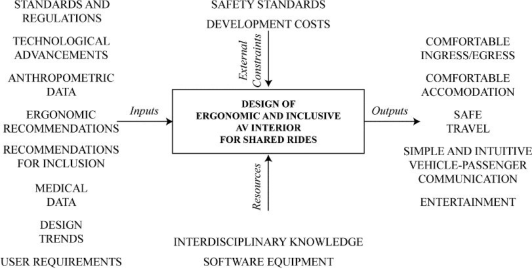
Figure 1: Description of the systems’ characteristics.
is “interior of AV”. According to categories of systems (Blanchard and Blyler, 2016), the system elaborated in this research is classified as a dynamic system that combines the functionalities of specific inputs and components through dynamic activities. These components are actually subsystems, which means the system is also defined as a “system of systems” (SoS). In addition, the system is an open-loop system, since it needs to receive and exchange informa- tion and respond to change of inputs, which means that it is under constant influence of external factors. The design process for the system “interior of AV”needs to incorporate information from several sources, among which the most crucial are: standards and regulations, anthropometric data, ergono- mic recommendations, recommendations for inclusion, medical information, technological advancements, user opinions and requirements, and design trends for the automotive industry. These inputs should be included in all the design stages to provide the following system outputs: comfortable ingres- s/egress, comfortable passenger accommodation, safe travel, simple and intuitive vehicle-passenger communication (exchange of information with no confusion) and entertainment during the ride (Figure 1).
System Hierarchy and Functional Decomposition For the main system “interior of AV”the main function is defined as “provide safe, comfortable and enjoyable transportation for persons with or without special needs”, or in the context of the design process the main function is to “create safe, ergonomic and inclusive design”. The main system is divi- ded into several subsystems at level 1 that are directly linked with the main function. Each of the subsystems at level 1 are then separated into their own subsystems at level 2 and all their required functionalities in favor of the main function are listed. This is done without a greater level of subdivisions since because of the conceptual nature of the system. Defining the ergonomic and inclusive AV interior as a system, branching it out in subsystems at different levels, as well as developing a functional analysis for them, helps to esta- blish the key functions that the system needs to perform in order to achieve its’ main goal. Based on the functional decomposition, the relevant system inputs (interdisciplinary information) can be systematized in the form of lists
of design guidelines and be assigned to the AV subsystems and components as minimum design requirements that, if followed in the development pro- cess, can help create a system (AV interior) that successfully carries out all the subfunctions at different subsystem levels.
DEVELOPMENT OF A MODEL FOR THE IAVID PLATFORM The analyzed “interior of AV” system is represented by a system model. All system inputs required in the system design process are organized as separate structural databases that can be updated. The information representation is simplified and with a level of abstraction in order for it to be understanda- ble regardless of the users’ expertise. This makes coping with the systems’ complexity much easier.
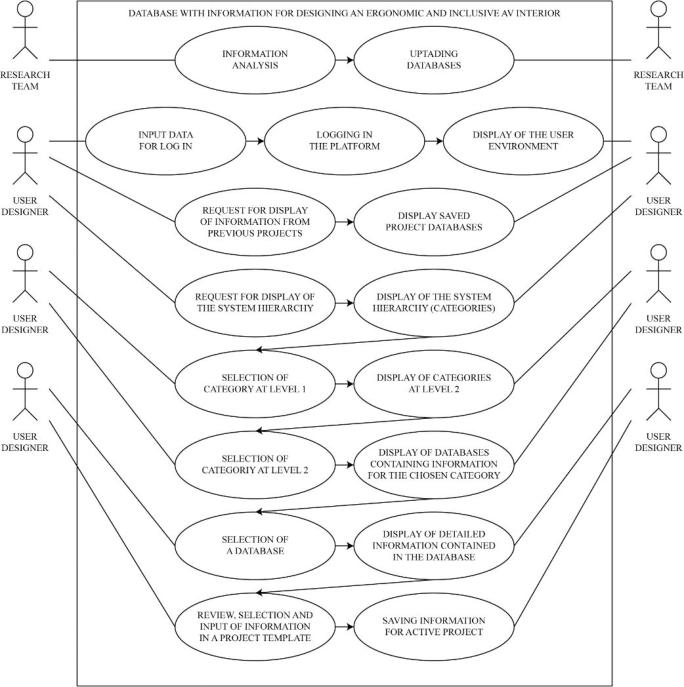
The basic activities required in order to achieve the functionality of the IAVID platform are very simple. The two involved sides that would use this platform are: the research team and the vehicle interior designer. The rese- arch team is responsible for following all current changes in the defined system inputs and updating the databases. On the other hand, the vehicle interior designer reviews the provided data in the databases and selects the information needed for designing each individual component of the interior. The designer saves all important information in a pre-defined project tem- plate which is then stored as a separate database and made available to all team members. Project data is stored with the intention of using some of the components for future projects simplifying the research phase.
The practical use of the proposed platform can be elaborated in greater detail by a use-case diagram illustrating a use scenario (Figure 2). The team consisted of experts from different fields is represented by one actor named “research team”. The research team analyzes information and updates the databases. The user of the platform is represented by an actor named “desi- gner”. The use-scenario happens in several main steps which are explained on the diagram.
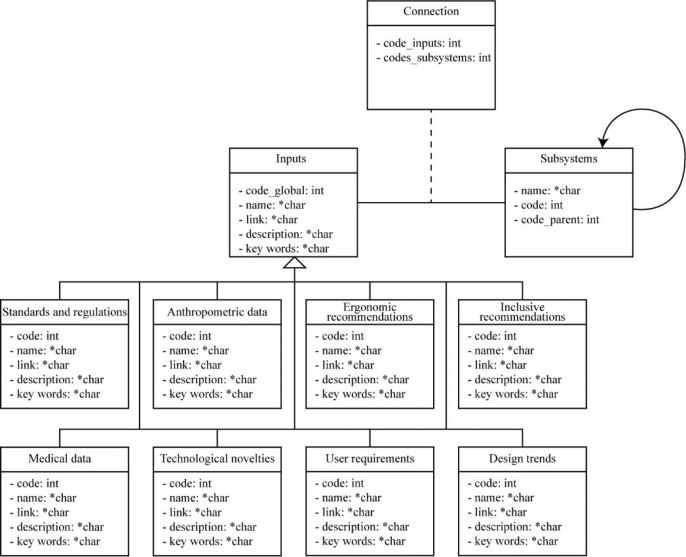
The representation of the platform is done by the class diagram on Figure 3. This diagram contains the formulation of all separate databases (classes) and the information that needs to be stored inside. The classes are illustrated as boxes containing the class name at the top followed by a list of all the class attributes. The lines between the classes are class associations which represent their connections.
All the previously described inputs need to be included in separate data- bases and are described by the class boxes. The data field descriptions that need to be contained in each class are standardized and include the class code, name, an external link, description and key words. If we take the class “standards and regulations” as an example, for each new standard written in the base the team member needs to provide a unique code, the name of the standard (for instance, SAE J287: Driver Hand Control Reach), a link to the pdf document of the standard, a summary of the most important informa- tion provided in the standard and key words which are actually the names of the interior of AV subsystems. For the standard SAE J287 given as an example among the key words would be: seats, armrest, user interface, visual
Figure 2: Use-case diagram – Description of a user scenario.
interaction, accessories, storage departments. The use of key words clarifies the connection between the new standard and appropriate system component and functionality.
Since all these separate classes have standardized attributes, they can be represented by one parent class named “inputs”. This parent class contains the attributes: global code, name, link, description and key words. The glo- bal code is used to represent each input class so that there are no conflicts where relevant data for the system categories (subsystems) is stored and a differentiation can be made between codes from separate input classes.
The class “subsystem” represents the attributes for each of the defined subsystems in the system hierarchy. The subsystem class has the attribu- tes name, code and parent code. Subsystems at level 2 have their separate codes, but have also the code of the subsystem at level 1 that they belong to (their parent), which helps maintain the system hierarchy. If we discuss the class “armrest” – it needs to have a separate code and also the code of the class parent class “seats”. This representation provides a possibility for future adding of more subsystems at different levels.
Figure 3: Class diagram – Description of the IAVID platform.
The connection between the class of inputs and class of subsystems is achieved by the global and local codes for the inputs and the codes for the subsystems. The end result is a user interface where designers can log in, select different system categories and approach the standards and regulations, anthropometric data, ergonomic recommendations, recommen- dations for inclusion, medical information, technological advancements, user requirements and design trends available for each category.
CONCLUSION
This paper presents a platform for human-centric, ergonomic and inclu- sive design of AV interiors. The proposed platform is based on a database composed of systematized recommendations and principles. The database is updated with information from all interdisciplinary areas involved in the vehicle interior development process.
The strength of this platform is that it offers a unique way to incor- porate all the input information and present it in an understandable way. MBSE and system models are already being used in the automotive industry since they help to understand the requirements and manage the development process. The difference of the platform proposed in this research lies in the addition of ergonomic and inclusive principles which turn the focus to human-centric design aspects in vehicle development, rather than engineering and construction aspects.
This platform is intended to be used as a tool mainly for industrial designers. Designers often lack expertise in technological and engineering domains of product design and they might have limited knowledge of stan- dards or medical data. The use of the proposed IAVID platform provides a way to bridge the knowledge gaps. Moreover, all information included in the database can be available to the members of the interdisciplinary deve- lopment team, which as a result will facilitate their communication and strengthen the link between all stakeholders. The application of this plat- form can also enable continuous recognition of the changing needs and the formulations of new directions to which future research should be aimed at.
Another important forte is the used representation of the proposed plat- form that can easily be understood by programmers and be directly applied in the field of informatics using a suitable programming language. This remains a subject for further research. This paper elaborates the theoretical and conce- ptual aspect of the IAVID platform. To closely investigate the success of its’ practical application there is a need to collaborate with IT experts and deve- lop a functional platform mock-up. The usability of the platform can then be evaluated and the model can be optimized. It is hoped that after adequate testing and improvement the proposed platform can be adopted for use by vehicle manufacturers and will improve the design process of future vehicle models, regardless of their level of automation, making them more ergonomic and inclusive.
ACKNOWLEDGMENT
The authors thank the Virtual Vehicle Research GmbH in Graz, Austria for funding the PhD project of Elena Angeleska which this research is a part of.
REFERENCES
Allu, S., Jaiswal, A., Lin, M., Malik, A., Ozay, L., Prashanth, T. (2017). Access to personal transportation for people with disabilities with autonomous Vehicles. IE 490/BME 495: Grand Challenges in Accessibility, Purdue University, Indiana, USA. Arun, Ulahannan. Cain, Rebecca. Thompson, Simon. Skrypchuk, Lee. Mouzakitis,
Alex. Jennings, Paul and Birrell, Stewart. (2020). User expectations of partial dri- ving automation capabilities and their effect on information design preferences in the vehicle, APPLIED ERGONOMICS Volume 82 2020. Blanchard, B.S., Blyler, J.E. (2016). Engineering Design: A Systematic Approach Systems engineering management. New Jersey: John Wiley & Sons. Bursaca, N., Albersa, A., Schmittb, T. (2016) “Model Based Systems Engineering in
Modular Design – A Potential Analysis using Portal Type Scraper Reclaimers as an Example”, in: 26th CIRP Design Conference Proceedings Volume 50, Elsevier, pp. 802–807. Claypool, H., Bin-Nun, A., Gerlach, J. (2017). Self-driving cars, The impact on people with disabilities. The Ruderman White Paper, Ruderman Family Foundation, SAFE, USA. Clery, E., Kiss, Z., Taylor, E., Gill, V. (2017). Disabled people’s travel behavior and
attitudes to travel. London: Department for Transport, Crown.
De Winkel, Ksander. Pretto, Paolo. Nooij, Suzanne. Cohen, Iris and Bülthoff, Heinrich. (2021). Efficacy of augmented visual environments for reducing sickness in autonomous vehicles, APPLIED ERGONOMICS Volume 90 2021 Happian-Smith, J. (2002). Intro to modern vehicle design. Oxford: Butterworth-
Heinemann, Reed Educational and Professional Publishing Ltd. Hause, Matthew. Buitelaar, Jaco. Van de Ven, Marcel and Burgers, Eric. (2015).
The Use of MBSE in Infrastructure Projects -- An MBSE Challenge Team Paper, INCOSE International Symposium Volume 25 No. 1, pp. 371–387. Hendriks, Han. Shih, Tim and Reichenbach, Michael. (2019). Experiencing the interior is more important than owning the car, ATZ WORLDWIDE, Volume 121 No. 11. Ka-Jun Mok, B., Sirkin, D., Sibi, Sr., Miller, D.B., Ju, W. (2015) “Understanding
driver-automated vehicle interactions through Wizard of Oz design improvisa- tion”, proceedings of the Eighth International Driving Symposium on Human Factors in Driver Assessment, Training and Vehicle Design, Driving Assessment, Utah, USA. Kraus, L., Lauer, E., Coleman, R., Houtenville, A. (2018). 2017 Disability statistics annual report. Durham, NH: University of New Hampshire, USA. Kumar, S. (1997). Perspectives in rehabilitation ergonomics. London: CRC Press. Systems Management College Department of Defense. (2001). Systems engineering
fundamentals. Fort Belvoir, Virginia: Defense Acquisition University Press. Visnic, Bill. (December 17, 2019). Autonomy already influencing vehicle interior design. SAE International Autonomous Vehicle Engineering Website: https://ww w.sae.org/news/2019/12/av-cabin-trends Xu, Sun. Cao, Shi and Tang, Pinyan. (2021). Shaping driver-vehicle interaction in
autonomous vehicles: How the new in-vehicle systems match the human needs, APPLIED ERGONOMICS Volume 90 2021.
LISTED IN THE AHFE DIGITAL BOOKSTORE CATALOGUE
Explore the complete digital volume
Design for Inclusion
Read this individual research paper free through the original publisher, or explore the full digital proceedings book.
ISBN 978-1-958651-21-6
Explore this ISBN in the AHFE Bookstore ↗Listed in the July 2026 bookstore catalogue; search by ISBN to confirm current availability · Digital book purchase optional