Paolo Pretto, Mateo Jukic, Manuela Prior, Inge Gsellmann, Thorsten Muik, Manfred Rosenberger (2026). Driver Cognitive, Emotional, and Behavioral Responses to Single-Day Highway Work Zones with Unexpected Lane Hazards. In: Cognitive Computing and Internet of Things. AHFE Open Access, vol. 205, pp. 148–158. https://doi.org/10.54941/ahfe1007369
Single-day highway work zones introduce temporary lane closures, altered traffic flow, and constrained maneuvering space that may affect drivers’ cognitive, emotional, and behavioral states. Despite their prevalence, the human-factors implications of short-term work zones, especially when combined with unexpected hazards, remain underexplored. This study examines how typical single-day work-zone layouts and minor unexpected objects influence driver workload, emotional state, and driving behavior. A high-fidelity VR-based driving simulator was developed to replicate a three-lane highway with a temporary daytime maintenance work zone, including realistic signage, cone delineation, and ambient traffic. Thirty-five licensed drivers completed a familiarization drive followed by three conditions: Baseline highway driving, a Work-Zone condition with right-lane closure, and an Events condition in which unexpected objects (e.g., displaced cones) appeared in the travel lane. Measures included subjective workload (DALI), emotional state (SAM), and driving performance metrics. Results showed significant increases in mental and temporal demand, self-reported stress, and emotional arousal in the Events condition compared to Baseline and Work-Zone driving. Speed variability was also higher in both Work-Zone and Events conditions than in Baseline, indicating sustained changes in longitudinal speed control. These findings indicate that even brief single-day work zones can substantially elevate driver demand, and that minor unexpected hazards can markedly amplify cognitive and emotional strain, with implications for temporary traffic-control design and safety.
Single-day highway work zones are widely used for short-duration activities such as roadway cleaning, inspections, and minor maintenance. Unlike long- term construction zones, these configurations are deployed and removed within the same day and are often encountered by drivers with little advance notice. Despite their operational frequency, single-day work zones remain comparatively underrepresented in the human factors and ergonomics literature, which has traditionally focused on extended construction sites with
Driver Cognitive, Emotional, and Behavioral Responses to Single-Day 149 stable layouts and prolonged exposure. From a human factors perspective, single-day work zones present a unique combination of challenges. Abrupt lane closures, reduced lateral clearance, and a visually cluttered arrangement of closely spaced traffic-control devices (e.g., cones and temporary signage) are introduced within an otherwise familiar driving environment, often alongside altered traffic flow. Together, these roadway changes increase perceptual and cognitive demands at a time when drivers may not anticipate elevated task difficulty. The resulting mismatch between driver expectations and actual roadway conditions can increase mental workload, alter emotional state, and prompt compensatory or potentially less efficient driving behaviors. Unlike long-term construction sites, which are typically announced in advance and remain stable over extended periods, single-day work zones provide drivers with limited opportunity for anticipation or adaptation. Drivers may have little prior experience with a specific configuration, and the rapid deployment of temporary traffic-control devices can result in greater variability in layout quality and device placement. From a human factors standpoint, this lack of anticipation and reduced adaptation window distinguishes short-duration work zones from long-term configurations and may lead to more pronounced acute increases in workload and emotional arousal, particularly during first exposure. Previous research has shown that work zones can elevate driver workload, stress, and error likelihood, particularly when lane closures or unexpected events are present (Huey et al., 2016; Chatterjee et al., 2018). However, much of this evidence is derived from studies of long-term or major construction zones, where drivers may have greater opportunity for anticipation and adaptation (Bella, 2008). Less is known about how short- duration work zones affect driver state, especially when minor but unexpected hazards (e.g., displaced traffic cones or objects encroaching on the travel lane) occur within already constrained road geometry. Understanding these effects is critical for applied ergonomics, as even small degradations in driver performance or increases in perceived stress can have safety implications in high-speed highway environments. The present study addresses this gap by experimentally examining how typical single-day work-zone layouts and minor unexpected hazards influence driver workload, emotional state, and driving behavior in representative highway scenarios.
RELATED WORK
Driver Workload and Stress in Highway Work Zones A substantial body of research has documented that highway work zones impose increased cognitive demand on drivers. Work-zone configurations that involve lane closures and merge areas have been shown to increase subjective workload in simulator studies (Shakouri et al., 2014; Ma et al., 2023), and merging behavior associated with lane closure can produce greater variability in travel speeds (Savolainen et al., 2024). These findings are consistent with broader evidence that temporary changes in lane geometry and control devices increase task demands and influence driver behavior in complex environments (FHWA, 2024). Such effects are commonly attributed to increased information processing requirements and the need for continuous
monitoring of both roadway geometry and surrounding traffic. Elevated stress in work zones, typically assessed through subjective ratings, is of particular concern in high-speed environments, where reduced attentional resources or delayed responses may increase crash risk (Matthews et al., 2012; FHWA, 2024). While these effects are well established for long-term work zones, comparatively few studies have focused on short-duration configurations, despite their prevalence and the limited opportunity they provide for driver adaptation.
Emotional State and Affective Responses While Driving Beyond workload and subjective stress, emotional state plays a critical role in driving performance. Negative emotional states, including anxiety and frustration, have been linked to altered risk perception, changes in visual scanning behavior, and less stable vehicle control (Matthews et al., 2012). In constrained or uncertain environments, emotional arousal may interact with cognitive workload, amplifying performance decrements. Human factors research increasingly emphasizes the importance of assessing emotional state alongside traditional workload measures, because affective responses can influence attention allocation, risk perception, and adaptive behavior during task performance (Matthews et al., 2012). Tools such as the Self-Assessment Manikin (SAM) have been widely adopted to capture dimensions of valence, arousal and dominance in driving contexts. However, emotional responses to temporary and unexpected roadway constraints, such as those found in single-day work zones, remain insufficiently characterized.
Unexpected Events and Hazard Perception Unexpected hazards represent a critical source of driver demand, particularly when they occur in environments that already restrict maneuvering options (Underwood et al., 2005). Sudden obstacles or displaced traffic-control devices require rapid perception, decision-making, and motor responses, often under time pressure. Research on hazard perception suggests that unexpected events can disproportionately increase driver workload and stress relative to their objective severity, particularly in situations where lateral or longitudinal escape options are limited (Underwood et al., 2005; Crundall et al., 2012). In work-zone contexts, minor hazards such as fallen cones or debris may be perceived as low risk individually, yet their occurrence within narrowed lanes and dense traffic-control environments may significantly elevate driver demand. Empirical evidence examining these combined effects is limited, highlighting a need for controlled studies that isolate the contribution of unexpected events within temporary work zones.
Multimodal Assessment of Driver State Assessing driver state benefits from combining subjective and behavioral measures. Subjective workload and emotional ratings provide insight into perceived demand, while behavioral measures, such as speed control, capture how drivers adapt their actions in response to increased task demands,
Driver Cognitive, Emotional, and Behavioral Responses to Single-Day 151 as commonly emphasized in human factors models of driver workload (Brookhuis and de Waard, 2010). The convergence of these measures strengthens interpretation by reducing reliance on any single data source. Such multimodal assessment is particularly valuable in applied ergonomics research, where understanding the mechanisms underlying observed behaviors is essential for informing design and policy decisions.
RESEARCH HYPOTHESES Based on prior research on driver workload, emotional responses, and hazard perception in constrained and uncertain driving environments, the following research hypotheses were formulated:
H1: Driving in a single-day work-zone configuration will result in higher mental workload, higher perceived stress, and more negative emotional states than baseline highway driving. H2: The presence of unexpected events within the work zone will further
increase driver workload and emotional strain relative to the work-zone condition without such events. H3: Increases in workload and perceived stress will be accompanied by measurable adaptations in driving behavior, reflected in changes in speed regulation.
METHOD
Participants Thirty-five licensed drivers participated in the study (24 male, 11 female). Participants had a mean age of 30.4 years (SD = 9.7) and had held a driving license for an average of 12.2 years (SD = 9.6). Fifty-seven percent of participants reported driving at least once per week. On average, participants estimated that 47.1% (SD = 25.8) of their driving occurred on highways. Participants showed moderate sensation seeking on average (M = 2.87, SD = 0.74; 5-point Likert scale). All participants reported normal or corrected-to-normal vision and had prior experience with highway driving. Participants provided informed consent prior to participation and were compensated for their time. The ethical aspects of the study were approved by the relevant institutional Review Board (Approval No. 202510).
Experimental Design A within-subject experimental design was employed. Each participant first completed a familiarization drive to become acquainted with the simulator setup, vehicle dynamics, and visual environment. This was followed by three experimental driving conditions. The Baseline condition was always presented first to establish reference measurements. The order of the remaining two conditions, Work-Zone and Events, was counterbalanced across participants. This design enabled direct comparison of driver state and behavior across roadway configurations with differing levels of demand while controlling for inter-individual variability and ensuring reliable baseline measurements.
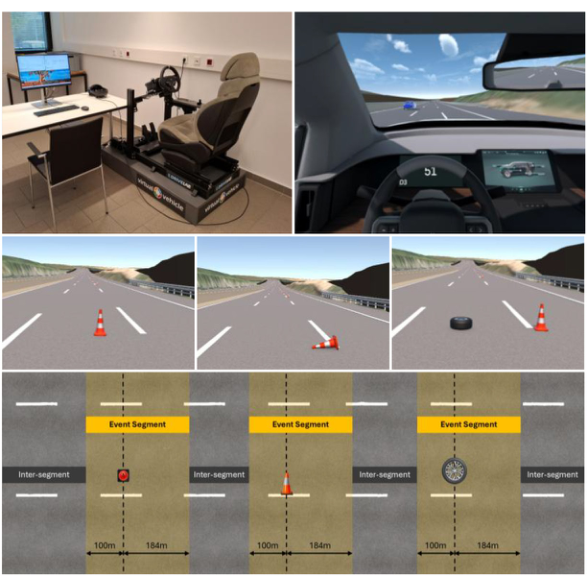
Driving Scenarios and Task The driving task was implemented in a VR-based driving simulator and represented a three-lane highway segment typical of high-speed roadways. Ambient traffic was present and traveled at speeds slightly above the posted speed limit on the leftmost lane, remaining within the tolerance margins typically applied by speed control authorities, and reflecting common real- world driving conditions. Each drive covered approximately 8 km, while the work-zone configuration extended for approximately 5 km. In the Baseline condition, participants drove on the rightmost lane under normal highway conditions without roadworks. In the Work-Zone condition, the rightmost lane was closed using standard signage and cone delineation, requiring participants to drive in the adjacent (middle) lane. In the Events condition, the same work-zone configuration was used, with the addition of minor unexpected hazards, such as displaced or falling cones or small objects encroaching on the travel lane, that required avoidance maneuvers. Examples of the unexpected hazards used in the Events condition are shown in Figure 1 (middle).
Experimental Setup The experiment was conducted using a fixed-base virtual reality (VR) driving simulator (Fig. 1, top). Visual immersion was provided via a head-mounted display (Meta Quest Pro), while vehicle control was enabled through a force- feedback steering wheel and pedal set mounted on a rigid simulator frame. The simulator provided a wide field of view and a high display refresh rate, supporting smooth visual flow and stable motion perception during highway driving. The driving simulation was implemented in Unity 3D and executed using a high-frequency internal simulation loop, while visual rendering was performed at a dynamically adjusted frame rate depending on computational load. All experimental scenarios were identical across participants in terms of roadway geometry, traffic configuration, and signage. In the Events condition, unexpected hazards were introduced at predefined road locations, with event type and exact placement randomized within controlled constraints. All driving-related data and event markers were recorded within the simulation environment using a common internal time base, ensuring precise temporal alignment for offline analysis.
Measures Prior to the experimental drives, participants completed a demographic questionnaire and the Short Sensation Seeking Scale (SSSS; Madsen, 1987). The demographic questionnaire included items on age, gender, driving experience, familiarity with highway driving, and prior experience with VR setups. Sensation seeking was assessed to characterize individual differences within the sample; descriptive statistics are reported, but sensation seeking was not included as a factor in the present analyses. Mental workload was assessed using the Driver Activity Load Index (DALI; Pauzié, 2008). Emotional state was measured using the Self-Assessment Manikin (SAM; Bradley and Lang, 1994), capturing valence and arousal. Driving behavior
Driver Cognitive, Emotional, and Behavioral Responses to Single-Day 153 was characterized using longitudinal vehicle-control metrics, including speed adaptation. Simulator-related discomfort was monitored to ensure that observed effects were attributable to the driving task rather than simulator sickness.
Figure 1: Top: driving simulator setup (l.), driver’s view (r.). Middle: examples of unexpected events (displaced cone, fallen cone, tire encroaching on the travel lane). Bottom: schematic representation of the spatial segmentation used for data analysis, illustrating event-centered segments and inter-segment road sections (not to scale).
RESULT
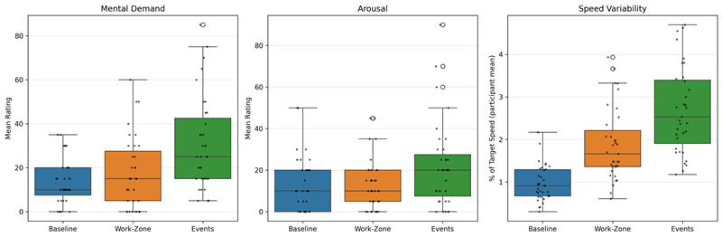
Results are reported for the three experimental conditions (Baseline, Work- Zone, and Events). Analyses are organized by outcome domain, covering mental workload, emotional state, and driving behavior. Condition effects were evaluated using repeated-measures ANOVA, with post-hoc comparisons applied where appropriate. An overview of the main cognitive, emotional, and behavioral effects across conditions is shown in Figure 2. To enable systematic comparison across experimental conditions, analyses were based on a consistent spatial segmentation applied uniformly to each drive (Fig. 1, bottom). In the Events condition, six unexpected events occurred within the work zone, comprising three event types presented twice in randomized order and separated spatially to avoid overlap. For analysis, data were aggregated within predefined segments centered on each event location, spanning from 100 m before to 184 m after the event, capturing both anticipatory and
reactive driver responses. Identical longitudinal segments were applied to the Baseline and Work-Zone conditions at corresponding roadway positions, enabling direct spatial comparison across conditions. In addition, inter- segment roadway sections were analyzed to assess driving behavior away from localized event influences, reflecting more sustained, condition-related effects.
Figure 2: Driver cognitive, emotional, and behavioral responses across experimental conditions. Panels show mental demand (left), emotional arousal (center), and inter- segment longitudinal speed variability (right). Boxes represent interquartile ranges, horizontal lines indicate medians, dots represent individual participants.
Mental Workload and Self-Reported Stress Subjective workload ratings revealed systematic differences across experimental conditions for selected DALI dimensions as illustrated in Figure 2 (left). Mental demand differed significantly between conditions, F(2, 68) = 14.03, p < .001. Driving in the Events condition was rated as more mentally demanding than both Baseline (p < .001) and Work-Zone (p < .001) while no significant difference was observed between Baseline and Work-Zone. A similar pattern was observed for temporal demand, which showed a strong main effect of condition, F(2, 68) = 44.55, p < .001. Temporal demand was lowest in the Baseline condition, intermediate in the Work-Zone condition, and highest in the Events condition, with all pairwise differences reaching statistical significance. Self-reported stress also differed significantly across conditions, F(2, 68) = 26.44, p < .001. Baseline driving was rated as less stressful than driving in the Events condition (p < .001), and the Events condition elicited higher stress ratings than the Work-Zone condition (p < .001). No significant difference in perceived stress was observed between Baseline and Work-Zone driving.
Emotional State Self-reported emotional state varied across experimental conditions (Fig. 2, center). Arousal ratings showed a significant main effect of condition, F(2, 68) = 12.95, p < .001. Driving in the Events condition was associated with higher arousal than both Baseline (p < .001) and Work-Zone (p < .001) driving, while arousal did not differ significantly between Baseline and
Driver Cognitive, Emotional, and Behavioral Responses to Single-Day 155 Work-Zone. Valence ratings also differed across conditions, F(2, 68) = 4.40, p < .05, indicating a shift toward more negative emotional states in the Events condition compared to Baseline driving (p < .05). No significant differences were observed between Baseline and Work-Zone or between Work-Zone and Events.
Longitudinal Speed Control Inter-segment analysis of longitudinal speed control showed significant differences in speed variability across conditions. Speed variability increased from Baseline to Work-Zone and was highest in the Events condition (Fig. 2, right). Repeated-measures ANOVA revealed a significant main effect of condition, F(2, 68) = 12.58, p < .001. Post-hoc comparisons indicated higher speed variability in both the Work-Zone (p < .01) and Events (p < .001) conditions compared to Baseline driving, while the difference between Work- Zone and Events was not statistically significant.
Simulator-related discomfort did not differ significantly across conditions, indicating that observed effects were not attributable to simulator sickness, F(2, 68) = 0.75, p = .451.
DISCUSSION
Summary of Key Findings This study investigated how single-day highway work zones and minor unexpected hazards influence driver workload, emotional state, and driving behavior. Consistent with H1, even short-duration work-zone configurations resulted in increased cognitive demand and emotional arousal relative to baseline highway driving. In line with H2, these effects were further amplified when unexpected events occurred within the work zone. Supporting H3, behavioral adaptations were observed in longitudinal speed control, indicating sustained changes in driving behavior beyond localized responses to individual events. Overall, the findings support the proposed hypotheses by demonstrating that constrained roadway geometry combined with unpredictability increases driver demand and alters both subjective experience and observable behavior.
Cognitive and Emotional Demand in Single-Day Work Zones Subjective workload measures revealed clear increases in mental and temporal demand in work-zone driving, with the highest levels observed when unexpected events were present. Temporal demand showed the strongest differentiation across conditions, suggesting that time pressure and the need for rapid decision-making are particularly salient in short-duration work zones. This interpretation is consistent with established models of driver workload, which emphasize the role of time pressure and task pacing in shaping perceived demand and stress responses (de Waard, 1996; Matthews and Desmond, 2002). Emotional state measures complemented these findings. Increased arousal in the Events condition suggests heightened activation in
response to uncertainty and constrained maneuvering space, while shifts in valence indicate a trend toward more negative affective states. Arousal appeared to be more sensitive to condition differences than valence, aligning with prior work showing that arousal is a key indicator of demand in time- critical driving contexts (Matthews et al., 2012). Together, the workload and emotional findings highlight the importance of considering affective responses alongside traditional workload measures when evaluating temporary traffic- control schemes. The pronounced effects observed in the Events condition further support the notion that violations of driver expectancy play a critical role in shaping demand. Unexpected hazards embedded within constrained environments may disproportionately elevate workload and emotional activation, even when the hazards themselves are minor (Rumar, 1990; Stanton and Young, 2005).
Behavioral Adaptation and Sustained Effects Changes in longitudinal speed control provided behavioral evidence of adaptation to work-zone conditions. Increased speed variability in the Work-Zone and Events conditions was observed in inter-segment analyses, indicating that drivers adjusted their control strategies not only in response to specific hazards but also at a broader contextual level. Speed variability has been identified as a sensitive behavioral indicator of increased workload and uncertainty in driving tasks, reflecting compensatory control strategies rather than simple changes in preferred speed, particularly in constrained or dynamically changing environments (Pauzié, 2008; Savolainen et al., 2024). From an applied ergonomics perspective, such sustained adaptations may reflect increased monitoring demands, heightened caution, or reduced confidence in available maneuvering space. These behavioral changes are consistent with models of adaptive driver behavior under perceived risk and uncertainty, in which drivers continuously recalibrate control strategies to maintain safety margins (Lewis-Evans and Rothengatter, 2009). Importantly, the presence of sustained behavioral changes suggests that the impact of single-day work zones extends beyond immediate hazard avoidance and influences overall driving strategy.
Methodological Considerations The methodological choices in this study were guided by the aim of capturing realistic, everyday driver responses while maintaining experimental control. Although self-reported stress differed significantly across conditions, absolute perceived stress levels remained moderate and did not approach extreme values. This indicates that the study successfully captured graded differences in driver demand without inducing highly stressful or potentially traumatic scenarios. Such moderation is appropriate for investigating everyday highway driving contexts and supports the ecological validity of the findings. Consistent with this aim, the definition of analysis segments was designed to distinguish localized event-related responses from more sustained driving behavior. Events were spatially constrained such that the minimum distance
Driver Cognitive, Emotional, and Behavioral Responses to Single-Day 157 between consecutive events was 284 m. Based on typical highway speeds in the scenario (approximately 80 km/h), the anticipation window was set to 100 m before each event, corresponding to the distance at which an object in the travel lane would likely become visually salient. The post-event portion of the segment extended to the maximum available distance before the anticipation window of the subsequent event. This approach ensured non-overlapping segments while allowing inter-segment sections to capture driving behavior away from immediate event influence.
Implications for Work-Zone Design and Management The results suggest that minimizing unexpected obstacles within single-day work zones can substantially reduce driver cognitive workload and emotional strain. Improving the stability and visibility of traffic-control devices, as well as reducing the likelihood of displaced objects encroaching on the travel lane, can help mitigate unnecessary demand in already constrained environments. More broadly, the findings underscore the importance of accounting for driver cognitive and emotional responses, in addition to geometric compliance, when designing and managing temporary traffic-control strategies (Edwards et al., 2017).
ACKNOWLEDGEMENTS
This research was carried out within the SafeRoadWorks project. The project was funded by the program “Digitale Technologien” of the Austrian Federal Ministry for Innovation, Mobility and Infrastructure (BMIMI). The Austrian Research Promotion Agency (FFG) has been authorized for the program management. The authors would like to thank Stelios Damalas, Nikolaus Kasper, and Marion Seidenberger for their support.
REFERENCES
Bella, F. (2008). Driving simulator for speed research on two-lane rural roads.
Accident Analysis & Prevention, 40(3), 1078–1087. Bradley, M.M. and Lang, P.J. (1994). Measuring emotion: The Self-Assessment Manikin and the semantic differential. Journal of Behavior Therapy and Experimental Psychiatry, 25(1), 49–59. Brookhuis, K.A. and de Waard, D. (2010). Monitoring drivers’ mental workload in
driving simulators using physiological measures. Accident Analysis & Prevention, 42(3), 898–903. Chatterjee, K., Hounsell, N., Firmin, P. and Bonsall, P. (2018). Driver response to variable message sign information in work zones. Transportation Research Part F: Traffic Psychology and Behaviour, 56, 241–255. Crundall, D., Chapman, P., Trawley, S., Collins, L., van Loon, E., Andrews, B., and
Underwood, G. (2012). Some hazards are more attractive than others: Drivers’ hazard perception and response. Accident Analysis & Prevention, 45, 600–609. De Waard, D. (1996). The Measurement of Drivers’ Mental Workload. Groningen: University of Groningen. Edwards, J., Davey, J. and Armstrong, K. (2017). Temporary roadworks, driver
behaviour and work zone safety: A human factors perspective. Safety Science, 98, 21–30.
Federal Highway Administration (FHWA) (2024). Work zone road safety audits: Guidelines and prompt lists. U.S. Department of Transportation. Huey, R., McDonald, A. and Porter, R. (2016). Driver workload and behavior in
highway work zones. Transportation Research Record, 2555(1), 1–9. Lewis-Evans, B. and Rothengatter, T. (2009). Task difficulty, risk, effort and comfort in a simulated driving task – Implications for risk allostasis theory. Accident Analysis & Prevention, 41(5), 1053–1063. Ma, Y., Li, Z. and Wang, Y. (2023). Driving workload and performance in highway
work zone transition areas: A driving simulator study. Applied Sciences, 13(21), 11669. Madsen, M.D. (1987). The short sensation seeking scale. Journal of Personality Assessment, 51(3), 431–435. Matthews, G., Dorn, L. and Glendon, A.I. (2012). Personality, stress, and driver
behavior. In: Porter, B.E. (Ed.), Handbook of Traffic Psychology. San Diego: Academic Press, pp. 251–265. Matthews, G. and Desmond, P.A. (2002). Task-induced fatigue states and simulated driving performance. The Quarterly Journal of Experimental Psychology, 55A(2), 659–686. Pauzié, A. (2008). A method to assess the driver mental workload: The driving
activity load index (DALI). IET Intelligent Transport Systems, 2(4), 315–322. Rumar, K. (1990). The basic driver error: Late detection. Ergonomics, 33(10–11), 1281–1290. Savolainen, P.T., Lord, D. and McGee, H. (2024). Improving the effectiveness of
merge control strategies in work zones. Transportation Research Record, 2678(3), 456–468. Shakouri, M., Nourinejad, M. and Prasetijo, J. (2014). Driver behavior and workload assessment in freeway work zone merging areas using driving simulation. Accident Analysis & Prevention, 72, 241–250. Stanton, N.A. and Young, M.S. (2005). Driver behaviour with adaptive cruise
control. Ergonomics, 48(10), 1294–1313. Underwood, G., Chapman, P., Bowden, K. and Crundall, D. (2005). Visual search while driving: skill and awareness during inspection of the scene. Transportation Research Part F: Traffic Psychology and Behaviour, 8(2), 87–97. Wynne, R., Beanland, V., Salmon, P.M. and Lenne, M.G. (2019). Systematic review
of driving simulator validation studies. Transportation Research Part F: Traffic Psychology and Behaviour, 65, 138–159.
LISTED IN THE AHFE DIGITAL BOOKSTORE CATALOGUE
Explore the complete digital volume
Cognitive Computing and Internet of Things
Read this individual research paper free through the original publisher, or explore the full digital proceedings book.
ISBN 978-1-964867-81-6
Explore this ISBN in the AHFE Bookstore ↗Listed in the July 2026 bookstore catalogue; search by ISBN to confirm current availability · Digital book purchase optional