Lance Chong (2026). Augmented Memory and Attention in UI Interaction: NTDC as an Information-Theoretic Framework for Learning and Multitasking. In: Cognitive Computing and Internet of Things. AHFE Open Access, vol. 205, pp. 114–126. https://doi.org/10.54941/ahfe1007366
Modern user interfaces require continuous learning, rapid attentional shifts, and the sustained appearance of multitasking, yet attention, memory, and learning are often modeled separately in HCI and cognitive theory. This paper presents the Networked Two-Dimensional Communication Channels (NTDC) framework as an information-theoretic model of UI-mediated interaction under uncertainty. Within NTDC, Shannon’s six entropy relations are instantiated as a directional Shannon-system and paired into bidirectional TDC nodes within a networked interaction model. Attention is modeled as decoding through mutual information, while memory is modeled as stabilized actionable interface entropy through the CAIO-UAIO partition or, under an alternative boundary specification, as part of the user’s cognitive state. Learning is represented as the progressive stabilization of previously uncertain actionable options across interaction states, and multitasking is interpreted as rapid sequential relocation of attention rather than parallel cognition. NTDC therefore offers a compact, boundary-relative analytical framework for examining informational alignment, interface scaffolding, and learning dynamics in complex UI systems.
External artifacts scaffold memory, while internal memory enables effective interface use (Hutchins, 1995; Roberts, 1964). UI/UX research likewise shows that cognition and interface structure operate reciprocally rather than independently (Kirsh & Maglio, 1994; Scaife & Rogers, 1996; Zhang, 1997). Contemporary interactive systems intensify this relation: users must sustain attention across distributed elements, learn evolving behaviors, and relocate focus rapidly between tasks (Risko & Gilbert, 2016; Mateescu & Kauffeld, 2024). What is commonly described as multitasking has therefore become routine, even though it usually reflects rapid serial attention shifts rather than true parallel cognition.
Augmented Memory and Attention in UI Interaction 115 Despite extensive work in cognitive psychology, neuroscience, and human- computer interaction (HCI), attention, memory, learning, multitasking, and interface architecture are still rarely integrated within a shared formal framework (Carroll, 2003; Kotseruba & Tsotsos, 2020). Attention is typically modeled as limited capacity, memory as modular storage, and usability as performance outcome (ISO, 2018; Brooke, 1996). Although each research tradition is mature, they remain structurally disconnected, reflecting Byrne’s broader “divide-and-conquer” pattern in cognitive science (Carroll, 2003; Byrne, 2012). The limitation is therefore not empirical. Evidence for forgetting, task switching, working-memory constraints, and skill acquisition is abundant (Ebbinghaus, 1885; Rogers & Monsell, 1995; Miller, 1956; Fitts & Posner, 1967; Tenison & Anderson, 2016). What remains lacking is a portable modeling structure that treats these phenomena as parts of a unified interaction system under statistical uncertainty.
This paper advances the Networked Two-Dimensional Communication Channels (NTDC) framework (Chong, 2023, 2024, 2025a, 2025b, 2026) as an information-theoretic model of UI-mediated interaction. Within NTDC, Shannon’s six entropy relations are formalized as directional Shannon- systems and paired into bidirectional TDC nodes that can be networked across interaction contexts. This makes it possible to represent interface structure, user cognition, and information flow within a shared analytical framework rather than through separate explanatory modules.
Within this framework, attention is modeled as decoding through mutual information, memory as stabilized actionable structure under a specified analytical boundary, learning as the progressive stabilization of previously uncertain actionable options across interaction states, and multitasking as rapid sequential relocation of attention rather than parallel cognition. Because the framework is boundary-relative, memory may be modeled either on the interface side as stabilized actionable entropy or on the user side as part of the cognitive state, depending on the analytical objective. The aim of this paper is not to propose a new cognitive architecture, but to provide a compact formal structure for analyzing attention, memory, learning, and interaction design within complex UI systems. The next section situates this proposal within prior work before Section 3 formalizes the model.
THEORETICAL AND REPRESENTATIONAL BACKGROUND Modern interface environments impose structured cognitive demands. Users must sustain attention across distributed elements, learn procedural regularities, interpret feedback, and shift rapidly between subtasks. Although attention, memory, learning, and usability have each been extensively studied, they are usually modeled in isolation. The limitation is therefore not empirical but representational: abundant evidence exists on forgetting, interference, task switching, and skill acquisition, yet there is still no shared formal structure that integrates user cognition and interface architecture within a single model of interaction under uncertainty.
Research on memory, attention, and multitasking provides the empirical background for understanding how cognitive systems encode, select, stabilize, and shift information during interaction. Ebbinghaus (1885) established the quantitative study of retention and forgetting. Atkinson and Shiffrin (1968) later differentiated sensory, short-term, and long-term memory, while Baddeley and Hitch (1974) refined short-term processing through the working-memory model. In parallel, Broadbent (1958), Treisman (1964), and Posner and colleagues (Posner et al., 1980; Posner & Petersen, 1990) established attention as selective and capacity-limited rather than globally available.
Research on multitasking and task switching reinforced the same conclusion. Pashler (1994) formalized the psychological refractory period, and Rogers and Monsell (1995) quantified switch costs in task performance. Across these traditions, apparent multitasking is better understood as rapid serial allocation of limited processing resources than as simultaneous executive processing. Together, these lines of work provide strong accounts of encoding, selection, stabilization, and coordination, but they primarily describe internal cognitive organization rather than uncertainty distributed across user-interface interaction.
Causal and Statistical Traditions This history reveals two complementary modeling traditions. Causal models explain mechanisms and functional roles. They show how memory stabilizes patterns, how attention selects input, and how executive systems coordinate tasks. Their strength lies in structural explanation, but they do not provide a common probabilistic representation of uncertainty distributed across user and interface boundaries.
Statistical models provide the complementary strength. Shannon’s information theory formalized entropy, mutual information, and conditional uncertainty as measures of structured uncertainty in communication systems (Shannon, 1948). This framework offers a content-agnostic coordinate system for representing information flow and alignment across interacting components. Its limitation is different: it quantifies uncertainty without itself specifying the cognitive mechanisms that produce decoding, stabilization, or task coordination. Causal models therefore explain process, while statistical models quantify uncertainty. What remains missing is a framework that can coordinate both within a shared representation of interaction.
Attention, Memory, and Boundary Relativity From an integrative perspective, attention may be understood as a bandwidth- constrained, temporally serial decoding process. Memory may be understood as stabilization: repeated interaction reduces conditional uncertainty and expands the portion of actionable structure that can be decoded reliably over time. In UI contexts, however, both attention and memory depend on where the analytical boundary is drawn. Stabilized structure may be
Augmented Memory and Attention in UI Interaction 117 bracketed on the interface side as external scaffolding or on the user side as internalized knowledge. From the NTDC perspective, this is not an ontological contradiction, but a consequence of boundary-relative modeling.
Interactions are also nested and networked. A local task may function as one node within a broader workflow, which itself belongs to a larger technological environment. Entropy, noise, and stabilization are therefore relative to the selected boundary and scale rather than absolute properties of isolated components. These considerations motivate a configuration-sensitive framework capable of combining causal clarity with statistical rigor. The following section formalizes NTDC through directional Shannon-systems, bidirectional TDC nodes, and the boundary-relative entropy partitions used to model attention, memory, learning, and multitasking.
FORMAL STRUCTURE OF THE NTDC FRAMEWORK NTDC (Networked Two-Dimensional Communication Channels) is an information-theoretic framework for modeling human-system interaction under uncertainty. Building on Shannon’s communication theory, it refactors the traditional one-way channel into a bidirectional, networked interaction structure. This is achieved by instantiating Shannon-systems (Z ) as the atomic one-directional informational units and pairing them into TDC nodes that can be linked across interaction contexts. Rather than replacing existing cognitive or design theories, NTDC provides a shared entropic structure within which attention, memory, learning, and multitasking can be modeled as boundary-relative configurations rather than as separate formal primitives.
The Shannon Six-Tuple as Atomic Modeling Unit Within NTDC, Shannon’s six entropy relations are instantiated as a structured one-directional communication state, referred to here as a Shannon-system (Z ) (Chong, 2025a, 2025b, 2026):
Equations and mathematical formulas are available in the original paper PDF.
Each entropy term retains its standard information-theoretic interpretation. As ( ) H X represents input entropy at the interaction boundary; ( ) H Y represents the user-side cognitive-state output entropy relevant to the current decoding event; ( ) , H X Y denotes the joint entropy across both sides of the interaction; ( ) | H X Y denotes residual input uncertainty given the current cognitive state; ( ) | H Y X denotes residual cognitive uncertainty given the current input; and ( ) ; I X Y denotes the mutual information currently aligned between the interface and user.
A TDC node is not identical to a single Shannon-system. Rather, it is a bidirectional interaction unit composed of two directional Shannon-systems: ( ) , s u TDC Z Z = or, s u TDC Z Z = ⊕
118 Chong where s Z represents system-to-user communication and u Z represents user- to-system communication. For local analysis, when only one directional interaction state is under examination, the relevant Shannon-system within the TDC node may be denoted simply as Z . The NTDC framework then consists of a network of such TDC nodes linked across interaction contexts.
Within the scope of this study, no additional atomic unit is introduced for attention or memory. Instead, attention, memory, learning, and multitasking are modeled as configurations within or across Shannon-systems and TDC nodes rather than as separate formal primitives.
Partition of Input Entropy
Within the relevant directional Shannon-system (Z ) of a TDC node, the modeled input entropy may be partitioned analytically as
where ( ) CAIO H X denotes the entropy contribution of Certain Actionable Interface Options (CAIO), and ( ) UAIO H X denotes the entropy contribution of Uncertain Actionable Interface Options (UAIO). CAIOs correspond to actionable options whose interpretation and use have already stabilized relative to the user’s prior interaction history, whereas UAIOs correspond to actionable options that remain unrecognized, or recognized but not yet stabilized, relative to the current cognitive state. (Chong, 2024, 2026) This decomposition is analytical and boundary-specific rather than a general Shannon identity over arbitrary variables. Its purpose is to distinguish stabilized from unstable actionable structures within the modeled interaction boundary. On this basis, learning may be represented as the progressive movement of actionable structure from ( ) UAIO H X to ( ) CAIO H X across sequential interaction states. No assumption is made that ( ) UAIO H X must vanish entirely; irreducible uncertainty remains a structural feature of open interaction systems.
Boundary Specification and Relativity In an NTDC network, every TDC node is defined relative to a specified analytical boundary. Boundary specification determines what counts as input entropy ( ) H X , what counts as cognitive-state entropy ( ) H Y , and which elements are treated as internal or external to the modeled UI-system.
Accordingly, a TDC node may function as a localized interaction unit, as part of a larger NTDC network, or as a higher-level container for finer- grained sub-nodes. The distinction between node and network is therefore relative to analytical scale rather than fixed ontology. The same interaction may be examined at different resolutions without altering the underlying Shannon-system/TDC architecture of the framework.
Because entropy measures are boundary-dependent, stabilization observed within one node does not necessarily imply stability across adjacent or
Augmented Memory and Attention in UI Interaction 119 higher-level nodes. This boundary relativity explains why an interaction may appear stable or intuitive within a local scope while still containing hidden uncertainty elsewhere in the system. Boundary specification is therefore not a secondary interpretive choice but a technical requirement of NTDC modeling.
Attention as Temporally Serial Decoding Along NTDC Node Edges Within NTDC, attention is modeled as a temporally serial decoding process. At the network level, the NTDC system may be represented as a directed graph
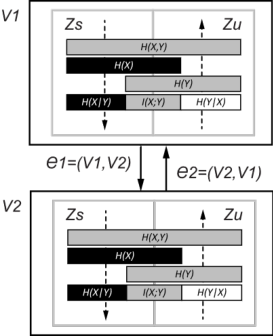
represents an entropy patch or information flow between nodes (Chong, 2026). Figure 1 summarizes this bidirectional node structure.
Figure 1: A TDC node is a bidirectional pair = ( , ) s u TDC Z Z of Shannon-systems corresponding to system-to-user and user-to-system communication. In the NTDC directed graph ( ) = , G V E , vertices are TDC nodes and directed edges transmit conditional-entropy patches between nodes. For a two-node subset { } 1 2 , v v , the interaction may be represented by two directed edges ( ) = 1 1 2 , e v v and ( ) = 2 2 1 , e v v , with ≠ 1 2 e e .
At the network level, attention may be represented by the directed edge relation connecting the currently active nodes, indicating the present locus of interaction within the broader UI system. At the local level, within the relevant Shannon-system (Z ) of a TDC node, attention is represented by the mutual-information term ( ) ; I X Y , which captures the actionable interface option or options currently being decoded.
This yields a two-layer representation of attention. At the network level, attention appears as movement across interaction nodes. At the local level,
120 Chong attention appears as decoding within a directional Shannon-system. What is commonly described as multitasking is therefore modeled not as simultaneous high-fidelity decoding of multiple streams, but as rapid sequential relocation of attention across different nodes or across different portions of the AIOs within a node. This interpretation remains consistent with empirical work on task switching while preserving a compact formal structure.
Furthermore, the NTDC framework can also be applied to analyze interactions involving non-human agents, such as machine users or collaborative teams represented as a single user-entity node. In such cases, the apparent capacity for multitasking may extend beyond a single point of attentional access and instead involve multiple coordinated access points within the NTDC network. In other words, NTDC is capable of modeling both single-user interactive systems and multi-user interactive systems, providing a unified, robust framework.
Bracketing Memory as Stabilized AIO Entropy in the UI-System Within the boundary configuration in which memory is bracketed on the interface side, input entropy may be partitioned as:
where ( ) CAIO H X denotes the entropy of Certain Actionable Interface Options
(CAIO), and ( ) UAIO H X denotes the entropy of Uncertain Actionable Interface
Options (UAIO). ( ) CAIO H X corresponds to actionable options whose
interpretation and use have already stabilized relative to the user’s prior interaction history, whereas ( ) UAIO H X corresponds to recognized actionable options that remain unstable relative to the current cognitive state.
Under this boundary choice, memory is modeled as the stabilized portion of actionable interface entropy, namely ( ) CAIO H X . This does not imply that memory literally resides in the interface. The placement is analytical and depends on the chosen system boundary. If external representations, signifiers, and recurrent interface structures are included within the modeled system, stabilized actionable structure may be bracketed on the interface side.
Learning may then be modeled as the progressive transformation of entropy from ( ) UAIO H X to ( ) CAIO H X across sequential interaction states. Attention and memory remain analytically distinct. ( ) ; I X Y represents the actionable structure currently being decoded, whereas ( ) CAIO H X represents the stabilized actionable structure available for decoding. Therefore, we can define memory (M ) as:
As the stabilized portion grows, decoding can often be achieved with lower conditional uncertainty and greater procedural fluency.
Augmented Memory and Attention in UI Interaction 121 Multitasking as Sequential Attention Relocation Across AIOs
Within NTDC, multitasking may be interpreted as rapid sequential relocation of attention across actionable interface options represented within or across TDC nodes. Because the mutual information term ( ) ; I X Y represents attention at the local level, multitasking does not correspond to simultaneous high-fidelity decoding of multiple interface elements. Instead, it reflects repeated transitions between distinct decoding events.
attentional relocation may occur across both stabilized and unstable portions of the actionable entropy space. Relocations toward ( ) CAIO H X typically involve lower conditional uncertainty because the relevant correspondences between interface structure and user cognition have already stabilized through prior interaction. Relocations toward ( ) UAIO H X typically involve greater conditional uncertainty and more real-time interpretive effort. What appears phenomenologically as multitasking may therefore arise from rapid movement across regions whose stabilization levels differ.
This relation does not require a separate augmentation module. Rather, stabilized actionable entropy provides the structural conditions under which some attentional relocations become faster and more fluent than others. Multitasking performance within a modeled task scope therefore depends not only on the speed of attentional relocation, but also on the current distribution of stabilized and unstable actionable structure.
At present, this interpretation remains a theoretical modeling proposal. Although existing empirical work on task switching and psychological refractory effects is broadly consistent with temporally serial allocation, the specific entropy decomposition proposed here has not yet been directly validated through controlled UI studies.
Memory Bracketed as a Component of User Cognitive State Memory may also be bracketed on the user side of the analytical boundary. In this configuration, ( ) H X represents only the actionable interface options present at the UI boundary, while the user’s cognitive state contains the internal structures relevant to decoding. The cognitive state may be partitioned analytically as:
where ( ) M H Y denotes the user’s accumulated operational knowledge—
“memory”—and ( ) P H Y denotes the user’s current functional “purpose”. This decomposition is analytical rather than ontological. It does not claim that memory and purpose are independent psychological modules in a strong architectural sense. Rather, it provides a boundary-specific representation of the user-side factors that condition decoding within the current interaction.
122 Chong Under this boundary choice, successful decoding depends on the relation between interface entropy ( ) H X , accumulated knowledge ( ) M H Y , and current purpose ( ) P H Y . This configuration is especially useful when the analytical focus lies in product structure, interface composition, or user-side task orientation. By contrast, the interface-side bracketing of Section 3.5 is better suited to analyses of scaffolding, stabilization, and learning in the interaction environment. The two configurations do not duplicate memory within a single model; they provide complementary descriptions of the same interaction under different boundary choices.
DISCUSSION
The main purpose of NTDC is not a full simulation of cognition, but a boundary-relative analytical instrument for reasoning about UI-mediated interaction under uncertainty. By defining a Shannon-system (Z ) as the atomic one-directional informational unit and a TDC node as the bidirectional (bidimensional) interaction unit ( , ) S u TDC Z Z = , the framework provides a shared coordinate system for representing uncertainty, decoding, stabilization, and interaction structure across user-system exchanges. In this sense, NTDC mediates between causal interpretations of cognition and statistical representations of information flow without requiring separate formal primitives for each process.
Integration of Memory, Learning, and CAIO Stabilization The CAIO-UAIO decomposition introduced in the previous section provides a compact representation of stabilization within the actionable input space. When memory is bracketed on the interface side, ( ) CAIO H X represents the stabilized actionable structure available for decoding, while ( ) UAIO H X represents actionable structure that remains uncertain relative to the current cognitive state.
Within this arrangement, learning may be modeled as an increase in the stabilized contribution ( ) CAIO H X across sequential interaction states.
Attention remains represented by ( ) ; I X Y , not by the stabilized partition itself. The decomposition therefore does not collapse memory and attention into the same term; rather, it distinguishes stabilized availability from current decoding.
Because this decomposition is located within the entropy structure of the relevant Shannon-system, it supports both conceptual analysis and computational tracking of familiarity, procedural fluency, and interface-side learning.
Boundary Flexibility and Modeling Perspective NTDC is a boundary-relative framework, and its modeling flexibility depends on keeping the analytical boundary explicit. As shown in previous discussions, the same interaction event E may be represented through two boundary-relative memory models: an interface-side model, where memory
Augmented Memory and Attention in UI Interaction 123 is represented by stabilized actionable entropy, and a user-side model, where memory is represented as a component of the cognitive state.
For a given event E, define
where ( ) X M E is the interface-side memory representation for the event E,
and ( ) Y M E is the user-side memory representation for the same event. These quantities are comparable only when they are computed over the same event scope, with the same logarithmic base and the same analytical granularity.
The discrepancy between the two boundary-relative representations may then be defined as
Ideal boundary alignment is given by
In practical interaction settings,
( ) 0 M E ∆ >
is generally expected. Smaller values indicate closer alignment between interface-side stabilization and user-side operational knowledge; larger values indicate greater divergence between the structure supported by the interface and the structure available in the user’s cognitive state.
This discrepancy is diagnostically useful. It does not imply that one model is correct and the other mistaken. Rather, it quantifies the difference between two formally compatible perspectives on the same interaction event. In this respect, NTDC’s boundary flexibility is not merely a notational convenience but a comparative modeling resource. The logic is analogous to Shannon’s use of asymmetric entropy terms to characterize the same communication event from different positions in the channel, while adapting that principle to interface-side and user-side memory bracketing in interactive systems.
Within NTDC, we can denote the analytical boundary of a use case as B, which sets the closure of the system-of-consideration, Range of Interest (ROI) marks the focal subset, attention is the active-based decoding within that ROI, memory is stabilized, actionable structure available for later decoding, and learning is the progressive stabilization of uncertain options across interaction states; this hierarchy and framework component repurposing is introduced not to complicate the model or the theory, but to let NTDC cope compactly with the complexity already present in fragmented scientific, cultural, and linguistic understandings of these terms.
Potential for Time-Slice Analysis of Learning Dynamics One practical extension of the framework is time-slice analysis of learning dynamics. Sequential interaction states may be indexed as ( ) { } i i Z t
∈[Equation or mathematical symbol available in the original paper PDF] when both communication directions are analytically relevant.
∈[Equation or mathematical symbol available in the original paper PDF], or as ( ) { } i i TDC t
124 Chong This makes it possible to track changes in stabilized and unstable actionable entropy across repeated interaction within the same modeled task scope.
Positive values indicate that more actionable structure has become stabilized between it and jt within the modeled scope. The complementary change in ( ) UAIO H X may be examined at the same time, although monotonic decrease should not be assumed in open systems, changing interfaces, or shifting task boundaries.
These time-sliced comparisons make it possible to study interface familiarization, procedural learning, and changes in task fluency without leaving the core NTDC formalism. At present, however, these implications remain theoretical. Controlled user studies are still needed to determine how changes in the entropy decomposition correspond to observable interaction behavior.
Reflection and Future Research This paper establishes the conceptual structure of NTDC as a boundary- relative framework for modeling interactive communication under uncertainty. Several implications, including the relation among memory stabilization, learning, and automation, remain outside the scope of the present study and require empirical testing. Future work should examine how the proposed entropy partitions correspond to observable interaction behavior in controlled UI studies.
NTDC may also be understood as a cognitive instrumentation framework. Like Shannon’s communication theory, it provides a measurement architecture for structured reasoning rather than a full semantic simulation. Within this architecture, the entropy terms of the directional Shannon-system (Z ) function as analytical variables, and paired Shannon-systems form TDC nodes for modeling user-system interaction. NTDC therefore serves as a compact instrument for diagnosing informational alignment, uncertainty, and stabilization in UI-mediated communication.
CONCLUSION
This paper has presented NTDC as an information-theoretic framework for modeling attention, memory, learning, and multitasking in UI-mediated interaction. Within NTDC, directional Shannon-systems are paired to form TDC nodes, allowing interface structure, user cognition, and information flow to be represented within a shared analytical model. Attention is treated as decoding through mutual information, memory as stabilized actionable structure under a specified boundary, and learning as the progressive stabilization of previously uncertain options across interaction states. Because the framework is boundary-relative, the same interaction may be modeled from interface-side and user-side perspectives, and the discrepancy between
Augmented Memory and Attention in UI Interaction 125 those perspectives can itself be analytically informative. NTDC therefore offers not a full cognitive simulation, but a compact analytical instrument for examining alignment, uncertainty, and stabilization in complex interactive systems. Future work should test these relations through empirical studies of interface use and learning.
NOTE FOR TERMINOLOGY UPDATES In the author’s previous publications (Chong, 2023–2026), the theoretical models of Two-Way Communication Channels (TCC) and Networked Two- Way Communication Channels (NTCC) were introduced to describe modern interactive UI design and user–system information exchanges. To avoid confusion with Claude E. Shannon’s (1961) term “Two-Way Communication Channels,” which refers to a physical bidirectional transmission system, these concepts are hereafter referred to as Two-Dimensional Communication Channels (TDCC), with the shorthand TDC adopted for general use. The corresponding networked framework is accordingly termed Networked Two-Dimensional Communication Channels (NTDCC), or NTDC in short.
REFERENCES
Atkinson, R.C., Shiffrin, R.M. (1968). Human memory: A proposed system and its control processes. Psychology of Learning and Motivation 2, 89–195. Baddeley, A.D., Hitch, G. (1974). Working memory. Psychology of Learning and
Motivation 8, 47–89. Broadbent, D.E. (1958). Perception and Communication. Pergamon Press, New York. Brooke, J. (1996). SUS: A ‘Quick and Dirty’ Usability Scale. In: Jordan, P.W., Thomas, B., Weerdmeester, B.A., McClelland, I.L. (eds.) Usability Evaluation in Industry, pp. 189–194. Taylor & Francis, London. Byrne, M.D. (2012). Unified theories of cognition. WIREs Cognitive Science 3(4),
431–438. Carroll, J.M. (ed.) (2003). HCI Models, Theories, and Frameworks: Toward a Multidisciplinary Science. Morgan Kaufmann, San Francisco, CA. Chong, L. (2023). Temperature, entropy, and usability: The theoretical and practical
resemblances between thermodynamics and user interface design. In: Stephanidis, C., Antona, M., Ntoa, S., Salvendy, G. (eds.) HCI International 2023 Posters. Communications in Computer and Information Science, vol. 1832, pp. 16–24. Springer, Cham. Chong, L. (2024). The relevancy of knowledge and the knowledge of relevancy: An information theory-based quantitative methodology for evaluating UI design and usability. In: Ahram, T., Falcão, C. (eds.) Usability and User Experience. AHFE Open Access, vol. 156, pp. 65–77. AHFE International, USA. Chong, L. (2025a). Maxwell’s Demon, System Boundary, and Interface ROI: The
Importance of Logical Integrity in UI/UX Design and Evaluation. In: Paletta, L. (ed.) Cognitive Computing and Internet of Things. AHFE Open Access, vol. 165, pp. 21–36. AHFE International, USA. Chong, L. (2025b). A computational view of affordance and signifier: indexing and logics in UI cognition and design. Human-Intelligent Systems Integration.
Dynamic Semantic Indexing Framework for UI Design and AI Alignment. In: Degen, H., Ntoa, S. (eds.) HCI International 2025 – Late Breaking Papers. Lecture Notes in Computer Science, vol. 16345, pp. 161–175. Springer, Cham. Ebbinghaus, H. (1885). Memory: A Contribution to Experimental Psychology.
Teachers College Press, New York. (Ruger, H.A., Bussenius, C.E., trans., 1913). Fitts, P.M., Posner, M.I. (1967). Human Performance. Brooks/Cole, Belmont, CA. Hutchins, E. (1995). Cognition in the Wild. MIT Press, Cambridge, MA. ISO 9241-11:2018 (2018). Ergonomics of human-system interaction — Part 11: Usability: Definitions and concepts. ISO, Geneva. Kirsh, D., Maglio, P. (1994). On distinguishing epistemic from pragmatic action.
Cognitive Science 18(4), 513–549. Kotseruba, I., Tsotsos, J.K. (2020). 40 years of cognitive architectures: core cognitive abilities and practical applications. Artificial Intelligence Review 53, 17–94. Mateescu, M., Kauffeld, S. (2024). Interactive external representations for knowledge-
building processes and performance in dyads: An experimental study. Computers in Human Behavior Reports 16, 100519. Miller, G.A. (1956). The magical number seven, plus or minus two: Some limits on our capacity for processing information. Psychological Review 63(2), 81–97. Pashler, H. (1994). Dual-task interference in simple tasks: Data and theory.
Psychological Bulletin 116(2), 220–244. Posner, M.I., Petersen, S.E. (1990). The attention system of the human brain. Annual Review of Neuroscience 13, 25–42. Posner, M.I., Snyder, C.R.R., Davidson, B.J. (1980). Attention and the detection of
signals. Journal of Experimental Psychology: General 109(2), 160–174. Risko, E., Gilbert, S. (2016). Cognitive offloading. Trends in Cognitive Sciences 20(9), 676–688. Roberts, J.M. (1964). The self-management of culture. In: Goodenough, W.H.
(ed.) Explorations in Cultural Anthropology: Essays in Honor of George Peter Murdock. McGraw-Hill, New York. Rogers, R.D., Monsell, S. (1995). Costs of a predictable switch between simple cognitive tasks. Journal of Experimental Psychology: General 124(2), 207–231. Scaife, M., Rogers, Y. (1996). External cognition: how do graphical representations
work? International Journal of Human-Computer Studies 45(2), 185–213. Shannon, C.E. (1948). A mathematical theory of communication. Bell System Technical Journal 27, 379–423, 623–656. Shannon, C.E. (1961). Two-way communication channels. In: Neyman, J. (ed.)
Proceedings of the Fourth Berkeley Symposium on Mathematical Statistics and Probability, vol. 1, pp. 611–644. University of California Press, Berkeley, CA. Tenison, C., Anderson, J.R. (2016). Modeling the distinct phases of skill acquisition.
Journal of Experimental Psychology: Learning, Memory, and Cognition 42(5), 749–767. Treisman, A. (1964). Monitoring and storage of irrelevant messages in selective attention. Journal of Verbal Learning and Verbal Behavior 3(6), 449–459. Zhang, J. (1997). The nature of external representations in problem solving.
Cognitive Science 21(2), 179–217.
LISTED IN THE AHFE DIGITAL BOOKSTORE CATALOGUE
Explore the complete digital volume
Cognitive Computing and Internet of Things
Read this individual research paper free through the original publisher, or explore the full digital proceedings book.
ISBN 978-1-964867-81-6
Explore this ISBN in the AHFE Bookstore ↗Listed in the July 2026 bookstore catalogue; search by ISBN to confirm current availability · Digital book purchase optional