Gülara Mat, Ekrem Cem Alppay (2026). Exploring Passenger Experience on High-Speed Rail for Digital Engagement: A Case Study of Turkish High Speed Train Passengers. In: Advances in Human Factors of Transportation. AHFE Open Access, vol. 224, pp. 400–407. https://doi.org/10.54941/ahfe1007868
As rail travel expands, understanding how passengers experience these environments, particularly those who rely on continuous digital engagement, becomes increasingly important for user-centered design research. Digitally engaged passengers are those who actively use their digital devices for work, communication, or personal tasks during travel. These behavioral shifts highlight the need to examine how digital engagement intersects with usability, comfort, and productivity in long-distance travel settings. This study aims to investigate the train travel interior for digitally engaged passengers, specifically in Turkey, focusing on how the physical and service-related aspects of long-distance Turkish train journeys affect their user experience, digital engagement, multitasking behaviors, and comfort during travel. To uncover these gaps, the research adopted an online survey answered by 181 people who have traveled on Turkish high-speed trains. The survey questions were designed to evaluate the passenger experiences of people using Turkish high-speed trains, particularly regarding digital device use, productivity, multitasking habits, and perception of the physical environment. These constraints were synthesized into five core pain point categories that consolidate the most prominent environmental barriers affecting digital productivity and multitasking during travel, highlighting the design elements passengers perceive as essential for a comfortable and usable digital workspace. These insights support the conceptualization of digitally engaged travel behaviors and contribute to defining a framework that links environmental factors to digital engagement levels.
HSR (High-speed rail) has emerged as an efficient transportation option to respond to the growing population and increased travel needs. It offers a faster and more efficient mode of transportation compared to traditional rail services. In parallel, as mobile connectivity and multitasking become integral to everyday life, long-distance train journeys are increasingly seen not just as transit time but as opportunities for productivity, communication, and digital engagement. This shift is often discussed through the concept of travel-based multitasking, where passengers simultaneously engage in
Exploring Passenger Experience on High-Speed Rail for Digital Engagement 401 activities such as reading, working, social interaction, or ICT (Information and Communication Technology) use during travel (Ettema and Verschuren, 2007; Keseru and Macharis, 2018). Travel time has started to be considered a potentially productive time rather than just wasted time.
In this context, the term digitally engaged passengers refers to those who actively use their digital devices for work, communication, or personal tasks during travel. As rail travel expands, understanding how these passengers experience HSR environments, especially in relation to digital engagement needs, becomes increasingly important for user-centered design research.
This study aims to investigate the train travel interior for digitally engaged passengers, specifically in Turkey, focusing on how the physical and service-related aspects of long-distance Turkish train journeys affect their user experience, digital engagement, multitasking behaviors, and comfort during travel. An increasing number of passengers depend on uninterrupted device access and ergonomic support during transit, effectively transforming trains into mobile environments for work, study, and digital engagement. This shift suggests practical requirements for sustained device use, including usable work surfaces, manageable noise levels, reliable power access, and stable ambient comfort. However, existing train interiors often overlook the behavioral shifts of digitally engaged passengers, offering interiors that are poorly suited for digital activities and multitasking-intensive travel routines.
This paper focuses on identifying the interior and service-related factors that prevent digitally engaged passengers from maintaining device-based activities and perceived productivity during travel in the Turkish HSR context. Using survey evidence, the findings are synthesized into a pain point diagram that consolidates recurring barriers and improvement priorities into design-relevant categories. The resulting set of pain points provides an empirical basis for rethinking HSR interiors and services to better support digital engagement routines.
Existing research has identified individual factors that affect travel- based multitasking, such as connectivity, noise, and seating. However, these barriers have largely been examined in isolation rather than synthesized into a unified, design-oriented framework. This study addresses that gap by consolidating survey-evidenced barriers into a structured set of pain point categories that map the relationships between environmental constraints and digital engagement during HSR travel, specifically within the underexplored Turkish context.
TRAVEL-BASED MULTITASKING & DIGITAL ENGAGEMENT The digitally engaged passenger represents a fundamental shift in travel behavior in which the device, the activity, and the passenger are closely connected. Travel-based multitasking is becoming more common as connectivity becomes a standard expectation (Pawlak, 2020; Keseru and Macharis, 2018). Travel time is increasingly reframed from “dead time” to productive or enjoyable time through digital engagement and multitasking (Lyons & Urry, 2005). Evidence suggests that digital technologies are widely
402 Mat and Alppay used across transport modes, particularly for accessing travel information (Rosa, 2023; Durand et al., 2024). Engagement, however, varies by age: younger passengers (especially Millennials) are more likely to adopt digital tools and value productive multitasking, whereas older groups show higher rejection (Malokin et al., 2021; Rosa, 2023). Additionally, device type varies by context; laptops are more strongly associated with train-based work than handheld use typical in bus travel (Rosa, 2023; Guo et al., 2015; Gripsrud and Hjorthol, 2012). These shifts make it necessary to reconsider transport interiors, as passengers move from passive sitting to active device-use postures with new ergonomic needs (Kamp et al., 2015; Hiemstra-van Mastrigt et al., 2017). Transport research increasingly treats travel time as having positive utility, not only as a cost to be reduced (Mokhtarian and Salomon, 2001). Building on this shift, scholars introduced multitasking to challenge the “wasted time” assumption and argued that travel time can be a valuable resource (Lyons and Urry, 2005; Kenyon and Lyons, 2007).
METHOD
This study used an online survey with Turkish HSR passengers to capture patterns of digital device use, perceived productivity barriers, and improvement priorities, which were subsequently consolidated into a pain point diagram. The survey was prepared in the Google Forms platform and distributed via posters at physical locations (universities, cafes and HSR train stations in Istanbul) and through online (social media and research website) platforms. The survey remained open for three months and received 200 answers, with 181 valid entries after data cleaning (e.g., incomplete entries and non-eligible responses). The online survey included 26 questions total covering demographic data, travel frequency, and digital device usage habits while traveling. The criterion for participation was prior experience with Turkish HSR. The survey consisted of various question types including single-choice questions, multiple-selection questions, 7-point rating scales, and open-ended responses. Quantitative responses were analyzed using descriptive statistics, while open-ended responses were analyzed thematically. Survey signals (reported barriers, improvement priorities, and open-ended themes) were then mapped into pain point categories to support design- relevant interpretation.
RESULTS
The cleaned survey dataset included 181 Turkish HSR passengers (56% female, 42% male, 2% prefer not to say). Participants were predominantly aged 25-34 (41%) or 18-24 (28%), and most held at least a bachelor’s degree (62% bachelor’s, 27% master’s, 9% doctorate). The largest professional groups were design/creative (24%) and students (21%), followed by engineering & IT/data (18%) and business/finance/management/law (15%). Travel purposes varied, most commonly visiting family/friends (38%) and leisure/tourism (29%), with business (19%) and education (14%) also
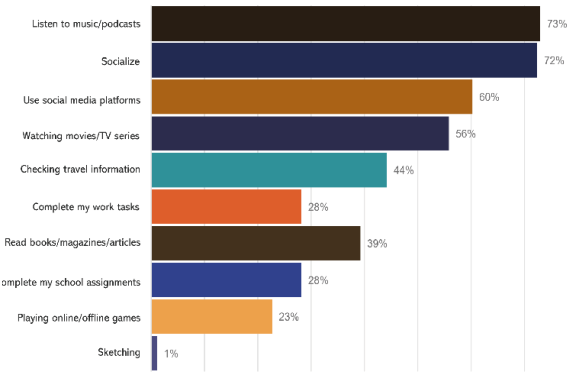
Exploring Passenger Experience on High-Speed Rail for Digital Engagement 403 reported. Digital device use was common: 72% reported always using devices during HSR travel, 18% often, and 10% rarely. Smartphones were the dominant device (97%), followed by laptops (39%) and tablets (31%). Reported purposes of device use were predominantly leisure-oriented (music/ podcasts 73%, socializing/communicating 72%, social media 60%, watching series/films 56%), while productivity-related use was also present (work tasks 28%, school assignments 28%) (Figure 1). Perceived importance of being productive was moderate-to-high (M = 4.6/7): 57% rated productivity importance between 5–7, while 30% selected 1–3. Reported productivity barriers were led by internet access/quality (73%), other passengers’ voices (55%), and lack/insufficient table space (54%), followed by seat comfort (34%) and ventilation (24%). Overall, this profile indicates that digital engagement during travel is predominantly leisure-oriented but still includes a meaningful productivity segment, and the split in productivity-importance ratings suggests heterogeneous expectations rather than a uniform “business traveler” pattern.
Figure 1: Purposes of digital device use during trips.
Correspondingly, the most selected improvement priorities were improved services for electronic device use (82%), better working conditions (57%), and more entertainment options (48%), with all remaining options below 10%. Travel patterns further showed that the Istanbul-Ankara corridor was the most frequently used route (49%), followed by Istanbul-Eskisehir (24%), Istanbul-Konya (9%), and Ankara-Eskisehir (8%), with remaining domestic HSR routes grouped as Other. The route-purpose mapping also indicated that the Istanbul-Ankara line primarily served Business Trips and Visiting Family/ Friends, while Education stood out more strongly on the Istanbul-Eskisehir route, suggesting a notable student mobility pattern on that corridor. Ticket purchase behavior was predominantly digital across all age groups (mobile app and website), whereas purchasing at the station remained comparatively low.
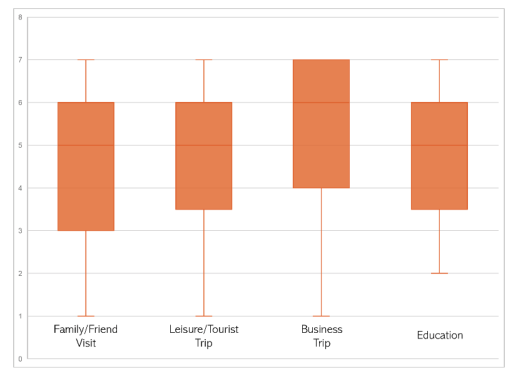
404 Mat and Alppay Perceived productivity importance also differed across travel purposes (1–7 scale). Ratings were generally moderate to high across all purposes, with medians clustering in the upper-middle range. Business trips showed a higher central tendency, with the distribution shifted upward (median ≈ 6), whereas Family/Friend Visit, Leisure/Tourist, and Education trips displayed similar central tendencies (medians ≈ 5) alongside substantial within-group variability (Figure 2).
Figure 2: Distribution of productivity ratings by travel purpose.
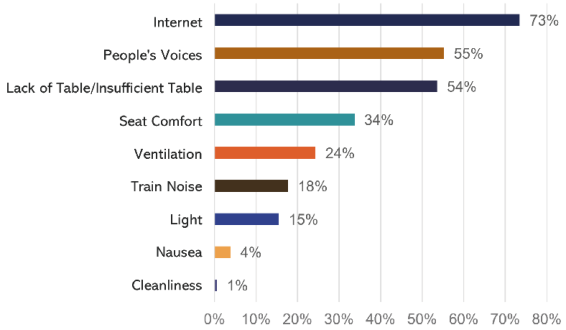
In addition, perceived productivity importance varied by professional context: Education and Academia ratings were more concentrated toward the upper end of the scale, whereas the student group showed broader dispersion and a lower central tendency. Beyond the top three productivity barriers: Internet (73%), People’s voices (55%) and Lack of table/insufficient table (54%); other reported constraints included seat comfort (34%), ventilation (24%), train noise (18%), and lighting (15%), while nausea (4%) and cleanliness (1%) were rarely mentioned as limiting factors (Figure 3).
Figure 3: Barriers to productivity during hsr travel.
Exploring Passenger Experience on High-Speed Rail for Digital Engagement 405 Overall satisfaction with the HSR travel experience was moderately high (M = 4.9/7), clustering around 5 (44%), 4 (22%), and 6 (18%), with low ratings being uncommon (3: 6%, 2: 2%, 1: 0%) and 7 selected by 8% of respondents. The four service satisfaction items (Cleanliness, Seat Comfort, Power Outlet, Customer Service) showed weak-to-moderate positive inter- item correlations and good internal consistency (Cronbach’s α = 0.80).
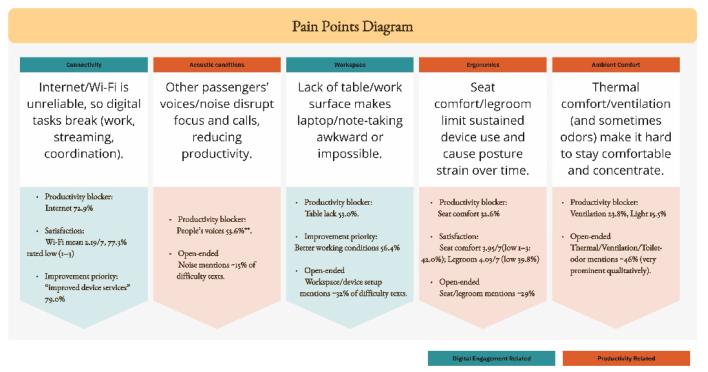
FROM RESULTS TO PAIN POINT DIAGRAM The Pain Point Diagram was derived from the survey findings to translate questionnaire outputs into a compact, design-oriented synthesis (Figure 4). First, survey items were treated as experience signals: (i) productivity blockers (e.g., connectivity, noise, workspace-related constraints), (ii) service satisfaction ratings that indicate weak points in the onboard experience, (iii) improvement priorities reflecting what respondents most want changed, and (iv) open-ended difficulty statements (within the survey) that qualitatively confirm or enrich the structured measures.
Figure 4: Pain point diagram.
These signals were then reviewed together to identify overlaps that point to the same underlying friction. Visualizing these frictions is critical, as passengers tend to evaluate their journeys based on negative moments and emotional lows, not on average service performance (van Hagen and Bron, 2014). Next, overlapping signals were clustered into pain point themes by consolidating related attributes (e.g., multiple items pointing to the same connectivity or acoustic issue) and combining quantitative ratings with qualitative confirmations from open-ended responses. Five distinct categories emerged after iterative review rather than being predetermined. Items that co-occurred across multiple survey signals or recurred consistently across respondents were grouped together, and the final number of pain point categories was determined by the structure of the data itself rather than an a priori framework. Because the study focuses on digital engagement during
406 Mat and Alppay travel, the diagram prioritizes the pain points that most directly constrain digital device use and travel-based multitasking, while survey-reported issues that reflect the broader train experience but do not directly shape digital engagement were kept out of the visual synthesis. The resulting diagram provides a survey-based baseline by highlighting the most recurrent and consequential breakdowns evidenced by the questionnaire and presenting them in a single view for design-relevant comparison.
CONCLUSION
This study’s results provide a baseline understanding of HSR passengers in Turkey and show that travel time is widely treated as “useful time,” enabled by frequent digital device use and travel-based multitasking. Across the sample, passengers reported near-constant engagement with smartphones and, to a lesser extent, laptops and tablets, using travel time for communication, entertainment, and work or study at a meaningful but smaller scale. At the same time, the survey indicates that digital productivity is not primarily constrained by motivation but by the onboard context: connectivity quality, other passengers’ voices, and insufficient or unusable workspace repeatedly emerged as the most common blockers, while improvement priorities emphasized better support for device use and more workable conditions for productive activities.
Translating these distributed survey signals into a design-oriented synthesis, the survey-driven pain point diagram consolidates recurring frictions into a small set of dominant pain points that most directly limit digitally engaged travel. In this context, the dominant pain points are connectivity breakdowns, acoustic disturbance, insufficient workspace, ergonomics-related strain, and ambient comfort issues. These findings provide a survey-based snapshot and should therefore be interpreted with appropriate caution. The sample may not fully represent the broader HSR population, responses reflect perceived rather than objectively measured conditions (e.g., Wi-Fi quality, noise, temperature, workspace dimensions), and clustering signals into pain points introduces interpretive subjectivity that may mask temporal dynamics and interactions between constraints. Taken together, the survey baseline and the pain point diagram suggest that enabling “useful time” in HSR requires an ecosystem approach, combining predictable connectivity with physical and sensory conditions that sustain device use.
REFERENCES
Durand, A., Hamersma, M., van Oort, N. and Hoogendoorn, S. (2024) ‘Digital engagement for travel information among car and public transport users in the Netherlands’, Transportation Research Interdisciplinary Perspectives, 28, p. 101285. Ettema, D. and Verschuren, L. (2007) ‘Multitasking and value of travel time savings’,
Transportation Research Record, 2010(1), pp. 19–25. Gripsrud, M. and Hjorthol, R. (2012) ‘Working on the train: from ‘dead time’ to productive and vital time’, Transportation, 39(5), pp. 941–956. Guo, Z., Derian, A. and Zhao, J. (2015) ‘Smart devices and travel time use by
bus passengers in Vancouver, Canada’, International Journal of Sustainable Transportation, 9(5), pp. 335–347.
Exploring Passenger Experience on High-Speed Rail for Digital Engagement 407 Hiemstra-van Mastrigt, S., Groenesteijn, L., Vink, P. and Kuijt-Evers, L.F. (2017)
‘Predicting passenger seat comfort and discomfort on the basis of human, context and seat characteristics: a literature review’, Ergonomics, 60(7), pp. 889–911. Kamp, I., Van Veen, S.A. and Vink, P. (2015) ‘Comfortable mobile offices: A literature review of the ergonomic aspects of mobile device use in transportation settings’, Work, 52(2), pp. 279–287. Kenyon, S. and Lyons, G. (2007) ‘Introducing multitasking to the study of travel and
ICT: Examining its extent and assessing its potential importance’, Transportation Research Part A: Policy and Practice, 41(2), pp. 161–175. Keseru, I. and Macharis, C. (2018) ‘Travel-based multitasking: review of the empirical evidence’, Transport Reviews, 38(2), pp. 162–183. Lyons, G. and Urry, J. (2005) ‘Travel time use in the information age’, Transportation
Research Part A: Policy and Practice, 39(2–3), pp. 257–276. Malokin, A., Circella, G. and Mokhtarian, P.L. (2021) ‘Do millennials value travel time differently because of productive multitasking? A revealed-preference study of Northern California commuters’, Transportation, pp. 1–37. Mokhtarian, P.L. and Salomon, I. (2001) ‘How derived is the demand for travel?
Some conceptual and measurement considerations’, Transportation Research Part A: Policy and Practice, 35(8), pp. 695–719. Pawlak, J. (2020) ‘Travel-based multitasking: review of the role of digital activities and connectivity’, Transport Reviews, 40(4), pp. 429–456. Rosa, G. (2023) ‘Digital traveler: The use of modern information technologies in
passenger transport’, European Research Studies Journal, 26(3), pp. 275–288. van Hagen, M. and Bron, P. (2014) ‘Enhancing the experience of the train journey: Changing the focus from satisfaction to emotional experience of customers’, Transportation Research Procedia, 1, pp. 253–263.
LISTED IN THE AHFE DIGITAL BOOKSTORE CATALOGUE
Explore the complete digital volume
Advances in Human Factors of Transportation
Read this individual research paper free through the original publisher, or explore the full digital proceedings book.
ISBN 979-8-950676-00-0
Explore this ISBN in the AHFE Bookstore ↗Listed in the July 2026 bookstore catalogue; search by ISBN to confirm current availability · Digital book purchase optional