Ece Cinar Balci, Ekrem Cem Alppay (2025). AI-Supported Personas vs Conventional Personas: A comparative Study Based on The Views and Opinions of Designers. In: Intelligent Human Systems Integration (IHSI 2025): Integrating People and Intelligent Systems. AHFE Open Access, vol. 160, pp. 618–628. https://doi.org/10.54941/ahfe1005868
In product design, understanding the target user group, their habits, preferences, and likes is crucial for ensuring a product meets user needs. User research plays a vital role in the early stages of the design process. The persona method, developed by Alan Cooper, is a widely used technique in the design process where users are grouped based on real data and represented by fictional characters. Conventional persona creation relies on qualitative data and designer intuition, which can be time-consuming and prone to bias. This paper explores the use of AI-driven tools, specifically ChatGPT-4o and DALL-E3, to generate dynamic, data-driven personas, offering a more efficient and precise alternative. The study compares four conventional and four AI-supported personas for mobile music streaming apps both derived from interviews with 24 users. Ten product designers evaluated both persona types, with results indicating that AI-supported personas hold significant potential for enhancing user experience design. The findings demonstrate how AI can enable more adaptive, user-centric designs, bridging the gap between conventional methods and AI-supported approaches.
In the human-computer interaction field, personas have long served as valuable tools for representing target users and guiding design decisions. According to Cooper, personas are not real people, but they are based on the behaviors and motivations of real people. They are hypothetical archetypes of actual users (1999). Adlin and Pruitt define a persona as a fictional but credible representation of a target user group (2010). Conventionally, persona creation relies on qualitative research methods such as interviews, surveys and focus groups, where designers synthesize insights based on user data and their own expertise. However, this approach has limitations: it is often time consuming, prone to biases and may struggle to capture the dynamic and evolving nature of user behaviors. According to Wilson and Daugherty (2018), the combination of humans’ leadership, teamwork, creativity and social skills with Artificial Intelligence (AI)’s speed, quantitative and qualitative scaling capabilities can complement each other’s weaknesses and improve performance. The integration of AI has emerged as a promising
AI-Supported Personas vs. Conventional Personas 619
solution, offering new possibilities for enhancing persona creation both verbally and visually.
This paper explores the use of AI, specifically text-generative AI, ChatGPT and DALL-E, in generating data-driven personas as a support tool by comparing personas created through conventional methods with AI-supported personas, assessing their impact on user experience (UX) design and evaluating their potential to improve product development outcomes. The term “AI-supported” refers to situations where AI assists or enhances human decision-making with AI tools aiding in tasks while the ultimate control remains human-driven. While some studies question whether personas are actually applied in the design process, others question whether personas are understood as a useful design method (Blomquist and Arvola, 2002; Matthews et al., 2012; Pruitt and Grudin, 2003). Some reports have also been presented on what can be done to use the persona concept more effectively and how they can be created and strengthened (Hinton, 2007; Junior and Filgueiras, 2005). There are studies in the literature suggesting that personas can be abstract, distracting (Matthews, et al., 2012), misleading and lacking identity (Marsden and Pröbster, 2019). According to Ferreira et al. (2016), various persona techniques use too much information and the description template does not clearly guide designers in defining the functions and features of applications. They emphasize the need for a common template that could positively impact designers’ processes. Building on this, the aim of this study is to explore professional product designers’ perceptions and attitudes toward the persona method and to evaluate the role of AI in developing an optimal persona template that aligns with designers’ preferences and practical needs within the context of music streaming personas.
THE USE OF ARTIFICIAL INTELLIGENCE IN PERSONA CREATION Persona creation process can be categorized in three broad classes: qualitative methods, quantitative methods and mixed methods. Qualitative methods are based on gathering verbal and other qualitative data from users in manual processes. Focus groups and user-interviews are widely used as qualitative data collection techniques. The data analysis process is usually interpretive and conducted by researchers. Open coding or axial-coding can take place in qualitative data analysis processes. Quantitative methods are based on quantitative data collection techniques, such as online surveys and employ statistical analysis such as regression analysis, factor analysis, clustering etc. Quantitative methods can gather data about a very large number of users therefore, can generate a detailed segmentation among users of a product. Lastly, mixed methods are based on the use of both qualitative and quantitative processes to produce more comprehensive personas. Pruitt and Grudin (2003) recommends the usage of mixed methods when creating personas. Each of these persona creation methods have its strengths and weaknesses (Jansen et al., 2022).
Text generation tools enhance and stimulate creativity in writing (Woo, 2022) and can be used to make personas more detailed, nuanced and
620 Balci and Alppay
diverse by using GPT-3 (Goel et al., 2023). The relationship between AI and persona creation is fundamentally transformative, reshaping how designers create and utilize personas. According to Jones, Floyd and Twidale (2008) personas should leverage real user data and adequately reflect the scope of the design space. AI, particularly through tools like ChatGPT, introduces efficiency and precision into this process by automating data analysis and generating dynamic, data-driven personas. Kocaballi (2023) demonstrated ChatGPT’s capabilities in a hypothetical design project that included persona creation, simulating interviews with fictional users, generating new design ideas, creating usage scenarios and evaluating user experience. The findings showed that ChatGPT effectively fulfilled roles as a designer, user or product, providing relevant responses; however, limitations such as forgotten information, incomplete answers and a lack of output diversity were noted. Similarly, Ha et al. (2024) compared interactions with CloChat and ChatGPT, finding that users formed emotional connections with personalized agents, engaged in more dynamic dialogues, and expressed interest in maintaining ongoing interactions.
AI can analyze large datasets from sources such as social media, online behaviors and user feedback, identifying patterns and trends that may not be immediately evident through conventional methods. This results in more accurate and adaptive personas that better reflect evolving user behaviors and preferences. Furthermore, AI mitigates the risk of subjective bias by relying on data-driven insights rather than personal intuition, leading to more objective representations of user groups. As AI becomes more integrated into design processes, it enables designers to create more relevant and user-centered products (Jung et al., 2018).
METHODOLOGY
A three-phase study was conducted to develop personas for mobile music streaming app users. Firstly, qualitative data were collected through online interviews with 24 participants, focusing on behaviors, needs, motivations, pain points and goals, using 47 questions across categories; demographics, general questions, awareness, evaluation, participation, usage, loyalty, self- identification and quotes. Audio and video recordings were transcribed and coded based on these categories. Common themes were identified and user types were grouped accordingly. Common themes were identified and user types grouped accordingly. Visual support, including images and color associations reflecting participants’ characters, was also analyzed, as requested at the end of the interviews. Based on real user data, four conventional persona proposals were created both verbally and visually.
In the second phase, the same interview transcripts were input into ChatGPT-4o to generate four additional personas. A specific prompt was given to the AI, instructing it to create distinct personas that included sections for a portrait, demographics, quotes, behaviors, pain points, gains, needs, and goals/motivations. The AI was given the following prompt: “A file will be shared containing transcripts from interviews with 24 individuals. Based on this data, four distinct Turkish personas should be generated, each including
AI-Supported Personas vs. Conventional Personas 621
sections for a portrait, quotes, demographics, behaviors, pain points, gains, needs, and goals/motivations. The visual persona templates should contain diagrams, icons, and text, along with a mood board.” While AI initially summarized these personas in text form, it also generated visual templates with DALL-E3. However, the text in these templates was not fully legible and comprehensive, so the visuals and text were manually adjusted to improve clarity and readability.
In the final phase, online interviews were conducted with 10 professional designers via Miro to evaluate the effectiveness and usability of both persona types. Designers shared their experiences with persona creation, their familiarity with AI tools and their opinions on the eight personas generated in this study. They were also asked to rate each persona on a scale of 1 to 7 using the Persona Perception Scale which includes dimensions; relatability, completeness, usefulness, consistency, engagement, empathy, distinctiveness and overall impression (Salminen et al., 2020).
Participants Participants interviewed for persona creation, represented a diverse demographic, with varied professions (students, managers, doctors, engineers etc.) and an age range from 22 to 65; 13 male and 11 female. This broad demographic profile supports a comprehensive evaluation of user experiences in mobile music applications. Ten product designers with over five years of industry experience in digital product design contributed to the evaluation phase.
FINDINGS Findings of the Data Collection for Persona Creation
The findings reveal that users prioritize ease of use, personalization, social interaction, advertisements/pricing, music quality, visual satisfaction and data usage/security. Participants’ preferences for music streaming varied across these categories. During the analysis of the transcriptions, key user needs, behaviors and expectations were identified. For ease of use, some users appreciated the convenience of streaming without needing to download albums or purchase CDs (P7), while others found managing multiple profiles challenging due to interface (P3). In terms of personalization, participants expressed a desire to create custom playlists (P4) and receive tailored music recommendations (P10). Social interaction also emerged as important, with one participant valuing the option to listen to music simultaneously with others (P11). Regarding advertisements and pricing, preferences differed: some participants were willing to pay for an ad-free experience (P9), while others were unwilling to pay additional fees (P1). Music quality was essential for participants, who wanted high-quality audio comparable to live performances (P3) and wished to avoid poor experiences, like listening through low-quality headphones (P8). For data usage and security, participants preferred trusted apps (P1) and minimal internet data usage for streaming (P11). Finally, opinions on visual satisfaction were mixed, with
622 Balci and Alppay
some participants finding visuals unimportant (P23), while others enjoyed seeing lyrics while listening (P5).
Participants were grouped based on their relationship with music including common themes, resulting in the following user groups: Exploratory Melomaniac; individuals who love discovering music and actively seek out new artists across different genres. Loyal Follower; those who remain devoted to a specific music genre or artist and listen to music to relax. Social Media Addict; users who express their lifestyle and identity through music and engage socially on various platforms.
Trend Follower; those who keep up with new album releases, popular songs, and technological trends. Playlist Creator and Sharer; individuals who personalize their music experience by creating and sharing custom playlists. Diverse Content Consumer; users who listen to other types of content, such as podcasts and audiobooks. They are not conscious music listeners and only play music when needed, using various platforms and tools. Musician / Band Member; member of a music group, earns money commercially from music streaming apps. It was noted that some participants fit into multiple groups, suggesting that user groups could potentially be merged (Table 1).
Table 1. Merged user groups.
Table available in the original PDF paper.
User Groups Participants
P4, P6, P11, P12, P15, P16, P23
Loyal Follower P1, P8, P10, P14, P18, P20, P21, P24 Exploratory Melomaniac Social Media Addict Trend Follower Playlist Creator and Sharer Diverse Content Consumer P2, P5, P7, P8, P13, P17, P19, P22 Musician / Band Member P3
Personas of Melis Yılmaz, the Music Enthusiast (Per 1), Ekin, the Tech- Savvy (Per 2), Tayfun Akın, the Loyal Follower (Per 3), Can Aslan, the Musician (Per 4) were created that fit these groups (Fig. 1).
Figure 1: Conventional personas created by researchers.
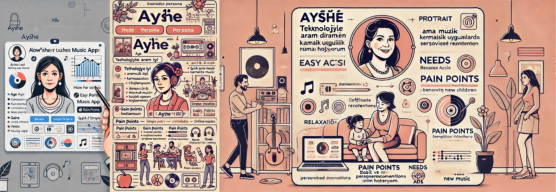
Findings of the AI-Supported Persona Creation The process took longer than expected as the initial response set required follow-up questions to refine realistic personas. Once text-based personas were finalized, the visual design process became iterative, improving lifestyle representation. AI provided quick, effective alternatives to lengthy illustrations but struggled to integrate text into visuals (Fig. 2).
AI-Supported Personas vs. Conventional Personas 623
Figure 2: Text-to-image AI-supported persona visualizations for Tech-savvy teacher Ay¸se.
AI-supported persona visuals offer detailed insights into daily life, functioning like a moodboard that covers aspects such as budget, lifestyle, work dynamics, routines, special interests and product usage (Fig. 3).
Figure 3: AI-supported personas created by researchers.
While they add diversity to conventional personas, the cultural context of AI training affects accuracy; for instance, prompts for a “Turkish” persona often yield European-like visuals, representing “Turkishness”mainly through the inclusion of the Turkish flag rather than cultural nuances.
Findings of the Designers’ Evaluation Designers highlighted personas as essential for aligning the design process with real user needs, bridging conceptual designs and practical experiences. They found personas especially valuable during ideation and prototyping, enabling user reaction anticipation and feature refinement. Personas create a user-centered framework that enhances empathy and ensures designs meet genuine expectations, but designers stressed the need for flexibility and regular updates based on user feedback. While all designers acknowledged the benefits of personas, not all used them; proto-personas (Gothelf, 2012) were preferred for narrowly defined audiences, while broader user bases posed challenges in narrowing personas. Designers use AI tools like ChatGPT and Microsoft Copilot to quickly generate persona insights and user scenarios, saving time compared to conventional methods. For visuals, Midjourney, DALL-E and Adobe Firefly are preferred, with Midjourney praised for its realistic imagery, while tools like Figma, FigJam and Miro are used for templates. Despite these advantages, designers noted AI’s limitations in emotional depth, finding conventionally created personas more relatable. Overall, they view AI as a helpful tool for efficiency and structure but believe human input is essential for creating authentic, empathetic personas.
Designers noted unique strengths in both AI-supported and conventional personas, favoring a hybrid model. AI-supported personas excelled in visual
624 Balci and Alppay
coherence, effectively contextualizing user environments and preferences, enhancing practical empathy without adding cognitive strain. Conventional personas, rooted in real-life research, provided greater relatability, depth and authenticity, particularly for complex or nuanced scenarios. Their simplicity facilitated quick cognitive processing while minimizing biases linked to overly detailed visuals. Designers envisioned an adaptable persona format combining visual and behavioral insights.
Core attributes such as age, demographics and relationships with technology should be concise to avoid overgeneralization while still shaping lifestyle and product perceptions. Realistic scenarios that illustrate user interactions and motivations are essential for providing context and fostering empathy, while emotional drivers like values and anxieties deepen this connection. Some designers highlighted the distinct behaviors and preferences of tech-savvy users, emphasizing the importance of diversity in persona creation. In comments on visualization, participants argued that using environmental details, personal objects and glimpses of daily life allows for a better understanding of the persona’s character. In addition to visuals, emphasizing features like daily routines, usage habits and technological literacy further enhances persona accuracy. Some participants stated that illustrations or caricatured drawings, instead of real photos, are more effective as they represent a broader audience. AI-supported visuals depicting user environments were praised for their ability to contextualize without overshadowing core behavioral insights. However, it was noted that AI- supported personas may overlook some important contextual information when not based on real user data.
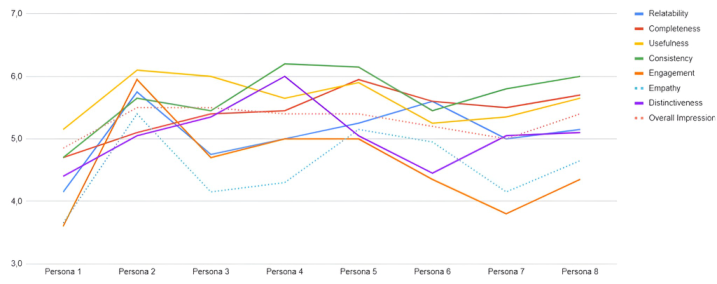
According to quantitative analysis, completeness and consistency were areas where AI-supported personas (Personas 5–8) outperformed, with Persona 5 (AI-supported) scoring the highest in Completeness at 6.0 and Consistency at 6.2. Relatability and empathy, which are more emotionally focused, showed higher scores for the conventional personas (Personas 1–4), with Persona 2 (conventional) receiving the highest score of 5.8 in relatability. Engagement was lower for both persona types but was more pronounced in conventional personas, with Persona 2 scoring the highest at 6.0 (Fig. 4).
Figure 4: Comparison of Personas according to Persona perception scale factors.
AI-Supported Personas vs. Conventional Personas 625
Higher ratings in consistency and usefulness, suggesting that AI-supported personas may offer more stable, reliable representations of user traits. This coherence likely arises from the AI’s ability to synthesize data-driven insights and maintain logical alignment across persona attributes, which designers rated favorably. Additionally, completeness and distinctiveness, indicating that the AI’s capacity to incorporate broad data sources may create personas that evaluators perceive as well-rounded and unique. Conversely, conventional personas’ relatively higher scores in empathy and engagement highlighting a perceived emotional depth that may stem from designers’ intuitive understanding of human characteristics. This result suggests that conventional personas, despite potential variability, can convey subtleties and emotional qualities that foster a sense of relatability. These findings are further supported by slight advantages in relatability for conventional personas, which points to a potential human element that AI currently struggles to replicate fully. According to the overall impression score, Persona 1 had the lowest score, with an average of 4,4 suggesting a relatively less favorable perception compared to the others. The identical high scores highlight a comparable level of appeal despite differences in their specific dimension ratings. This distribution of scores points to the potential for both AI-supported and conventionally crafted personas to achieve similar levels of positive overall perception. There are some differences between verbal assessments and survey results. While designers highlighted Personas 2, 4, 6 and 7 in their verbal evaluations, the survey results show that Personas 2 and 3 received the highest average score of 5.5 following Personas 4, 5 and 8 with 5, 4 score (Table 2).
Designers may have preferred certain personas for their specific characteristics or emotional connection, but the structured survey format yielded different outcomes. This highlights the perceptual differences between personal feedback and systematic evaluation, suggesting the value of using both methods complementarily. These findings suggest that AI-supported persona generation excels in creating structured, comprehensive and functionally clear representations, whereas conventional persona creation
626 Balci and Alppay
may offer a nuanced, empathetic touch that enhances user connection. The complementary strengths of each approach underscore a potential hybrid model for persona development, where AI-supported frameworks are used to establish consistency and structure, while human input enhances emotional engagement and relatability.
CONCLUSION
The findings highlight the importance of personas in creating user-centered designs, particularly when these personas provide detailed and relatable insights into users’ goals, challenges and interactions with technology. Designers are experiencing the lack of a system that, instead of repeatedly conducting user tests and analysis for each new project, builds on previous data to provide updated insights that can be revisited and offer new recommendations when needed. AI could fill this gap. A balanced, hybrid model combining AI-supported structural consistency with conventionally crafted empathy is ideal. AI-supported personas excel in completeness and coherence, efficiently delivering well-rounded representations, while conventionally created personas offer a nuanced, empathetic connection that resonates emotionally with users. Together, these approaches suggest a dynamic, adaptable persona framework that can evolve iteratively in response to user feedback. It has been observed that both require a human researcher who will manage the process and make decisions.
Designers recommend a flexible structure for an optimal music streaming persona template, one that includes essential user attributes and relatable behavioral scenarios. Brief core demographics and lifestyle set the foundation, while contextualized usage scenarios and emotional drivers like user goals or barriers provide a realistic, human touch. AI-supported visuals depicting user environments can further enhance understanding without overwhelming detail. This dynamic format enables personas to be adjusted iteratively and applied across diverse design contexts, supporting a design process that aligns closely with authentic user needs and experiences. In settings like music applications, where user preferences vary, this hybrid, adaptable persona template serves as a valuable tool for refining both functional clarity and user relatability.
ACKNOWLEDGMENT
This research is supported by Istanbul Technical University Scientific Research Projects Coordination Unit (BAP) within the heading of General Research Projects (Project Title: Investigation of the Use of Persona Concept in Industrial Design Processes; Proje ID: 44641; Proje Code: MGA- 2023-44641). The authors would like to acknowledge Istanbul Technical University Scientific Research Projects Coordination Unit for their support and contribution.
REFERENCES
Adlin, T. and Pruitt, J. (2010) The Essential Persona Lifecycle: Your guide to building and using personas, Elsevier eBooks. https://doi.org/10.1016/c2009-0-62475-2
AI-Supported Personas vs. Conventional Personas 627
Blomquist, Å. and Arvola, M. (2002) ‘Personas in action: Ethnography in an interaction design team’, Proceedings of the second Nordic conference on Human- computer interaction (NordiCHI ’02), Association for Computing Machinery, New York, NY, USA, pp. 197–200. doi: 10.1145/572020.572044. Cooper, A. (1999) The inmates are running the asylum: Why high tech products drive
us crazy and how to restore the sanity. https://openlibrary.org/books/OL52849M /The_inmates_are_running_the_asylum Ferreira, B., Silva, W., Barbosa, S. D. J. and Conte, T. (2018) ‘Technique for representing requirements using personas: A controlled experiment’, IET Software, 12(3), pp. 280–290. Available at: https://doi.org/10.1049/iet-sen.2017. 0313. Goel, T., Shaer, O., Delcourt, C., Gu, Q. and Cooper, A. (2023) ‘Preparing future
designers for human-AI collaboration in persona creation’, Proceedings of the 2nd Annual Meeting of the Symposium on Human-Computer Interaction for Work (CHIWORK ’23), Association for Computing Machinery, New York, NY, USA, pp. 1–14. doi: 10.1145/3596671.3598574. Gothelf, J. (2012) ‘Using proto-personas for executive alignment’, UX Mag, (821).
Available at: https://uxmag.com/articles/using-proto-personas-for-executive-alig nment (Accessed: 6 October 2024). Ha, J., Jeon, H., Han, D., Seo, J. and Oh, C. (2024) ‘CloChat: Understanding how people customize, interact, and experience personas in large language models’, Proceedings of the CHI Conference on Human Factors in Computing Systems (CHI ’24), Association for Computing Machinery, New York, NY, USA, Article 305, pp. 1–24. doi: 10.1145/3613904.3642472. Hinton, A. (2007) ‘Personas: Less method, more mindset’, Inkblurt. Available
at: http://www.inkblurt.com/2007/04/20/personas-less-method-more-mindset/ (Accessed: 5 July 2024). Jones, M. C., Floyd, I. R. and Twidale, M. B. (2008) ‘Teaching design with personas’, Proceedings of the 2008 ACM conference on Human Factors in Computing Systems (CHI ’08), pp. 1–4. Jansen, B. J., Jung, S. G., Nielsen, L., Guan, K. W. and Salminen, J. (2022) ‘How
to create personas: Three persona creation methodologies with implications for practical employment’, Pacific Asia Journal of the Association for Information Systems, 14(3). Available at: https://doi.org/10.17705/1pais.14301. Jung, S.-G., Salminen, J., Kwak, H., An, J. and Jansen, B. J. (2018) ‘Automatic persona generation (APG): A rationale and demonstration’, Proceedings of the 2018 Conference on Human Information Interaction & Retrieval, pp. 321–324. Junior, P. T. A. and Filgueiras, L. V. L. (2005) ‘User modeling with personas’,
Proceedings of the 2005 Latin American Conference on Human-Computer Interaction, pp. 277–282. ACM, New York, NY, USA. Kocaballi, A. B. (2023) ‘Conversational AI-Powered Design: ChatGPT as Designer, User, and Product’, arXiv. Available at: https://doi.org/10.48550/arXiv.2302. 07406. Marsden, N. and Pröbster, M. (2019) ‘Personas and identity: Looking at multiple
identities to inform the construction of personas’, Proceedings of the 2019 CHI Conference on Human Factors in Computing Systems, pp. 1–14. Matthews, T., Judge, T. and Whittaker, S. (2012) ‘How do designers and user experience professionals actually perceive and use personas?’, Proceedings of the SIGCHI Conference on Human Factors in Computing Systems, pp. 1219–1228.
628 Balci and Alppay
Pruitt, J. and Grudin, J. (2003) ‘Personas: Practice and theory’, Proceedings of the Conference on Designing for User Experiences, DUX ’03, New York, NY, USA, ACM, pp. 1–15. Salminen, J., Santos, J. M., Kwak, H., An, J., Jung, S. G. and Jansen, B. J.
(2020) ‘Persona perception scale: Development and exploratory validation of an instrument for evaluating individuals’ perceptions of personas’, International Journal of Human-Computer Studies, 141, p. 102437. Wilson, H. J. and Daugherty, P. R. (2018) ‘Collaborative intelligence: Humans and AI are joining forces’, Harvard Business Review. Woo, D. J. (2022) ‘Secondary school student-AI creative writing: Strategies from text
Intelligent Human Systems Integration (IHSI 2025): Integrating People and Intelligent Systems
Read this individual research paper free through the original publisher, or explore the full digital proceedings book.
ISBN 978-1-964867-36-6
Explore this ISBN in the AHFE Bookstore ↗Listed in the July 2026 bookstore catalogue; search by ISBN to confirm current availability · Digital book purchase optional