Müge Göken, Ekrem Cem Alppay (2021). Application of Kansei Engineering Techniques to the Redesign of a Turkish Coffee Maker. In: Human Systems Engineering and Design (IHSED2021): Future Trends and Applications. AHFE Open Access, vol. 21. https://doi.org/10.54941/ahfe1001108
Turkish Coffee Maker is a well-known product that was invented and first manufactured in Turkey. Although it is a novel product, there is a huge demand for these machines as well as competition among the manufacturers. These companies are already implementing many innovation strategies. However, the study aims to carry out a computer-aided innovation method named Kansei Engineering in the Turkish Coffee Maker domain. Furthermore, many sub-methods were conducted in this research. These are extracting Kansei words, selecting specimens, choosing product properties, conducting affinity diagrams, SD Surveys, Factor, QT1, Descriptive and Multiple Linear Regression Analysis. In total, 257 Turkish people have participated in the study. It is expected that the findings will be beneficial for design experts who are redesigning Turkish Coffee Maker.
Human Systems Engineering and Design (IHSED 2021) https://openaccess.cms-conferences.org/#/publications/book/978-1-7923-8987-0
INTRODUCTION
Turkish Coffee is a well-known, cultural beverage being consumed by Turkish people frequently. Before the Turkish Coffee Maker’s invention, people generally have made this beverage in traditional coffee pots. Arçelik developed the first patented Turkish coffee-making device (Telve) in 2003, and it gained an impressive reputation both in Turkey and abroad after being launched. Following this great commercial as well as cultural success, a large amount of demand has occurred for Turkish Coffee Maker. Many electronic household companies have started to design and manufacture these machines. Thus, the competition began among these companies, and the need for innovative strategies has occurred.
In this study, Kansei Engineering is considered as one of these strategies. This paper aims to conduct Kansei Engineering methodologies on the Turkish Coffee Maker domain. It is expected that the findings will guide designers in their idea and concept generation processes of these machines. Moreover, it is aimed to reach consumers’ emotions about these products and link them with these machines’ design properties.
Kansei Engineering is an innovation methodology that is customer-oriented (Nagamachi, 2002), emotional (Schütte, 2002) and computer-aided (Schütte, 2002; Bouchard, Lim and Aoussat, 2003). This methodology is especially famous in the east and was founded at Hiroshima University by Nagamachi in the 1970s. According to Nagamachi (2002) “Kansei engineering aims at a translation of Kansei (customers’ feelings) into the product design field including product mechanical function.”. Furthermore, Schütte (2002) explained this methodology as “building a bridge between customers’ feelings and product measurements”. He proposed a theoretical model on Kansei Engineering (KE) processes that includes six steps: choosing the domain, spanning semantic space, spanning product properties, synthesis, a test of validity, and model building (Schütte, 2002). This paper follows a similar path with Schütte’s model.
On the other hand, some part of Nagamachi and Lokman’s (2016) KE Type 2 model was also used in this study. Similar to this model, the low-level Kansei words are extracted after selecting the target. Then, by conducting SD Survey and Factor Analysis, high-level Kansei word-pairs are determined.
Besides these models, some Kansei Engineering case studies inspired this investigation. For instance, the study of Mamaghani, Rahimian, and Mortezaei (2014) has affected the Factor Analysis of this research. Moreover, Alves’s (2018) research on water bottles assisted in selecting the specimens, determining the product properties, conducting QT 1 analysis, and multiple linear analysis. Lastly, Razza and Paschoarelli’s (2015) case study on disposable razors inspired showing the affective dimensions of Turkish Coffee Maker.
Human Systems Engineering and Design (IHSED 2021) https://openaccess.cms-conferences.org/#/publications/book/978-1-7923-8987-0
METHODS AND MATERIALS Many methods were conducted in this study and they were grouped into four parts to explain them clearly. These are choosing the domain, spanning the semantic space, study 1 and 2. While choosing the domain, an observational study was carried out on seven dealers in Izmir and Istanbul, Turkey. This domain is the one-pot Turkish Coffee Maker without a water tank for working young adults (between 20-45 ages).
SPANNING THE SEMANTIC SPACE In this part of the research, following the studies of Schütte (2002) and Nagamachi and Lokman (2016), low-level Kansei words were extracted. Unlike this literature, awarded product descriptions and jury statements from Red Dot Design Awards (www.red-dot.org) and IF Design Awards (ifworlddesignguide.com) were used to gather Kansei words in this study. Additionally, the customer reviews in e-commerce websites such as Amazon (www.amazon.com.tr), trendyol (www.trendyol.com.tr), gittigidiyor (www.gittigidiyor.com), n11 (www.n11.com), and hepsiburada (www.hepsiburada.com); sectoral news and relevant Kansei engineering articles are the other sources that Kansei words were gathered.
In recent years, text mining applications have become popular in extracting Kansei words in Kansei Engineering researches (Hsiao, Chen, and Liao, 2017; Chiu and Lin, 2018). Similarly, in this study, “text mining” was used in extracting Kansei Words. On the Trendyol marketing website (www.trendyol.com.tr), 1600 reviews of customers were analyzed. WebHarvy, which is a web scraping software was preferred to extract the text from the source. Then, Microsoft Excel was used to translate all text into words and sort them depending on the repetition frequency.
Until this stage, 384 Kansei words were extracted. Because working with 384 Kansei words is difficult and time-consuming, the KJ (affinity diagram) method (Lokman and Kamaruddin, 2010) was carried out to reduce the number of Kansei Words by keeping the critical information. In the study of affinity diagrams, words with similar meanings were grouped, and each group was given a representative name. Then, the study continued with 105 words.
STUDY 1 To select the product properties, customer comments were used similar to the extraction of Kansei words, in this study. Most repetitive product features that are body volume, width, shape, and weight were chosen. After that, 10 varied Turkish Coffee Maker products (with one-pot and without water tanks) were determined as the specimens.
In the SD Survey 1, to measure the customer feelings about these specimens, Osgood’s semantic differential method was conducted. 7 points Likert scale is used
Human Systems Engineering and Design (IHSED 2021) https://openaccess.cms-conferences.org/#/publications/book/978-1-7923-8987-0 with the visuals of 10 products and 5 Kansei word pairs. In total, 21 surveys and 105 Kansei word pairs were evaluated. These surveys were shared with the participants via social media such as Linkedin, WhatsApp. 210 Turkish volunteers have participated in the study; their ages were ranging from 20 to 45. 128 are women, and 82 are men of the participants.
In the synthesis stage, “semantic space” and “space of properties” were connected. Considering the models (Schütte, 2002; Nagamachi and Lokman, 2016) factor and multiple linear regression analyses were conducted in IBM SPSS V.26 software. Thus, significant design factors and correlations between Kansei words and product features of Turkish Coffee Maker were investigated.
STUDY 2 Via factor analysis, the representing words of the factors (high-level Kansei words) were chosen for the second study and SD Survey 2. These selected word-pairs are youthful-older; easy to use-not easy to use; pleasurable-non-pleasurable; innovative- non-innovative; stylish-unfashionable; functional-non-functional; artistic-non- artistic.
After forming the high-level Kansei words, some of the key product properties were chosen. Alves’s (2018) research was examined while determining these features. The selected items and categories are body shape (curvy-orthogonal), body volume (small-large), the material of coffee pot (plastic-steel) and, body colors (black and black-red). According to Alves (2018), the samples should include the pre- selected product features. Figure 1 shows these 8 Turkish Coffee Maker specimens involved in SD Survey 2.
1 2 3 4 5 6 7 8
Figure 1. Specimens of the Second SD Survey Similar to SD Survey 1, in SD Survey 2, a 7 point Likert scale was used with the visuals of 8 specimens and 7 Kansei word-pairs. 47 Turkish participants responded to the survey. Their ages were ranging from 20 to 35. 25 are women, and 12 are men of the volunteers. In the synthesis phase, SD Survey 2 responses were analyzed in IBM SPSS v.26 software. Via this program, QT1 (Alves, 2018) and descriptive (Razza and Paschoarelli, 2015) analyses were conducted.
Human Systems Engineering and Design (IHSED 2021) https://openaccess.cms-conferences.org/#/publications/book/978-1-7923-8987-0
RESULTS AND DISCUSSION
RESULTS OF STUDY 1 Factor Analysis
Factor analysis was conducted to define the factors affecting the appeal of Turkish Coffee Maker in the market. The first factor “ stylish” represents 12.371% of data. This factor has the biggest impact on the market success of these machines. The other factors represent 6.911%, 6.258%, 5.908%, 4.877%, etc…of all data. The tenth and the eleventh factors have a minimum impact on product appeal.
Mamaghani et al. (2014) carried out a similar factor analysis on the domain of ketchup sauce bottles. The first factor of this study explains 43.672% of the data and the other factors have smaller effects than the first factor in this study. There is a significant difference between Mamaghani et al.’s (2014) and this research in terms of the first factors. The first factor in Mamaghani et al.’s (2014) study has high domination among the other factors. It is estimated that the reason for this situation is the differences between the numbers of evaluated Kansei words. While 105 words were evaluated in this study, Mamaghani et al.’s (2014) tested 29 words in their case study.
Table 1 presents the variables having values bigger than .650. Factors up to eleven were selected that the eigenvalue became greater than 1. Nagamachi and Lokman (2016) stated that “they give each factor a name that contains a common meaning that covers all the Kansei words with the high loading values.” Similar to Nagamachi and Lokman (2016), the factors of this Turkish Coffee Maker domain (with one pot, without water tank for young adults) were named as stylish, energetic, trend follower, ideal capacity, functional, desirable, youthful, remarkable, strong, cultural, and smart.
11 factors were found in this Turkish Coffee Maker KE study. On the other hand, in Mamaghani et al.’s (2014) study, only 5 factors were shown because they eliminated the factors with low impacts as being insignificant. However, in this study, because the cultural and smart Kansei words may still inspire the designers, they were shown as factors although they have lower impacts. Moreover, 12. and 13. factors were eliminated similar to Mamaghani et al.’s (2014) study.
Table 1. Result of Factor Analysis with Rotation Varymax F1-Stylish F2- Energetic F3-Trend Follower F4-Ideal Capacity
Human Systems Engineering and Design (IHSED 2021) https://openaccess.cms-conferences.org/#/publications/book/978-1-7923-8987-0
Reformist Sturdy
.778 .665
design Like it
.649
Speedy Fashionable
.741 .736
Luxury Balanced F11-Smart
.813 .669 F9-Strong F10- Cultural Cultural .690 Smart .695 Strong Natural
.657 .654
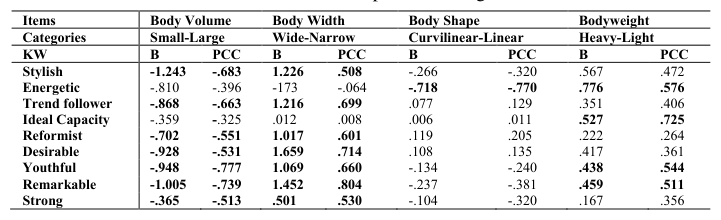
Multiple Linear Regression The results of multiple linear regression are shown in Table 2. According to the findings, designing Turkish Coffee Maker in small volume and narrow evokes the customers’ feelings of “stylish, trend follower, reformist, desirable, youthful, remarkable, and strong”. On the other hand, designing these machines in curvy forms evokes the energetic emotions of customers. Lastly, light products reveal energetic, ideal capacity, youthful and remarkable feelings of the customers on these machines.
The Unstandardized Coefficients B and Partial Correlation Coefficients values obtained from the analysis are also displayed in Table 2. For instance, for small body volume, this would mean that for every one-unit increase in small volume, trend follower (the dependent variable) increases by 0.868 units. Moreover, PCC values >. 500 are shown in bold. In this multiple linear regression analysis, Alves’s (2018) case study was followed.
Table 3 shows the affective dimensions of the Turkish Coffee Maker as the result of descriptive analysis. 47 Turkish people participated in this study and rated an SD scale from 1 to 7. In Table 3, the Kansei words at the top are related to the high level (7 points); the Kansei words at the bottom are related to the low level (1 point). The bold numbers are the highest and lowest scores.
According to the results, “Product 2” has the highest scores on all the variables except “ East to Use”. On the other hand, “Product 7” has the lowest scores on all the variables. Additionally, “Product 3” and “Product 5” were rated with the minimum score for the variable “Ease to Use”. “Product 1” was rated with the greatest score for the same variable.
Human Systems Engineering and Design (IHSED 2021) https://openaccess.cms-conferences.org/#/publications/book/978-1-7923-8987-0
This part of the study follows Razza and Paschoarelli’s (2015) research about disposable razors. These razor products have a long history and many varieties. Thus, in this study, 40 specimens were used and rated. However, the Turkish Coffee Maker is a novel product and has less variety in the market. Therefore, in this part of the study, 8 branded coffee maker products of Turkey were evaluated.
Table 3: Evaluation of Affective Dimension Highest side of the scale (7) Youthful
The results of QT 1 analysis show that there are strong and positive correlations between “Coffee Pot with Plastic” and “Youthful”; “Small Body Volume” and “Easy to Use”; “Black Body Color” and “Innovative” and “Curvy Body Shape” and “Artistic”. Table 4 displays the values of PCC (Correlations Partial) and Unstandardized Coefficients B. In Table 4, PCC values >. 700 are presented.
In this QT1 analysis, Alves’s (2018) KE case study on water bottle packaging was followed. The disadvantage of QT1 analysis is the ability to test a low amount of product features. For instance, in this study, only two color alternatives could be evaluated. Therefore, in future studies, PLS analysis will be conducted additionally. Thus, more colors and properties of these machines would be tested.
Table 4: Results of QT1 Analysis Property PCC Level
Table available in the original PDF paper.
Kansei Words
-0.322 0.322
Youthful Material of Coffee Pot
.788 Plastic Steel
0.337 -0.337
Easy to Use
Body Volume
0.415
-0.415
.808 Small Large Innovative Body Color .804 Black Red-Black Artistic Body Shape
.703 Curvy Orthogonal
0.330 -0.330
CONCLUSION
The theoretical structure of this paper proposes to search the differences between
Human Systems Engineering and Design (IHSED 2021) https://openaccess.cms-conferences.org/#/publications/book/978-1-7923-8987-0 traditional-manual products and electronic versions in terms of evoking emotions. The results of factor analysis show that Turkish Coffee Maker include 9 hedonic and 2 pragmatic factors. On the other hand, it is estimated that traditional coffee pots do not have all these hedonic factors. One reason may be the coffee pots are being kept in the kitchen drawers and the machines are being displayed on kitchen counters. This theoretical approach would be searched and analyzed in similar product groups such as tea pot-machine; toast tool-machine; citrus juicer-machine, etc.
As mentioned above, Turkish Coffee Makers include 11 factors. The first three factors (hedonic values) represent the highest part 12.271%. 6.911%, 6.258% of data gradually. It means that this product should be redesigned to evoke the feelings of “stylish, energetic and trend follower” for young adults. The fourth (5.908%) and fifth factors (%4.877) are the pragmatic factors which are ideal capacity and functionality. It displays that Turkish Coffee Maker also needs to be designed to evoke these pragmatic feelings.
In this study, there were two main syntheses of Kansei words and product features. Firstly, Multiple Regression outcomes suggest that designers should develop Turkish Coffee Maker in small volume and curvilinear forms, narrow, and as light as possible. Secondly, QT1 results show that industrial designers need to design coffee pots with plastic material and the main body in black color, small volume, curvy forms. These proposals are valid for the same domain.
LIMITATIONS & FURTHER STUDIES This research is a part of an ongoing Ph.D. dissertation that the findings will be used in another experimental study. A design brief will be created with these design inputs, and then, almost 10-15 professional industrial designers will redesign a Turkish Coffee Maker considering this brief. In their design processes, protocol analysis will be conducted. Thus, the ideas and experiences of industrial designers on Kansei Engineering will be searched and documented.
However, the most significant limitation of the study can be considered to be the COVID-19 pandemic situation which forces the researchers to conduct their studies online. In the future, SD surveys can be carried out face-to-face.
REFERENCES
Alves, J. C. (2018). Kansei Engineering methodology to support the development of a water bottle packaging. (Unpublished master’s thesis). Technico Lisboa, Universidade de Lisboa, Portugal.
Human Systems Engineering and Design (IHSED 2021) https://openaccess.cms-conferences.org/#/publications/book/978-1-7923-8987-0
Bouchard, C., Lim, D., & Aoussat, A. (2003). Development of a Kansei Engineering System for industrial design. In Proceedings of the Asian Design International Conference (Vol. 1, pp. 1-12). Chiu, M. C., & Lin, K. Z. (2018). Utilizing text mining and Kansei Engineering to
support data-driven design automation at conceptual design stage. Advanced Engineering Informatics, 38, 826-839. Hsiao, Y. H., Chen, M. C., & Liao, W. C. (2017). Logistics service design for crossborder E-commerce using Kansei engineering with text-mining-based online content analysis. Telematics and Informatics, 34(4), 284-302. Lokman, A. M., & Kamaruddin, K. A. (2010, December). Kansei affinity cluster for
affective product design. In 2010 international conference on user science and engineering (i-user) (pp. 38-43). IEEE. Mamaghani, N. K., Rahimian, E., & Mortezaei, S. R. (2014, June). Kansei engineering approach for consumer’s perception of the ketchup sauce bottle. In KEER2014. Proceedings of the 5th Kanesi Engineering and Emotion Research; International Conference; Linköping; Sweden; June 11-13 (No. 100, pp. 1487-1494). Linköping University Electronic Press. Nagamachi, M. (2002). Kansei engineering as a powerful consumer-oriented
technology for product development. Applied Ergonomics, 33(3), 289-294. Nagamachi, M., & Lokman, A. M. (2016). Innovations of Kansei engineering. CRC Press. Schütte, S. (2002). Designing feelings into products: Integrating kansei engineering
methodology in product development (Doctoral dissertation, Institutionen för konstruktions-och produktionsteknik). Razza, B., & Paschoarelli, L. C. (2015). Affective perception of disposable razors: a kansei engineering approach. Procedia Manufacturing, 3, 6228-6236.
Human Systems Engineering and Design (IHSED 2021) https://openaccess.cms-conferences.org/#/publications/book/978-1-7923-8987-0
LISTED IN THE AHFE DIGITAL BOOKSTORE CATALOGUE
Explore the complete digital volume
Human Systems Engineering and Design (IHSED2021): Future Trends and Applications
Read this individual research paper free through the original publisher, or explore the full digital proceedings book.
ISBN 978-1-7923-8987-0
Explore this ISBN in the AHFE Bookstore ↗Listed in the July 2026 bookstore catalogue; search by ISBN to confirm current availability · Digital book purchase optional