Galo Robayo, Janio Jadán Guerrero (2021). A Prospective View of Virtual Education in Autonomous Decentralized Governments: Case Study of Honorable Provincial Government of Tungurahua. In: Human Systems Engineering and Design (IHSED2021): Future Trends and Applications. AHFE Open Access, vol. 21. https://doi.org/10.54941/ahfe1001105
1 Maestría en Educación, mención pedagogía en entornos digitales (MEPED) Universidad Tecnológica Indoamérica Quito, 170103, Ecuador 2 Centro de Investigación en Mecatrónica y Sistemas Interactivos (MIST) Universidad Tecnológica Indoamérica Quito, 170103, Ecuador ↗
Governments distribute resources according to their strategic planning to develop studies in a variety of competence areas. Therefore, due to the COVID-19 pandemic, the need to establish citizen participation processes through training has increased, however it cannot be carried out in a complete face-to-face way due to the pandemic. In this context, the use of innovative technological tools is necessary to establish teaching-learning processes. The Honorable Provincial Government of Tungurahua through its Citizen Training Center has implemented an educational platform to provide training services in order to encourage Tungurahua citizen participation, located in the central region of Ecuador that has nine provinces and has a population of 590,600 people. By introducing innovative training processes using technology, this study attempts to solve the need for virtual training and also seeks citizen participation to strengthen and maintain training services during the pandemic. 422 people participated in this study, of which 67.54% belonged to the female gender and 32.46% to the male gender, from this total 70.14% had university education. In order to collect information about people’s training needs, an online 15 questions survey was conducted. These results made it possible to establish that 90% of the participants have an interest in digital literacy processes as well as in a variety of interesting topics that would allow them to increase their knowledge. Finally, a proposal was designed to implement the virtual environment using Moodle. The online environment was designed between the months of March and September 2020 and allowed the development of ten virtual training processes with the participation of 1,817 people, of which 47% were women and 53% men. In addition, it was found that 74% of the participants were residents and 26% were rural residents. In addition, their age ranged between 18 and 29 years, which represents 76% of the total participants.
The digital revolution has enabled governments to perform better governance and more inclusive and participatory service delivery. Today, there are many public websites, digital platforms and applications through which governments inform and assist citizens using information and communication technologies (ICT) [1]. However, not all government institutions have planned the development of these platforms, as is the case of the Honorable Provincial Government of Tungurahua (HPGT) in Ecuador, on which this research is focused.
The objective of this research is to implement a training platform to teach online courses to the citizens of Tungurahua, to the institution to continue with the planning that had been carried out in person before the pandemic caused by Covid 19. This crisis has challenged local governments to implement new solutions to respond to novel problems.
The onset of the COVID-19 pandemic was characterized by the adoption of an attitude focused on the unexpected and uncertainty. The institutions had to implement communication and service platforms. One of the areas where change was adopted the fastest was the education sector, which has had to innovate in its way of teaching. [2-4].
Like many governments around the world, the local governments faced significant governance challenges, including e-government services aim to establish a relationship between government and citizens or other governments using information technology [5]. In this context the HPGT developed a digital literacy program for citizens. This training
Human Systems Engineering and Design (IHSED 2021) https://openaccess.cms-conferences.org/#/publications/book/978-1-7923-8987-0 program was created with the aim of reducing the digital divide in times of pandemic, as well as enriching the potential of citizens to use them.
The rest of the document describes how a platform was implemented for ICT training programs. As well as the results obtained in the digital literacy program carried out to 422 citizens.
RELATED WORK
Institutions face new challenges and not only those whose business is education but also the government and others that support the educational field; and new concepts are being reborn that, despite being implemented, have gained strength today due to virtuality. There were several platforms available to choose from to promote digital literacy. Despite the alternatives, the almost overnight shutdown of all non-essential services, many institutions selected Zoom as the preferred platform for meetings [6].
The change in the distance education system has been possible thanks to the use of complementary platforms. Among the most used is Moodle, which has a great impact in various educational circles such as teachers, students and institutions that must continue to carry out distance education despite the various limitations that exist [7] [8].
The Honorable Provincial Government of Tungurahua based on its management model, has three parliaments and among them is the Popular Parliament, which is oriented within its axes to the education and training of its members. The Planning Direction that is part of the HPGT has the Citizen Training Center (CTC), which has been contributing to the consolidation of a participatory and critical society, reaching more than 37,000 participants in processes and / or activities generated during 14 years of uninterrupted management.
The current situation of the Citizen Training Center of the Honorable Provincial Government of Tungurahua was analyzed, where it was determined that the main objective pursued by the center is to strengthen and enhance the leadership of men and women from the province of Tungurahua, contributing to their involvement in decision-making and co-responsible management of provincial development through education and training processes in citizenship and associativity.
METHODOLOGY
This research is a qualitative–quantitative study, with a sample of people who belong to the People's Parliament of the Honorable Provincial Government of Tungurahua. This study was carried out during the month of September 2020.
Human Systems Engineering and Design (IHSED 2021) https://openaccess.cms-conferences.org/#/publications/book/978-1-7923-8987-0
Participants The participants included 422 people who belong to the Interest Groups of the Honorable Provincial Government of Tungurahua. People aged 30 to 65 years old from the province of Tungurahua. 285 were women (70%) and 137 were men (30%), 208 were from rural areas and 214 from urban area.
Materials and instruments The technology used to design the virtual classroom was the Moodle Platform integrated with external Web 2.0 resources, such as: Jitsi, Genially, Infogram among others. In reference to the Computer Server where Moodle was installed, it is a Nutanix Hyperconvergent three nodes NX'1176S'G7. To virtualize the server and install the operating system, VMware was installed. The instrument used was a 15 multiple-choice questions survey applied to the members of the People’s Parliament that allow determining the importance of virtual environments in training processes and interest topics.
Procedure The proposal is the implementation of the virtual classroom for the Citizen Training Center of the Honorable Provincial Government of Tungurahua, in order to integrate the interest groups of the People’s Parliament in training processes, in order to strengthen their knowledge as well as promote digital literacy. The 3.9 Moodle version is installed, which was released on July 13, 2020, which has improved accessibility and security features compared to previous versions.
In order to implement the virtual classroom, the following objectives have been set.
Implement the Moodle virtual environment in the Honorable Provincial Government of Tungurahua.
Establish an instructional design model in order to develop an appropriate learning environment.
Design virtual courses for adult interest groups of the People's Parliament of the Honorable Provincial Government of Tungurahua using Moodle.
Validate the virtual platform through stress tests in order to determine its correct performance.
Human Systems Engineering and Design (IHSED 2021) https://openaccess.cms-conferences.org/#/publications/book/978-1-7923-8987-0
The courses virtually designed during 2020 were the following:
Training of trainers
Leadership and Rights for young people
Health Training Process
Environmental Leadership and Social Management
Gender and Society Approach IMPLEMENTATION OF THE VIRTUAL CLASSROOM WITH MOODLE Once the technical requirements of the computer server had been established and the corresponding operating system was installed, the 3.9 Moodle version was installed. After the installation, the platform interface is changed, for which the themes can be downloaded from https://docs.moodle.org/all/es/Temas, in that sense it must execute the following process:
Install the corresponding plugin within the appearance tab
Change the interface choosing from themes options, if necessary, change the colors and styles that Moodle allows.
The graphic interface adapted to the virtual platform of the HPGT Citizen Training Center is shown below in Fig. 1.
Figure 1. Graphical interface of the installed platform.
Human Systems Engineering and Design (IHSED 2021) https://openaccess.cms-conferences.org/#/publications/book/978-1-7923-8987-0
The virtual classroom is accessible from the following link: https://aulavirtual.tungurahua.gob.ec/moodle/. To make it more dynamic the virtual classroom, a component was installed that allowed synchronous learning processes, the plugin is Jitsi, which can be installed on the Moodle platform and can be downloaded from: https://jitsi.org/. Once installed, it is shown as an additional component within the platform resources.
Once the classroom was installed and configured, a pilot test was carried out with the creation of “Training of Trainers” course, as a commitment to reduce social inequalities through the strengthening of management and advocacy capacities of men and women.
RESULTS
Based on the survey applied, it was determined that 90% of people surveyed are interested on receiving courses virtually, which led to promoting a course as a pilot test.
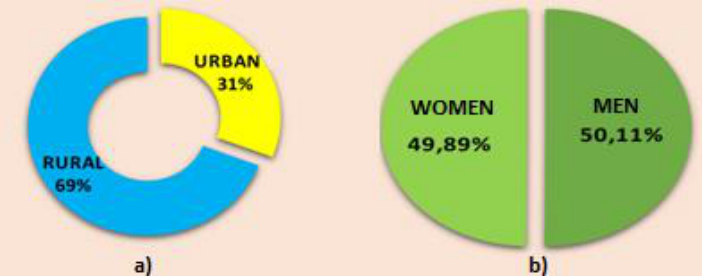
After applying the pilot test and promoting the “Training of Trainers” course, there was an acceptable 45 people participation, including men and women, which led to the offer expansion of virtual courses oriented to the People’s Parliament and the following results were obtained: From 2922 participants in processes, events and / or workshops, 31% (902) are from urban areas, while 69% (2020) are from rural areas, see Fig 2.a. Regarding the participation of men and women, it is visualized that 1,458, 49.89% are women and 1,464 that 50.11% are men. See Fig 2.b.
Fig 2. a) Participation results by Urban or Rural Zone b) Participation results by male and female
Human Systems Engineering and Design (IHSED 2021) https://openaccess.cms-conferences.org/#/publications/book/978-1-7923-8987-0
The education level of the population that participated in the training processes corresponds to 55% (1607) had a high school degree, 22% (630) college education, 19% (565) and 4% (120) had postgraduate studies.
CONCLUSIONS
The virtual Moodle environment implemented in the Honorable Provincial Government of Tungurahua has allowed the renewal of training activities and their training axes, a relevant proposal due to the current contexts that are experienced worldwide by the COVID-19 pandemic in that sense. The research allowed it to identify the training topics and the dimensions of use of the information technologies, the synchronous or asynchronous communication media and the pedagogical models to be applied in training. The implementation of Moodle's virtual environment allows the Citizen Training Center to be able to freely administer virtual training processes, providing consistency to citizen demands and an agile and timely response to the required processes. Finally, it is evident that from different governments, both local and national, it is possible to encourage citizen participation through a culture of digitized education.
ACKNOWLEDGMENTS
The authors would like to acknowledge to Maestría en Educación, mención pedagogía en Entornos digitales (MEPED) form Universidad Tecnológica Indoamérica to finance the research and participation in the 4th International Conference on Human Systems Engineering and Design: Future Trends and Applications (IHSED 2021). A special thanks to the Provincial Government of Tungurahua for providing its technological resources to carry out this research.
REFERENCES
Aspridis, G. The Educational Process in Higher Education in the Era of Covid-19 - Students’ Views. Global Education, Teaching & Learning Conference, Proceedings 2020, (2020). Deutsch C., Gottlieb M., Pongratz H. Adoption of E-Government Requirements to Higher
Education Institutions Regarding the Digital Transformation. In: Edelmann N. et al. (eds) Electronic Participation. ePart 2021. Lecture Notes in Computer Science, vol 12849. Springer, Cham, (2021), https://doi.org/10.1007/978-3-030-82824-0_8
Human Systems Engineering and Design (IHSED 2021) https://openaccess.cms-conferences.org/#/publications/book/978-1-7923-8987-0
Hanafie, W., Halik, A., Iman, B., Tahir, M., Elihami, E., Fitriani, A., Kenre, I. Developing a Sociocultural Approach in Learning Management System through Moodle in the Era of the Covid-19. International Journal of Innovation, Creativity and Change, 13 (27). pp. 941-958, (2020). Kapila, P. Rethinking Education: An Overview of E-Learning in Post Covid-19 Scenario.
International Journal of Creative Research Thoughts (IJCRT), Volume 9, Issue , (2021). Mal, W., Bakhuraybah, H., Khayyat, M. Toward Better Utilization of E-Government Platforms in Light of Logistics. International Journal of Computer Science and Network Security, Vol.20, No.3, (2020). Nash, C. Report on Digital Literacy in Academic Meetings during the 2020 COVID-19
Lockdown. Challenges 2020, 11, (2020), https://doi.org/10.3390 Ramírez de la Cruz, E., Grin, E., Sanabria-Pulido, P., Cravacuore, D., Orellana, A. The Transaction Costs of Government Responses to the COVID-19 Emergency in Latin America, Volume 80, Issue 5, Public Administration Review pages: 909-909 (2020). Sanchez-Gordon, S., Luján-Mora, S. Design, Implementation and Evaluation of MOOCs to Improve Inclusion of Diverse Learners. Accessibility and Diversity in Education: Breakthroughs in Research and Practice, Doi: 10.4018/978-1-4666-9743-0.ch008, (2020).
Human Systems Engineering and Design (IHSED 2021) https://openaccess.cms-conferences.org/#/publications/book/978-1-7923-8987-0
LISTED IN THE AHFE DIGITAL BOOKSTORE CATALOGUE
Explore the complete digital volume
Human Systems Engineering and Design (IHSED2021): Future Trends and Applications
Read this individual research paper free through the original publisher, or explore the full digital proceedings book.
ISBN 978-1-7923-8987-0
Explore this ISBN in the AHFE Bookstore ↗Listed in the July 2026 bookstore catalogue; search by ISBN to confirm current availability · Digital book purchase optional