Isabel Carole Metz, Maria Hagl, Jörn Jakobi (2026). From Tower to Center: Conversion Training for Remote Tower Operations. In: Intelligent Human Systems Integration (IHSI 2026): Disruptive and Innovative Technologies. AHFE Open Access, vol. 200, pp. 840–850. https://doi.org/10.54941/ahfe1007145
The concept of Remote Tower Operations, where Air Traffic Services are provided remotely rather than on-site, is increasingly implemented by Air Navigation Service Providers across the globe. Within Remote Tower Operations, Air Traffic Controllers and Aerodrome Flight Information Officers control the air traffic from a highly digitalized working position including a panoramic view of the airfield as well as sophisticated interfaces for the control of zoom cameras, runway lighting systems and communications. To demonstrate that safety of operations is maintained within this new operational framework, strict regulations by the Civil Aviation Authorities have to be complied with. For the opening of the Remote Tower Center Lower Saxony in Germany, the provision of a conversion training for the Air Traffic Control Officers of Braunschweig airport, as well as the Aerodrome Flight Information Officers of Emden airfield was required. This training took place at the simulation facilities of the German Aerospace Center’s Institute of Flight Guidance. The aim of the training was to familiarize the personnel with the novel working environment and to enable them to safely guide and control traffic from this environment. Throughout the training, subjective and objective metrics were recorded to evaluate the effectiveness of the conversion training. Expecting a learning effect throughout five simulation runs, it was hypothesized that despite increasing scenario complexity, more situational awareness as well as trust and thus more efficiency in handling traffic would be observed. Although not statistically significant, a descriptive overall training effect was observed for all parameters from the first run to the exam run. Especially important are the findings regarding self-reported situational awareness and trust in the system, which indicate not only successful adjustment to but also acceptance of the new working conditions, an important factor considering the transition to the new working position at Remote Tower Center Lower Saxony. The conversion training design, its framework, as well as the results of this study, can serve as guidance material for future conversion training designs.
Remote Tower is an innovative concept in Air Traffic Management (ATM) which allow tower Air Traffic Control Officers (ATCOs) and Airport Flight Information Officers (AFISOs) to provide Air Traffic Services (ATS) without being physically present at the airport. Instead of relying on a traditional con trol tower, Remote Towers use advanced optical and digital sensor technologies
From Tower to Center: Conversion Training for Remote Tower Operations 841 to create a real-time visual representation of the airport environment. The inputs of high-definition cameras and infrared sensors are transmitted to a highly digitalized working position including a panoramic view of the air field as well as sophisticated interfaces for the control of zoom cameras, run way lighting systems and communications. The adoption of Remote Towers marks a substantial advancement in ATM, offering greater flexibility, cost savings, and operational resilience (Hamann and Jakobi, 2022).
Several Remote Tower Centers (RTC), overseeing multiple airports from one facility, have been successfully deployed worldwide, demonstrating the feasibility and effectiveness of the concept. By pooling resources, airports can maintain high safety standards while reducing financial burdens associated with maintaining individual control towers (Fürstenau, et al., 2022; DLR 2025). Notable examples include the world’s first RTC in Sundsvall, Sweden, which has been operational since 2015 (Svedavia Airports, 2017), the world’s largest digital tower center in Bodø (Norway) (Kongsberg, 2015), and RTC Leipzig in Germany (Europäische Sicherheit und Technik, 2019). Most recently, the RTC Lower Saxony in Braunschweig has started operations for the remote supervision of the uncontrolled airport of Emden (EME) and of the controlled airport of Braunschweig (BWE) (DAS, 2024). These facilities centralise ATS for multiple airports, improving cost-effectiveness and opera tional flexibility.
Before an ATCO or AFISO can begin operations at a Remote Tower, specialised training is required. A structured training fostering adaptation strategies will be crucial to ensure that controllers can maintain the high est safety and efficiency standards while embracing this new technology. Regulation (EU) 2017/373 mandates service providers to ensure adequate training, competencies and qualifications of their personnel (European Union, 2017). This includes understanding new technologies, adapting to the remote working position, and maintaining situational awareness using digital inter faces instead of direct visual observation. ATCOs must meet the licensing and qualification requirements outlined in Regulation (EU) 2015/340, while AFISOs must adhere to Member State-specific regulations (European Union, 2015). Air Traffic Safety Electronics Personnel (ATSEP) responsible for main taining Remote Tower systems must follow structured training programs as defined by EU regulations.
According to the European regulations (European Union, 2017), a key element of transitioning to remote operations is the so-called conversion training, which prepares ATCOs and AFISOs for the new working posi tion including the new digital tools and interfaces they will use. For the ATCOs and AFISOS working at the new RTC Lower Saxony, this conver sion training was conducted in close collaboration between the operator Deutsche Flugsicherung Aviation Services (DAS) and the German Aerospace Center DLR. The training took place at the DLR Remote TowerLab in 2024, where the future working positions of the ATCOs and AFISOs were rebuilt and integrated in a simulation environment.
After a theoretical introduction to the systems, the personnel were acquainted with the working position and exposed to traffic with increasing
demands in four simulation runs with the new remote setup, allowing them to practice managing traffic under realistic conditions. In a final exam run, the compliance with the regulation requirements had to be demonstrated.
It has been postulated that after these sessions, ATCOs and AFISOs could manage traffic at the same levels as they did from their conventional tower cabins at the airports, ensuring a smooth transition to remote operations. To test this hypothesis and to evaluate the training’s effectiveness, air traffic movements were recorded throughout and structured questionnaires were completed by the ATCOs and AFISOs. This study presents the framework of the conversion training. Moreover, the analysis of objective and subjective parameters provides valuable insights into the effectiveness of the conver sions training considering achieved performance at the new remote tower working position.
METHOD
The conversion trainings were conducted according to a training plan developed by DAS and approved by the Bundesaufsichtsamt für Flugsicherung (BAF), the German Civil Aviation Authority branch responsible for super vision and licensing of Air Navigation Service Providers (ANSPs) and their personnel. The conversion training started of a theoretical introduction to the remote working position. Thereafter, the ATCOs of BWE and the AFISOs of EME were given time to get acquainted with the working position itself and to test the interaction with the interface. This was followed by four simulation runs of 45 minutes each, where each ATCO/AFISO had to control realistic air traffic scenarios with increasing traffic complexity. In a fifth simulation run of one hour, an exam of the requirements set by the BAF was performed.
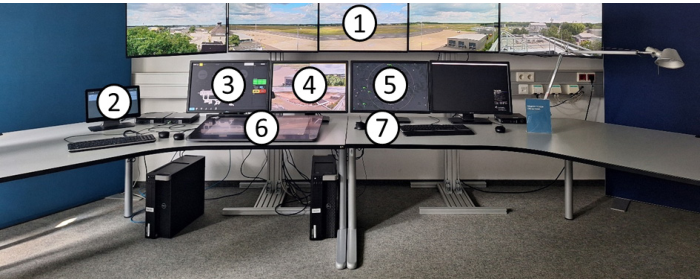
Remote Working Position and Simulator Set-Up The remote working position for the conversion training was replicating the working position at the RTC Lower Saxony. The elements are visualized in Figure 1. The main element is the panorama view, displaying a 180° panorama (1). Since the cameras cover the full 360° range, the area visible on the display can be progressively changed by the controller. The lower screens, from left to right indicate (2) the radio and telephone communica tion, (3) SmartTools, (4) Camera view of areas not visible in the panorama display and (5) a radar view of the surrounding airspace. In the display lying flat (6), the frames captured by the two Pan-Tilt-Zoom cameras (PTZ) and the infrared camera are shown. The focus of both cameras can be freely selected by the ATCO/AFISO. They can also be used to track a selected air craft or vehicle. Tracked aircraft will also be highlighted in the panoramic view. The SmartTools display provides an overview of the airport layout as well as the current weather and runway conditions. The controller can set the lighting system, block the runway, or perform an emergency call via this interface. All displays can be interacted with using a special mouse (7) con taining a total of 20 functions.
Figure 1: Remote tower working position at the DLR TowerLab.
For the conversion training, a simulated outside view of the airports of BWE and EME were developed with an in-house software. The simulations were performed with the NARSIM software, with aircraft performance being represented by BADA 3.15. The simulated aircraft were steered from an adjacent room by two so-called simulation pilots who were connected to the ATCOs/AFISOs by radio.
Scenarios For both airports, flight plans with mostly increasing complexity based on real flight plans were provided by DAS. Thereby, complexity is composed of different parameters. Both airports have flights performed by Visual Flight Rules (VFR) and Instrument Flight Rules (IFR). Consequently, the personnel have to keep in mind procedures for both traffic types and to switch language between flights (English for IFR, German for VFR). While IFR flights perform landings and take-offs which need controlling, some VFR flights perform traffic patterns which need supervision and coordina tion with IFR traffic by the controller. Due to a highly heterogenous traf fic mix regarding aircraft types ranging from ultralight to jets, the various performances and influence on separation minima have to be considered. In BWE, mainly fixed-wing aircraft are active. In EME, up to half of the airspace users are rotorcraft, requiring individual procedures again.The four training scenarios per airport were set up to last 45 minutes, the exam run was designed to last one hour.
Table 1 presents an overview of the simulation runs. Within the trainings, S1_R1 and S1_R2 would be performed on one day and S2_R1, S2_R2, as well as the exam, on another day. The period in between varied depending on DAS personnel availability. While the active runway direction alternated between training scenarios, the ATCOs/AFISOs could select their preferred runway direction for the exam run.
PARTICIPANTS The conversion training was performed for eight ATCOs of BWE (average age 37.7 years; STD 13.45; average licence holding time 10.44 years;
STD 9.47) and five AFISOs of EME (average age 25.8 years; STD 4.76; license holding time < 1 year for all participants). The difference for both age (t(12) = −2.21, p = 0.05) as well as license holding time (t(12) = −2.50, p < 0.05) are statistically significant. One ATCO and all AFISOs attended the conversion training right from leaving the academy and had thus no working experience beyond their education.
Table 1: Traffic scenarios per simulation run.
Table available in the original PDF paper.
BWE EME Number of Rotorcraft Number of Rotorcraft Total Number of Flights Number of Traffic Patterns Total Number of Flights
Number of Traffic Patterns S1_R1 5 1 6 3 1
S1_R2 7 8 3 S2_R1 17 4 9 4 4
S2_R2 16 3 12 4 4 Exam 13 1 9 16 6
EVALUATION The goal of the conversion training was to empower the ATCOs/AFISOs to successfully master the transition from an on-site to a remote working position. The goal of the here presented study is to evaluate the effective ness of the conversion training and to demonstrate a learning curve through out the scenarios. Two counteracting effects which influence the personnel’s performance throughout the training were expected. First, the increasing complexity of the traffic scenarios would result in more mental demand for the personnel. Second, the accumulating exposure to the new working envi ronment should lead to more confidence and thus more efficiency in handling traffic.
Subjective and objective metrics were applied to assess situational aware ness, trust, task load and efficiency. To measure situational awareness, we used the Situational Awareness for Human Automation Partnerships in European ATM (SHAPE) questionnaire (Dehn, 2008). The questionnaire assesses perceived situational awareness of participants on a 7-point Likert scale ranging from 0 (“never”) to 6 (“always”). Trust was measured via the SHAPE Automation Trust Index (SATI), which also employs a 7-point Likert scale with the same range. Both instruments are established tools in the con text of air traffic management (Dehn, 2008). Both questionnaires were com pleted by each ATCO/AFISO after each run.
To assess efficiency, the taxi times between the stands and the runways were obtained from the simulation recordings and the sum of taxi times per aircraft was calculated for each ATCO/AFISO. Taxi times of departures started, as soon as the aircraft started moving from its stand and ended with the initiating of the line-up. Taxi times of arrivals started after leaving the runway until a still stand at the destination gate. With both airports having
From Tower to Center: Conversion Training for Remote Tower Operations 845 simple layouts with one runway and one main taxiway each, delays on these routes were interpreted as reduced efficiency due to e.g. crossing traffic or delays for further taxi clearances.
Task load was evaluated by calculating the total radio occupancy by ATCO/AFISO and the number of flights per simulation. Since all actions to be completed by the pilots have to be transmitted orally, radio occupation was selected as metric. It does not serve as a measure for efficiency though, since the amount of information to be transmitted also depends on pilot performance.
All questionnaires were completed by every ATCO/AFISO. The simulation recordings for EME are complete for all AFISOs for all runs. The record ings for BWE are available for six ATCOs for S1_R1 and S2_R1, for seven ATCOs for S2_R2 and for all eight ATCOs for S1_R2, S2_R2 and the exam run.
RESULTS
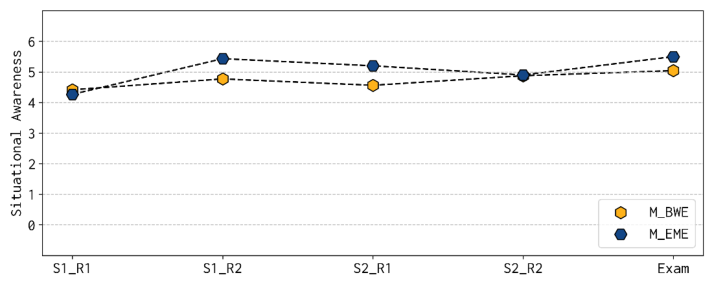
Situational Awareness When analysing the average situational awareness (see Figure 2), results indicate that overall scores were relatively high across all simulation runs and both airport conditions displaying a range from 4.27 (S1_R1; EME) to 5.50 (Exam; EME) on a 7-point Likert scale ranging from 0 “never” to 6 “always”. It can be assumed that situational awareness was sufficiently high from the initial training session onward, enabling participants to accomplish their tasks effectively.
Figure 2: Mean situational awareness over training simulation runs and exam, per airport.
Situational awareness increased in both airport conditions from S1_R1 to S1_R2: for BWE, from M = 4.42 (SD = .58) to M = 4.77 (SD = .65), and slightly more in EME, from M = 4.27 (SD = 1.67) to M = 5.43 (SD = .52). Results in S2 show a different pattern. While situational awareness in BWE slightly increases from S2_R1 (M = 4.56; SD = .89) to S2_R2 (M = 4.88; SD = .68), the EME condition experienced a small decline in from
S2_R1 (M = 5.20; SD = .84) to S2_R1 (M = 4.90; SD = 1.65), accompanied by a significant rise in standard deviation.
Throughout the training, the ATCOs show a more gradual yet stable improvement in situational awareness, with relatively consistent standard deviations (ranging from .58 to .89). Conversely, the AFISO showed more dynamic changes in both mean scores and variability. The exam run yielded the highest situational awareness scores across both groups, with EME surpassing BWE (M = 5.50; SD = .61 vs. M = 5.04; SD = .65). The total increase in situational awareness from S1_R1 to the exam run was more pro nounced in EME (Δ = 1.23) than BWE (Δ = .62). A Wilcoxon rank-sum test shows no significant difference between S1_R1 and Exam for neither EME (z = 1.59; p = .14) nor BWE (z = 1.91; p = .06).
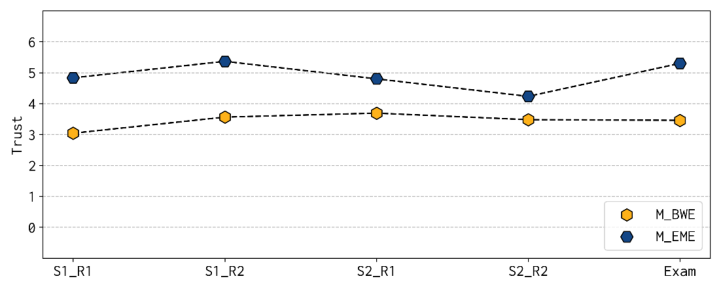
Trust The results of average perceived trust (see Figure 2) indicate that participants from the EME condition consistently reported higher levels of trust across all simulation runs and the final exam compared to their BWE counterparts. Both groups followed a similar pattern over time, with trust rising or falling in parallel.
Trust scores increased for both conditions from S1_R1 to S1_R2, from M = 3.04 (SD = 1.10) to M = 3.56 (SD = 1.14) for BWE and from M = 4.83 (SD = 1.59) to M = 5.37 (SD = 1.23) for EME. A Wilcoxon rank-sum test shows significantly higher trust scores of the AFISOs, both in S1_R1 (z = −2.07; p < .05) and S1_R2 (z = −2.06; p < .05). S2 shows a different tendency. In the BWE condition, participants’ trust scores decreased from S2_R1 (M = 3.69; SD = 1.12) to S2_R2 (M = 3.48; SD = 1.26). This trend is slightly more pronounced in the EME condition, where scores decreased from M = 4.80; SD = 1.03 to M = 4.23; SD = 2.00. Thereby, the con siderable increase in variability in EME suggests higher individual differ ences in trust perception and/or scenario-specific effects during this phase. A Wilcoxon rank-sum test shows no significant difference between BWE and EME for either S2_R1 (z = − 1.80; p = .08) or S2_R2 (z = −1.54; p = .13).
Figure 3: Mean trust over training simulation runs and exam, per airport.
From Tower to Center: Conversion Training for Remote Tower Operations 847 After the exam run, ATCOs showed moderate trust (M = 3.46; SD = 1.45), whereas AFISOs consistently reported high trust (M = 5.30; SD = .38), with low variability indicating strong agreement. A Wilcoxon rank-sum test confirmed a significant difference between groups (z = − 2.42; p < .05), and thus a higher trust rating by the AFISOs. Across all sessions, EME scores were consistently higher (particularly in early phases and the final exam), suggesting differing perceptions of system reliability. Despite these contrasts, the overall increase in trust from S1_R1 to the exam run was similar in both groups (Δ_BWE = 0.42 and Δ_EME = 0.47). No significant difference between S1_R1 and the exam run is found for either BWE (z = 1.91; p = .06) or EME (z = 1.59; p = .14).
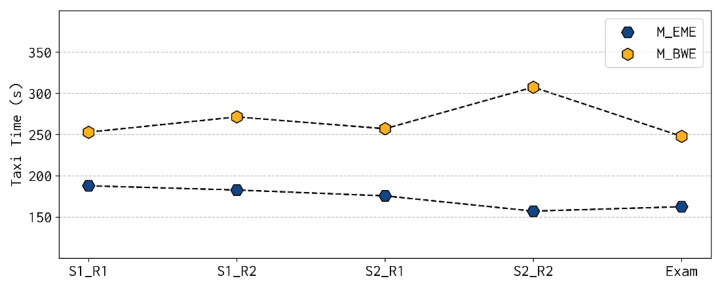
Taxi Time The analysis of taxi times (see Figure 4) consistently indicates a “performance advantage” for the EME condition across all simulation runs and the exam. Descriptively, taxi times were consistently lower in the AFISOs compared to the ATCOs. Wilcoxon rank-sum tests show that the difference is significant for each simulation run p < .05. This is in line with longer taxi distances in BWE.
In S1_R1, AFISOs averaged 188 seconds (SD = 25), while ATCOs averaged 253 s (SD = 27). In S1_R2, taxi times in EME improved slightly to M = 183 s (SD = 23), whereas the BWE group experienced a further increase to M = 271 s (SD = 35). The same tendency is observed in S2. In S2_R1, the EME recorded an average taxi time of M = 176 s (SD = 16), compared to M = 257 s (SD = 73) for the ATCOs. In S2_R2, the AFISOs showed a slight decrease in taxi times (M = 157; SD = 51), while taxi times in BWE increased further to M = 307 s (SD = 30).
The overall decrease in taxi time from the S1_R1 to the exam run was more pronounced in EME (Δ = −25s) compared to BWE (Δ = −5). A Wilcoxon rank-sum test shows no significant difference between S1_R1 and the exam run for neither EME (z = −1.78, p = .10) nor BWE (z = −.13, p = .95).
Figure 4: Mean taxi times over training simulation runs and exam, per airport.
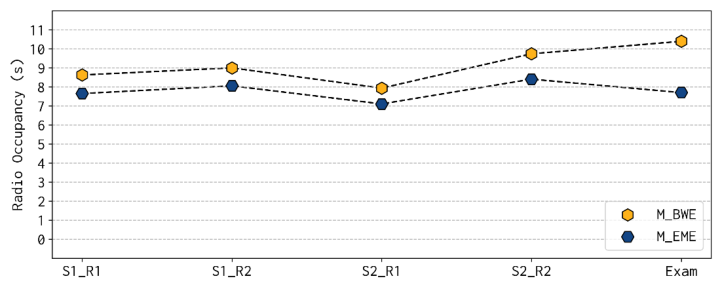
Radio Occupancy Average radio occupancy times (see Figure 5) show slightly lower values in the EME condition compared to the BWE condition across all simulation runs. The differences are relatively small and not statistically significant (Wilcoxon rank-sum tests with values ranging from p = .07 in the exam to p = .66 in S1_R1).
Figure 5: Mean radio occupancy over training simulation runs and exam, per airport.
In S1_R1, the AFISOs averaged 7.7 s of radio occupancy (SD = 1.8), while the ATCOs averaged 8.6 s (SD = 3.4). This pattern remained similar in S1_ R2 (EME: M = 8.1, SD = 2.3; BWE: M = 9.0, SD = 2.8). In S2_R1, the AFISOs recorded 7.1 s (SD = 3.0) and 8.4 s (SD = 4.2) in S2_R2, whereas the ATCOs showed a slight increase from 7.9 s (SD = 0.9) to 9.7 s (SD = 2.5).
In the exam run, the AFISOs maintained an average of 7.7 s (SD = 3.3), while the ATCOs averaged 10.4 s (SD = 1.9). From S1_R1 to the exam run, average radio occupancy remained stable for EME (Δ = 0) and increased slightly for BWE (Δ = 1.8). No statistically significant differences between S1_R1 and the exam runs were found by Wilcoxon rank-sum tests for nei ther EME (z = .31; p = .84) nor BWE (z = 1.94; p = .06).
DISCUSSION AND CONCLUSION When considering the results in their entirety, a training effect for both, the ATCOs from BWE and the AFISOs from EME, can be observed. More spe cifically, some findings require more investigation.
While the ATCOs reported an increasing situational awareness through out the simulation runs, their initially rising trust slightly decreased again in S2_R2. Simultaneously, radio occupancy and taxi times increased. Hence, there might have been more need for coordination, leading to more inter action with the system and thus higher task load. Provided a relatively high standard deviation regarding thrust and a stabilization in the exam run, accustoming to the system apparently increased despite a further, if slight, increase in radio occupancy. Eventually, moderate trust was expressed by the ATCOs. The peak in average taxi times in S2_R2 was most likely due to
From Tower to Center: Conversion Training for Remote Tower Operations 849 stand locations in combination with the runway direction of that scenario. The small increases in radio occupancy in S2_R2 and the exam run were most likely connected to the higher number of traffic patterns which require more communication than the control of departing and arriving aircraft. This is supported by the results for EME, where increasing radio occupancy was observed for higher numbers of traffic patterns.
The other results for EME demonstrate an overall tendency implying training effect. There was an almost steady increase in situational awareness between S1_R1 and the exam run, with a slight decrease in S2_R2. In that run, as in S1_R1, the highest standard deviations for situational awareness were observed. Hence, this decline may indicate cognitive fatigue, scenar io-specific challenges, or higher individual differences in adaptability during this phase.
In the EME condition, the number of flights continuously increased. Moreover, there were four traffic patterns in S2_R1 and S2_R2, additionally adding to the complexity. Still, taxi times decreased continuously until the exam and radio occupancy only slightly increased by an average of 1.3 seconds in S2_R2. Hence, the increase in task load seems to be negligible for EME, which may contribute to the positive development of situational awareness. Still, when considering trust, the increased interaction with the system required to observe the aircraft performing traffic patterns seems to have an impact. Provided high standard deviations for this value especially in S2_R2, this again, as for situational awareness implies high variabilities in perception of the trustworthiness of the system. When considering the small standard deviation – by means the smallest over all scenarios – for the exam run, combined with an increase in trust to the highest value across all scenarios, the experience of successfully mastering S2_R2 must have had a positive effect after all.
Highest trust and situational awareness were reported for the exam run. Thereby, while situational awareness was similar for both, the AFISOs consistently showed higher levels of trust in the system. There are two possible reasons. First, AFISOs have less responsibilities compared to ATCOs, leading to lower required system reliance. Second, with all AFISOs joining the conversion training right from the academy, they have no comparison to an onsite working position, possibly leading to a generally more positive attitude towards novel technology.
Overall, S2_R2 was most challenging for all participants. Within the exam runs, except for radio occupancy in BWE, all parameters were most performant everybody. Hence, it can be concluded that the training successfully prepared them for the exam run, which was passed by all participants. Considering the increased trust and situational awareness, it was also demonstrated that the personnel increasingly adjusted to their novel working space which is highly relevant both for intrinsic motivation as well as a safe and efficient job performance.
REFERENCES
Dehn, D. M. (2008). Assessing the impact of automation on the air traffic controller: The SHAPE questionnaires. Air traffic control quarterly, 16(2), 127–146. DFS Aviation Services DAS (2024) DFS Aviation Services eröffnet Remote Tower
Center Niedersachsen in Braunschweig https://dfs-as.aero/dfs-aviation-ser vices-eroeffnet-remote-tower-center-niedersachsen-in-braunschweig/. Accessed on 18.08.2025 DLR (2025). Multiple Remote Tower at a Glance. A short introduction. Online: https://www.remote-tower.eu/wp/videos/. Accessed on 22.08.2025 EU (2015) Commission Implementing Regulation (EU) 2017/373 of 1 March 2017
laying down common requirements for providers of air traffic management/ air navigation services and other air traffic management network functions and their oversight, repealing Regulation (EC) No 482/2008, Implementing Regulations (EU) No 1034/2011, (EU) No 1035/2011 and (EU) 2016/1377 and amending Regulation (EU) No 677/2011. Online: http://data.europa.eu/eli/reg_ impl/2017/373/oj. Accessed on 22.08.2025. EU (2017) Commission Regulation (EU) 2015/340 of 20 February 2015 laying down technical requirements and administrative procedures relating to air traffic con trollers’ licences and certificates pursuant to Regulation (EC) No 216/2008 of the European Parliament and of the Council, amending Commission Implementing Regulation (EU) No 923/2012 and repealing Commission Regulation (EU) No 805/2011. Online: http://data.europa.eu/eli/reg/2015/340/oj. Accessed on 22.08.2025. Europäische Sicherheit und Technik. 2019. Erster ferngesteuerter Tower in
Deutschland. Online: https://esut.de/2019/04/meldungen/luft/12556/erst er-ferngesteuerter-tower-deutschland/. Accessed on 18.08.2025 Fürstenau, N., Jakobi, J. and Papenfuß, A. (2022) Introduction: Basics, History and Overview. In: Virtual and Remote Tower (2nd edition) - Research, Design, Development, Validation and Implementation Research Topics in Aerospace. Springer Publishers. Pages 3-22. doi: 10.1007/978-3-030-93650-1_1. ISBN 978- 3-030-93649-5. ISSN 2194-8240. Hamann, A. and Jakobi, J. (2022) Changing of the Guards: The impact of hando
ver procedures on human performance in Multiple Remote Tower Operations. In: Virtual and Remote Control Tower (2nd edition) – Research, Design, Development, Validation, and Implementation Research Topics in Aerospace. Springer Publishers. Seiten 343-363. doi: 10.1007/978-3-030-93650-1_14. ISBN 978-3-030-93649-5. ISSN 2194-8240. Kongsberg (2015) World’s biggest digital tower centre opens in Norway. Online: https://www.kongsberg.com/newsroom/stories/20222/6/worlds-biggest-digital- tower-centre-opens-in-norway/. Accessed on 18.08.2025. Svedavia Airports, (2017) LFV and Swedavia establish remote air traffic service from
a remote position at four airports. Online: https://www.swedavia.com/about-swe davia/news/lfv-and-swedavia-establish-remote-air-traffic-service-from-a-remote- position-at-four-airports/ Accessed on 18.08 2025.
LISTED IN THE AHFE DIGITAL BOOKSTORE CATALOGUE
Explore the complete digital volume
Intelligent Human Systems Integration (IHSI 2026): Disruptive and Innovative Technologies
Read this individual research paper free through the original publisher, or explore the full digital proceedings book.
ISBN 978-1-964867-76-2
Explore this ISBN in the AHFE Bookstore ↗Listed in the July 2026 bookstore catalogue; search by ISBN to confirm current availability · Digital book purchase optional