Julio Ronceros, Heyul Chavez, Sergio Salas, Gianpierre Zapata, Carlos Raymundo, Jose Alvarez, Miguel Lara, Anthony De-La-Cruz, Wilmer Silva, Carlos Herrera, Nestor Mamani, Jorge Inche (2021). Design of a low-cost digital spirometer for remote monitoring of COPD and COVID patients. In: Human Systems Engineering and Design (IHSED2021): Future Trends and Applications. AHFE Open Access, vol. 21. https://doi.org/10.54941/ahfe1001198
This research presents the proposal for a low-cost digital spirometer called “Phukuy” that includes the following sensors: an oximeter that measures the per-centage of oxygenation of the blood (SpO2) and the heart rate (bpm), a body and environmental thermometer, and a barometer. This spirometer will serve for the diagnosis and remote monitoring of people with Chronic Obstructive Pulmonary Diseases (COPD) including COVID; benefiting people who do not have a near-by health center; This will help decongest hospitals and prevent them from be-coming an infectious source. In addition, all the information obtained from the measurements will be saved on a web platform, which can be accessed by a des-ignated doctor. The proposed spirometer was validated with a 3-liter calibration syringe, obtaining an average error of 0.033 L (1.1%) and a maximum error of 0.070 L (2.33%), which is within the range recommended by SEPAR (± 3 %).
Human Systems Engineering and Design (IHSED 2021) https://openaccess.cms-conferences.org/#/publications/book/978-1-7923-8987-0
INTRODUCTION
Since 2020, the world economy has been experiencing a health, human and eco- nomic crisis unprecedented in the last century and that is continually evolving due to the Coronavirus (COVID-19) pandemic. According to the WHO “About 1 in 6 people who contract COVID-19 develop a serious illness and have difficulty breathing. Older people and those with underlying medical conditions, such as high blood pressure, heart problems, or diabetes, are more likely to develop serious illness. About 2% of the people who have contracted the disease have died. People with fever, cough, and shortness of breath should seek medical attention” (ONU, 2021).
The elderly, people with Chronic Obstructive Pulmonary Diseases (COPD) or other medical conditions such as diabetes or heart disease, are more vulnerable to becoming seriously ill and causing pneumonia or breathing difficulties (Spriggs, 1978).
Within this scenario of severity of respiratory conditions, the spirometer is an instrument that allows to know the lung function of a person by measuring the volumes and capacities of the lung through respiration (blowing and breathing), this, provides information of high clinical relevance that allows establishing a possible ventilatory alteration and typifying it. In this way, detect and evaluate any pulmonary dysfunction in its evolutionary control to monitor its treatment of patients with COVID-19. However, most spirometers are “fixed spirometers” and digital ones have a very high cost, and they could spread the virus due to their reuse with other patients in a subsequent visit to the specialist in Pulmonology, thus generating an important infectious focus.
The registry of new cases of people infected with coronavirus in Peru continues to increase, with a total of 1.81 million confirmed cases and more than 62 thousand deaths (CSSE – JHU, 2021), in addition to the fact that there are many cases that are not registered, which is why it is estimated that the number of cases is higher.
A study conducted on the long-term health effects of other coronavirus infections showed that there was a persistent and significant deterioration in exercise capacity and health status in SARS survivors after 24 months (NGAI, 2010).
Another study (Lam, 2009) shows that 40% of people who recovered from SARS 3 to 4 years after being diagnosed still had symptoms of chronic fatigue.
The motivation for carrying out this project is to develop a low-cost portable spirometer that can be distributed and used by patients and medical personnel in a simple way, in this way any disease that affects respiration such as COVID can be detected early. COPD or asthma.
In addition, this device can also be used to monitor the status of the lungs and check if the treatment the patient is receiving is helping to improve their lung status.
Human Systems Engineering and Design (IHSED 2021) https://openaccess.cms-conferences.org/#/publications/book/978-1-7923-8987-0
STATE OF THE ART AND TECHNOLOGY There are currently many spirometers on the market from the most economical incentive spirometers (see Fig. 1) that cost approximately USD 17 (HealthAndYoga, 2021) to specialized spirometers (see Fig. 2) that can cost more than USD 2,000 (Spirometer EasyOne Pro®, 2021).
Figure 2. MIR Turbine Spirometer - Spirobank II
Figure available in the original PDF paper.
Figure 3. Spirometer EasyOne Pro ® (EasyOne
Figure available in the original PDF paper.
Figure 1. Incentive Spirometer (Armstrong, 2018)
Figure available in the original PDF paper.
The MIR turbine spirometer (Fig. 2) is a digital spirometer in which the parameters of FVC, FEV1, FEV1 / FVC%, PEF, FEF25-75 are obtained, showing the graphs on its integrated screen, it also has an external oximeter that connects to the device (Spirodoc, 2021).
EasyOne Pro® (Fig. 3) is a spirometer that is not portable, however, it has ultrasonic technology to measure air flow and obtain spirometry parameters, including graphs and as an additional function it is capable of diagnosing asthma, COPD, emphysema and pulmonary vascular disorders (EasyOne Pro®, 2021).
CONTRIBUTION A low-cost device called Phukuy was designed, which is portable and for personal use. It consists of a turbine spirometer, a body and environmental thermometer, an oximeter (SpO2 and heart rate) and a barometer (Fig. 4). These sensors were
Human Systems Engineering and Design (IHSED 2021) https://openaccess.cms-conferences.org/#/publications/book/978-1-7923-8987-0 integrated to obtain a better interpretation of spirometry.
Figure 4. Proposed spirometer Figure 5. Proposed system
Figure available in the original PDF paper.
Signal processing In the case of oximetry (see Fig. 6), SpO2 and cardiac pulse are obtained, additionally in this stage the ambient temperature and ambient pressure are also added.
In Fig. 7 spirometry values such as FVC, FEV1, PEF, FEV1 / FVC, FEF 25-75 are obtained, as well as the Volume – Time and Flow – Volume graphs.
In Fig. 8 the body temperature is obtained.
Storage The storage is done on the patient's cell phone and on a server hosted in the cloud (see Fig. 5), in this way a doctor designated to the patient can access his reports generated by the system and be able to track the patient.
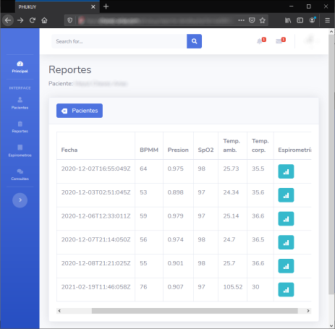
Web platform In Fig. 9 you can see the platform developed where doctors can access patient reports.
Human Systems Engineering and Design (IHSED 2021) https://openaccess.cms-conferences.org/#/publications/book/978-1-7923-8987-0
Figure 7. Spirometry
Figure available in the original PDF paper.
Figure 6. Analysis of oximetry, temperature and
Figure available in the original PDF paper.
Figure 8. Body Temperature Analysis ambient pressure
Figure available in the original PDF paper.
Figure 9. Web platform
Human Systems Engineering and Design (IHSED 2021) https://openaccess.cms-conferences.org/#/publications/book/978-1-7923-8987-0
VALIDATION Spirometer Calibration
For the spirometer calibration phase, the most relevant official recommendations of spirometry published by the American Thoracic Society and the European Respiratory Society (ATS / ERS) (Miller, 2005) and the Spanish Society of Pneumology and Thoracic Surgery (SEPAR) were taken (García-Río, 2013) that indicate:
Measure volumes greater than or equal to 8 liters and a flow of 0 to 14 liters / sec, with a minimum detectable volume of 30 ml.
Accumulate signal for 30 seconds.
Measure the volume with a minimum accuracy of ± 3% or ± 50 ml.
Resistance to a flow of 12 liters / sec less than 1.5 cm H2O / liter / sec.
Simultaneous graphic recording, with on-screen display.
Availability of adequate reference values, being able to select among them the one that corresponds to each work area and specific patient.
Export of the final report, which allows the data to be transmitted easily and even attached to an electronic medical record.
For the calibration of the spirometer, the syringe “Hans Rudolph Calibration Syringe 3 liters - Series 5530” (Fig. 10) was used, which is calibrated according to the specifications of the standard, and has the following characteristics:
Total volume: 3L
Smallest graduation (ml): 100
Stroke volume (cm): 37.47
Cylinder bore (cm): 10.16
Weight (grams): 2268
Human Systems Engineering and Design (IHSED 2021) https://openaccess.cms-conferences.org/#/publications/book/978-1-7923-8987-0
Figure 9. Calibration syringe Hans Rudolph calibration Syringe 3 liters – Series 5530 The calibration protocol was based on the comparison of the results obtained from inducing, with the syringe, 3 liters of air both to the MIR Spirodoc spirometer and to the PHUKUY prototype and to see if the result of the PHUKUY proto-type is consistent with the results of a certified and commercial equipment such as the MIR Spirodoc spirometer (Fig. 11 and Fig. 12).
Figure available in the original PDF paper.
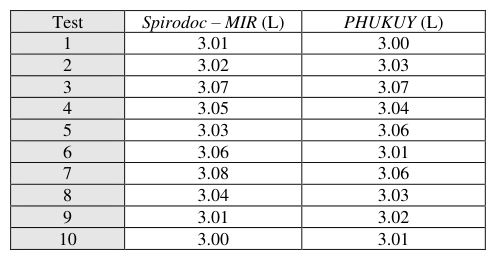
Figure 10. Spirodoc de MIR test Figure 11. PHUKUY test When performing 10 tests with the 3L syringe, as can be seen in Table 1, in the case of the Spirodoc - MIR, a maximum error of 0.08L was obtained, that is, 2.6%, which is within the standard (± 3%) (Miller, 2005). (Table 2)
Figure available in the original PDF paper.
In the case of PHUKUY, a maximum error of 0.07L was obtained, which trans-lates into 2.3% error, which is within the standard (Miller, 2005). (Table 2)
Table 1. 3-liter syringe tests Test Spirodoc – MIR (L) PHUKUY (L) 1 3.01 3.00 2 3.02 3.03 3 3.07 3.07 4 3.05 3.04 5 3.03 3.06 6 3.06 3.01 7 3.08 3.06 8 3.04 3.03 9 3.01 3.02 10 3.00 3.01Table 2. 3-liter syringe test error Spirodoc – MIR PHUKUY Maximum error 0.08 L 0.07 L % of error 2.66 % 2.33 %
Human Systems Engineering and Design (IHSED 2021) https://openaccess.cms-conferences.org/#/publications/book/978-1-7923-8987-0
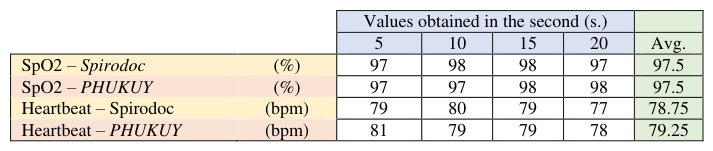
Calibrating the pulse oximeter The validation protocol has been based on comparing the results obtained from measuring the heart pulse and the oxygen saturation in the blood both in the MIR equipment and the PHUKUY prototype and comparing both results and checking if the result of the PHUKUY prototype is consistent with the results of a certified and commercial equipment such as the MIR spirometer (Fig. 13, Fig. 14).
Figure 12. Oximetría con Spirodoc MIR Figure 13. Oximetría con PHUKUY
Figure available in the original PDF paper.
According to Table 3, the results of blood oxygen saturation (SpO2) and heart rate are congruent, but not equal, since these values are not constant and vary over time, however, values are obtained very similar, which indicates that the PHUKUY prototype is working properly.
Table 3. Oximetry comparison
CONCLUSIONS
A prototype portable spirometer was developed at low cost with additional sensors to be able to perform spirometry with greater precision. In addition, a web platform was implemented where all the reports generated by the patients are saved and a designated doctor can access it to monitor the patient.
With this proposed system, patients do not have to go to the hospital to take their
Human Systems Engineering and Design (IHSED 2021) https://openaccess.cms-conferences.org/#/publications/book/978-1-7923-8987-0 measurements, thus avoiding contagions that can be generated in the hospital.
In addition, with this system, access to health can be given to people who live in remote areas and cannot go to hospitals for routine measurements.
REFERENCES
Organización de las Naciones Unidas (ONU), “Preguntas frecuentes sobre la COVID-19” [Online] [Reviewed: April 27th, 2021] https://www.un.org/es/coronavirus/covid-19-faqs. E.A. Spriggs (1978) “The history of spirometry” British Journal of Diseases of the
Chest Volume 72, 1978, Pages 165-180. DOI: https://doi.org/10.1016/0007- 0971(78)90038-4 COVID-19 Dashboard by the Center for Systems Science and Engineering (CSSE) at Johns Hopkins University (JHU) [Online] [Reviewed: April 27th, 2021] https://www.arcgis.com/apps/opsdashboard/index.html#/bda7594740fd402994 23467b48e9ecf6 NGAI, J.C., KO, F.W., NG, S.S., TO, K.- W., TONG, M. and HUI, D.S. (2010),
“The long- term impact of severe acute respiratory syndrome on pulmonary function, exercise capacity and health status” Respirology, 15: 543-550. https://doi.org/10.1111/j.1440-1843.2010.01720.x Lam MH, Wing Y, Yu MW, et al. (2009) “Mental Morbidities and Chronic Fatigue in Severe Acute Respiratory Syndrome Survivors: Long-term Follow-up”. Arch Intern Med. 2009;169(22):2142–2147. doi:10.1001/archinternmed.2009.384 HealthAndYoga(TM) - Ejercitador de respiración profunda - Sistema de medición
de ejercicios de respiración, Amazon [Online] [Reviewed: April 27th, 2021] https://www.amazon.com/-/es/HealthAndYoga-TM-Ejercitador- respiraci%C3%B3n-ejerci- cios/dp/B00MVKTAHQ/ref=sr_1_3?__mk_es_US=%C3%85M%C3%85%C5 %BD%C3%95%C3%91&crid=C9O45P5OM9JZ&dchild=1&keywords=Incen tive+spirometer&qid=1635297997&sprefix=incentive+spirometer%2Caps%2 C147&sr=8-3 Spirometer EasyOne Pro® [Online] [Reviewed: April 27th, 2021] https://nddmed.com/products/complete-pft/easyone-pro Christie O. Armstrong (2018), “Espirometría de incentivo posoperatoria: por qué,
cuándo y cómo” Vol. 35. Num. 1. pp 46-49 (January - February 2018) DOI: 10.1016/j.nursi.2018.02.013 Spirodoc, Handheld, Stand-alone and PC-Based Spirometer, with Oximetry option [Online] [Reviewed: April 4th, 2021] https://www.spirometry.com/prodotti/spirodoc/ EasyOne Pro®, Mediciones portables de DLCO, volúmenes pulmonares y espi-
rometría [Online] [Reviewed: April 4th, 2021] https://nddmed.com/es/productos/pfp-completas/easyone-pro M.R. Miller, J. Hankinson, V. Brusasco, F. Burgos, R. Casaburi, A. Coates, R.
Crapo, P. Enright, C.P.M. van der Grinten, P. Gustafsson, R. Jensen, D.C. Johnson, N. MacIntyre, R. McKay, D. Navajas, O.F. Pedersen, R. Pellegrino,
Human Systems Engineering and Design (IHSED 2021) https://openaccess.cms-conferences.org/#/publications/book/978-1-7923-8987-0
G. Viegi and J. Wanger “Standardisation of spirometry” SERIES ‘ATS/ERS TASK FORCE: STANDARDISATION OF LUNG FUNCTION TESTING’ European Respiratory Journal 2005 26: 319-338; DOI: 10.1183/09031936.05.00034805 Francisco García-Río, Myriam Calle, Felip Burgos, Pere Casan, Félix del Campo, Juan B. Gáldiz, Jordi Giner, Nicolas González-Mangado, Francisco Ortega, Luis Puente Maestu. “Normativa sobre la espirometría (revisión 2013)” Normativa SEPAR, Arch Bronconeumol. 2013;49(9):388–40. Editorial Respira, ISBN Módulo 63: 978-84-940708-0-8.
Human Systems Engineering and Design (IHSED 2021) https://openaccess.cms-conferences.org/#/publications/book/978-1-7923-8987-0
LISTED IN THE AHFE DIGITAL BOOKSTORE CATALOGUE
Explore the complete digital volume
Human Systems Engineering and Design (IHSED2021): Future Trends and Applications
Read this individual research paper free through the original publisher, or explore the full digital proceedings book.
ISBN 978-1-7923-8987-0
Explore this ISBN in the AHFE Bookstore ↗Listed in the July 2026 bookstore catalogue; search by ISBN to confirm current availability · Digital book purchase optional