Juan Ramos-Barrial, Erick Leon-Plasencia, Yaneth Vasquez-Olivera, Luis Arauzo-Gallardo, Carlos Raymundo (2021). Predictive Method of Influencing Factors on Air Flow Instability Using Black Propagation Artificial to Optimize Mining Ventilation Monitoring and Control. In: Human Systems Engineering and Design (IHSED2021): Future Trends and Applications. AHFE Open Access, vol. 21. https://doi.org/10.54941/ahfe1001125
Publisher statistics will load when you open Metrics.
AHFE OPEN ACCESS OPEN ACCESS CONFERENCE PROCEEDINGS PAPER
Predictive Method of Influencing Factors on Air Flow Instability Using Black Propagation Artificial to Optimize Mining Ventilation Monitoring and Control
Existing techniques for monitoring and controlling the ventilation system in un-derground mines are limited; since they only detect areas of low oxygen level or use software to model systems based on standardized data, but not, they evaluate the factors and identify the causes that generate the deficiency in the system. For this reason, a predictive method of factors influencing the airflow of the ventila-tion system is proposed as a possible solution with the use of artificial neural networks (ANN) to strengthen the monitoring and control process. The method-ology proposed in this research includes the analysis of air flow factors in critical mining areas to identify the study parameters. In the case study, a database of rec-ords of ventilation conditions of a mine was used. A test of 11 predictive neural networks was developed, with approximately a base of 250 standardized data.
Underground mining is an extractive activity of mineral resources from the subsoil that are eco-nomically profitable for their commercialization. It is decided to execute the under-ground exploitation method when the economic, environmental and social analysis indicates it as the best option for the extraction of resources. The environmental and safety conditions in which mining extraction activities take place are high risk. How-ever, guaranteeing safe working conditions in mining requires teamwork from the mining geomechanics and ventilation area. The first one recognizes and classifies the rock mass based on standardized parameters that guarantee structurally stable work areas. The second, the area that we will focus our study, has as its main objective to prevent the concentration of gases and mitigate them in the shortest possible time to provide safe work environments (Mingming, 2019). In addition, it performs the monitoring and control of environmental conditions, since it has the responsibility of sustaining and guaranteeing at least 19.5% oxygen level in the air flow (Walentek, 2019).
OSINERGMIN (2018) recorded a fatal accident rate in the mining sector, of which gassing accidents stood out as one of the most influential with a 17% share of the total. Gassing accidents are directly related to the ventilation system in the mine, since it has the responsibility of monitoring and controlling areas with unstable air flows in mining operations (Mingming, 2019) (Cano, 2020). Air instability in mine ventilation systems; have generated, that various investigations are carried out in order to identify the causes of the problem. However, many of the existing techniques used in mines to model ventilation systems focus only on the most relevant variables, the most common being speed, temperature and pressure (Bascompta, 2018), this generates low information. reliability of airflow characterization. The variability of friction, resistance, omission of air loss that exists in the ventilation system and roughness is not considered (Bascompta, 2018). At present, the identification and classification of the factors with the greatest influence on airflow instability is important for the monitoring and control performance of the ventilation system. For this reason, a technique is required that guarantees the reliable identification of the factors.
Human Systems Engineering and Design (IHSED 2021) https://openaccess.cms-conferences.org/#/publications/book/978-1-7923-8987-0
The case study proposes a predictive method using RNA to identify the factors that influence airflow instability in the ventilation systems of a specific conventional mine to guarantee optimal monitoring and control. The reason for the investigation is due to the existence of gassing accidents due to the deficiency in the air flow caused by the ventilation monitoring and control system.
ESTATE OF THE ART Optimization of the underground ventilation system
In the presentation of two investigations, the first in a mining project in Spain and the second in a polymetallic mining deposit in the United States, the optimization of the ventilation system was proposed under the criteria of studying the parameters that intervene in the air flow to identify the most representative factors that are considered in each of the scenarios. In the case of Spain, they evaluated the optimization of the ventilation system based on deepening of the mine, considering temperature levels as its main factor; However, in the United States they quantified the optimization of the ventilation system in different work tasks, considering temperature and pressure drop as their main study factors, using Eye CAN roof support. (Roghanchi, 2016) (Bascompta, 2018). The evaluation of the impact of the location of fans in the interior of the mine is vital for the control of air in the work tasks, whether in conventional drilling or long holes in coal mines (Park, 2018) (Walentek, 2019). The optimization of the ventilation system in mining is fundamental to guarantee safe conditions in all areas, since the comfort of the collaborators is fundamental for the performance of their activities (Chang, 2019).
The control of the factors based on a preliminary analysis is essential for the adequate management of the air flow in mining, since ventilation is considered as the main component to eliminate toxic gases and guarantee an adequate comfort zone. The elimination of toxic gases in the shortest possible time is one of the indicators of the effectiveness of the ventilation system and the optimization of air distribution in critical areas of the operation (Walentek, 2019) (Bascompta, 2018) (Park, 2018). The effects of air velocity, temperature indices, and gas concentration in mining operations are parameters that are evaluated to control their participation in airflow instability (Roghanchi, 2016) (Chang, 2019) (Zhou, 2020).
Application of neural networks in the optimization of the ventilation system Artificial intelligence (IA) in recent years is part of the technological evolution in the mining sector and responsible for continuous improvements in the processes that have been used (Ren, 2020) (Nie, 2017) (Keith, 2015). In the United States, the neural network was applied to model and predict methane emissions from longwall mines in the United States. In this case the author collected data from the ventilation system of 63 mines and resulted in 17 parameters that potentially affected methane emissions. Based on the selected parameters, the principal component analysis was performed
Human Systems Engineering and Design (IHSED 2021) https://openaccess.cms-conferences.org/#/publications/book/978-1-7923-8987-0 to determine the variables that most influenced ventilation and they were considered for predictive modeling using ANN. (Cano, 2020) (Yuntao, 2018) In addition, the use of Artificial Neural Networks (ANN) for the rapid prediction of pollutants based on a linear model of ventilation (MLV) combining it with limited cases of Computational Fluid Dynamics (CFD) simulations, to which was needed of variables that are identified as input variables. Regarding the ventilation system, the stability in the air flow will depend on variables such as the accumulation of dust, the temperature, the distribution of the fans, the air speed. Identifying each of these will allow us to better control the ventilation system (Ren, 2020) (Yuntao, 2018).
Deep learning is fundamental for research since it will be considered that, unlike the traditional method, deep learning had more beneficial characteristics for a prediction, such as automatically and independently learning the characteristics of a large amount of data without human intervention (Keith, 2015) (Semin,2019) (Zhou, 2018).
Optimization of the monitoring and control system in mining ventilation.
Monitoring the ventilation system is a critical component to efficiently remove hazardous gases and maintain an acceptable temperature in the work area. The effect of mine ventilation depends on the proportion of oxygen and its air flow distribution in the ventilation networks, as it changes during the life of the mine (Zhou, 2020) (Wang, 2017). The monitoring of the ventilation system is carried out with intelligent sensors to control environmental conditions in the mine or spontaneous combustion simulations in coal mine scenarios; since the objective is the control and administration of the air flow based on the identification of the most relevant parameters (Semin, 2019) (Jia, 2020). The optimization of the monitoring and control goes through sensitivity analysis of its parameters to identify the most significant variables in the ventilation system (Zhou, 2018).
The need to maintain the required air flow in all workplaces is important to ensure production and safety in mining work; However, to meet the minimum safety requirements demanded by mining operations, the main factors that intervene in the ventilation system must be identified to provide optimal monitoring and control (Zhou, 2020) (Jia, 2020).
CONTRIBUTIONS
Method
The methodology proposed in this research considers the analysis of influencing factors of a certain underground work in the center of the country. Simultaneously analyzing after obtaining the data and randomizing them and then inserting them into the neural network.
Human Systems Engineering and Design (IHSED 2021) https://openaccess.cms-conferences.org/#/publications/book/978-1-7923-8987-0
Figure 1. Methodology proposed Phases of the Method
Figure available in the original PDF paper.
Phase One (Ventilation Analysis). The information obtained from a mine in central Peru was analyzed in order to detect and identify the parameters that would be included in the neural network as input variables. In addition to identifying if they were complying with what was proposed by DS 024-2016. In addition, it was determined if the air cover was supplied with respect to the air inlet that was in this mine.
Phase Two (Neural Networks). The numerical value of the input parameters is standardized with the Excel tool in order to organize them by degree of importance. These tables with established values are imported to work with the same analytical criteria for efficient ventilation. A total of 11 neural networks were made to classify and analyze them in order to determine the degree of importance of each one.
Phase Three (Ventilation Model). The validity of the simulated data was verified by cross validation. To achieve this, the data were regrouped into a subset in which all the factors that we selected as input variables and their standardized values were included. For this analysis, a maximum permissible error was not selected, but all networks were accepted. The error was estimated by applying the absolute mean error method (PEMA).
Indicators Percentage of absolute mean error (PEMA). It is a relative measurement of a forecast, it is expressed in percentages and indicates how big the forecast is with actual values. This technique is useful when you have large values to compare the precision of the same.
Human Systems Engineering and Design (IHSED 2021) https://openaccess.cms-conferences.org/#/publications/book/978-1-7923-8987-0
(1)
Variogram. Variogram analysis involves identifying the spatial correlation of data.
(2) This process depends on the level of similarity between the variographic structures for various directions. When the structures are similar, the variable under test has an isotropic behavior. Otherwise, its behavior is considered anisotropic.
VALIDATIONS Description of the Scenario
The data collection area is from a model mine that is located in the Huallanca district, Bolognesi province, Ancash department (Peru), at an altitude of 4000 meters above sea level. The district of Huallanca is located in the Southeast of the Ancash Region and geographically it is located on the eastern side of the Western chain of the Andes Mountains.
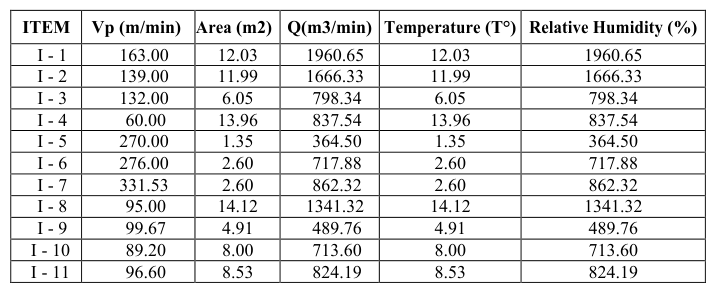
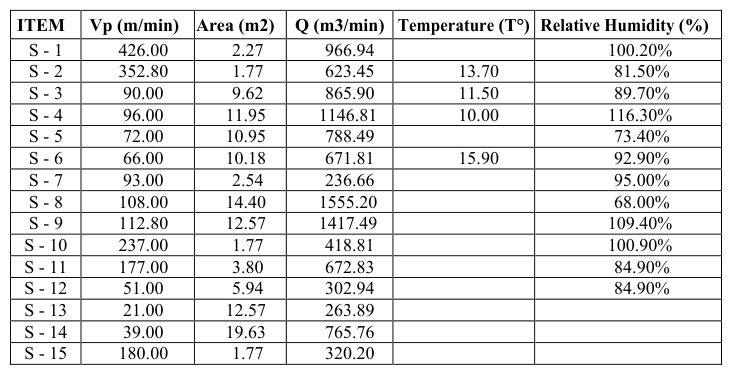
Initial Diagnosis Measurements were made of both the input and output variables in order to compare them and verify that the maximum air exceedance that could exist is met, which should be a minimum of 10%.
Table 1. Air Inlet Parameters
Human Systems Engineering and Design (IHSED 2021) https://openaccess.cms-conferences.org/#/publications/book/978-1-7923-8987-0
Table 2. Air Outlet ParametersTable 3. Air Cover AIR COVER (%) AIR ENTRANCE = 10,576.4 m3/min AIR REQUIREMENT = 10,435.0 m3/min AIR COVER (%) = 101.36%
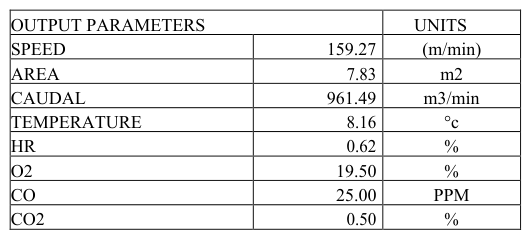
Application to the Stage After all the analysis and selection of the input parameters and their variables, we also proceeded to select those variables that characterize an efficient air flow (Table 4).
Table 4. Output Parameters OUTPUT PARAMETERS UNITS SPEED 159.27 (m/min) AREA 7.83 m2 CAUDAL 961.49 m3/min TEMPERATURE 8.16 °c HR 0.62 % O2 19.50 % CO 25.00 PPM CO2 0.50 %
Table available in the original PDF paper.
Human Systems Engineering and Design (IHSED 2021) https://openaccess.cms-conferences.org/#/publications/book/978-1-7923-8987-0
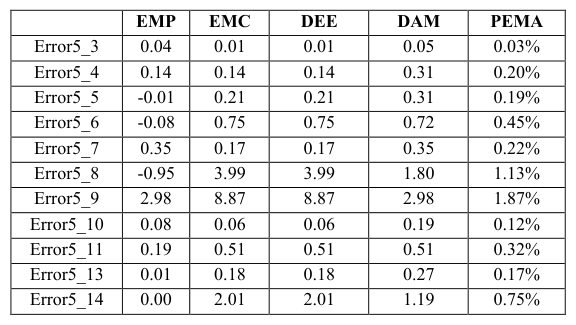
Around 11 neural networks were manufactured, which were intended as an advance to classify the degree of importance of each variable around the error that it denoted in its analysis. Obtaining graphs and tables that allowed the 11 networks to be averaged based on that criterion.
Figure 2. PEMA comparison chart
Figure available in the original PDF paper.
DISCUSSION
Table 5 shows the statistics of the 11 neural networks that were designed in this investigation. In addition to the probabilistic errors that we use for the selection of the network. The criterion that to select 1 of the 11 neural networks was based on the value of the PEMA (Percentage of absolute mean value) which is lower in network number 3.
The underground mine presents poor air flow circulation and becomes highly variable
Human Systems Engineering and Design (IHSED 2021) https://openaccess.cms-conferences.org/#/publications/book/978-1-7923-8987-0 in certain tasks, due to the variation in temperatures, gas concentration and the presence of humidity. In development work, the factors with the most presence and participation is temperature and gas concentration. In order to improve the analysis, it is necessary to have a data average close to 250 because if it is less than this it would generate a great margin of error.
REFERENCES
Fu Mingming, Zheng Qian, He Shuai, Yan Yiran, Wang Xiaohui, «Oxygen control mechanism in nonventilation excavation based on the simultaneous mining of coal and gas.,» Process Safety and Environmental Protection, vol. 123, nº 20, pp. 33 - 38, 2019. Andrzej Walentek , Tomasz Janoszek , Stanisław Prusek , Aleksander Wrana,
«Influence of longwall gateroad convergence on the process of mine ventilation network-model tests.,» International Journal of Mining Science and Technology, vol. 29, pp. 585 - 590, 2019. Cano Y., Quispe G., Chavez H., Mamani-Macedo N., Raymundo-Ibañez C., Dominguez F. (2020) “Occupational Health and Safety Management Model for Mining Contracts”. Human Interaction, Emerging Technologies and Future Applications II. IHIET 2020. Advances in Intelligent Systems and Computing, vol 1152. Springer, Cham. DOI: https://doi.org/10.1007/978-3-030-44267- 5_74. M. Bascompta, L. Sanmiquel, H. Zhang, «Air flow stability and diagonal mine
ventilation system optimization: case study. Journal of mining science.,» Journal of Mining Science, vol. 54, pp. 813 - 820, 2018. Pedram Roghanchi, Karoly C. Kocsis, Maurice Sunkpal , « Sensitivity analysis of the effect of airflow velocity on the thermal comfort in underground mines.,» Journal of Sustainable Mining, vol. 15, pp. 175-180, 2016. Park J, Youngdo J,Park G., «Flow characteristics of fresh air discharged from a
ventilation duct for mine ventilation.,» Journal of Mechanical Science and Technology, vol. 32, nº 3, pp. 1187-1194, 2018. Ping Chang, Guang Xu, Fubao Zhou, Benjamin Mullins, S. Abishek, Duncan Chalmers, «Minimizing DPM pollution in an underground mine by optimizing auxiliary ventilation systems using CFD.,» Tunnelling and Underground Space Technology, vol. 87, 2019. Zhou A., Zhang M., Wang K., Elsworth D., Wang J., Fan L, «Airflow disturbance
induced by coal mine outburst shock waves: A case study of a gas outburst disaster in China,» International Journal of Rock Mechanics and Mining Sciences, vol. 128, nº 104262, 2020. Chen Ren , Shi-Jie Cao. , 52, 14., « Implementation and visualization of artificial intelligent ventilation control system using fast prediction models and limited monitoring data.,» Sustainable Cities and Society, vol. 52, nº 101860, 2020. W. Nie, «The effects of ventilation parameters on the migration behaviors of head-
on dusts in the heading fase» Tunnelling and Underground Space Technology, vol. 70, pp. 400-408, 2017.
Human Systems Engineering and Design (IHSED 2021) https://openaccess.cms-conferences.org/#/publications/book/978-1-7923-8987-0
Wallace Keith, Prosser B., Stinnette J. Daniel, «The practice of mine ventilation engineering.,» International Journal of Mining Science and Technology, vol. 25, pp. 165-169, 2015. M.A. Semin L.Yu. Levin, «Stability of air flows in mine ventilation networks,»
Process Safety and Environmental Protection, vol. 124, pp. 167-171, 2019. Liang Yuntao , «Application of ventilation simulation to spontaneous combustion control in underground coal mine: A case study from Bulianta colliery,» International Journal of Mining Science and Technology, vol. 28, pp. 231- 242., 2018. Zhou, Aitao, Wang, Kai, Wu, Longgang, Xiao, Yiwen. , « Influence of gas
ventilation pressure on the stability of airways airflow.,» International Journal of Mining Science and Technology., vol. 28, nº 2, pp. 297-301, 2018. Kai Wang, Shuguang Jiang, Zhengyan Wu, Hao Shao, Weiqing Zhang, Xiaodong Pei, Chuanbo Cui. , «Intelligent safety adjustment of branch airflow volume during ventilation-on-demand changes in coal mines.,» Process Safety and Environmental Protection, vol. 111, pp. 491-506, 2017. Jia J., Jia P., Li Z. , «Theoretical study on stability of mine ventilation network
based on sensitivity analysis.,» Energy Science and Engineering, vol. 8, nº 8, pp. 2823-2830, 2020. Aitao Zhou , «The role of methane buoyancy on the stability of airway airflow in underground coal mine ventilation.,» Journal of Loss Prevention in the Process Industries, vol. 54, pp. 346-351, 2018.
Human Systems Engineering and Design (IHSED 2021) https://openaccess.cms-conferences.org/#/publications/book/978-1-7923-8987-0
LISTED IN THE AHFE DIGITAL BOOKSTORE CATALOGUE
Explore the complete digital volume
Human Systems Engineering and Design (IHSED2021): Future Trends and Applications
Read this individual research paper free through the original publisher, or explore the full digital proceedings book.
ISBN 978-1-7923-8987-0
Explore this ISBN in the AHFE Bookstore ↗Listed in the July 2026 bookstore catalogue; search by ISBN to confirm current availability · Digital book purchase optional