Omar Cóndor-Herrera, Mónica Bolaños-Pasquel, Pamela Acosta-Rodas, Jorge Cruz-Cardenas, Carlos Ramos-Galarza (2021). The Role of Digital Interactive Whiteboards in Students´ Learning and Participation. In: Human Systems Engineering and Design (IHSED2021): Future Trends and Applications. AHFE Open Access, vol. 21. https://doi.org/10.54941/ahfe1001095
1 Centro de Investigación en Mecatrónica y Sistemas Interactivos MIST/Carrera de Psicología, Centro de Investigación ESTec Universidad Tecnológica Indoamérica Av. Machala y Sabanilla, Quito, Ecuador ↗
2 Facultad de Psicología, Pontificia Universidad Católica del Ecuador Av. 12 de Octubre y Roca, Quito, Ecuador ↗
Nowadays, the teaching – learning process is characterized by the application and implementation of technological resources that look for the improvement of students´ attention and motivation within the educative process. In this context, one of those resources looking to accomplish this objective are digital whiteboards, that allow to make cooperative work, interact in audio and video in real time, closing the gap with the real world. The objective of this paper is to analyze the benefits that interactive whiteboards offer to the learning process, as well as to review previous studies that validate their application and the positive effects given to the educational process.
Human Systems Engineering and Design (IHSED 2021) https://openaccess.cms-conferences.org/#/publications/book/978-1-7923-8987-0
INTRODUCTION
Nowadays, educational characteristics anwers mostly to the digital world and to students’ abilities and skills with modern educative technologies (Dudaitė & Prakapas, 2019). Teachers use frequently a diversity of technical solutions to complement daily activities in classrooms as well as in the e-learning environments (Cóndor-Herrera & Ramos-Galarza, 2020).In the virtual education modality or electronic learning (e-learning), teachers must manage a variety of tools that allow the development of their teaching content to virtual environments. The educational challenge for teachers is to get students’ attention through a class content adequate to their sight and, it is the point where, the denominated digital interactive whiteboards, are one of the elements with major utility in the virtual teaching process. Generally, this tool is used to write down ideas, individually or cooperatively, (Atencio et al., 2019). Although, at present, this kind of digital whiteboards count with tools and plenty of functionalities, that allow to visualize the contributions made by the users in a determined period of time (Hara et al., 2018), as an example, realizing activities in a cooperative way, to interact through audio and video in real time, also, to count with different tools for visual and academic support for teacher when giving a class. It has allowed students to perceive and interact within virtual environments as they would do in the real world (Petrykowski., 2019). Different to a traditional class where whiteboards with limited options of interaction and creativity offered are limited (Ringe et al., 2015), it has been shown that the usage of digital interactive whiteboards is more efficient than traditional schooling, since learning with a digital interactive whiteboard makes easier to students to acquire new knowledge [7].
Similar studies show that, students like the most to work with teaching interactive tools as well as they find this activity as interesting and attractive (Dudaitė & Prakapas, 2019). It is useful as a pedagogic educative objective, since the resources given to students in the teaching-learning process are attractive for them, their motivation to learn will arise and, an improvement in educative results will be seen.
Within this context, the objective of this paper is to analyze the benefits that interactive whiteboards offer to the learning process, as well as to review previous studies that validate their application and the positive effects given to the educational process, offering teachers a broad range of possibilities and pedagogic digital resources to strengthen their teaching process at presence or through a virtual environment.
Human Systems Engineering and Design (IHSED 2021) https://openaccess.cms-conferences.org/#/publications/book/978-1-7923-8987-0
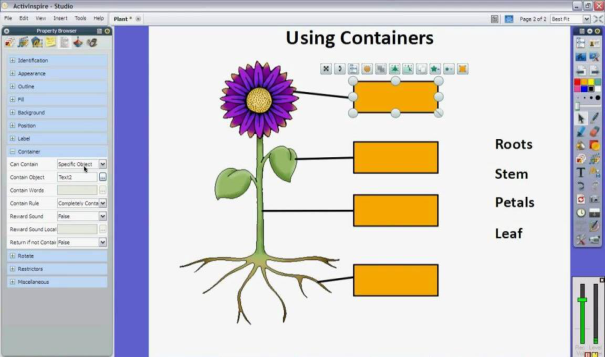
Digital Whiteboards’ Utilities Revision: ActivInspire is a collaborative software used to teach through interactive screens (PROMETHEAN LIMITED, 2020), in fact, allow the teacher to import resources created previously such as PPT’s slides, PDF files or multimedia resources from the personal computer, as well as web resources with the corresponding links.
Activinspire Interactive Whiteboards
Figure 1. Activities in the Activinspire Whiteboard.
Teachers have new ways to participate in interactive activities totally personalized, because the software counts with 10 premade frames, with many different activities including Matching, Flash Cards, Crossword, Memory, among others that could be adopted by teachers depending on the activity, or in function of the subject that is planned to work on. As it is shown in figure 1.
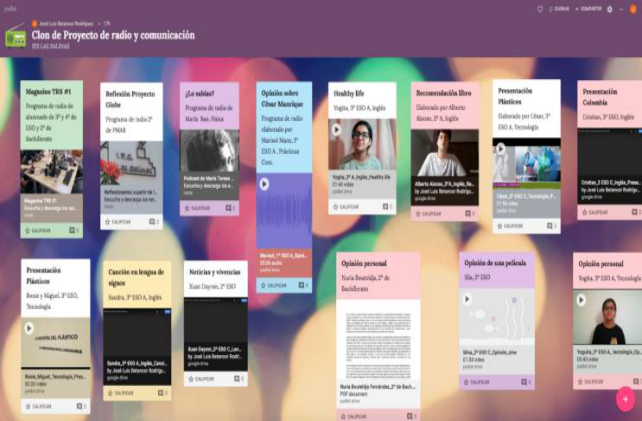
PADLET Padlet is a web site and an application that allows people to gather information in virtual on- line announcement’s boards. This tool allows students to begin with a frame or a white page and, as activities are being completed it is possible to add audios, videos, text, links, documents, images and everything they want in a Wall and organize its content, just as a
Human Systems Engineering and Design (IHSED 2021) https://openaccess.cms-conferences.org/#/publications/book/978-1-7923-8987-0 page full of notes in a Post-it style. Once teacher or students create a wall, it may be shared through social networks (Facebook, Twitter), or, instead to activate the function of sharing the link and anyone that has it is able to interact and participate in real time of the different activities proposed.
Figure 2. Student’s activities in a Padlet Screen.
This tool may be used by teachers to realize co-evaluation activities, because Padlet includes a function of voting or qualifying where participants could value their classmate’s activities with numbers or figures, for example hearts or stars, which motivate collaborative activities for students, where their attention and interest is caught.
Padlet let students to upload documents that had been created, such as class notes or completed tasks. More than one person can contribute in a Padlet Wall, at the same time, teachers are able propose activities to be developed by teams and group projects, as it is show in Fig. 2.
Once the activities proposed by the teacher are completed, all of them can be exported into a file, as evidence of their work or, to insert this information in a blog or website, and it is possible to convert it into a QR code too (Common Sense Media, 2020).
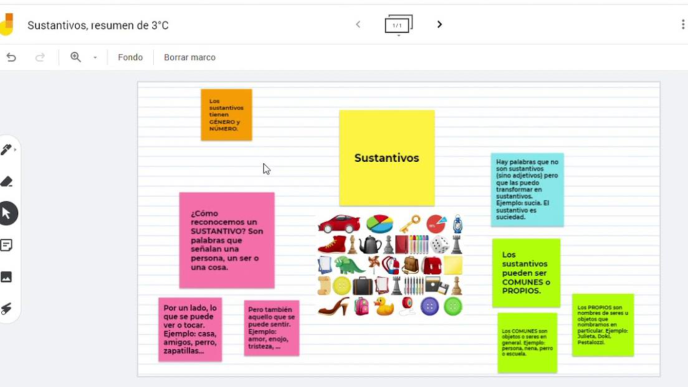
GOOGLE JAMBOARD Jamboard is an interactive whiteboard that allows the collaboration in the creation of content in real time with different users from anyplace in the world, connected through the web or
Human Systems Engineering and Design (IHSED 2021) https://openaccess.cms-conferences.org/#/publications/book/978-1-7923-8987-0 mobile application. This whiteboard gives great precision to realize drawings, including functions of hand-writing and figures’ recognition, making possible for users to write as being in a traditional chalkboard, also, they are able to look for information in sites as Google, and to make teams work in the Google Workspace. Also, it offers the function of selecting images and other web contents and insert them directly in a jam, to import documents files, spreadsheets and presentations, even adding photos from Drive (Google, 2021), as can be seen in the Fig. 3.
Figure 3. Student’s activities in a Padlet Screen.
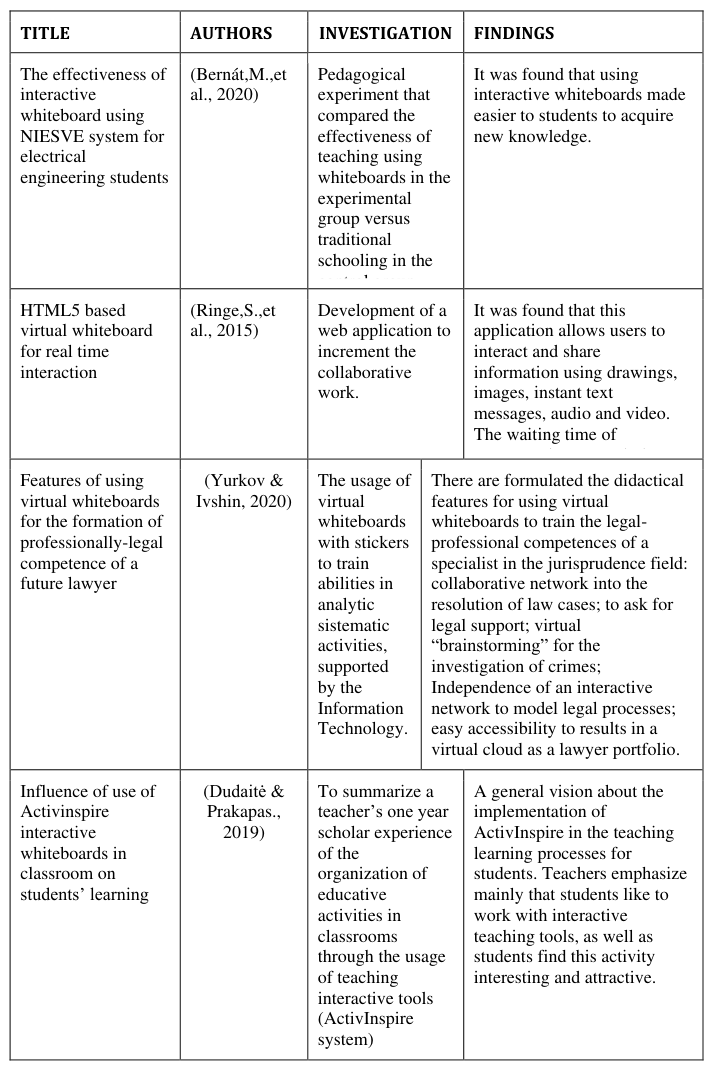
PREVIOUS STUDIES OF INTERACTIVE WHITEBOARDS USED IN EDUCATION Table 1 shows the previous studies where interactive whiteboards have been applied in the educative process.
Human Systems Engineering and Design (IHSED 2021) https://openaccess.cms-conferences.org/#/publications/book/978-1-7923-8987-0
Table 1: Previous studies of interactive whiteboards.
Human Systems Engineering and Design (IHSED 2021) https://openaccess.cms-conferences.org/#/publications/book/978-1-7923-8987-0
CONCLUSIONS
This article has described the goodness of using interactive whiteboards into the educational field, highlighting the possibility of using these resources in the collaborative work on-line, that results positive and beneficial in the teaching-learning virtual process that is being used lately.
The benefits of using interactive whiteboards, such as google Jamboard, padlet in learning are mainly emphasized in motivating students as they like to work with interactive teaching tools, plus students find these activities interesting and engaging which improves their predisposition to carry out academic activities, since interactive whiteboards allow users to interact and share information through drawings, images, instant text messages, audio, and video.
The next phase of this investigation relies on the application of digital interactive whiteboards in longitudinal experimental processes, that allow to identify the contribution of this technological advances in favor of the diverse learning indicators, such as cooperative work and academic performance.
REFERENCES
Atencio, Y., Cabrera, M., & Huaman , L. (2019). A Cooperative Drawing Tool to Improve Children’s Creativity. 16th International Conference on Cooperative Design, Visualization, and Engineering, CDVE, 11792, 162-171. doi:10.1007/978-3-030- 30949-7_19 Bernát, M., Pavlovkin, J., Džmura, J., Žáčok, L., Bernátová, R., Petráš, J., . . . Sepešiová, M.
(2020). The effectiveness of interactive whiteboard using NIESVE system for electrical engineering students. Journal of Technical Education and Training, 12(1), 204-217. doi:10.30880/jtet.2020.12.01.022 Common Sense Media. (2020). Common Sense Education. Recuperado el 18 de 10 de 2020, de https://www.commonsense.org/education/website/padlet Cóndor-Herrera, O., & Ramos-Galarza, C. (2020). The impact of a technological
intervention program on learning mathematical skills. Education and Information Technologies, 1-13. Dudaitė, J., & Prakapas, R. (2019). Influence of use of Activinspire interactive whiteboards in classroom on students’ learning. Digital Education Review(35), 299-308. Obtenido de https://eric.ed.gov/?id=EJ1220152 Google. (2021). Google Workspace. Recuperado el 20 de 10 de 2020, de
https://workspace.google.com/products/jamboard/
Human Systems Engineering and Design (IHSED 2021) https://openaccess.cms-conferences.org/#/publications/book/978-1-7923-8987-0
Hara, T., Braun, I., Kapp, F., Hara, K., Leydecker, M., & Schill, A. (2018). Supporting Feedback Phases of Self-Regulated Learning in University Settings through Canvas-Based Discussions. Proceedings of 2018 IEEE International Conference on Teaching, Assessment, and Learning for Engineering, 1158-1161. doi:10.1109/TALE.2018.8615205 Petrykowski, M., Berger, P., Hennig, P., & Meinel, C. (2019). Digital collaboration with a
whiteboard in virtual reality. Advances in Intelligent Systems and Computing, 880, 962-981. doi:10.1007/978-3-030-02686-8_72 PROMETHEAN LIMITED. (2020 ). Promethean World. Recuperado el 17 de 10 de 2020, de https://www.prometheanworld.com/products/lesson-delivery- software/activinspire/ Ringe, S., Kedia, R., Poddar, A., & Patel, S. (2015). HTML5 based virtual whiteboard for
real time interaction. Proceedings of International Conference on Advances in Computing, Communication and Control, ICAC3, 49(1), 170-177. doi:10.1016/j.procs.2015.04.241 Yurkov, S., & Ivshin, M. (2020). Features of using virtual whiteboards for the formation of professionally-legal competence of a future lawyer. Perspectives of Science & Education, 46(4), 425-440. doi:10.32744/pse.2020.4.30
Human Systems Engineering and Design (IHSED 2021) https://openaccess.cms-conferences.org/#/publications/book/978-1-7923-8987-0
LISTED IN THE AHFE DIGITAL BOOKSTORE CATALOGUE
Explore the complete digital volume
Human Systems Engineering and Design (IHSED2021): Future Trends and Applications
Read this individual research paper free through the original publisher, or explore the full digital proceedings book.
ISBN 978-1-7923-8987-0
Explore this ISBN in the AHFE Bookstore ↗Listed in the July 2026 bookstore catalogue; search by ISBN to confirm current availability · Digital book purchase optional