Carlos Ramos-Galarza, Janio Jadán-Guerrero, Hugo Arias-Flores, Pamela Acosta Rodas, Mónica Bolaños-Pasquel (2021). Technological Proposal to Stimulate Memory and Attention: DR. LOBUS. In: Human Systems Engineering and Design (IHSED2021): Future Trends and Applications. AHFE Open Access, vol. 21. https://doi.org/10.54941/ahfe1001098
1 Facultad de Psicología, Pontificia Universidad Católica del Ecuador Av. 12 de Octubre y Roca, Quito, Ecuador ↗
2 Centro de Investigación en Mecatrónica y Sistemas Interactivos MIST, Carrera de Psicología, Carrera de Ingeniería en Ciencias de la Computación, Universidad Tecnológica Indoamérica Av. Machala y Sabanilla, Quito, Ecuador ↗
The executive functions that are at the core of human neuropsychological functioning are attention and memory. Attention encompasses a series of brain subprocesses that allow an individual to focus his/her state of consciousness on a determined stimulus of internal and external reality. On the ohter hand, memory refers to the capacity to store and recall information. The aim of the research was to develop a smartphone application that allows stimulate memory and older adults. This artiche describes the conceptual proposal that was followed to develop a smartphone application that seeks to improve the functioning of these two brain abilities named DR. LOBUS. This application includes a series of exercises that stimulate various sub-levels of attention and memory, such as selective and sustained attention, as well as immediate memory capacity.
Human Systems Engineering and Design (IHSED 2021) https://openaccess.cms-conferences.org/#/publications/book/978-1-7923-8987-0
INTRODUCTION
Humans´neuropsychological performance and the processes applied for its stimulation are key, since brain functioning depends in its development, to a great extend, on the stimulation that receives from the external environment (Ramos- Galarza et al., 2019; Ramos-Galarza & Pérez-Salas, 2016). In this context, the different technological devices are key to favor the performance of human cognitive processes (Ramos-Galarza et al., 2021a; Ramos-Galarza et al., 2021b).
Brain´s key functions in information processing are memory and attention, since these mental abilities are the basis of human beings cognitive and intellectual functioning (Ardila & Roselli, 2007).
Memory has been defined as a cognitive process that allows humans to encode, store and retrive information about a given concept or event (Cohen, 2014; González & Muñoz, 2008). Attention is a mental ability that allows a state of activation that favours the processing of information and has a high complexity and sub-levels that identify it as a brain function distributed throughout the brain (Muñoz, 2009).
These two cognitive functions suffer a deterioration in the old adulthood stage of the human being, since neuronal functioning is sensitive to the passage of time, and, in the last stage of a human´s life, there is an alteration of these two mental abilities (Ramos-Galarza et al., 2017), because of it, it is indispensable the innovation to develop these devices that allow the stimulation of these two functions in elderly people.
After having reviewed databases and patent proposals, it has not been found that in Ecuador, the country in which this research will be carried out, there is no technological development that seeks to prevent cognitive deterioration in human old age. Within this context, the aim of the research was to develop a smartphone application that allows stimulate memory and older adults.
RESEARCH METHOD As a research method, the following strategies were applied: (a) expert judgment to determine the characteristics of the application, (b) documentary review of exercises for attention and memory, (c) interviews with neuropsychologists to know times and conditions of the exercises , and (d) iterative evaluations to determine the best state of the application for use.
TECHNOLOGICAL PROPOSAL To stimulate memory and attention, the application DR. LOBUS is proposed. The programming of this application was done entirely with Adobe Animate under the
Human Systems Engineering and Design (IHSED 2021) https://openaccess.cms-conferences.org/#/publications/book/978-1-7923-8987-0
ActionScript 3 programming language, focused on the development of mobile applications, in order to optimize its operation on different devices. Among the different mobile programming techniques, there was used a lightweight SQLite database, which is responsable for handling all the data collected in the application for study purposes.
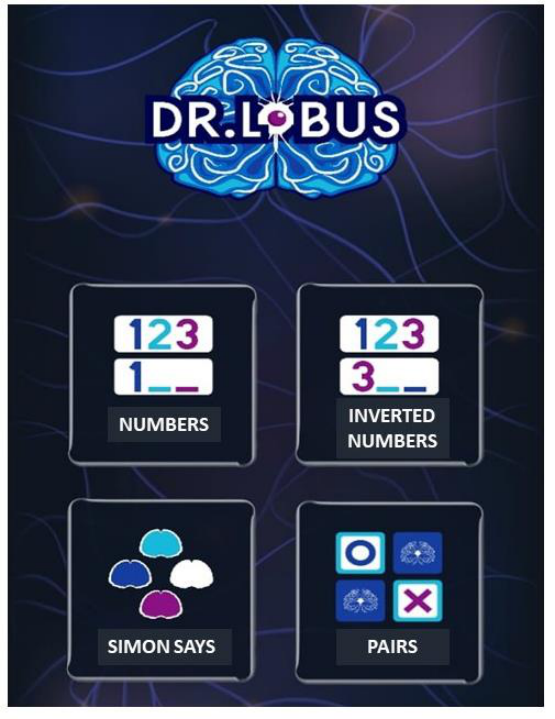
Object oriented programming was mainly used to have the best possible performance on all possible mobile devices, the generation of error reports stored in the database are automatically sent by electronic mail, in order to streamline the process of obtaining data from different users who use the application, in order to send this e-mails, web requests were used. Cognitive Stimulation DR. LOBUS application counts with four games that seek to stimulate memory and attention: (a) numbers, there are presented a series of numbers that the user should recall and answer in a limited time, such as it is presented in the example, there are presented more complex stimuli once there have been solved those presented previosly; (b) inverted numbers, there are presented a series of numbers that the user must recall inversely, from the last number to the first, at the same time, in this activity, the difficulty increases according to the right completition of previous exercises; (c) Simon Says, where the user finds 4 brains, every brain emiting a different sound, presenting sequences that must be reproduced by the user, which increase in their difficulty according it is answered correctly; and, (d) pairs, where a series of stimuli 4X6 are presented and the user must find the pair of each stimulus presented (figure 1).
Also, it is important to mention that, this application counts with an avatar named DR. LOBUS, who is responsible for giving feedback to the user about his/her performance, as well as the information about brain functioning, and the directions for each game (figure 2).
Human Systems Engineering and Design (IHSED 2021) https://openaccess.cms-conferences.org/#/publications/book/978-1-7923-8987-0
Figure 1. Sreenshoot of the exercises for attention and memory stimulation of the application DR. LOBUS
Human Systems Engineering and Design (IHSED 2021) https://openaccess.cms-conferences.org/#/publications/book/978-1-7923-8987-0
Figure 2. Dr. Lobus avatar, who gives feedback about the activities completed in the application Application Download At the moment, the research team has developed the application to be used in spanish language, and could be used in devices with ANDROID operating system. Anyone interested in using this app, can freely download it at: http://www.kiteracy.com/DrLobus/DrLobus.apk.
CONCLUSIONS
Memory and attention are the two fundamental functions in human cognitive processing. Because of it, in this article we have presented an application for smartphones that allows to stimulate, through different activities, attention and memory. Our application is named DR. LOBUS and has with 4 games that allow the achievement of this type of stimulation.
The research team considers that the use of smartphones is ideal for this type of work, since human beings currently rely on this device to solve different problems they face daily, so its use for therapeutic purposes is another of the benefits of the use of this type of technology in favor of the cognitive performance of older adults.
Human Systems Engineering and Design (IHSED 2021) https://openaccess.cms-conferences.org/#/publications/book/978-1-7923-8987-0
Following with the reseach line of technological development in favor of attention and memory of elderly people, in a next phase we will seek to nalyze the effectiveness of the application, through its application in a longitudinal study where is possible to compare pre and post tests measurements with control and experimental groups.
ACKNOWLEDGMENTS
The authors of this work thank CEDIA for the financing within the CEPRA XIV- 2020-07 ADULTOS MAYORES project Integration of New Technologies for the Design of Cognitive Solutions in Assisted Living Environments for Older Adults: Evaluation of Attention and Memory Areas.
REFERENCES
Ardila, A., Roselli, M. (2007). Neuropsicología Clínica. Manual Moderno, México DF. Cohen, R. (2014). The Neuropsychology of Attention (second edition). Springer,
London. González, B., Muñoz, E. (2008). Estimulación de la memoria en personas mayores.
Principios básicos y ejercicios prácticos. Madrid: Editorial Síntesis. Muñoz, E. (2009). Estimulación cognitiva y rehabilitación neuropsicológica.
Barcelona: Editorial UOC. Ramos-Galarza, C., Acosta-Rodas, M., Jadán-Guerrero, J., Bolaños-Pasquel, M., Saez-Delgado, F. (2021a). Rehabilitation of Children Affected by Attention Deficit Disorder. Advances in Intelligent Systems and Computing, 1269, 369- 373. https://doi.org/10.1007/978-3-030-58282-1_58 Ramos-Galarza, C., Acosta-Rodas, M., Sánchez-Gordón, S., Calle-Jiménez, T.
(2021b). Mobile Technological Apps to Improve Frontal Lobe Functioning. Advances in Intelligent Systems and Computing, 1201, 89-93. https://doi.org/10.1007/978-3-030-51041-1_13 Ramos-Galarza, C., Bolaños-Pasquel, M., García-Gómez, A., Martínez-Suárez, P., Jadán-Guerrero, J. (2019). EFECO Scale for Assessing Executive Functions in Self-Report Format. Revista Iberoamericana de Diagnóstico y Evaluación Psicológica Volumen 51 No 1, 83-93. https://doi.org/10.21865/RIDEP50.1.07 Ramos-Galarza, C., Pérez-Salas, C. (2016). Psychometric propierties: ADHD rating
scale IV self-report. Revista Chilena de Neuro-Psiquiatría Volumen 54 No 1, 9- 18. http://dx.doi.org/10.4067/S0717-92272016000100002 Ramos-Galarza, C., Ramos, V., Jadán, J., Lepe, N., Paredes, L., Gómez, A., Bolaños, M. (2017). Conceptos fundamentales en la Teoría Neuropsicológica. Revista Ecuatoriana de Neurología Volumen 26 No 1, 53-60.
Human Systems Engineering and Design (IHSED 2021) https://openaccess.cms-conferences.org/#/publications/book/978-1-7923-8987-0
LISTED IN THE AHFE DIGITAL BOOKSTORE CATALOGUE
Explore the complete digital volume
Human Systems Engineering and Design (IHSED2021): Future Trends and Applications
Read this individual research paper free through the original publisher, or explore the full digital proceedings book.
ISBN 978-1-7923-8987-0
Explore this ISBN in the AHFE Bookstore ↗Listed in the July 2026 bookstore catalogue; search by ISBN to confirm current availability · Digital book purchase optional