Omar Cóndor-Herrera, Jorge Cruz-Cárdenas, Carlos Ramos-Galarza (2022). Implementing Alexa virtual assistant in learning a new language: Students’ perception analysis. In: Human Factors in Software and Systems Engineering. AHFE Open Access, vol. 61, pp. 26–30. https://doi.org/10.54941/ahfe1002519
Centro de Investigación en Mecatrónica y Sistemas Interactivos MIST/ Research Center in Business, Society, and Technology, ESTec/ School of Administrative and Economic Science/Carrera de Psicología, Universidad Tecnológica Indoamérica, Av. Machala y Sabanilla, Quito, Ecuador ↗
This article reports the results found in an investigation that analyzed students' perception of the learning process based on the "Alexa" virtual assistant as an educational resource. Alexa was used during 6 sessions; at the end of the session, each participant answered a survey. The results showed evidence that most students answered in favor of the use of Alexa to improve their motivation and willingness to perform learning activities.
A virtual assistant introduces a new communication form in which a compu- ter mimics common conversation when interacting using natural language. Thus, the interaction between humans and virtual assistants are often percei- ved like between human interactions (Mann, 2021). Consequently, virtual assistants have been able to work with artificial intelligence (AI) in dif- ferent scenarios such as customer service, education, health, etc. showing encouraging results.
The potential use of virtual assistants is growing every day (Terzopoulos & Satratzemi, 2020) just as user acceptance. Although initially, users had some privacy concerns, nowadays consumers balance between privacy risks and the benefits associated with using voice-based virtual assistants (VBDA) (Vimalkumar et al., 2021) (Pitardi & Marriott, 2021). As a result, users have significantly increased in recent years.
This research shows the results of the students’ perception of an experi- ment based on the use of Alexa to work on the language skills to learn a new language.
Implementing Alexa Virtual Assistant in Learning a New Language 27
VOICE VIRTUAL ASSISTANTS’ RESEARCH The tendency to incorporate conversation assistant agents into people’s lives has followed the unprecedented expansion in the use of artificial intellige- nce (AI). Amazon has been a key pioneer in this area through its assistant Alexa (Ramadan et al., 2021). Currently, there is a wide range of virtual assistants (Cóndor- Herrera, Jadán- Guerrero, & Ramos-Galarza, 2020) and as mentioned above the application has been extended to different fields. A recent study used Alexa to support people in prenatal care (Schindler et al., 2021), other studies have analyzed how voice-activated smart home devices like Alexa and Google Home influence consumer search and request beh- aviors (Canziani & MacSween, 2021). Some studies have analyzed Alexa’s potential for people with special needs, findings indicate that a relationship between Alexa and consumers with special needs helps them to regain their independence and freedom by providing solutions that facilitate their lives (Ramadan et al., 2021).
Another field that has driven the application of virtual assistants is the educational field in which virtual assistants are used for pedagogical purposes (Cóndor- Herrera, Jadán- Guerrero, & Ramos-Galarza, 2020). For example, a recent study reported that students who learn a second language aided by a Russian voice assistant “Alice”obtaining encouraging results when practicing speech (Al-Kaisi et al., 2021). Besides, these virtual assistants can function as virtual teachers, maintain an interactive conversation with the user and being able to solve doubts and explain certain topics. (Ramos-Galarza et al., 2021).
STUDENT’S MOTIVATION TO USE TECHNOLOGY It is undeniable that new technologies have revolutionized not only the pro- ductive world but also the educational field resulting in a diversification of the sources of knowledge (Fernández et al., 2013), (Cóndor -Herrera & Ramos- Galarza, 2020). According to UNESCO, students and teachers already use technologies in various contexts for a wide range of purposes (UNESCO, 2013). In this sense, ICTs have changed how knowledge is organized. Conse- quently, when adopted by teachers, ICTs have made it possible to propose a transformation of teaching by building knowledge supported using technolo- gies where the teaching process is more attractive to students allowing them to use their technological skills and increasing their interest and motivation which improves their willingness to learn.
METHODOLOGY
Quantitative research was conducted in which a questionnaire was applied to identify aspects such as the educational benefit, motivation, and taste of the student in favor of using the Alexa virtual assistant as a learning resource.
A sample of 32 students consented to their voluntary participation in the intervention. The students were between 9 and 12 years old. In terms of gender, 50% were female and 50% male. All participants belonged to the educational system of the city of Quito, Ecuador.
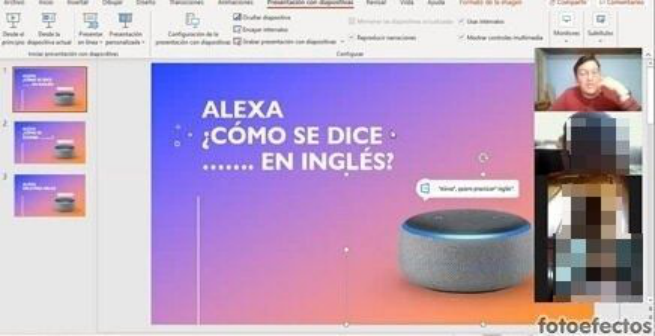
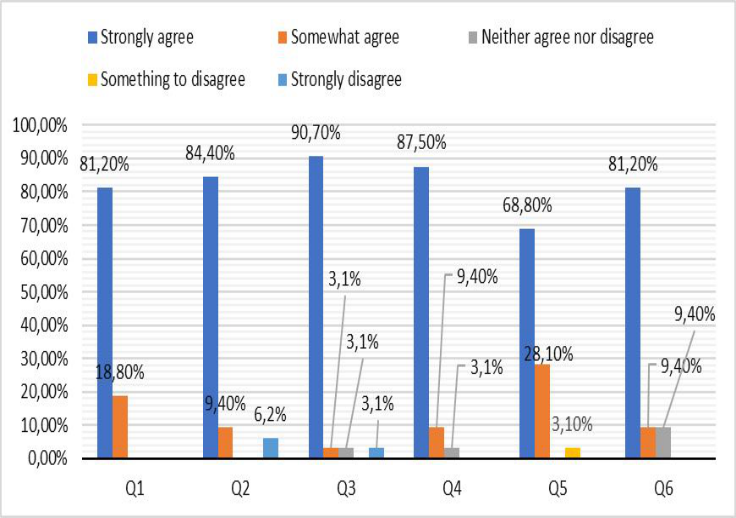
Figure 1: Example of voice commands used in the intervention.Figure 2: Percentage representation of participants’ responses.
INTERVENTION PROTOCOL An intervention was performed using the virtual assistant Alexa, the device used in the intervention was the Amazon Echo Dot (fourth generation).
There were 6 working sessions in which students were able to interact with the assistant using different voice commands such as “Alexa how do you say x in English” among others (Figure 1), to work skills for learning a second language.
At the end of the intervention, all students were surveyed to collect data on their perception of the work done with the virtual assistant.
Implementing Alexa Virtual Assistant in Learning a New Language 29
Table 1. Questionnaire results.
Table available in the original PDF paper.
ITEM ANSWER FREQUENCY
Strongly Somewhat
Somewhat
agree agree
Neither agree nor disagree
Strongly disagree
disagree
26 6 0 0 0
Q1. Do you believe that the use of a virtual assistant “encourage your participation in the learning process”?
27 3 0 0 2
Q2. Were you motivated to work with Alexa?
29 1 1 0 1
Q3. Did you like activities with Alexa?
28 3 1 0 0
Q4. Would you like to work on other topics with Alexa?
22 9 0 1 0
Q5. Do you think you were able to learn the topics studied with this work methodology?
26 3 3 0 0
Q6. How would you rate the learning experience with Alexa?
The results obtained are presented in the following section.
RESULTS
The participants’ response frequencies are presented in Table 1.
The reader is invited to review in Figure 2 the participants’ responses percentages.
DISCUSSION
This article has reported the results found in an investigation that analyzed student perception around the learning process based on the use of virtual assistant Alexa. A high percentage of students expressed favorable responses around the use of the virtual assistant Alexa in the learning-teaching process. Most students agree that using the virtual assistant improved their motivation to learn and increased their willingness to perform learning activities.
Future research will focus on the use of different virtual assistants in experimental studies at a longitudinal level. Pre and post-test measurements will allow to determine the effectiveness of this type of technologies in the academic performance of the student.
REFERENCES
Al-Kaisi, A., Arkhangelskaya, A., & Rudenco-Morgun, O. (2021). The didactic potential of the voice assistant “Alice” for students of a foreign langu- age at a university. Education and Information Technologies, 26, 715–732. doi:https://doi.org/10.1007/s10639-020-10277-2 Canziani, B., & MacSween, S. (2021). Consumer acceptance of voice-activated smart
home devices for product information seeking and online ordering. Computers in Human Behavior, 119. doi:10.1016/j.chb.2021.106714 Cóndor -Herrera, O., & Ramos- Galarza, C. (2020). The impact of a technological intervention program on learning mathematical skills. Education and Information Technologies, 1–13. doi:https://doi.org/10.1007/s10639-020-10308-y Cóndor- Herrera, O., Jadán- Guerrero, J., & Ramos-Galarza, C. (2020). Virtual Assi-
stants and Its Implementation in the Teaching-Learning Process. Human Systems Engineering and Design III. IHSED 2020. Advances in Intelligent Systems and Computing, 1269, 203–208. doi:https://doi.org/10.1007/978-3-030-58282-1_33 Fernández Tilve, M., Álvarez Núñez, Q., & Mariño , R. (2013). E-learning: Otra manera de enseñar y aprender en una Universidad tradicionalmente presencial.,≫ Profesorado. PROFESORADO, Revista de Currículum y formación del profeso- rado, 17(3), 273–291. Mann, C. (2021). Can Conversing with a Computer Increase Turnout? Mobilization
Using Chatbot Communication. Journal of Experimental Political Science, 8(1), 51–62. doi:10.1017/XPS.2020.5 Pitardi, V., & Marriott, H. (2021). Alexa, she’s not human but… Unveiling the drivers of consumers’ trust in voice-based artificial intelligence. Psychology and Marketing, 38(4), 626–642. doi:10.1002/mar.21457 Ramadan, Z., F. Farah, M., & El Essrawi, L. (2021). From Amazon.com to
Amazon.love: How Alexa is redefining companionship and interdependence for people with special needs. Psychology and Marketing, 38(4), 596-609. doi:10.1002/mar.21441 Ramos-Galarza, C., Jadán-Guerrero, J., Arias-Flores, H., & Cóndor-Herrera, O.
(2021). Tecnologías de apoyo para la vida: aportes desde la investigación. Quito, Ecuador: Universidad Tecnológica Indoamérica. Obtenido de http://repositorio. uti.edu.ec//handle/123456789/1687 Schindler-Ruwisch, J., & Palancia, C. (2021). “Alexa, Am I pregnant?”: A content analysis of a virtual assistant’s responses to prenatal health questions during the COVID-19 pandemic. Patient Education and Counseling, 104(3), 460–463. doi:10.1016/j.pec.2020.12.026 Terzopoulos, G., & Satratzemi, M. (2020). Voice Assistants and Smart Speakers in
Everyday Life and in Education. INFORMATICS IN EDUCATION, 9(3), hbox473–490. doi:https://doi.org/10.15388/infedu.2020.21 UNESCO. (2013). El futuro del aprendizaje móvil. Implicaciones para la planificación y la formulación de políticas. Organización de las Naciones Unidas para la Educación, la Ciencia y la Cultura. Obtenido de https://unesdoc.unesco.org/ark: /48223/pf0000219637_spa Vimalkumar, M., Sharma, S., Singh, J., & Dwivedi, Y. (2021). ‘Okay google, what about my privacy?’: User’s privacy perceptions and accepta- nce of voice based digital assistants. Computers in Human Behavior, 120. doi:https://doi.org/10.1016/j.chb.2021.106763
LISTED IN THE AHFE DIGITAL BOOKSTORE CATALOGUE
Explore the complete digital volume
Human Factors in Software and Systems Engineering
Read this individual research paper free through the original publisher, or explore the full digital proceedings book.
ISBN 978-1-958651-37-7
Explore this ISBN in the AHFE Bookstore ↗Listed in the July 2026 bookstore catalogue; search by ISBN to confirm current availability · Digital book purchase optional