Nejood Faisal Abdulsattar, Mustafa Hamid Hassan, Salama Mostafa, Hassnen Shakir Mansour, Nayef Alduais, Aida Mustapha, Mohammed Ahmed Jubair (2022). Evaluating MANET Technology in Optimizing IoT-based Multiple WBSN Model in Soccer Players Health Study. In: Human Factors in Software and Systems Engineering. AHFE Open Access, vol. 61, pp. 79–87. https://doi.org/10.54941/ahfe1002527
As a merit for the Internet of Things (IoT) domain, congregating MANET with WSN application in omnipresent smart environments presents novel opportunities in observing the extensive or wide-ranging built-up area or urban region and provides a new communication system for diverse applications. Sensors are utilized to comprehend the surrounding environment by sensing the signals and sending the data via the gateway node to the MANET node, specifically designed for data gathering or harvesting. IoT applications in this work are regarded as devices worn by soccer players whose monitoring is done using wireless sensor nodes. The challenge in this work is identifying paths or routes of high-level or top-ranking Quality of Service (QoS), such as topology. The implementation of a QoS-aware protocol in MANETs is aimed at enabling the finding of more effective paths between the source and destination nodes of the network and has made QoS a necessity. This paper proposed a model that can select an optimum path based on the efficient QoS parameters in routing protocol for the MANET environment. A model is built based on Flower Pollination Algorithm (FPA) and Multi-Agent system (MAS). An example scenario is written to show the impact of the proposed model on the MANET environment.
Internet of Things (IoT) is a contemporary model of communication in which elements of diverse types of our everyday or mundane lifestyle ranging from smartphones to sensors or devices are linked with networking capable com- ponents (like RFID) communicating with one another and being part of the Internet (Alam, 2020, 2022). The major objective of IoT is to make the Inter- net increasingly motivating and prevalent (Alam, 2020; Alam & Benaida, 2018). Through linking an expansive range of heterogeneous or different
elements and providing ease of access of these devices, varieties of applicati- ons are being utilized in IoT, in handling huge amount of data created by the attached devices in decision-making which has proved essential to industries or in controlling the linked components depending on the data generated. The plethora of areas like electricity transmission and distribution, home auto- mation, industrial automation, medical aids, mobile health care, etc. have witnessed high utilization of IoT.
Presently, smart cities have become one of many developing domains of IoT, where scientists are suggesting various communication paradigms and principles in providing some applications which facilitate people by improving the standard of their daily lifestyle. With the advancement in communication and micro-controller technologies, Wireless Sensor Network (WSN) on one hand, has played a vital function in IoT. Sensor nodes, which are inexpensive devices are used in detecting various environmental para- meters. They can provide temporary data storage in their memory and can utilize communication technologies such as Bluetooth Low Energy (BLE) or IEEE802.15.4 in communicating with other capable devices. The RFID tag on the other hand is in addition, a functional tool in IoT, utilized in identif- ying an item having an RFID tag [1-5]. The challenging part of this work is the identification of routes with effective or superior QoS such as topology. This paper endeavors to examine QoS Efficiency in AODV based on the new model. A new model that can be used in FPA and MAS in improving the QoS of MANETs’ routing protocols. The MANET pattern for routing and mobility is implemented in IoT applications.
METHODS AND MATERIALS The materials and methods utilized in this paper are explained in the sub- sequent sections. They comprise the Flower Pollination Algorithm (FPA), Multi-Agent System (MAS), and FPA-MAS model. They followed by the evaluation of the QoS.
FLOWER POLLINATION ALGORITHM The angiosperms (flowering plants) are for a long stretch the largest phylum of plants that survived the last Cretaceous Period, which is over 140 million years ago. This domination is a result of an optimized pollination process with regards to the Darwinian principle of “Survival of the fittest”. A flower is specially structured to hold the reproductive organs in charge of reprodu- ction in plants through the production of the lants’ reproductive cells (ovules and pollens) that combine to reproduce seeds which comprise plants’ dor- mant offspring. Flowers that have both the stamen (male) and carpel (female) reproductive organs in different flowers are termed unisexual (Imperfect) flo- wers while flowers that have both organs in the same flower are referred to as bisexual (Perfect). Pollination is seen as the process of transferring the male gametes (pollen) to the stigma for fertilization of the female gametes. Colorful petals, fragrances, and nectars in flowers allow more conspicuity to pollinators like insects or birds. Pollinators can be influenced by some
Evaluating MANET Technology in Optimizing IoT-based Multiple WBSN Model 81
flowers to make exclusive visits by exploiting their power of attraction and preserving the flower consistency. In addition, through visits to similar flower species, pollinators ensure nectar availability with few explorations. In other scenarios, pollens are transported simply by the wind, diffusion in water, or gravity. Thus, pollination is subdivided into two major kinds: self and cross- pollination processes. In self-pollination, pollens are moved from between flowers of the same plant. In cross-pollination, pollens are transported betw- een flowers in different plants. In another way, pollination can be classified into biotic and abiotic pollination depending on pollinators (whether they are living or non-living). Abiotic pollination has a limited occurrence compared to biotic pollination (Cui & He, 2018).
MULTI-AGENT SYSTEM A MAS is considered as many intelligent agents or specialists that are con- nected within a field. The MAS collaborate pro-vide solutions to issues that they are unable to handle independently. They have many attributes including adaptability, autonomy, sensitivity and reactive, appropriation and neighbo- rhood perspective or awareness. In completing a definite task, it is required of the agents to cooperate. MAS has an implementation in a distinguished domain such as in airline service support or management, web agents, ecolo- gical and weather checking and observing health services, military demining, spacecraft controlling, and industrial controls (Jubair et al., 2021, 2018). The following are the major reasons that agents are implemented in applications is to enhance: (i) Efficiency and performance’s speed, (ii) Operations, flexibility and scalability, and (iii) System modules’ reusability.
MAS implementation has been done by several scientists to come u with various dynamic routing platforms. Generally, agents are self-governing com- ponents that accomplish one or many tasks with the sole purpose of achieving some goals. In the network domain, agents work continuously unconcerned about if users are disengaged from the network or not. Most agents run on dedicated servers as opposed to few who reside in standardized platforms (M.H. Hassan et al., 2020; Mustafa Hamid Hassan et al., 2018; S.A. Mostafa et al., 2018; Salama A Mostafa et al., 2017).
FPA-MAS MODEL A type of self-adjusting or configuring network is a wireless ad-hoc network. For re-mote detection or sensing and processing, nodes deployment is in vast regions. Route creation is as required in ad-hoc networks and the shortest path is chosen for communication. Here, the challenge is in QoS for effective communication since nodes get their power from batteries in ad-hoc netw- orks. As the selection of a suitable is made, packets get transmitted via the shortest route from the source until the destination. Multiple or several sele- ctions of this path may get the nodes exhausted leading to loss of packets or communication failure. In military or disaster aid implementations, these nodes must have a high lifetime. For continuous communication, nodes’ life- time requires enhancement. For Ad-hoc networks’ QoS efficiency a choice
of the use of optimized routing methods rather than the use of shortest path algorithms can be made. In the studies of the cooperative routing method in improving the QoS of nodes, the optimized paths selections are done based on nodes’ energy or power levels. Compared to the threshold, if the nodes’ energy level is lower, nodes in neighboring regions share their energy based on cooperative routing. Cooperative routing is deficient in effectiveness pointing to if all nodes in the neighboring regions are low in energy, there will accept the loss and hence, communication failure. As a result, an FPA-MAS optimi- zed routing model is suggested. In the algorithm for FPA, the paths chosen are based on nodes’ power threshold level. Efficient routes selection is done based on the size of the transmitting packets. Small-sized packets favor rou- tes of nodes with lower energy levels while packets of large sizes are routed through nodes with higher energy. MAS technique applications in various fields have shown promising results. This paper, try to combine FPA and MAS (FPA-MAS) in proposing a new platform for improving used routing processes in MANET (Marwan Hamid Hassan et al., 2021; Mustafa Hamid Hassan et al., 2020; Jubair et al., 2020, 2019; S.A. Mostafa et al., 2021). The technique for path selection relies on three QoS metrics namely: Bandwidth (BW), delay, and Number of Hops (NoH). The consequent algorithm depicts the major steps in the FPA-MAS architecture. In a functional system, the sou- rce and destination nodes are determined. The source hub sends an RREQ to determine a specific destination. The destination hub replies to the source with an RREP. This procedure is conducted to find all possible routes from the source to the destination. Consequently, the FPA-MAS stores every path and evaluates its quality by focusing on the three QoS parameters; BW, delay, and NH. Then categorized to levels or qualities and the best path is selected to transmit the data to the destination.
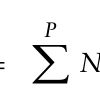
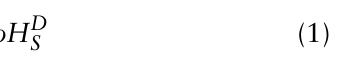
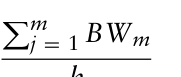
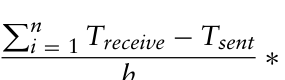
EVALUATION OF QUALITY OF SERVICE In determining the model performance parameters, formulae 1, 2, and 3 are respectively applied. The categorization of paths based on quality allows or facilitates the selection of paths; starting with paths containing less NoH, lag or delay, and high BW. Below are equations for determining the best paths:
Equation reproduced from the original PDF.
NoHD
Equation reproduced from the original PDF.
Pm
Equation reproduced from the original PDF.
Pn
Equation reproduced from the original PDF.
where S is the source node, D is the destination node, P is the number of paths, i,n, j, m are the iteration counts, T is the time and h is the number of nodes. Selection is based on optimal QoS level: Utilizing FPA-MAS, several
Evaluating MANET Technology in Optimizing IoT-based Multiple WBSN Model 83
Algorithm: The basic FPA-MAS Begin While (t < Maximum number of iterations) Select the Source and Destination; Source Initialize the path Discovery; Generate initial solutions (paths); α1 evaluate the quality of paths through NoH, BW, Delay; α2 Sorting the paths based on QoS, Equ (1, 2, 3); α3 Select the optimum paths based on criteria, f(x) = Bandwidth No.ofhops∗Delay; FPA operator for all paths; Generate new paths and compare with old ones; Update the solutions; α3assess the quality of the new paths;
if (new > old) Select best paths else Operate the mutation; Update the solutions (paths); Rank the paths and determine the best path; Accept the new solutions; End
optimized paths can be obtained and the most efficient path is chosen depen- ding on the optimal QoS level. Selection of the nodes’ threshold optimal QoS level is done and the resulting paths made up of nodes with the higher QoS level in comparison with the threshold level are chosen for communication. Packets size consideration in paths selection is allowed where large packets take routes of higher power levels and small packets go through nodes with lower energy levels. Hence, optimized energy-efficient routing is achieved through this method.
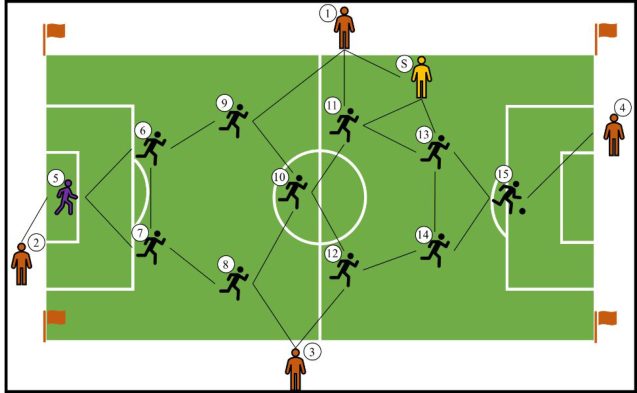
EXAMPLE SCENARIO Suppose a MANET network has 16 hubs/nodes linked with one another with dissimilar metrics (QoS). A small number of routes may be available from the source hub, S to the destination hub, D. The FPA-MAS path selecting procedure relies on the three metrics’ values (bandwidth, delay, and a number of hops). Figure 1 is an example of the model’s application in soccer players health study.
At the initial step, the source node “S” (Yellow) floods an RREQ message to collect the information about the available paths that lead to communi- cation with all players in the field. In the routing protocol of FLP-MAS as shown in Figure 2 below, the path having the highest transfer speed (or ban- dwidth), smaller number of bounces or hops, and lags (or delay) is considered preferentially as in Table 1.
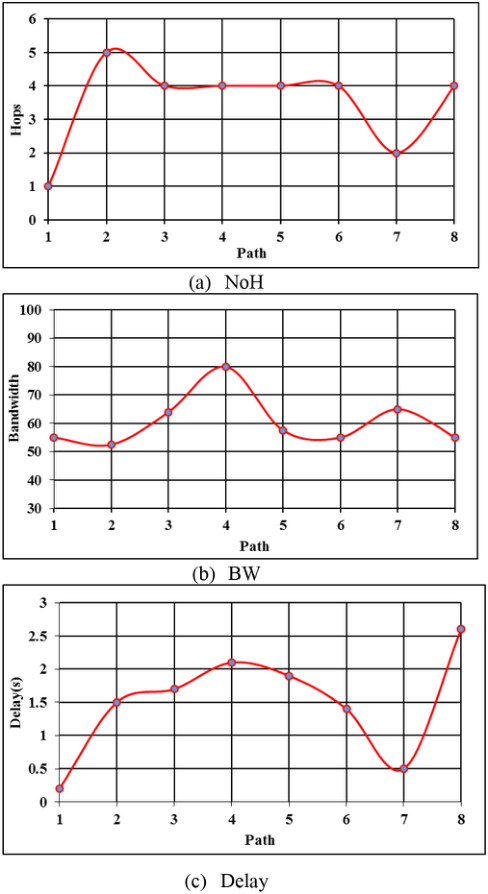
Figure 2 is showing the variation of paths based on the example scenario and through the three different evaluation parameters which are; delay, NoH,
Figure 1: Example scenario.Table 1. Routes details.
and BW. From these simulation results, we can see the applicability of the proposed FPA-MAS model in soccer players’ health studies.
CONCLUSION
The Internet of Things (IoT) is a cutting-edge technology that connects physical objects to the digital world via heterogeneous networks and com- munication technologies. The wireless sensor network plays an important role in an IoT system since its components include sensing, data acquisition, heterogeneous connectivity, and data processing. MANETs are networks of mobile nodes that connect via wireless links and are highly self-configuring. Each node in such a network serves as both a router and a host at the same time. The combination of MANETs and the Internet of Things offers up new avenues for service provision in smart environments while also posing netw- orking challenges. The mobility of network nodes is one of the fundamental concerns in MANET–IoT systems: The routing protocol must incorporate topological changes into its algorithm design. IoT applications in this work are regarded as devices worn by soccer players whose monitoring is done
Evaluating MANET Technology in Optimizing IoT-based Multiple WBSN Model 85
Figure 2: Variation of paths parameters.
using wireless sensor nodes. This research is identifying paths or routes of high-level or top-ranking QoS, such as topology. This model is constructed based on the integration between FPA and MAS to find a path with high QoS parameters. The model is applied in routing protocol of MANET’s environment.
ACKNOWLEDGMENT
This research was supported by the Ministry of Higher Education (MoHE) through the Fundamental Research Grant Scheme (FRGS/1/2021/ICT01/ UTHM/02/1) grant vot number K389.
REFERENCES
Alam, T. (2020). Internet of Things: A Secure Cloud-based MANET Mobility Model.
SSRN Electronic Journal, May. https://doi.org/10.2139/ssrn.3638992 Alam, T. (2022). Internet of things : review , architecture and applications. 3(1), 31–38. https://doi.org/10.11591/csit.v3i1.pp31-38 Alam, T., & Benaida, M. (2018). The role of cloud-MANET framework in the Inter-
net of Things (IoT). International Journal of Online Engineering, 14(12), 97–111. https://doi.org/10.3991/ijoe.v14i12.8338 Cui, W., & He, Y. (2018). Biological Flower Pollination Algorithm with Orthogonal Learning Strategy and Catfish Effect Mechanism for Global Optimization Problems. Mathematical Problems in Engineering, 2018. https://doi.org/10.1155/ 2018/6906295 Hassan, M.H., Jubair, M. A., Mostafa, S. A., Kamaludin, H., Mustapha, A., Fudzee,
M. F. M., & Mahdin, H. (2020). A general framework of genetic multi-agent routing protocol for improving the performance of manet environment. IAES International Journal of Artificial Intelligence, 9(2). https://doi.org/10.11591/ij ai.v9.i2. pp. 310–316 Hassan, Marwan Hamid, Mostafa, S. A., Mahdin, H., Mustapha, A., Ramli, A. A., Hassan, M. H., & Jubair, M. A. (2021). Mobile ad- hoc network routing protocols of time-critical events for search and rescue missions. Bulletin of Electrical Engineering and Informatics, 10(1), 192–199. Hassan, Mustafa Hamid, Jubair, M. A., Mostafa, S. A., Kamaludin, H., Mustapha, A., Fudzee, M. F. M., & Mahdin, H. (2020). A general framework of genetic multi-agent routing protocol for impro- ving the performance of manet environment. IAES International Journal of Artificial Intelligence, 9(2), 310–316. https://doi.org/10.11591/ijai.v9.i2. pp. 310–316. Hassan, Mustafa Hamid, Mostafa, S. A., Mustapha, A., Wahab, M. H. A., & Nor, D. M. (2018). A Survey of Multi-Agent System Approach in Risk Assessment. International Symposium on Agents, Multi-Agent Systems and Robotics 2018, ISAMSR 2018, August, 1–6. https://doi.org/10.1109/ISAMSR.2018.8540551 Jubair, M. A., Alabdullah, A. I. M., Mostafa, S. A., Mustapha, A., Hassan, M. H.,
& Gunasekaran, S. S. (2021). Exploring the Roles of Agents and Multi-Agent in Improving Mobile Ad Hoc Networks. In Proceedings - ISAMSR 2021: 4th Inter- national Symposium on Agents, Multi-Agents Systems and Robotics (pp. 91–95). https://doi.org/10.1109/ISAMSR53229.2021.9567772 Jubair, M. A., Hassan, M. H., Mostafa, S. A., Mahdin, H., Mustapha, A., Audah, L.
H., Shaqwi, F. S., & Abbas, A. H. (2020). Competitive analysis of single and multi- path routing protocols in MANET. Indonesian Journal of Electrical Engineering and Computer Science, 19(1), 293–300. https://doi.org/10.11591/ijeecs.v19.i1. pp. 293–300 Jubair, M. A., Mostafa, S. A., Muniyandi, R. C., Mahdin, H., Mustapha, A., Hassan, M. H., Mahmoud, M. A., Al-Jawhar, Y. A., Al-Khaleefa, A. S., & Mahmood, A. J. (2019). Bat optimized link state routing protocol for energy-aware mobile ad-hoc networks. Symmetry, 11(11). https://doi.org/10.3390/sym11111409 Jubair, M. A., Mostafa, S. A., Mustapha, A., & Hafit, H. (2018). A Survey of Multi-
Agent Systems and Case-Based Reasoning Integration. International Symposium on Agents, Multi-Agent Systems and Robotics 2018, ISAMSR 2018, August. http s://doi.org/10.1109/ISAMSR.2018.8540549
Evaluating MANET Technology in Optimizing IoT-based Multiple WBSN Model 87
Mostafa, S.A., Mustapha, A., Ramli, A. A., Jubair, M. A., Hassan, M. H., & Abbas, A. H. (2021). Comparative Analysis to the Performance of Three Mobile Ad- Hoc Network Routing Protocols in Time-Critical Events of Search and Rescue Missions. In Advances in Intelligent Systems and Computing: Vol. 1206 AISC. https://doi.org/10.1007/978-3-030-51064-0_16 Mostafa, S.A., Tang, A. Y. C., Hassan, M. H., Jubair, M. A., & Khaleefah, S.
H. (2018). A Multi-Agent Ad Hoc On-Demand Distance Vector for Improving the Quality of Service in MANETs. International Symposium on Agents, Multi- Agent Systems and Robotics 2018, ISAMSR 2018. https://doi.org/10.1109/ISAM SR.2018.8540554 Mostafa, Salama A, Ahmad, M. S., Mustapha, A., & Mohammed, M. A.
(2017). A Concise Overview of Software Agent Research, Modeling, and Development. Software Engineering, 5(1), 8–25. https://doi.org/10.11648/J.SE .20170501.12
LISTED IN THE AHFE DIGITAL BOOKSTORE CATALOGUE
Explore the complete digital volume
Human Factors in Software and Systems Engineering
Read this individual research paper free through the original publisher, or explore the full digital proceedings book.
ISBN 978-1-958651-37-7
Explore this ISBN in the AHFE Bookstore ↗Listed in the July 2026 bookstore catalogue; search by ISBN to confirm current availability · Digital book purchase optional