Tauqeer Ali Khan, Omar Huerta, Dipo Olaosun, Jonathan Biner, Ertu Unver, Peter Culmer (2026). A Modular Edge-to-Cloud Architecture for Remote Monitoring and Condition-Based Maintenance in Scalp Cooling Cyber-Physical Systems. In: Human Interaction and Emerging Technologies (IHIET 2026). AHFE Open Access, vol. 236, pp. 191–200. https://doi.org/10.54941/ahfe1008095
Scalp cooling (SC) systems operate as refrigeration-based therapeutic cyber-physical systems in which deterministic embedded control, closed-loop thermal regulation, and multi-sensor acquisition must satisfy strict real-time performance, reliability, and medical software compliance requirements. Existing embedded architectures for such systems primarily function as isolated controllers that provide local temperature regulation but lack system-level telemetry, condition-based health monitoring, and traceable compliance verification across treatment cycles. This work introduces a modular edge-to-cloud architecture for connected medical refrigeration cyber-physical systems that preserve deterministic embedded control while enabling device observability and fleet-level analytics. The proposed framework integrates heterogeneous sensor acquisition with differentiated sampling cadences, including 3-second synchronous monitoring of coolant tank temperature and flow rate, event-driven treatment stage capture, and low-frequency coolant pH monitoring. Fault-tolerant local persistence is achieved through an embedded SQLite datastore with periodic batch synchronization to AWS cloud infrastructure. In addition, the system enables automated compliance verification against Instructions for Use (IFU) treatment-stage constraints and supports condition-based maintenance analytics derived from thermal performance, coolant quality, and device utilization metrics. The architecture was evaluated across fifteen controlled deployments at two sites under ambient conditions ranging from 14.7-26.0°C. All deployments successfully achieved the operational temperature of −4°C, demonstrating reliable and deterministic thermal control under heterogeneous environmental conditions. The proposed framework provides a scalable retrofit pathway that enables legacy refrigeration-based medical devices to transition into connected, observable, and compliance-verifiable cyber-physical system fleets suitable for large-scale clinical deployment.
Scalp cooling (SC) reduces chemotherapy-induced alopecia through four distinct controlled mechanisms: vasoconstriction, reduced drug uptake, reduced hair follicle cell division, and reduced metabolic activity. Randomised Received June 11, 2026; Revised July 5, 2026; Accepted July 29, 2026; Available online August 25, 2026
clinical evidence has established that maintaining defined thermal thresholds yields significant hair preservation outcomes (Nangia et al., 2017; Rugo et al., 2017). From a systems perspective, refrigeration-based SC devices constitute cyber-physical systems (CPS) characterised by tight coupling between sensing, actuation, embedded computation, and thermodynamic heat exchange (Lee, 2008; Rajkumar et al., 2010). IoT connectivity has demonstrated substantial clinical value across medical device domains. Philip et al. (2021) demonstrated that IoT-enabled in-home health monitoring systems can deliver continuous vital sign acquisition, remote clinician access, and alerting through edge-cloud architectures. Pradhan et al. (2021) established that sensor-cloud integration improves both operational visibility and patient safety outcomes across embedded healthcare devices. Pace et al. (2019) further demonstrated that edge-based IoT architectures can support latency-sensitive healthcare applications in clinical environments while satisfying connectivity and data governance constraints of regulated deployments.
Despite this broader progress, SC devices continue to operate as isolated refrigeration controllers without system-level telemetry, fleet observability, or automated compliance verification. The architectural modelling and system-level analysis of connected therapeutic refrigeration CPS therefore remain largely absent from the embedded systems literature, representing the primary gap this work addresses.
RESEARCH GAPS AND CONTRIBUTIONS This work addresses three structural gaps. First, refrigeration-based SC devices lack a formalised cyber-physical systems architecture that integrates deterministic embedded control with system-level telemetry and fleet observability. Second, no existing embedded architecture for therapeutic SC systems incorporates an automated compliance verification engine capable of validating treatment sessions against IFU constraints. Third, condition- based maintenance (CBM) frameworks adapted for medical refrigeration devices remain absent from the literature.
The primary contribution of this paper is a monitoring and compliance architecture. The original device retains full responsibility for closed-loop thermal regulation; this architecture observes, records, verifies, and reports. The paper presents: (i) a modular three-tier edge-to-cloud architecture for non-invasive retrofit of existing SC devices; (ii) an embedded IFU compliance verification engine with binary session-level pass/fail reporting and (iii) a condition-based maintenance framework comprising three composite health indicators. The architecture is evaluated across fifteen real-world deployment sessions at two independent clinical sites.
METHODOLOGY
The proposed system implements a three-tier edge-to-cloud architecture designed to retrofit existing scalp cooling devices with scheduled monitoring, IFU compliance verification, and condition-based maintenance capabilities without modifying the underlying closed-loop thermal control system.
A Modular Edge-to-Cloud Architecture for Remote Monitoring 193 The architecture follows an edge-first operational model: all safety-critical data acquisition and compliance logic execute locally on the embedded edge controller, ensuring uninterrupted therapeutic operation independent of network availability. Cloud connectivity is treated as an asynchronous analytics channel rather than a control dependency.
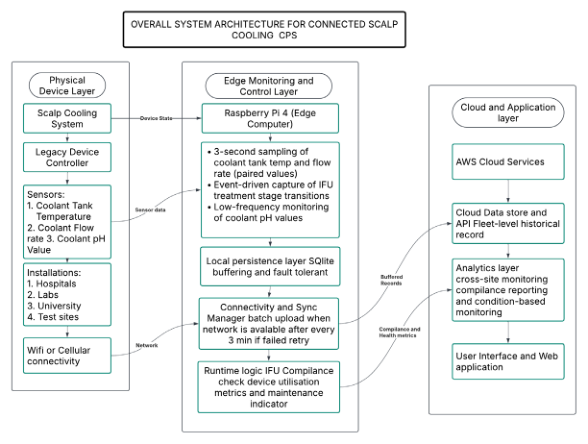
The three tiers are: (1) the Device Tier, handling deterministic sensor acquisition, treatment stage event capture, and local fault-tolerant storage; (2) the Edge-Cloud Synchronisation Tier, managing batch extraction, payload formatting, and secure transmission to cloud infrastructure and (3) the Cloud Analytics Tier, providing relational storage, role-based access control, fleet- level monitoring, and condition-based maintenance dashboards. The overall architecture is illustrated in Figure 1.
Figure 1: SC System architecture, illustrating the three-tier edge-to-cloud design.
Each SC unit is retrofitted with a Raspberry Pi single-board computer acting as the embedded edge controller. The host platform, Paxman Scalp Cooling System, the global market leader in scalp cooling and an established Class II medical device deployed across more than 60 countries already holds regulatory clearance, so the Raspberry Pi is integrated non-invasively, it interfaces directly with the existing device, intercepting sensor signals and capturing treatment-stage state transitions without replacing or modifying the original control firmware. This approach preserves the device’s regulatory approval status and minimises hardware redesign complexity. The choice of Raspberry Pi reflects the research and evaluation context of this deployment, production implementations targeting mass deployment would warrant evaluation of medical-grade embedded alternatives such as dedicated microcontroller units (MCUs) with appropriate certification profiles.
Multi-parameter sensor acquisition is implemented across three distinct modalities with differentiated sampling cadences, as summarised in Table 2. Coolant temperature and flow rate are acquired as synchronous paired measurements at a fixed interval of 3 seconds constituting scheduled periodic sampling, not hard real-time control in the CPS sense. Coolant pH is acquired once per week, reflecting the electrochemical dynamics of coolant degradation. Treatment stage events are captured as asynchronous triggers generated by operator interaction with the existing device UI.
Table 1: Sensor sampling parameters.
Table available in the original PDF paper.
Parameter Sensor Type Sample Rate Storage Target Rationale Coolant Temp NTC Thermistor 3 seconds SQLite (edge) Primary therapeutic control variable; pull- down and steady-state monitoring
Coolant Flow Rate
flow sensor 3 seconds SQLite (edge) Detects blockage, pump degradation, and flow efficiency trends Coolant pH Electrochemical pH probe Once per week SQLite + AWS Coolant quality indicator; acceptable range 8.0–9.5
SQLite Edge Database All sensor records and event logs are written synchronously to a local SQLite database hosted on the Raspberry Pi edge controller. SQLite was selected for three properties: zero-configuration operation requiring no separate server process, ACID-compliant transaction semantics guaranteeing write integrity under power interruption, and a sufficiently compact footprint for constrained storage capacity. The local persistence layer serves as both a fault-tolerant buffer guaranteeing data capture continuity during network disruptions, and as the authoritative local audit trail satisfying IEC 62304 traceability requirements independent of cloud availability.
Edge-to-Cloud Synchronisation A background synchronisation service implemented as a cron-scheduled process on the Raspberry Pi executes batch extraction and transmission at a fixed interval of 3 minutes. At each execution, the service queries the local SQLite database for records accumulated since the previous synchronisation timestamp, formats them into structured JSON payloads, and transmits
A Modular Edge-to-Cloud Architecture for Remote Monitoring 195 them to the AWS cloud backend over either LTE-M or Wi-Fi connectivity. The 3-minute interval balances cloud ingestion load against monitoring latency, providing near-real-time fleet visibility while avoiding per-record transmission overhead.
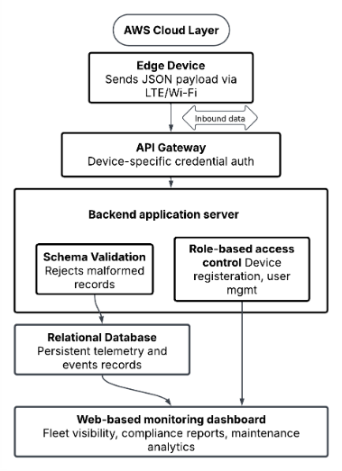
Cloud Layer The cloud layer is implemented on AWS infrastructure, comprising a relational database for persistent record storage, a backend application server managing authentication, device registration, API request validation, and role-based access control, and a web-based monitoring dashboard. Three access roles are defined: administrator access for device fleet management, service engineer access for maintenance analytics and alert management, and R&D access for full historical time-series data and compliance report export. Inbound data is authenticated at the API gateway layer using device-specific credentials and validated against a defined schema before database insertion (see Figure 2).
Figure 2: SC system architecture, illustrating the three-tier edge-to-cloud design.
Compliance Verification and Condition Monitoring The efficacy of scalp cooling in preventing chemotherapy-induced alopecia is contingent upon strict clinician adherence to a three-phase treatment protocol, where each phase serves a distinct physiological purpose and deviation at any stage risks negating the cumulative protective effect. During pre-infusion, the scalp must reach its target temperature to induce vasoconstriction in
the follicular microvasculature, reducing both drug perfusion and cellular metabolic activity before cytotoxic agents enter systemic circulation (Grevelman & Breed, 2005; Dunnill et al., 2018). Continuous cooling throughout the infusion phase then sustains this protection during the period of peak plasma drug concentration (Nangia et al., 2017), while the mandatory post-infusion period maintains follicular protection across the pharmacokinetic clearance window against residual cytotoxic exposure—a duration that is regimen-dependent, ranging from 20 minutes for docetaxel to 60 minutes for weekly paclitaxel and up to 90 minutes for other alopecia- inducing regimens per the device instructions for use (IFU) (Komen et al., 2013). Given the high potential for human error in time-critical clinical environments, strict IFU compliance is essential not only for patient safety but for ensuring therapeutic efficacy remains consistent and reproducible across treatment sessions. To address this, the present study implements an embedded verification module on the Raspberry Pi–based SC device that autonomously evaluates each session against key IFU parameters, including attainment of the minimum 30-minute pre-infusion period (extendable to 45 minutes for thick or type 3–4 hair), correct sequential phase progression, and completion of the regimen-specific post-infusion cooling duration. Stage- annotated sensor data enable automatic reconstruction of the full treatment timeline, providing a continuous, automated safeguard against protocol non- compliance across deployed devices.
In parallel, condition monitoring assesses device health using thermal performance, coolant quality, and utilisation indicators. These metrics analyse cooling performance relative to ambient temperature, monitor long- term pH trends, and track device runtime and treatment counts to support condition-based maintenance and early fault detection. Further validation of maintenance effectiveness and false alarm rates will require larger-scale fleet deployments.
EXPERIMENTAL RESULTS Experimental validation was carried out through 15 controlled deployment sessions conducted across two sites: Paxman Headquarters (Paxman HQ), Huddersfield, and the University of Leeds. Sessions were performed under heterogeneous ambient conditions ranging from 14.7°C to 26.0°C to assess monitoring architecture behaviour and variability in pull-down time under representative real-world operating environments. Each device was instrumented with a Raspberry Pi controller connected to the device sensor interfaces. The cooling device was operated using a small cooling cap connected to a glass head model emulating the thermal load of the human scalp. All measurements were stored locally within the embedded SQLite datastore and synchronised periodically to AWS cloud infrastructure.
4 Paxman HQ 19.8 9 Yes 5 University of Leeds 23.0 17 Yes
6 Paxman HQ 17.0 9 Yes 7 University of Leeds 22.6 16 Yes
8 University of Leeds 18.0 15 Yes 9 University of Leeds 18.0 15 Yes
10 Paxman HQ 26.0 13 Yes 11 University of Leeds 22.0 17 Yes
12 Paxman HQ 16.6 8 Yes 13 University of Leeds 18.2 14 Yes
14 Paxman HQ 16.0 10 Yes 15 University of Leeds 21.0 17 Yes
Cross Site Deployment The higher average ambient temperatures observed at the University of Leeds (20.7°C versus 17.8°C at Paxman HQ) directly explain the longer pull-down times and slower cooling rates recorded there. Both devices achieved the −4°C target in every session, confirming the robustness of the underlying closed-loop thermal control system and the non-interference property of the monitoring architecture.
Table 3: Comparison.
Table available in the original PDF paper.
Metric Paxman HQ University of Leeds Number of Sessions 8 7
Ambient Temp Range 14.7–26.0°C 18.0–23.0°C Average Ambient Temp 17.8°C 20.7°C
Pull-Down Time Range 8–13 min 14–17 min Average Pull-Down Time 9.25 min 15.9 min
Average Cooling Rate 2.17°C/min 1.50°C/min All Sessions Reached −4°C Yes Yes
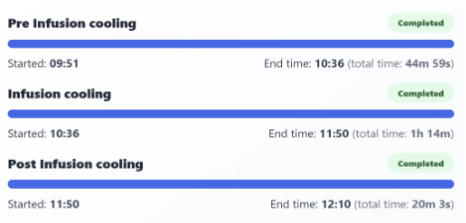
Treatment Stage Observability Treatment stage observability and compliance verification form the key monitoring objective of the proposed architecture, enabling automated assessment of treatment execution in accordance with the IFU protocol. Each treatment session comprises three stages: pre-infusion cooling, infusion cooling, and post-infusion cooling. Across all fully instrumented sessions
conducted at both sites, the recorded stage durations consistently satisfied IFU-defined requirements, with pre-infusion durations of approximately 30 minutes, post-infusion durations of at least 20 minutes, and correct sequential stage progression, resulting in full compliance across all evaluated sessions (see Figure 3).
Figure 3: Treatment stage timeline illustrating pre-infusion, infusion, and post-infusion.
CONCLUSION
This paper presented and validated a modular edge-to-cloud monitoring architecture for connected medical refrigeration cyber-physical systems through fifteen deployment sessions across two independent sites. The proposed framework combines embedded IFU compliance verification with remote monitoring, enabling automated assessment of treatment adherence, device performance, coolant quality, and utilisation trends while maintaining complete separation from the device’s closed-loop thermal control functions. By incorporating ambient-normalised thermal performance analysis, the architecture provides a practical approach for condition-based maintenance that distinguishes environmental influences from potential mechanical degradation, addressing limitations of traditional calendar-based maintenance strategies. All deployment sessions successfully achieved the target operational temperature of −4°C while the monitoring system remained active, confirming non-interference with therapeutic operation. Beyond its technical contributions, the framework supports improved healthcare delivery by relieving clinicians of manual compliance checks, safeguarding the protocol adherence on which therapeutic efficacy depends, and helping ensure device readiness so that patients receive consistent, uninterrupted treatment together creating the conditions for the highest achievable patient outcomes. Overall, the results demonstrate the potential of the proposed framework as a scalable monitoring, compliance, and maintenance solution for future large-scale clinical deployments of connected therapeutic refrigeration devices.
REFERENCES
Beghi, A., Cecchinato, L., Cosi, G. and Rampazzo, M. (2011). Fault detection and diagnosis for HVAC systems. Applied Thermal Engineering, 31(17–18), pp. 3612–3622. Bonomi, F., Milito, R., Zhu, J. and Addepalli, S. (2012). Fog computing and its role
in the Internet of Things. Proceedings of the MCC Workshop on Mobile Cloud Computing, pp. 13–16. Chen, Y., Zheng, Y., Li, W. and Huang, X. (2023). Edge intelligence for IoMT: A survey on resource-constrained inference and on-device learning. IEEE Internet of Things Journal, 10(5), pp. 3878–3897. Dunnill, C. J., Al-Tameemi, W., Collett, A., Haslam, I. S., & Georgopoulos, N. T.
(2018). A clinical and biological guide for understanding chemotherapy-induced alopecia and its prevention. The Oncologist, 23(1), 84–96 Grevelman, E. G., & Breed, W. P. M. (2005). Prevention of chemotherapy-induced hair loss by scalp cooling. Annals of Oncology, 16(3), 352–358. International Electrotechnical Commission (2006). IEC 62304: Medical device
software — Software life cycle processes. Amendment 1, 2015. International Organization for Standardization (2016). ISO 13485: Medical devices — Quality management systems. Islam, M.M., Rahaman, A. and Islam, M.R. (2015). The Internet of Things for health
care: A comprehensive survey. IEEE Access, 3, pp. 678–708. Katipamula, S. and Brambley, M.R. (2005). Methods for fault detection, diagnostics, and prognostics for building systems. HVAC&R Research, 11(1), pp. 3–25. Komen, M. M. C., Smorenburg, C. H., van den Hurk, C. J. G., & Nortier, J. W. R.
(2013). Factors influencing the effectiveness of scalp cooling in the prevention of chemotherapy-induced alopecia. The Oncologist, 18(8), 885–891. Lee, E.A. (2008). Cyber physical systems: Design challenges. Proceedings of IEEE ISORC, pp. 363–369. Lee, J., Davari, H., Singh, J. and Pandhare, V. (2018). Industrial artificial intelligence
for Industry 4.0-based manufacturing systems. Manufacturing Letters, 18, pp. 20–23. Medical Device Coordination Group (2019). MDCG 2019-16: Guidance on cybersecurity for medical devices. European Commission. Mobley, R.K. (2002). An Introduction to Predictive Maintenance. 2nd ed. Oxford:
Butterworth-Heinemann. Nangia, D., Baranwal, N., Bhatt, P. and Singhal, S. (2017). Effect of a scalp cooling device on alopecia in women undergoing chemotherapy for breast cancer: The SCALP randomised clinical trial. JAMA, 317(6), pp. 596–605. Pace, P., Aloi, G., Gravina, R., Caliciuri, G., Fortino, G. and Liotta, A. (2019). An
edge-based architecture to support efficient applications for healthcare industry 4.0. IEEE Transactions on Industrial Informatics, 15(1), pp. 481–489. Pang, G., Shen, C., Cao, L. and Hengel, A.V.D. (2021). Deep learning for anomaly detection: A review. ACM Computing Surveys, 54(2), pp. 1–38. Philip, N.Y., Rodrigues, J.J.P.C., Wang, H., Fong, S.J. and Chen, J. (2021). Internet
of Things for in-home health monitoring systems: Current advances, challenges and future directions. IEEE Journal on Selected Areas in Communications, 39(2), pp. 300–310. Pradhan, B., Bhattacharyya, S. and Pal, K. (2021). IoT-based applications in healthcare devices. Journal of Healthcare Engineering, 2021, Art. no. 6632599. Rahmani, A.M., Gia, T.N., Negash, B., Anzanpour, A., Azimi, I., Jiang, M. and
Liljeberg, P. (2018). Internet of Things for healthcare: Applications, challenges, and solutions. IEEE Reviews in Biomedical Engineering, 11, pp. 68–83.
Rajkumar, R., Lee, I., Sha, L. and Stankovic, J. (2010). Cyber-physical systems: The next computing revolution. Proceedings of ACM/IEEE DAC, pp. 731–736. Rugo, H.S., Klein, P., Melin, S.A., Hurvitz, S.A., Melisko, M.E., Moore, A., Park, G.,
Mitchel, J. and Somlo, G. (2017). Association between use of a scalp cooling device and alopecia after chemotherapy for breast cancer. JAMA, 317(6), pp. 606–614. Shi, W., Cao, J., Zhang, Q., Li, Y. and Xu, L. (2016). Edge computing: Vision and challenges. IEEE Internet of Things Journal, 3(5), pp. 637–646. U.S. Food and Drug Administration (2023). Cybersecurity in medical devices: Quality
system considerations and content of premarket submissions. FDA Guidance. Wang, S. and Xiao, F. (2004). AHU sensor fault diagnosis using principal component analysis. Energy and Buildings, 36(2), pp. 147–160. Yin, S., Ding, S.X., Xie, X. and Luo, H. (2015). Data-based techniques focused
on modern industry: An overview. IEEE Transactions on Industrial Electronics, 62(1), pp. 657–667.
SEARCH THE AHFE DIGITAL BOOKSTORE BY ISBN
Explore the complete digital volume
Human Interaction and Emerging Technologies (IHIET 2026)
Read this individual research paper free through the original publisher, or explore the full digital proceedings book.