Sai Raghava Pathuri, Bhushan Lohar, Sudhanshu Tarale, Ninad Pandit (2026). A Digital Twin Framework for Uncrewed Systems (UxS): Uncrewed Ground Vehicle (UGV) Use Case. In: Industrial and Systems Engineering. AHFE Open Access, vol. 219, pp. 165–174. https://doi.org/10.54941/ahfe1007787
The rapid convergence of Artificial Intelligence, the Internet of Things, and high-capacity Cloud Computing has accelerated the implementation of the Digital Twin (DT) paradigm. However, the practical realization of high-fidelity, interoperable DTs within a Cyber-Physical System (CPS) context remains hindered by architectural deficiencies and the complexity of integrating formal predictive models with the dynamic state of physical assets. This paper addresses these constraints by advancing the previously proposed Digital Twin Enabled Artificial Intelligence Uncrewed System (DEAUS) framework transitioning from theoretical abstraction to utility through a Model-Based Systems Engineering (MBSE) application featuring the Boston Dynamics SPOT as a Uncrewed Ground Vehicle (UGV). By developing a formal system architecture using System Modeling Language (SysML), this work serves as the axiomatic foundation for the Virtual Twin. This high-fidelity digital representation moves beyond traditional “Digital Shadows” by enabling bi-directional, synchronous emulation. A critical advancement in this work is the modeling of low-level system Technical Performance Measures and constraint blocks. This level of precision allows DT to accurately predict stability failure, model actuator wear, and optimize performance in hazardous environments. This foundational framework facilitates the conceptual modularization of complex systems into tractable units while enforcing the Single Source of Truth principle. Furthermore, the architecture embeds digital traceability and data lineage, essential for rigorous Verification and Validation, and for maintaining a forensically sound Chain-of-Custody. Providing an unambiguous blueprint, this domain-agnostic CPS DT solution is designed for replication across diverse UxS platforms, significantly enhancing operational guidance and system resiliency in time-critical mission scenarios such as Disaster Response.
The demand for Uncrewed Systems (UxS) has surged as modern industries and emergency services face increasingly complex and hazardous environments. Traditional disaster response paradigms often rely on human-centric intelligence, which is susceptible to cognitive biases and heuristic errors that
result in sub-optimal outcomes during high-stress scenarios (Pathuri et al., 2025). These limitations necessitate a shift towards autonomous systems capable of objective data processing and rapid tactical adjustments without the physiological constraints of human responders. To mitigate these risks and enhance operational efficiency, there is a critical need for autonomous systems that can perform safe exploration and data collection in locations inaccessible to humans (Wong et al., 2018). The evolution of robotics from simple pre-programmed machines to self-thinking, autonomous agents like the Boston Dynamics SPOT robot represents a significant leap in technology, merging mechanical agility with sophisticated onboard edge computing (Azeta et al., 2025).
This research introduces a novel framework that integrates Digital Twin (DT) technology with Model-Based Systems Engineering (MBSE) and Artificial Intelligence (AI) to form a robust Cyber-Physical System (CPS) architecture (Pathuri et al., 2025). By bridging the gap between abstract systems theory and physical hardware, the proposed framework ensures that every digital instruction is grounded in the physical realities of the asset. Creating a high-fidelity virtual replica of a physical asset, such as SPOT, enables organizations to simulate, predict, and optimize operations in a risk- free environment before execution (Pathuri et al., 2025). This paper explores the architectural components, Technical Performance Requirements (TPMs), and real-world application of this DT framework in the context of disaster response and industrial exploration.
System of Interest: Boston Dynamics SPOT Robot The proposed DT framework demonstrates Boston Dynamics SPOT robot as the primary System of Interest (SoI), a quadruped, Uncrewed Ground Vehicle (UGV) platform known for its agility, durability, and scalability (Boston Dynamics, n.d.-a). As a “Winner System” in the robotics market, SPOT provides a standardized hardware baseline that allows researchers to focus on high-level software and architectural integration. SPOT is designed to navigate complex terrains while maintaining stability using an array of sensors and advanced perception software. Its four-legged design allows it to traverse obstacles and uneven ground that would be impassable for traditional wheeled or tracked robots. The system’s gait is dynamically adjusted via internal feedback loops, ensuring upright posture even when subjected to external disturbances or slippery surfaces. The robot’s architecture is highly modular, allowing for the integration of various payloads and sensors via a Python API, making it a versatile tool for diverse industrial and research applications. Beyond its physical mobility, SPOT features an autonomous charging system and the ability to replan paths around obstacles in real-time. These capabilities make it an ideal candidate for long-duration missions in remote or dangerous areas. The system’s purpose is to alleviate the burden on human operators by providing a reliable, self-orienting platform for data acquisition and environmental monitoring. By clustering these functions into a harmonious system, the SoI becomes a critical node in any broader digital engineering ecosystem.
A Digital Twin Framework for Uncrewed Systems (UxS) 167 Mission and Enterprise Analysis
The implementation of UxS like SPOT is driven by the mission to enhance safety and efficiency in high-risk sectors. The primary mission is to provide high-resolution situational awareness in environments that are “Dull, Dirty, or Dangerous” for human personnel. Enterprise analysis reveals that industries such as mining, manufacturing, and disaster management face significant costs and health risks when deploying human teams to hazardous sites (International Labour Organization, 2023). In these cases, the organizational goals are to reduce operational downtime and minimize the legal liabilities associated with workplace injuries. As a result, one of the goals of the proposed DT framework is to provide a cost-effective and energy-efficient solution that can operate autonomously with minimal human intervention.
The enterprise must also consider the digital lifecycle of the system. This lifecycle management begins at the Evolution (Cradle) phase and extends through Extinction (Grave), ensuring that all modifications are reflected in the system’s digital pedigree. This involves not just the physical deployment of the robot, but the management of the data it generates and the maintenance of its DT. By adopting the Digital Twin Enabled Artificial Intelligence Uncrewed System (DEAUS) framework, enterprises can establish a Single Source of Truth (SSOT) for all operational data, ensuring consistency and transparency across the organization (Pathuri et al., 2025). This transparency is vital for aligning the technical outputs of the robot with the strategic goals of the enterprise management.
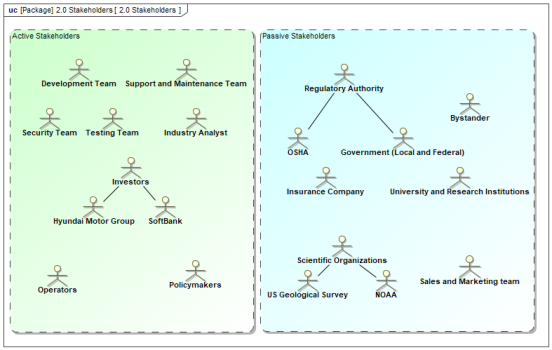
Stakeholder Analysis and System Boundary A comprehensive understanding of the system requires identifying the key stakeholders and defining the boundaries of operation. Stakeholders are categorized based on their level of influence and impact on the system, ranging from direct operators to indirect financial backers. Active stakeholders include the engineering teams responsible for development and maintenance, the operators who deploy the robot, and the end-users who consume the collected data (Tarale, 2024). These individuals are involved in the daily “feedback loop” that refines system performance. Passive stakeholders may include regulatory bodies like Federal Emergency Management Agency (FEMA), insurance companies, and even potential “hackers” or unauthorized entities that represent security risks (Tarale, 2024). Recognizing these passive actors is crucial for developing robust security protocols and ensuring legal compliance. To visualize these roles, Figure 1 below categorizes stakeholders based on their relationship with the system.
The system boundary encompasses the physical robot, its onboard sensors, communication networks (WiFi, Cloud), and user interface. Defining this boundary clearly prevents scope creep and ensures that the Virtual Twin (VT) does not attempt to model variables that are outside the system’s control. External factors such as environmental conditions (temperature, moisture, radiation) interact with the system through its sensor interfaces, providing
critical data for the decision-making process (Tarale, 2024). The interface between the robot and these external factors is managed through strict TPMs to maintain operational integrity. Understanding these boundaries is essential for ensuring that the DT accurately reflects the real-world interactions of the physical asset.
Figure 1: Stakeholder diagram. (Tarale, 2024).
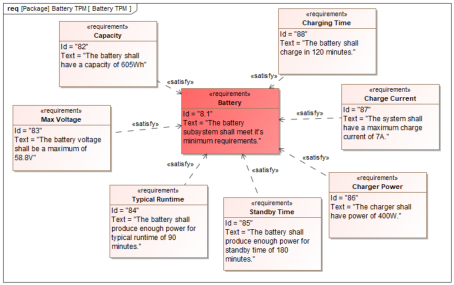
System Requirements and Technical Performance Measures To ensure the system meets its operational goals, specific technical requirements and performance measures must be established. Requirements are derived from stakeholder desirements and translated into rigorous engineering specifications. These requirements are categorized into several key areas, including mobility, navigation, power, and data protection (Tarale, 2024). TPMs provide a quantitative way to track the system’s ability to meet these requirements during development and operation. These metrics serve as “early warning” indicators if the system begins to deviate from its design parameters. For instance, the battery TPM in Figure 2 below shows that the system must have a typical runtime of 90 minutes and a standby time of 180 minutes (Boston dynamics, n.d.-b). It includes technical battery parameters of capacity, charging time, charge current, charge power, standby time, typical runtime, and max voltage. Monitoring these levels in real-time allows the DT to predict when the robot must cease a mission and return to its docking station. The power system is a Key Performance Parameter (KPP), as it provides the necessary energy for all operations regardless of the environment (Tarale, 2024). Additionally, data protection is a critical requirement; the system must utilize Transport Layer Security (TLS) 1.2/1.3 protocols and Wi-Fi Protected Access Pre-Shared Key (WPA-PSK) security to prevent unauthorized access and maintain data integrity (Tarale, 2024). Cybersecurity requirements are integrated directly into the architecture to ensure that the “cyber” element of the CPS remains resilient against intrusion. Payload compatibility is also a measured TPM, with the system designed to support up to 14 kg of external equipment.
Figure 2: Battery TPMs. (Tarale, 2024).
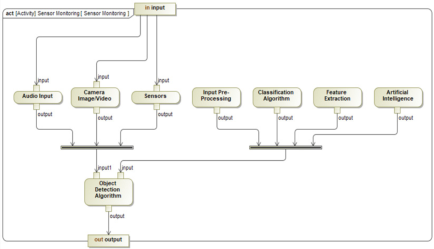
Conceptual Architecture and Use Cases The conceptual architecture of UGV DT framework is built around several core use cases that define its functionality. Use cases serve as the narrative foundation that describes how the system provides value to the user(s). At the top level, the system must be able to start, navigate, and select operational modes based on the mission (Tarale, 2024). Navigation use cases involve complex tasks such as recording “autowalks” and scanning the environment to create 3D maps (Morenville et al., 2022). The ability to switch between manual teleoperation and autonomous mission execution is a central feature of this conceptual architecture. Operational scenarios are further detailed through activity diagrams that map out the sequence of events during a mission. These diagrams illustrate the decision-making logic when the system encounters environmental “branch points”. For example, the sensor monitoring activity involves capturing audio, visual (image and video), and various multi-modal input data from sensor feeds to pre-process using classification and feature extraction algorithms, pre-processing techniques to remove noise, and state- of-the art AI models to classify obstacles as shown in Figure 3 (Tarale, 2024). This multi-stage processing ensures that the VT receives clean, actionable intelligence. These detailed use cases and scenarios ensure that the logical architecture of the DT can support all required physical behaviours.
Model-Based Systems Engineering (MBSE) and SysML Foundation The transition from a physical robot to a high-fidelity DT is achieved through MBSE, which moves the “source of truth” from static documents to a dynamic, interconnected model database. MBSE uses formal modeling languages like System Modeling Language (SysML) to create a structured representation of the system’s requirements, behaviour, and architecture (Pathuri et al., 2025). This model-centric approach replaces traditional document-based methods, allowing for better traceability and consistency throughout the system lifecycle (Kossiakoff et al., 2011). Every change in a requirement is automatically propagated through the functional and physical blocks of the model.
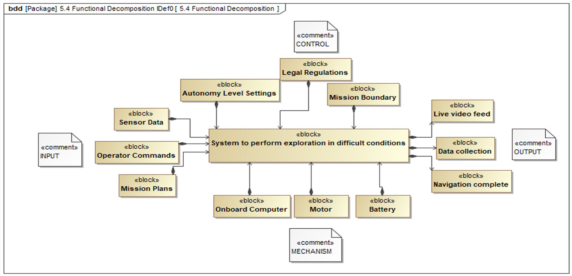
In this framework, SysML is used to define the axiomatic foundation of the VT. This foundation acts as the “DNA” of the digital representation, dictating how the virtual asset should respond to stimuli. This includes creating Block Definition Diagrams (BDD) for the physical architecture and Internal Block Diagrams (IBD) for the data flow between subsystems (Tarale, 2024). Figure 4 illustrates the high-level inputs, outputs, constraints that guide the system, and mechanisms that perform the functions through an IDEF0 BDD.
Figure 4: Boston SPOT functional decomposition IDEF0 BDD. (Tarale, 2024).
Digital Twin Architecture: Virtual and Physical Realization The DT framework consists of a physical system (UGV SPOT) and its virtual counterpart. The VT is not merely a 3D visualization; it is a computational engine that mirrors the state and behaviour of the physical asset. Unlike a static “digital shadow” that only receives data, a true digital twin enables bi-directional, synchronous emulation. This means the VT can send control commands back to the physical system based on the outcomes of its simulations. This close-loop interaction allows the system to self-correct during a mission. The VT integrates multi-modal data from the robot’s sensors and external inter-agency feeds to maintain real-time situational awareness (Pathuri et al., 2025). By fusing internal robot data with external weather or topography feeds, the DT creates a comprehensive operational picture. This federated
A Digital Twin Framework for Uncrewed Systems (UxS) 171 architecture ensures that the digital model remains synchronized with the physical asset’s state, even in dynamic and unpredictable environments. This synchronization is vital for identifying potential failures such as a battery drop or a mechanical stall before they occur in the real world.
Model-Based Artificial Intelligence Cognitive Core The “brain” of the DT framework is the Model-Based Artificial Intelligence (MBAI) engine. MBAI differs from traditional “black box” AI using the system’s own MBSE models as a logical framework. The MBAI engine synergizes MBSE artifacts with advanced AI algorithms to derive optimal control policies (Pathuri et al., 2025). It leverages Model-Based Pattern Libraries (MBPLs) to recognize known operational patterns and constraint- based models to ensure that decisions remain within the system’s physical limits (PivotPoint Technology, 2025). This provides AI with necessary guardrails to prevent the system from performing manoeuvres that would violate its safety constraints. Operationally, the MBAI-driven DT autonomously evaluates state-space evolutions to generate a Minimum Viable Plan (MVP). The MVP represents the safest and most efficient path to mission completion given the current environmental hazards. For instance, if SPOT encounters an unknown obstacle, the MBAI engine can use predictive Modeling and Simulation (ModSim) to explore various paths in the virtual environment before instructing the system to move (Pathuri et al., 2025). This cognitive core allows the system to perform real-time risk analysis and performance optimization, significantly enhancing the autonomy of the uncrewed platform (Pathuri et al., 2025). This predictive capability transforms UGVs from reactive machines into proactive agents.
Operational Resilience and Disaster Response Applications The primary application for this domain-agnostic framework is disaster response. In these high-stakes environments, the ability of DEAUS to predict cascading failures can save both equipment and lives. In the aftermath of a catastrophe, UxS like SPOT can be deployed to establish situational awareness and identify critical infrastructure interdependencies (Pathuri et al., 2025). The DEAUS framework allows for the dynamic allocation of assets, ensuring that multiple robots can work together as a heterogeneous fleet to cover large areas efficiently. This fleet management capability is enhanced by the DT’s ability to track the health of every unit simultaneously. During such missions, the DT provides a risk-free virtual environment to test search-and-rescue strategies. Operators can fast-forward simulations to see how a specific strategy might play out over a particular period of time. By interfacing with Emergency Support Functions (ESF), DEAUS can help pre-empt cascading failures in power or communication grids (Pathuri et al., 2025). The high-fidelity data gathered by the DT during these operations is not only useful for immediate guidance but also serves as a permanent record for post-incident analysis. This data could serve as a critical asset for building “Lessons Learned” for future deployments.
Digital Traceability and Chain-of-Custody A key requirement for systems involved in emergency response is digital traceability. Which ensures that every decision made by AI can be traced back to the specific sensor reading and model logic that triggered it. The DEAUS framework embeds data lineage and forensic documentation into its architecture, ensuring a sound Chain-of-Custody for all collected information (Pathuri et al., 2025). This is achieved by adhering to the SSOT principle, where every data point is documented from its point of origin through its processing history. This prevents the corruption or accidental loss of vital mission data. This auditable provenance is essential for post-hoc forensic analysis and model refinement. If a mission fails, the “digital black box” housed within DEAUS allows engineers to reconstruct the event exactly as it happened. Furthermore, it provides a quantitative basis for legal and financial adjudication, such as FEMA damage assessments and insurance claims (Pathuri et al., 2025). By maintaining rigorous digital records, the framework ensures that the decisions made by the autonomous system are transparent and can be defended in professional or legal settings. This level of accountability is a prerequisite for the widespread adoption of autonomous systems in public sectors.
System Integration, Verification, and Validation (V&V) Robustness in the DT framework is ensured through the Systems Engineering (SE) Vee model, which guides the integration, Verification, and Validation (V&V) processes (Kossiakoff et al., 2011). The left side of the Vee focuses on decomposition and design, while the right side focuses on building and testing the system. Verification confirms that the system was built correctly according to the SysML models and technical requirements, while validation ensures that the system actually meets the needs of the stakeholders in real-world scenarios. This distinction ensures that we are not just building the system right, but building the right system. Initial field deployments of the SPOT robot will be used to calibrate the VT, ensuring that its simulations match real-world physical behaviours. Testing includes verifying the MBAI decision fidelity against various operational scenarios and ensuring that the physical system adheres to the constraint models defined in the TPMs. This rigorous V&V process is essential for building trust in autonomous systems before they are used in mission-critical applications. Regular V&V cycles ensure that the DT remains accurate even as the physical hardware ages or undergoes repairs.
Future Work and Digital Engineering Trends The future of this framework lies in deeper AI/Machine Learning integration and the expansion of the System of Systems (SoS) architecture. Future research will explore unsupervised learning, where the DT can discover new operational patterns without human labelling. Future development will focus on refining the decision system models to enhance predictive capabilities, such as anticipating mechanical failures before they lead to mission degradation. There is also a push toward making these systems more repairable and understandable for
A Digital Twin Framework for Uncrewed Systems (UxS) 173 non-engineer users, which would require extensive documentation and user- friendly digital interfaces (Tarale, 2024). Empowering users to perform field repairs would significantly increase the operational uptime of UGV fleets. In terms of digital engineering, the framework will eventually model the UGV’s precise interaction with external systems like Uncrewed Traffic Management (UTM) and autonomous charging stations. This integration will allow for large- scale coordination between ground robots and aerial drones. This will facilitate “swarm intelligence” where multiple DTs coordinate their actions to achieve large-scale objectives. The ongoing evolution toward fully integrated DT will continue to transform how we manage UxS across all industries. The ultimate goal is a seamless “Digital Thread” that connects design, manufacturing, operation, and retirement.
CONCLUSION
This research has presented a comprehensive framework for realizing high- fidelity DTs for UxS, with a specific focus on the Boston Dynamics SPOT UGV. By providing a structured approach to DT implementation, this work lowers the barrier to entry for organizations seeking to adopt autonomous robotics. Leveraging MBSE, SysML, and MBAI cognitive core, the framework addresses the architectural deficiencies that have previously hindered the implementation of interoperable DTs in cyber-physical contexts. The resulting system provides bi-directional, synchronous emulation that significantly enhances situational awareness and operational resilience.
The integration of low-level physics modeling and TPMs ensures that the DT is an accurate reflection of the physical asset, capable of predicting failures and optimizing performance in hazardous environments. The ability to simulate what-if scenarios in real-time gives operators a decisive advantage in time-critical missions. Furthermore, the framework’s commitment to digital traceability and the SSOT principle provides the auditable provenance required for complex disaster response and industrial applications. This study serves as a blueprint for the deployment of resilient, autonomous UxS platforms across various domains. As the technology matures, these frameworks will become the standard for managing the complex interaction between humans, machines and digital intelligence.
REFERENCES
Azeta, J., Omeche, T.T., Daniyan, I., Abiola, J.O., Daniyan, L., Phuluwa, H.S. and Muvunzi, R., 2025. “Artificial intelligence and robotics in predictive maintenance: A comprehensive review. Frontiers in Mechanical Engineering”, 11, p. 1722114. Boston Dynamics (n.d.-a). Spot® – The agile mobile robot. Available at: https://
bostondynamics.com/products/spot/ (Accessed: 18 February 2026). Boston Dynamics (n.d.-b). Spot battery and charging system. Available at: https:// support.bostondynamics.com/s/article/Spot-Battery-and-Charging-System-72069 (Accessed: 18 February 2026) Drabek, T.L. and McEntire, D.A. (2002) “Emergent phenomena and multiorganizational coordination in disasters: Lessons from the research literature”, International Journal of Mass Emergencies and Disasters, 20(2), pp. 197–224.
International Council on Systems Engineering (INCOSE). (2022). Systems Engineering Vision 2035. website: https://www.incose.org/publications/se-vision-2035 International Labour Organization (2023).Nearly 3 million people die of work-
related accidents and diseases. Available at: https://www.ilo.org/resource/news/ nearly-3-million-people-die-work-related-accidents-and-diseases (Accessed: 18 February 2026) Kossiakoff, A., Sweet, W.N., Seymour, S.J., Biemer, S.M. (2011). “Systems engineering principles and practice”. Vol. 83. Hoboken, NJ: John Wiley & Sons. Morenville, A., Vermeulen, L., Schaus, P., Nijssen, S. (2022). “Simultaneous
localization and mapping and autonomous navigation on SPOT robot from Boston Dynamics”. Pathuri, S.R., Lohar, B., Pandit, N., Tarale, S. (2025). “Enhancing disaster responses using uncrewed systems (UxS) as a digital twin (DT)”. Applied Human Factors and Ergonomics (AHFE2025), 199, pp. 2232–2243. Available at: https://doi. org/10.54941/ahfe1007035 PivotPoint Technology (2025). PivotPoint FAQ: What is model-based AI? Available
at: https://ptcorp.com/faq/what-is-model-based-ai.html. Tarale, S. (2024). Architecture: Boston Dynamics SPOT Robot. Course Report, SE-606 Systems Architecture. Department of systems Engineering, University of South Alabama, Mobile, AL. Tarale, S., Chaudhary, P. (2024). System of interest: Boston Dynamics SPOT robot.
Course Report, SE-601 Fundamentals of systems Engineering. Department of systems Engineering, University of South Alabama, Mobile, AL. Thelen, A., Zhang, X., Fink, O., Lu, Y., Ghosh, S., Youn, B. D., Todd, M. D., Mahadevan, S., Hu, C., & Hu, Z. (2022). “A comprehensive review of digital twin – Part 1: Modeling and twinning enabling technologies”. Journal of Manufacturing Systems, 65, 554–573. Wong, C., Yang, E., Yan, X.T. and Gu, D., 2018. “Autonomous robots for harsh
environments: A holistic overview of current solutions and ongoing challenges. Systems Science & Control Engineering”, 6(1), pp.213–219. Zimmermann, S., Poranne, R., Coros, S. (2021).” Go fetch! – Dynamic grasps using Boston Dynamics SPOT with external robotic arm. In: 2021 IEEE International Conference on Robotics and Automation (ICRA)”, pp. 4488–4494. Available at: https://doi.org/10.1109/ICRA48506.2021.9561835
LISTED IN THE AHFE DIGITAL BOOKSTORE CATALOGUE
Explore the complete digital volume
Industrial and Systems Engineering
Read this individual research paper free through the original publisher, or explore the full digital proceedings book.
ISBN 978-1-964867-95-3
Explore this ISBN in the AHFE Bookstore ↗Listed in the July 2026 bookstore catalogue; search by ISBN to confirm current availability · Digital book purchase optional