Elena Andrushchenko, Dogan Efe, Muhammad Muneeb Riaz, Roland Jochem (2026). Designing Human-Centric Interfaces for the Digital Product Passport in Small and Medium Enterprises. In: Industrial and Systems Engineering. AHFE Open Access, vol. 219, pp. 116–127. https://doi.org/10.54941/ahfe1007782
The mandatory implementation of the Digital Product Passport (DPP) under the EU Battery Regulation (EU 2023/1542) requires Economic Operators to exchange comprehensive lifecycle data in order to support transparency and circularity across complex value chains. Although current standardization efforts provide detailed specifications for semantic and technical interoperability and define machine-readable formats for data exchange, the design of the human-facing interaction layer remains insufficiently addressed. As a result, users with different levels of technical familiarity and varying operational objectives must work with highly technical information, although a single interface concept may not equally support the needs of all stakeholder groups.This paper proposes a human-centered design framework for DPP interfaces that translates abstract API outputs into user-specific and actionable information. The approach examines the information needs and cognitive constraints of different user roles within the DPP ecosystem, with particular consideration of small and medium-sized enterprises (SMEs), where personnel often lack specialized software engineering expertise but are still required to make operationally relevant decisions based on technically structured product and lifecycle data. The paper outlines how role-based adaptation, progressive disclosure, and targeted visualization strategies can help reduce information density, lower cognitive load, and decrease the risk of misinterpretation. In addition, a prototype implemented as a browser-based application is presented, and its design decisions are discussed in relation to established principles from Human-Computer Interaction and Cognitive Load Theory.
The transition towards a circular economy has increased the need for digital infrastructures that enable transparent and interoperable product lifecycle management. Within the European Union, the Digital Product Passport (DPP) has emerged as a central instrument for improving the availability and exchange of sustainability-related product information. In the battery sector, EU Regulation 2023/1542 introduces a Digital Battery Passport (DBP) for electric vehicle (EV), light means of transport (LMT), and industrial batteries exceeding 2 kWh from 18 February 2027 onward. The regulation further Received March 6, 2026; Revised April 5, 2026; Accepted April 23, 2026; Available online July 20, 2026
Designing Human-Centric Interfaces for the Digital Product Passport 117 requires that the publicly accessible passport data be made available through a QR code attached to the battery, enabling users to retrieve the relevant information directly (European Parliament, Council of the European Union 2025). This requirement is embedded in the broader policy framework of the Ecodesign for Sustainable Products Regulation (ESPR), EU Regulation 2024/1781, which aims to improve product sustainability and transparency across the EU market (European Parliament, Council of the European Union 2024). The implementation of the DBP is shaped by a broader European regulatory and standardization framework, including the work of CEN-CENELEC Joint Technical Committee 24 (JTC 24), which lays the foundation for interoperable DPP systems. In practice, battery passport data are created, exchanged, and accessed in machine-readable formats, typically through APIs and JSON-based structures. While this architecture supports system- to-system communication, it poses challenges for human users who need to create, review, update, or delete DPP records. As a serialization format, JSON is intended primarily for machine processing rather than human understanding (Norman, 2013), and its hierarchical, schema-dependent structure requires technical knowledge that cannot be assumed across all DPP stakeholders.
This issue is particularly relevant for small and medium-sized enterprises (SMEs), where personnel often work with highly structured technical data without specialized expertise in software engineering or data modeling. To address this gap between machine-oriented DPP structures and practical user needs, this paper applies human-centered design principles to DPP interfaces and presents a browser-based prototype that renders DPP records in a structured and readable form, supports schema-based validation, highlights errors clearly, and adapts the interface to different user roles.
REGULATORY AND TECHNICAL CONTEXT OF THE DIGITAL BATTERY PASSPORT The DBP mandated by EU Regulation 2023/1542 is based on a decentralized data architecture in which product information is compiled from distributed records maintained by different actors along the lifecycle of the battery (Jensen et al., 2023). Access to this information depends on the user role: some data are public, some are restricted to notified bodies and market surveillance authorities, and others are available only to actors with a legitimate interest, such as dismantlers, repairers, remanufacturers, and recyclers (European Parliament and Council of the EU, 2023; CEN/CENELEC, 2025b). As a result, the system must support not only technical interoperability, but also meaningful use by different stakeholder groups.
This challenge is reinforced by the scope and structure of the required data. DIN DKE SPEC 99100 operationalizes the legal requirements in a structured battery passport data model with more than 90 attributes across areas such as product and manufacturer information, material composition, performance and durability, carbon footprint, and supply chain due diligence (DIN DKE, 2025). In practice, these data are typically represented in nested JSON structures, with interoperability supported through semantic dictionaries such as ECLASS and their compliance checked against a published JSON
schema (Jansen et al., 2023). This means that users are expected to work with technically rigorous, machine-readable data, even though their levels of technical expertise may differ considerably. Addressing this gap between technical structure and practical usability is therefore a central motivation of this paper.
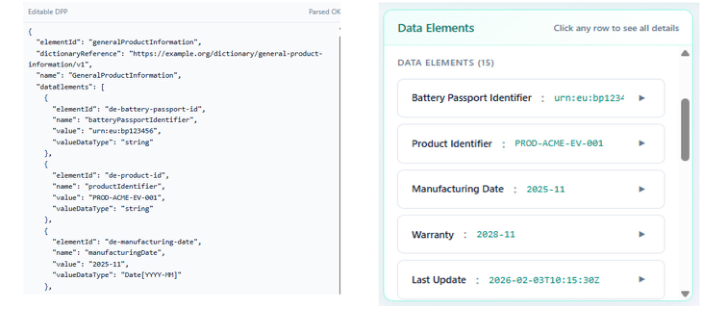
THE USABILITY LIMITATIONS OF JSON-ONLY AND API-ONLY APPROACHES In DPP compliance workflows, usability problems increase both the risk of invalid records and the effort required to identify and correct errors. For SMEs, this can turn a regulatory reporting task into repeated technical troubleshootingand divert attention from core operational tasks. A JSON file viewed in a text editor or returned by an API endpoint presents raw key-value structures that require considerable interpretive effort from non-specialist users. As shown in Figure 1, the raw DPP record (left) contains internal field identifiers, nested arrays, and format annotations that are not self- explanatory, whereas the human-readable interface (right) presents the same information as a structured and labelled form with clearer navigation. This contrast shows that JSON-only access may ensure formal data availability while limiting practical accessibility (IETF, 2017; ISO, 2018).
Figure 1: DPP record in raw JSON format (left) and in the proposed human-readable interface (right).
These usability limitations translate directly into interface requirements. Internal identifiers need to be replaced with human-readable labels, units, and inline guidance; schema-restricted attributes should be supported through constrained inputs such as drop-down menus; nested data should be organized through progressive disclosure; and validation feedback should highlight affected fields and provide understandable repair suggestions rather than developer-oriented error messages (JSON Schema Community, 2020–2024; Attouche et al., 2024). The consequences go beyond inconvenience. Missing mandatory fields, format violations, or invalid enumerations can render a DPP record non-compliant and expose the Economic Operator to sanctions This is
Designing Human-Centric Interfaces for the Digital Product Passport 119 particularly challenging for SMEs, which often lack dedicated compliance or IT departments. Eurostat (2024) reports that only around one in five EU enterprises employs ICT specialists, while OECD (2021) identifies skills shortages and limited organizational capacity as persistent barriers to SME digital transformation. Under these conditions, the assumption that legally required DBPs can be managed solely through developer-oriented JSON artefacts and API-based interfaces is difficult to sustain (Sagala & Őri, 2024).
Although API-based exchange is suitable for high-volume manufacturers, it may overlook smaller actors in the circular economy. Repair shops, second- life refurbishers, and small-scale recyclers may need to update only individual records without having the resources to build custom API integrations. For these stakeholders, overly technical interfaces can become a practical barrier to participation and may encourage workarounds such as placeholder entries that weaken data quality and undermine the integrity of the wider European DPP system (Langley et al., 2023).
THEORETICAL FRAMEWORK This paper is grounded in Cognitive Load Theory (CLT) and established principles from Human-Computer Interaction (HCI). Together, these perspectives explain why technically valid DPP data may still be difficult to use in practice and provide the conceptual basis for interface design decisions that aim to reduce cognitive effort, improve comprehension, and support role-appropriate interaction.
Cognitive Load Theory CLT, originally developed by Sweller (1988) and further elaborated by Sweller et al. (1998), distinguishes between intrinsic load, which arises from the inherent complexity of a task, extraneous load, which is caused by the way information is presented, and germane load, which supports schema formation and understanding. In the context of the DPP intrinsic load is already high because users must work with regulatory terminology, standardized units, and formally constrained data structures. When this information is presented only as raw JSON or developer-oriented API output, additional extraneous load is introduced because users must interpret syntax, navigate nested structures, and identify errors without adequate guidance. Research in HCI confirms that information density and syntactic complexity are primary drivers of extraneous load in data-intensive interfaces. Under heavy cognitive load, users work more slowly, experience higher stress and frustration, and are more likely to disengage from or misuse digital tools (Kosch et al., 2023).
HCI Principles and Role-Based Adaptation Norman’s (2013) concept of affordances informs the design of the interactive elements. By restricting input to schema-compliant options through constrained menus rather than free-text fields, the interface reduces the effort required to identify valid entries. Nielsen’s (2010) usability heuristics, particularly error prevention and contextual help, are reflected throughout
the proposed system. Progressive disclosure, identified by Shneiderman et al. (2016) and Muralidhar et al. (2025) as an effective strategy for managing information density in complex applications, is especially relevant to the layered structure of DPP data. Mayer’s (2009) contiguity principle, which emphasizes placing explanatory information close to the relevant interactive element, provides the basis for the tooltip design.
Role-based view adaptation must be understood as both a usability and a compliance requirement. DIN EN 18239 defines an access-rights model in which different actor groups, such as manufacturers, economic operators, recyclers, notified bodies, and consumers, are granted different read and write permissions for specific data elements, with further detail to be specified through delegated acts (CEN/CENELEC, 2025b). A human- centered interface should therefore indicate which fields may be modified and why others remain read-only. Without such guidance, accidental non- compliance may occur even if access control is correctly implemented at the API level (Carrera-Rivera et al., 2024). Adaptive, role-based interfaces have also been shown to reduce task completion time and error rates for users with differing levels of familiarity with digital systems and structured data (Carrera-Rivera et al., 2024).
HUMAN-CENTRED DESIGN FRAMEWORK: PROTOTYPE IMPLEMENTATION Information Architecture, Schema Integration, and API Connectivity
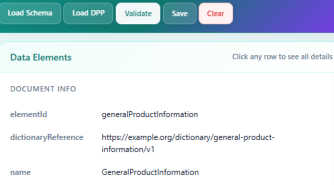
The prototype includes a schema-driven interaction layer that connects the user interface to DIN EN 18222-compliant API endpoints. The “Load Schema” function retrieves the JSON schema from the API and uses it for validation and interface rendering. Because the schema is loaded dynamically, updates to attribute specifications can be reflected without hard-coded interface changes. The “Load DPP” and “Save” functions correspond to GET and PATCH operations (CEN/CENELEC, 2025a)., with format handling performed by the application. This functionality is presented in Figure 2.
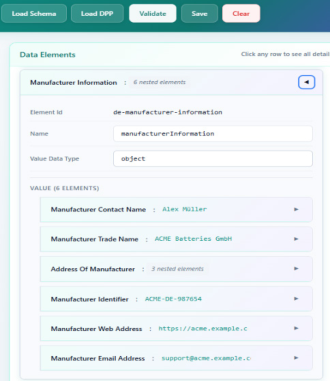
The information architecture presents top-level elements as expandable rows within a structured list. Nested structures, such as Manufacturer Information and its subordinate fields, can be explored through successive expansion, as shown in Figure 3. This progressive disclosure strategy (Nielsen, 2006; Muralidhar et al., 2025) reduces visible complexity by limiting the displayed information to what is relevant for the user’s current task.
Figure 2: Schema loading, DPP retrieval, validation, and update functions.Figure 3: Representation of nested data structures.Figure 4: Hover-activated tooltip for the Battery Passport Identifier field.
Contextual Tooltip System A hover-activated tooltip system provides field-level guidance directly within the editing interface. As shown in Figure 4, hovering over the Battery Passport Identifier field reveals a plain-language explanation, the required format, and an example value. This inline support follows Mayer’s (2009) contiguity principle, reduces reliance on external schema documentation, and supports users with varying levels of digital literacy and technical expertise (ISO, 2019).
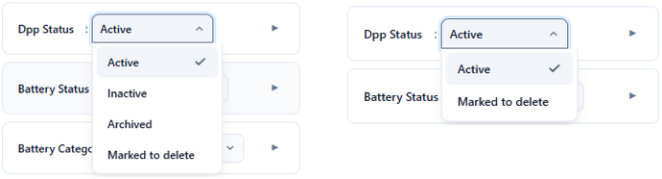
Constraint-Based Input and Role Filtering Where the JSON schema specifies enumerated values, the interface renders the input as a constrained drop-down menu containing only valid options, thereby implementing the enum keyword at the interaction layer (JSON Schema Community, 2020–2024). Figure 5 shows the role-based dimension of this mechanism. In the full schema view of the DPP Status field (left), all four permitted values are available. In the Recycler role view (right), the selector is limited to the two lifecycle-relevant options permitted for end-of- life operators: Active and Marked to delete. This design supports Nielsen’s (2010) error-prevention heuristic and operationalizes the access rights model
at the interaction layer, making legal constraints visible without requiring users to understand the underlying API permission structure. As delegated acts further define attribute-level access rights, the role-filtering mechanism can be updated through the schema without changes to the UI code.
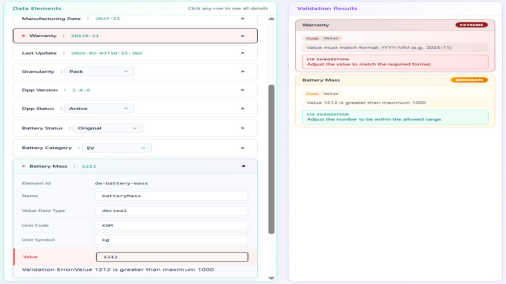
Validation, Error Communication, and Pre-Submission Conformance Validation begins once both a JSON schema and a DPP instance document have been loaded. The Validation Results panel (Figure 6) displays each detected error as a card containing the human-readable field name, a plain-language explanation, a severity level classified as EXTREME or MODERATE, and a suggested corrective action. By identifying such issues before submission, the system enables SMEs to correct records in advance and avoid rejection cycles. In the main data panel, erroneous fields are highlighted in red, supporting immediate visual identification in line with W3C guidance on error identification and WCAG 2.2 success criterion 3.3.1 (W3C WAI, 2023). Figure 6 also shows the expanded Battery Mass field, where the validation error appears directly next to the editable value and the associated metadata. This integrated presentation supports more efficient error correction and is consistent with Nielsen’s (2010) heuristics and W3C accessibility guidance (W3C WAI, 2023).
Figure 5: Constraint-based input for the DPP Status field. Left: full schema view with all four permissible values. Right: Recycler role view.Figure 6: Validation results panel.
Designing Human-Centric Interfaces for the Digital Product Passport 123 COMPARATIVE EVALUATION AND SOCIO-TECHNICAL IMPLICATIONS
Performance Comparison To assess the practical relevance of the proposed approach, Table 1 compares the human-centric application with a JSON-only or API-only method across key SME performance indicators The comparison indicates that the proposed application reduces the operational burden of DPP interaction by shifting complexity from the user to the system design while remaining aligned with the underlying technical architecture. Table 2 relates these improvements to the corresponding cognitive load reduction strategies and HCI-based design principles.
Table 1: Comparison of raw JSON / API-only approach and the proposed human-centric interface.
Error rate High; syntax and schema errors are frequent and hard to detect
Low; schema validation and fix suggestions catch errors in real time
Data integrity Prone to accidental deletion of braces/quotes or silent enumeration violations
High; users interact with values while the system manages code structure
Task speed Slow; requires manual parsing of code blocks to find specific fields
Fast; categorized views and search functions allow rapid navigation
Access rights alignment
Role differentiation enforced only at API layer; invisible to user
DIN EN 18239 role tiers reflected as visible UI constraints; permitted actions are explicit
Compliance proof
Opaque; difficult for managers to verify data before submission
Transparent; human-readable validation report provides clear evidence of compliance
Accessibility, Trust, and Industry 5.0 Alignment Beyond task performance, DPP systems must also be evaluated in terms of accessibility and socio-technical viability. In SME environments, users differ in digital literacy, technical background, and age-related capabilities, which makes accessibility not only a compliance issue but also a practical requirement for reliable industrial use (W3C WAI, 2023).
The proposed interface also incorporates accessibility-oriented design choices, including clear visual signalling, keyboard-accessible interaction, and plain-language support through fix suggestions and contextual tooltips. Together, these features reduce mental effort and support broader participation in DPP-related processes (W3C WAI, 2023; ISO, 2019).
Table 2: Cognitive load reduction strategies, CLT principles, and implementation.
Nested elements collapsed by default; expanded on demand (Fig. 3)
Enumerated value constraints
Drop-down menus with schema-permitted values eliminate free-text errors (Fig. 5)
Reduction of germane decision load Inline contextual tooltips Schema knowledge acquisition
Hover overlays: field description, format, example value (Fig. 4)
Severity-graded validation
Prioritisation of intrinsic load
Severity labels; color-coded field highlights; plain-language fix suggestions (Fig. 6)
Role-based view filtering
Elimination of irrelevant information
Interface adapts displayed and editable fields to user role per DIN EN 18239 access tiers (Fig. 5) Trust is another key socio-technical requirement. Effective reliance on automated systems depends on a calibrated understanding of their capabilities and limitations (Lee & See, 2004). In the DPP context, users need to understand why entries are flagged as invalid, which fields they may modify, and where system support ends. By making validation states, problematic fields, and remediation guidance visible, the interface supports such calibrated trust. Where data are provided by third parties, provenance information should also be displayed, since schema validation confirms structural conformity but does not establish the source of the information. This is consistent with Trust-by-Design principles (Merchán-Cruz et al., 2025). and with the Battery Pass Consortium’s (2023, 2024) observation that different attributes carry different levels of criticality and may therefore require differentiated trust and conformity mechanisms.
These considerations also align the proposed application with Industry 5.0, which emphasizes human-centered digitalization and the integration of human actors into complex industrial systems (Psarommatis & May, 2024). For the DPP, the challenge is therefore not only technical data exchange, but also whether actors across the value chain can use the data effectively, confidently, and in a legally compliant manner.
This is particularly relevant for SMEs, which often lack the legal, IT, and financial resources required to build dedicated DPP infrastructures. Accessible cloud-based solutions, for example in the form of Software-as-a- Service or Platform-as-a-Service, can therefore lower barriers to participation in emerging battery traceability and circularity ecosystem (Gieß et al., 2025).
Finally, readable and operationally interpretable DPP data can support not only compliance, but also decision-making. SMEs may use information such as carbon footprint, material composition, or recycling efficiency to inform supplier selection, process improvement, or sustainability planning. In this way, the DPP can move beyond a compliance artifact and become a source of actionable operational knowledge (Langley et al., 2023).
CONCLUSION
The DPP under the EU Battery Regulation introduces not only technical requirements for interoperable data exchange, but also practical challenges for human users. Machine-readable formats and API-based architectures are appropriate for system-to-system communication, yet they remain difficult to use for many stakeholders who must work with DPP data in practice, especially in SME contexts.
This paper addressed that gap by proposing a human-centered design framework for DPP interfaces. The presented prototype shows how schema- based rendering, role-based adaptation, progressive disclosure, constrained input, contextual guidance, and validation support can make DPP records more understandable and manageable for non-technical users while remaining aligned with the underlying technical architecture.
The findings suggest that effective DPP implementation depends not only on standards and data models, but also on the usability of the interaction layer. Human-centered interface design should therefore be considered an important part of future DPP development, particularly as digital passports are extended to additional product groups.
REFERENCES
Attouche, L., Baazizi, M.-A., Colazzo, D., Ghelli, G., Sartiani, C., & Scherzinger, S. (2024). Validation of modern JSON schema: Formalization and complexity. Proceedings of the ACM on Programming Languages, 8(POPL), Article 51. https://doi.org/10.1145/3632912 Battery Pass Consortium. (2023). Battery passport content guidance (Version 1.0).
https://thebatterypass.eu Carrera-Rivera, A., Larrinaga, F., Lasa, G., Martinez-Arellano, G., & Unamuno, G.
(2024). AdaptUI: A framework for the development of adaptive user interfaces in smart product-service systems. User Modeling and User-Adapted Interaction, 34(5), 1929–1980. https://doi.org/10.1007/s11257-024-09414-0 CEN/CENELEC. (2025). DIN EN 18222 (prEN 18222:2025) – Digitaler Produktpass – Programmierschnittstellen (APIs) für das Lebenszyklusmanagement und die Durchsuchbarkeit vom Produktpass [Digital Product Passport – Application Programming Interfaces (APIs) for the product passport lifecycle management and searchability]. CEN/CENELEC. (2025). DIN EN 18239 (prEN 18239:2025) – Digitaler Produktpass
– Management der Benutzerrechte, IT-Sicherheit und Geschäftsgeheimnisse [Digital Product Passport – Access rights management, information system security, and business confidentiality]. DIN DKE SPEC 99100:2025-02. (2025). Anforderungen an Datenattribute des Batteriepasses. Eurostat. (2024). ICT specialists – Statistics on hard-to-fill vacancies in enterprises.
European Commission. https://ec.europa.eu/eurostat European Parliament, & Council of the European Union. (2023). Regulation (EU) 2023/1542 of the European Parliament and of the Council of 12 July 2023 concerning batteries and waste batteries, amending Directive 2008/98/EC and Regulation (EU) 2019/1020 and repealing Directive 2006/66/EC (Text with EEA relevance). http://data.europa.eu/eli/reg/2023/1542/oj
European Parliament, & Council of the European Union. (2025). Regulation (EU) 2024/1781 of the European Parliament and of the Council of 13 June 2024 establishing a framework for the setting of ecodesign requirements for sustainable products, amending Directive (EU) 2020/1828 and Regulation (EU) 2023/1542 and repealing Directive 2009/125/EC (Text with EEA relevance). http://data. europa.eu/eli/reg/2024/1781/oj Gieß, A., & Möller, F. (2025). Exploring the value ecosystem of digital product
passports. Journal of Industrial Ecology, 29(2), 561–573. https://doi.org/10.1111/ jiec.13621 IETF. (2017). RFC 8259: The JSON data interchange format. Internet Engineering Task Force. https://www.rfc-editor.org/rfc/rfc8259 ISO. (2018). ISO 9241-11:2018 – Ergonomics of human-system interaction –
Part 11: Usability: Definitions and concepts. International Organization for Standardization. ISO. (2019). ISO 9241-210:2019 – Ergonomics of human-system interaction – Part 210: Human-centred design for interactive systems. International Organization for Standardization. Jensen, S. F., Kristensen, J. H., Adamsen, S., Christensen, A., & Wæhrens, B. V. (2023).
Digital product passports for a circular economy: Data needs for product life cycle decision-making. Sustainable Production and Consumption, 37, 242–255. https://doi.org/10.1016/j.spc.2023.02.021 JSON Schema Community. (2020–2024). JSON schema validation: A vocabulary for structural validation of JSON. https://json-schema.org Kosch, T., Karolus, J., Zagermann, J., Reiterer, H., Schmidt, A., & Woźniak, P. W.
(2023). A survey on measuring cognitive workload in human-computer interaction. ACM Computing Surveys, 55(13s), Article 283. https://doi.org/10.1145/3582272 Langley, D. J., Rosca, E., Angelopoulos, M., Kamminga, O., & Hooijer, C. (2023).
Orchestrating a smart circular economy: Guiding principles for digital product passports. Journal of Business Research, 169, 114259. https://doi.org/10.1016/j. jbusres.2023.114259 Lee, J. D., & See, K. A. (2004). Trust in automation: Designing for appropriate reliance.
Human Factors, 46(1), 50–80. https://doi.org/10.1518/hfes.46.1.50_30392 Mayer, R. E. (2009). Multimedia learning (2nd ed.). Cambridge University Press.
https://doi.org/10.1017/CBO9780511811678 Merchán-Cruz, E. A., Gabelaia, I., Savrasovs, M., Hansen, M. F., Soe, S., Rodriguez- Cañizo, R. G., & Aragón-Camarasa, G. (2025). Trust by design: An ethical framework for collaborative intelligence systems in Industry 5.0. Electronics, 14(10), 1952. https://doi.org/10.3390/electronics14101952 Muralidhar, D., Belloum, R., & Ashok, A. (2025). Operationalizing selective
transparency using progressive disclosure in artificial intelligence clinical diagnosis systems. International Journal of Human-Computer Studies, 204, 103591. https:// doi.org/10.1016/j.ijhcs.2025.103591 Nielsen, J. (2006). Progressive disclosure. Nielsen Norman Group. https://www.
nngroup.com/articles/progressive-disclosure/ OECD. (2021). The digital transformation of SMEs. OECD Publishing. https://doi.
org/10.1787/bdb9256a-en Psarommatis, F., & May, G. (2024). Digital product passport: A pathway to circularity and sustainability in modern manufacturing. Sustainability, 16(1), 396. https://doi.org/10.3390/su16010396
Designing Human-Centric Interfaces for the Digital Product Passport 127 Sagala, G. H., & Őri, D. (2024). Toward SMEs digital transformation success: A
systematic literature review. Information Systems and e-Business Management, 22(4), 667–719. https://doi.org/10.1007/s10257-024-00682-2 Shneiderman, B., Plaisant, C., Cohen, M., Jacobs, S., Elmqvist, N., & Diakopoulos, N. (2016). Designing the user interface: Strategies for effective human-computer interaction (6th ed.). Pearson. Sweller, J. (1988). Cognitive load during problem solving: Effects on learning.
Cognitive Science, 12(2), 257–285. https://doi.org/10.1207/s15516709cog1202_4 Sweller, J., van Merriënboer, J. J. G., & Paas, F. (1998). Cognitive architecture and instructional design. Educational Psychology Review, 10(3), 251–296. https://doi. org/10.1023/A:1022193728205 W3C Web Accessibility Initiative. (2023). Web content accessibility guidelines
(WCAG) 2.2. https://www.w3.org/TR/WCAG22/
LISTED IN THE AHFE DIGITAL BOOKSTORE CATALOGUE
Explore the complete digital volume
Industrial and Systems Engineering
Read this individual research paper free through the original publisher, or explore the full digital proceedings book.
ISBN 978-1-964867-95-3
Explore this ISBN in the AHFE Bookstore ↗Listed in the July 2026 bookstore catalogue; search by ISBN to confirm current availability · Digital book purchase optional