Turgut Refik Caglar, Elena Andrushchenko, Maurice Meyer, Efe Deniz Karaaslan, Roland Jochem (2023). Developing a Human-Centered Reference Model for Streamlining Failure Management in Supply Chains: An Integrative Approach to Communication Processes and Recommender Systems for SME. In: Application of Emerging Technologies. AHFE Open Access, vol. 115, pp. 147–156. https://doi.org/10.54941/ahfe1004311
Publisher statistics will load when you open Metrics.
AHFE OPEN ACCESS OPEN ACCESS CONFERENCE PROCEEDINGS PAPER
Developing a Human-Centered Reference Model for Streamlining Failure Management in Supply Chains: An Integrative Approach to Communication Processes and Recommender Systems for SME
The efficacy of a company's supply chain and its communication processes plays a pivotal role in determining its success. Reference models, which are essentially enterprise or information models with specific, reusable content, offer benefits such as expediting the modelling process, leveraging experiential knowledge, and boosting economic efficiency. Noteworthy among such models are the Supply Chain Operations Reference (SCOR) model, the damaged parts analysis process, and the 8D report, predominantly utilized to chronicle and assess communication discrepancies in supply chains. The SCOR model, applicable across diverse sectors, concentrates on five fundamental processes: Planning, Procurement, Production, Delivery, and Return. Despite its extensive functionalities, the SCOR is primarily employed for depicting processes rather than devising them. It offers limited direction in designing cooperative coordination processes and lacks a direct role in methodically addressing and resolving failures. The damaged parts analysis process, an initiative by the German Association of the Automotive Industry (VDA), offers collaborative solutions for supply chain issues. However, it doesn't deliver comprehensive guidelines or procedures for fostering cooperation and communication. On the other hand, the 8D method is a paramount problem-solving strategy in the automotive realm, focusing on streamlining complaint management and fostering effective communication with stakeholders. Alongside the 8D, methodologies like Six Sigma and the PDCA cycle can be incorporated into supply chains. Nevertheless, the adoption of these methodologies often proves resource-intensive for small and medium-sized Enterprises (SMEs), leading to constrained defect data gathering and prolonged durations for defect detection and resolution. This predicament is exacerbated by many SMEs' absence of a systematic approach to failure documentation. The prevalence of manual or localised record-keeping among SMEs impedes the development of a consolidated, data-informed failure knowledge base. A potential remedy could be envisioned in a robust knowledge base at the heart of an automated recommender system. Such a system might offer timely failure detection, discern correlations, pinpoint causes, and recommend interventions. These advancements could be instrumental in curtailing failure-associated expenses and procuring a sustained competitive edge. Moreover, these innovations can pave the way for SMEs to attain a digital maturity crucial for their prospective competitiveness.The objective of this paper is the conceptualisation of a human-centered reference model tailored to simplify the management of supply chain failures. This model aspires to facilitate the transparent delineation, communication, and rectification of failures spanning the entire supply chain continuum. Implementation of the reference model, in tandem with recommendation assistants, can dramatically curtail the timespan required to detect and address supply chain failures.
Small and medium-sized enterprises (SME) play a significant role in the Ger- man economy, accounting for 3.5 million businesses and contributing to 60% of the country’s total net value added (BVMW, 2023). SMEs are consid- ered drivers of innovation and are often referred to as the backbone of the economy, particularly within the automotive industry as original equipment manufacturers (OEMs) (Kemle, 2018). In addition to coping with mega- trends such as digitalization and climate change, SMEs also face pressure from OEMs (Bardt and Plünnecke, 2021).
Collaborative problem-solving within the entire supply chain can be chal- lenging, especially when strained relationships exist. In situations where the entire supply chain must work together to find solutions, the presence of tension and strained relationships can give rise to various problems (Gerster, 2018). These challenges often arise between the OEMs and the suppliers, stemming from the expectations placed on SMEs to navigate complex chal- lenges such as globalization, increased competition, cost pressures, and OEM audits (Luckert et al. 2018). As a result, there is a need to address the exist- ing problems and improve collaboration and communication within supply chains.
When a field failure occurs, it tends to propagate along the supply chain (Ide, 2009). Typically, each supplier independently investigates poten- tial causes and devises corrective actions. This decentralized approach to problem-solving can lead to inefficiencies and delays in resolving field failures.
For the documentation and analysis of failures of communication in the supply chain, reference models “SCOR model”, “damaged parts analysis pro- cess” and “8D report” are widely used in practice (VDA, 2017a) (Friedrichs et al. 2017). While these methods have been valuable, they come with signif- icant time and personnel costs, and there is often a lack of clear guidelines on how to effectively communicate and disseminate the results (Bearing Point, 2007). This communication gap hinders efficient handling of failures within supply chains. To address these challenges, the envisioned research paper intends to develop a comprehensive reference model that facilitates targeted communication between OEMs and SMEs, thereby simplifying the manage- ment of field failures (Dombrowski and Mielke, 2015). Table 1 gives an overview of these three reference models.
Reference models, which are enterprise or information models with speci- fied contents for specific purposes, offer advantages such as accelerating the modeling process, utilizing experiential knowledge, and enhancing economic efficiency (vom Brocke and Fettke, 2018) (vom Brocke and Fettke, 2021). In line with the research paper, the developed reference model concept will be supported by recommendation assistants. These recommendation assistants will enhance the value of the reference model by providing specific cause and action recommendations for handling field failures, in addition to the generic communication recommendations provided by the reference model.
Implementing of the proposed reference model and leveraging the assis- tance of recommendation assistants, the research aims to reduce the detection
Developing a Human-Centered Reference Model 149
and remediation time for field failures within supply chains. This approach holds promise in minimizing failure costs, achieving sustainable competitive advantages, and supporting the digital transformation efforts of SMEs.
The objective of the research is to contribute to the field by providing SMEs with a systematic approach to failure management in their supply chains. The proposed reference model, along with the support of recommendation assis- tants, seeks to improve the efficiency and effectiveness of failure management processes, ultimately enhancing the competitiveness and resilience of SMEs in the industry.
STATE OF ART The present challenges and opportunities encountered by SMEs necessitate a thorough understanding of the supply chain industry. This section pro- vides an overview of the industry landscape, with a particular focus on three prominent reference models developed to tackle failure management within supply chains. By examining reference models, including their advantages, limitations, and areas of application, valuable knowledge can be acquired about existing approaches and areas that require further attention can be identified.
The SCOR model represents the processes both internally and externally on three levels with an increasing level of detail. The basis for the model is formed by the five core processes in supply chains: Plan, Source, Make, Deliver and Return. On the second level, these processes are linked to process types. The process types are differentiated into planning processes, execu- tion processes or support processes. On the third level, the sub-processes are described in detail. The process model is complemented by a performance system, which also has three levels, and the description of management prac- tices to increase performance. The necessary staff qualifications to carry out the processes are also part of the model (Asrol and Syahruddin, 2021) (Poppe, 2017). The SCOR model serves to describe the processes and relation- ships, but is explicitly not intended for the design of these. The model does not provide guidance on the design of collaborative coordination processes. However, it supports communication within the supply chain by creating a unified definition of processes. The management practices provided include various recommendations such as information technology elements that can be followed to build a collaborative platform (Poppe, 2017). In this con- text, the SCOR model is only a reference model in the supply chain, which describes all internal and cross-company processes along the entire supply chain with a uniform concept and has no direct influence on systematic troubleshooting and problem-solving (Handayani et al. 2021).
Another relevant reference model is the damaged parts analysis process, developed by the German Association of the Automotive Industry (VDA). Originally designed for the automotive industry, this model has applicability in other industries as well (VDA, 2017b). This model focuses on collaborative problem-solving within the supply chain, particularly in the analysis of field parts. It aims to determine the cause of failures and establish common inter- faces between suppliers and customers. While it highlights the importance
of regulated data exchange, it does not provide comprehensive recommen- dations or process descriptions for cooperation and communication beyond the analysis of field parts.
Table 1. Overview of the reference models.
Table available in the original PDF paper.
8D Method
Reference Model
SCOR Model Damaged Parts Analysis Process
Structured problem-solving approach.
Focuses on problem-solving for field parts within the supply chain.
Description Comprehensive framework for supply chain processes and performance evaluation.
Key Processes Plan, Source, Make, Deliver, Return
Evaluation, No Trouble Found (NTF) process, problem analysis, continuous improvement.
Steps: 1. Establish the team 2. Problem description 3. Containment/ Short-term/ Interim actions 4. Identifying and Verifying Root Cause 5. Identify/ choose permanent corrective actions 6. Implement permanent corrective actions 7. Preventive actions 8. Team recognition
- Structured problem-solving approach with clear phases. - Facilitates effective problem resolution.
- Establishes common interfaces between suppliers and customers. - Facilitates effective analysis and problem resolution.
Advantages - Provides a common definition of processes. - Supports communication within the supply chain. - Enables process optimization and performance improvement.
Limitations - Does not provide guidance for cooperative coordination processes. - Limited focus on SME-specific challenges (e.g., resource constraints).
- Resource-intensive for SMEs, limited data collection, and delays in resolution. - Requires significant personnel and time investment.
- Limited focus on field parts within the supply chain. - Lack of comprehensive recommendations or process descriptions for cooperation and communication.
Widely used in the supply chain context.
Applicable in the automotive industry and potentially other industries.
Applicability Used globally across industries, particularly prominent in the automotive industry.
Key Focus Areas for Improvement
- Cooperative coordination processes. - Systematic failure elimination and problem-solving. - Consideration of SME-specific challenges.
- Efficiency for SMEs (simplifying and streamlining the process). - Enhanced data collection and analysis. - Integration with broader supply chain processes.
- Comprehensive recommendations and process descriptions for cooperation and communication. - Integration with broader supply chain processes. - Enhanced data collection and analysis.
The 8D (Eight Disciplines) method is another widely used problem-solving method in the supply chain context (Burghartz-Widmann, 2021). Primarily
Developing a Human-Centered Reference Model 151
employed in the automotive industry, the 8D method follows a standard worksheet documenting eight phases of problem-solving. The eight disci- plines include establishing the team and team leader, describing the problem in detail, implementing immediate actions, identifying the root cause, deter- mining and planning corrective actions, implementing and evaluating cor- rective actions, preventing recurrence, and recognizing the team’s efforts. It serves as a communication tool between suppliers and OEMs, facilitating the addressing of quality problems and reporting the outcomes. The 8D method is integral to supplier quality management in various industries. However, its application can be labor-intensive and time-consuming for SMEs, leading to limited collection of failure data and delays in detection and resolution.
By examining these reference models and understanding their advantages and limitations, valuable insights can be gained about existing approaches in failure management within supply chains. However, they provide valu- able frameworks and methodologies, existing reference models may not fully address the challenges faced by SMEs in failure management, cooperative coordination, and comprehensive problem-solving within the supply chain. SMEs often struggle with manual record-keeping practices, limited failure analysis capabilities, and inadequate communication and data exchange (Bearing Point, 2007) (Dombrowski and Mielke, 2015). These challenges call for a more comprehensive approach that integrates advanced technologies.
METHODOLOGY
The proposed scientific approach for the development of the reference model aims to address the challenges faced by SMEs when dealing with field failures in supply chains. The objective is to create a comprehensive and effi- cient framework that combines a reference model and two recommendation assistants to facilitate failure diagnosis and resolution. While one assistant suggests potential root causes, the second assistant suggests specific measures to rectify the failures.
As part of the necessary data exchange, the reference model includes a template for standardized information transmission regarding field fail- ures. Within this framework, the OEM provides necessary information for assessing the classification of the failure and other data to be determined to the suppliers. Furthermore, an assessment regarding the expected respon- sibility for failure correction must be made. Both the template and the subsequent determination of responsibility ensure more clarity and a stan- dardized framework for failure correction, thereby facilitating it (Günther, 2020). In summary, the reference model is capable of facilitating or enabling the necessary communication and data exchange for failure handling.
Once the responsibility is determined, the respective SME receives an auto- mated and prioritized list of potential root causes for the classified field failure, mainly based on historical frequency values.
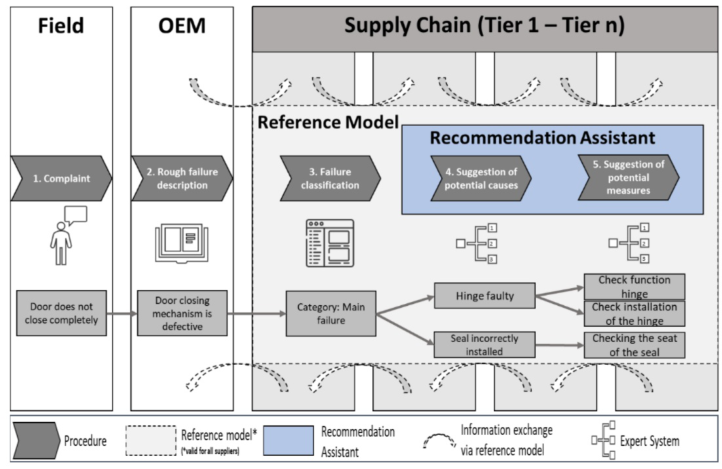
The following is a preliminary implementation of the reference model (Figure 1).
The first step of developed approach starts with the collection of customer complaints related to field failures. At the second stage, these complaints are
obtained either from workshops or directly from the OEM. Detailed failure descriptions are then performed by the OEM, incorporating a minimum set of data to enable effective failure classification. This step ensures that SMEs can assess the severity and urgency of the field failures, allowing them to determine the necessary course of action.
Figure 1: Implementation of the new reference model.
The classification of failures can be carried out centralized or decentral- ized, depending on the specific circumstances. In cases where centralization is feasible, an interdisciplinary team or a supply chain task force can be estab- lished to ensure consistency in failure classification throughout the supply chain. This approach promotes collaboration and facilitates communication between the stakeholders involved.
The recommendation assistants, supported by a recommendation assis- tant system, come into play after the failure classification. These assistants leverage past experiences and knowledge stored in the system to propose potential causes of the identified field failures. Additionally, insights from studies and surveys conducted by the OEM are considered. The recommen- dations are provided to SMEs in the form of a prioritized list of potential causes, enabling them to make informed decisions based on the most critical factors contributing to the failures.
Once the SME selects the potential cause from the prioritized list, the sec- ond recommendation assistant suggests concrete measures to address and resolve the identified cause of the failure. The SME retains autonomy in selecting the most appropriate measures from the list of highest-priority rec- ommendations. These measures serve as a guide for SMEs, eliminating the need for them to independently determine and execute failure diagnosis and
Developing a Human-Centered Reference Model 153
resolution methods. This streamlines the process, saving time and human resources.
In a given scenario (Figure 1), a workshop raises a complaint regarding the incomplete closure of a vehicle door. It is recommended, in the case of the field failure “faulty door closing mechanism,” that an investigation be conducted to identify potential causes associated with the hinge or the seal. These suggestions are based on previously accumulated experiential knowl- edge. Consequently, the SME is presented with a prioritized list of various plausible root causes for consideration. From this list, the SME is required to autonomously select the highest-priority causal factor(s) it wishes to address.
Subsequently, a second recommendation assistant provides the SME with appropriate measures to rectify the chosen causal factor. Once again, the SME retains the discretion to independently select from the highest-priority recommended measures. Should the SME determine that the hinge is the iden- tified root cause, future installations of hinges will undergo random sampling inspections. Alternatively, design modifications of the hinge may be con- sidered, as preventive measures are generally preferable to failure-detecting measures.
To enhance the effectiveness of the recommendations, static recommenda- tions are provided, detailing the prerequisites and necessary conditions for implementing the suggested measures. This additional information ensures that SMEs are well-informed about the requirements and can adequately pre- pare for the execution of the recommended actions. For instance, in the case of conducting random inspections of door hinges, the recommendations may include verifying the machine capabilities, assessing the skills of the operators, and ensuring the proper functioning of the measuring instruments.
It is important to note that the scientific methodology outlined above is a preliminary proposal based on the provided information. Further research and development would be required to refine and validate the methodology, including data analysis, model development, and rigorous evaluation of the reference model’s effectiveness in real-world scenarios.
DISCUSSION
In the context of failure handling within supply chains, the recommendation assistants and the reference model contribute to faster failure rectification and efficient communication of knowledge throughout the supply chain (Gün- ther, 2020). By providing timely information and saving valuable time and human resources, the recommendation assistants reduce costs for suppli- ers involved in the failure handling process. This resource optimization is particularly advantageous for SMEs facing challenges in their day-to-day operations (Müller-Jones, 2019).
The reference model facilitates both vertical and horizontal communi- cation within and between supply chains. Vertically, the reference model streamlines communication by enabling problem-solving processes to be per- formed by selected suppliers, rather than requiring every supplier to address the same issue. This leads to significant time savings within individual supply chains.
Additionally, the reference model supports horizontal communication by anonymously sharing information about failures, their causes, and successful corrective actions between different supply chains. This proactive approach to field failures enhances the overall quality of supply chains (Bischoff, 2015).
To achieve sustainable and systematic failure resolution in the supply chain, interactive communication with a knowledge base is crucial. Expert systems (ES) offer a means to present problem-solving knowledge from experts and store it directly in an failure knowledge base. ES possess problem- solving capabilities, the ability to understand and solve problems, explain and evaluate solutions, and acquire and structure knowledge (Crostack and Ellouze, 2005) (Bracke, 2016) (Schmitt and Pfeifer, 2010) (Heiliger, 2003) (Theden, 1997) (it-production, 2016). When failures occur, the knowledge base can be accessed to retrieve relevant information for problem-solving, thereby improving the efficiency and effectiveness of failure resolution (Schmitt and Pfeifer, 2010). Unlike other artificial intelligence (AI) tech- niques, ES do not require extensive training datasets for model building, making them suitable for building recommendation systems with intelli- gent algorithms even when large amounts of training data are not available (Bekker, 2019) (Elsner et al. 2018).
The recommendation assistants and the reference model enhance com- munication and knowledge sharing within supply chains. They streamline the failure handling process, reduce costs, and enable targeted problem- solving based on the expertise stored in the knowledge base. By leveraging the capabilities of expert systems and intelligent algorithms, SMEs can achieve efficient failure resolution, leading to improved supply chain performance and overall competitiveness.
CONCLUSION
In summary, the effectiveness of a company’s supply chain is deeply inter- twined with the robustness of its communication processes. While current reference models like SCOR and the 8D method offer significant value in diagnosing and documenting communication gaps in the supply chain, they come with inherent limitations, especially in the context of SMEs. These enterprises often face challenges with resource-intensive methodolo- gies and lack systematic failure documentation, which hinders the develop- ment of a cohesive, data-driven failure knowledge base. The introduction of an automated recommender system, underpinned by a well-maintained knowledge base, emerges as a promising solution. Such a system could drive timely failure detection, identify correlations and causes, and sug- gest actionable measures, ultimately reducing failure-associated costs. This paper’s proposed reference model serves as a cornerstone in enhancing supply chain management, aiming to simplify the identification, commu- nication, and rectification of failures across the supply chain spectrum. Its implementation could pave the way for improved operational efficiency and a competitive edge, critical for the future sustainability and success of businesses.
Developing a Human-Centered Reference Model 155
REFERENCES
Asrol, M. & Syahruddin (2022) ‘Supply Chain Performance Measurement and Improvement for Forging Industry IJIEPR’, 2022; 33(3): 1–14. Bardt, H. & Plünnecke, A. (2021) ‘Mehrere Disruptionen zur gleichen Zeit belasten
Unternehmen’, IW-Kurzbericht 57/2021. Bearing Point (2007) ‘Global Automotive Warranty Survey Report’. Avail- able at: https://www.aiag.org/docs/default-source/Quality-/global_auto_ wrnty_rpt.pdf?sfvrsn=99af409d_0 (Accessed: 24 March 2023). Bekker, A. (2019) ‘4 Methoden der Datenanalyse: ein Überblick für tiefere Einblicke’. Available at: https://www.scnsoft.de/blog/4-methoden-der-datenanalyse (Accessed: 24 March 2023). Bischoff, J. et al. (2015) ‘Erschliessen der Potenziale der Anwendung von Industrie
4.0 im Mittelstand’. BVMW (2023) ‘Der Mittelstand ist Garant für Stabilität und Fortschritt – Wir sind die 99 Prozent’. Available at: https://www.bvmw.de/de/der- verband/%C3%BCber-uns/zahlen-fakten (Accessed: 24 August 2023). Crostack, H-A. & Ellouze, W. (2005) ‘Extensive Failure Management- A Refer-
ence Model’, The 8th International QMOD Conference (Quality Management for Organisational and Regional Development), Conference Proceedings, Palermo June 29–July 1. Dombrowski, U. & Mielke, T. (2015) Ganzheitliche Produktionssysteme, Springer Berlin Heidelberg, Berlin, Heidelberg. Elsner, H., Heutmann, T., Lindemann, H., & Schmitt, R. (2018) ‘Hellsehen in
vier Schritten – Data Analytics für das Qualitätsmanagement’, QZ Qualität und Zuverlässigkeit, Heft 02, Carl Hanser Verlag, München. Friedrichs, W., Lutz, M., Buschhorn, B., & Joepen, M. (2017) ‘Das Fitnessprogramm für KMU. Methoden für mehr Effizienz im Automobil-, Anlagen- und Sondermaschinenbau’, Praxisreihe Qualitätswissen, Hanser Carl, München. Gerster, M. (2018) ‘Abkehr von den guten Sitten - Wie Zulieferer für mehr Fairness
in der Autoindustrie kämpfen’. Available at: https://www.automobilwoche.de/ar ticle/20180629/BCONLINE/180629865/abkehr-von-den-guten-sitten-wie-zuli eferer-fuer-mehr-fairness-in-der-autoindustrie-kaempfen (Accessed: 24 August 2023). Günther, R. (2020) ‘Nachhaltigkeit und Digitalisierung. Nachhaltiges Fehlermanagement – Produktions- und Prozesskosten senken durch Digitalisierung’, Mittelstand Digital Magazin, Ausgabe 14:25–29. Handayani, N. U., Mustikasari, A., Wibowo, M. A., & Simanungkalit, C. S.
(2021) ‘Designing System Assessment of Supply Chain Management Performance in Bridge Project using SCOR’, Proceedings of the International Conference on Industrial Engineering and Operations Management, Monterrey, Mexico. Heiliger, S. (2003) Rapid Quality Deployment, Qualitätsorientierte Produktentstehung durch modularisierte Qualitätsmethoden, Fortschrittsberichte VDI, Reihe 16, Nr.: 156, VDI Verlag, Düsseldorf. Ide, H. (2009) ‘Reklamation - aber bitte effizient! 54(10)’. Available at: https://vda-qmc.de/fileadmin/redakteur/presse/Reklamation_aber_bitte_effiz ient.pdf (Accessed: 24 August 2023). Kemle, J. (2018) ‘Die schwierige Zusammenarbeit von OEM und Zulieferer’.
Available at: https://www.marktundmittelstand.de/technologie/die-schwierige-zu sammenarbeit-von-oem-und-zulieferer-1278541/ (Accessed: 24 August 2023). Kuhn, H. (2017) ‘Kosten der Qualität. Nachhaltiges Kostenmanagement’, QZ Qualität und Zuverlässigkeit, Heft 02:32–35.
Obermeier, A. & Niederhofer, M. (2022) Anwendungsbereichsübergreifende Qualitätsmethoden, Springer Fachmedien Wiesbaden, Wiesbaden. Poppe, R. (2017) Kooperationsplattformen für das Supply Chain Management,
Springer Fachmedien Wiesbaden, Wiesbaden. Schmitt, R. & Pfeifer, T. (2010) Qualitätsmanagement Strategien-Methoden- Techniken, 4., vollständig überarbeitete Auflage, Carl Hanser Verlag München Wien. Schonert, M. & Heinrich, S. (2018) Supply Chain Risikomanagement in kleinen und mittleren Unternehmen – Problemstellung und Anforderungen, 18. Deutscher Logistik-Kongress, Berlin. Statista (2023) ‘Statista Dossier+ zu den Automobilzulieferern’, Statista GmbH.
Available at: https://de.statista.com/statistik/dossier/26/industrie/ (Accessed: 24 August 2023). Svenja (2018) ‘Die Zukunft der Automobilzulieferer’. Available at: https://www.
scheer-group.com/branchen/industrie/fertigungsindustrie/automobilzulieferer/ (Accessed: 24 August 2023). Theden, P. (1997) Analyse und Rentabilität von Qualitätstechniken, Berichte aus dem Produktionstechnischen Zentrum Berlin, zugl. Dissertation, Berlin. VDA (2017a) Zuverlässigkeitssicherung bei Automobilherstellern und Lieferan-
ten - Teil 3. Case Studies im Zuverlässigkeitsregelkreis. 1. Ausgabe, Henrich Druck + Medien GmbH, Frankfurt am Main. VDA (2017b) Das gemeinsame Qualitätsmanagement in der Lieferkette. Vermarktung und Kundenbetreuung, Schadteilanalyse Feld + Auditstandard, 2. Auflage. vom Brocke, J. & Fettke, P. (2021) ‘Referenzmodellierung’, Enzyklopaedie der
Wirtschaftsinformatik. Available at: https://www.enzyklopaedie-der-wirtschaftsi nformatik.de/lexikon/daten-wissen/Informationsmanagement/referenzmodellier ung (Accessed: 24 August 2023). vom Brocke, J. & Fettke, P. (2018) ‘Referenzmodellierung’, Lehrstuhl für Wirtschaftsinformatik, Universität Potsdam. Available at: https://www.enzyklopaedie-der-wirtschaftsinformatik.de/lexikon/daten-wisse n/Informationsmanagement/referenzmodellierung (Accessed: 24 August 2023).
LISTED IN THE AHFE DIGITAL BOOKSTORE CATALOGUE
Explore the complete digital volume
Application of Emerging Technologies
Read this individual research paper free through the original publisher, or explore the full digital proceedings book.
ISBN 978-1-958651-91-9
Explore this ISBN in the AHFE Bookstore ↗Listed in the July 2026 bookstore catalogue; search by ISBN to confirm current availability · Digital book purchase optional