Pei-ju Lin, Fan-chu Kuo (2023). Application of fishery waste on window grilles cement tile. In: Application of Emerging Technologies. AHFE Open Access, vol. 115, pp. 11–16. https://doi.org/10.54941/ahfe1004297
Aquaculture by-products, such as oyster shells, clam shells, and fish scales, are considered business wastes and are frequently discarded and buried without treatment, causing environmental and ecological problems. To recycle fishery waste, this study proposed using recycled materials such as oyster shell powders, clam shell powders, and fish scale fragments as aggregate substitutes in cement mortar for making cement tiles. The application of cement materials is diverse, ranging from indoor and outdoor landscape decoration and building materials to artistic creations and home decoration products. This study is proposed to produce cement tiles with a richer window grilles surface texture. First, wastes from the aquaculture industry, such as oyster shells, clam shells, and fish scales, were washed, ground, and mixed with cement mortar in different proportions to produce cement tiles, which were then subjected to relevant tests to assess their physical properties such as water absorption, compressive strength, flexural strength, and warpage. The cement tiles that meet the CNS specification for indoor wall tiles were further integrated into the window grilles processing.
Recycling waste in the aquaculture industry is an inevitable trend in the current industrial environment. However, the difference between produc- tion and actual recycling quantity is large. Therefore, the majority of the wastes are still discarded, piled up, and buried, leading to environmental, and health problems. The by-products of the aquaculture industry, such as oyster shells, clam shells, and fish scales, are business wastes. To recycle fish- ery waste in the aquaculture industry, recycled materials, such as oyster shell powders, clam shell powders, and fish scale fragments, were proposed in this study to be used as aggregate substitutes in cement mortar (Lu et al., 1998; Monzo et al., 1996; Ochi et al., 2007). Cement tiles with window grilles effects were through 3D spatial simulation, the spatial imagery and preferences of consumers when this method is applied to interior decoration could be understood (Izard, 1977; Ulrich, 1983; Baloglu, 2000; Kleinginna and Kleinginna, 1981; Im, 1984). According to the 2020 Fisheries Statistics Annual Report (www.fa.gov.tw) of the Fisheries Agency, Council of Agricul- ture, Executive Yuan, Taiwan, fish farming yielded 256,109 tons of produce.
Shellfish processing accounts for a greater portion of the non-food prod- ucts. In recent years, the main fish farming species have been river clams and tilapia. In Hualien, river clam farming takes up 60.28 hectares of area, with an annual production of approximately 569 tons; tilapia farming takes up 51.99 hectares, with an annual production of approximately 404 tons. Based on the literature, oyster shells, clam shells, and fish scales were used as lightweight aggregate to be added to the cement mortar in this study.
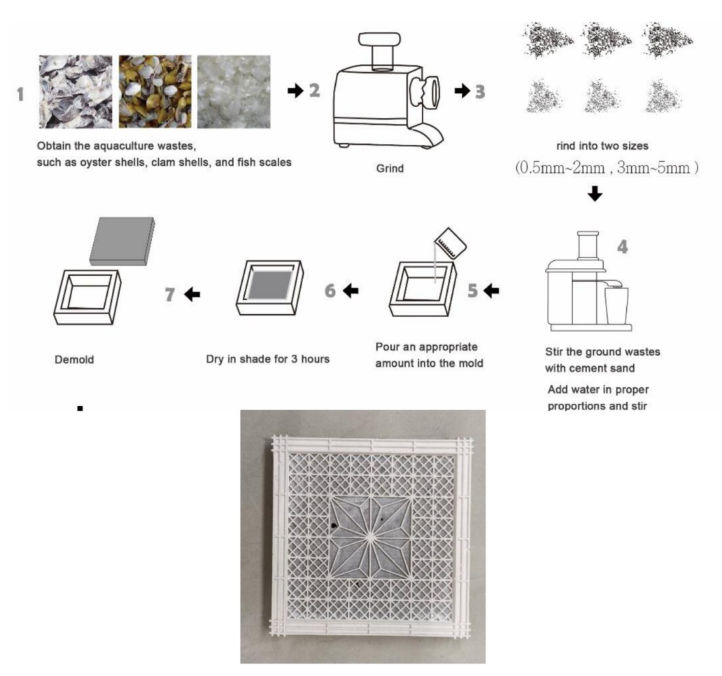
Figure 1: Sample making process.
CEMENT TILE Bricks have been manufactured for thousands of years (Li et al., 2016), with many different types of bricks produced, such as clay bricks, autoclaved sand-lime bricks, autoclaved fly ash-lime bricks, concrete hollow blocks, and concrete bricks. They are widely used in masonry structures, because of their low cost, ease of application, and good sound and heat insulation (Riaz et al., 2019). Changes in color, pattern, or texture of the brick sur- face play an important role in the design. This study aims to improve the application of cement brick building materials for decoration by manufac- turing cement bricks with texture changes using a manufacturing method developed based on the research results on cement mortar materials and the
Application of Fishery Waste on Window Grilles Cement Tile 13
form of bricks. Cement concrete materials are used in a variety of building structures. Its main application is in the production of concrete mortar by incorporating coarse or fine aggregate into cement that is cast in slab molds and reinforcement (Lu et al., 1998; Monzo et al., 1996). The production of bricks dates back thousands of years (Li et al., 2016). There are many types of bricks such as clay bricks, autoclaved sand-lime bricks, autoclaved flyash-lime bricks, concrete hollow blocks, and concrete bricks. Bricks are widely used in masonry construction owing to their low cost, ease of use, and good sound and thermal insulation (Riaz and Khitab, 2019). Variations in color, pattern, or texture as parts of the surface texture of the brick play an important role in the design. In this study, the texture variations of the cement mortar materials in the form of bricks made using the window grilles process were be made into decoration materials to improve the application of cement tile as building materials.
Production of Cement Tiles With Window Grilles From Aquaculture Wastes Three types of purified materials, oyster shells, golden clam shells, and tilapia scales, that are produced more in the aquaculture industry of Taiwan, were used as recycled materials and processed through the controlled crusher (model MD - B25, HP: 40, KG: 1800 kg, The Wanming Machinery Industrial Co., LTD.) to produce two types of materials with different fineness (of diam- eters approximately 0.5–2 mm and 3–5 mm). The oyster shell grains, clam shell grains, and fish scale fragments of these two different fineness were mixed with cement mortar in different proportions (5% and 15%), yielding a total of 12 groups of cement tiles made of aquaculture wastes for water absorption, compressive strength, flexural strength, and warpage tests, as shown in Table 1. CNS 13295 is a specification for testing high-pressure con- crete materials. The basic test requires basic dimensions; however, the cement tiles manufactured in this study were not ceramic tiles. They were fabricated to be applied on interior walls and not on outdoor floors or walls. There- fore, the wall tile testing specifications in CNS 3299 were consulted. The raw materials of the cement mortar include silicate cement of types I and III, water reducing agent, gypsum, and quartz powder. Adding water reducing agent to cement can reduce the water requirement of cement mortar with- out affecting the original design strength (Cement mortar was provided by Taiwan Aiho. Co. Ltd). The manufacturing method of this study is shown in steps 3–5 in the flow chart in Fig. 1. A cement mixer (model CM-M5, 5L, 125 ± 10 rpm, AC380 V/220 V) was used to mix and stir the aggregates and cement mortar (at a standard water–cement ratio of 0.48), which was subsequently weighed using a stainless steel cup. Furthermore, the cement mortar (at 23
C) was poured into the mold until it was completely filled. The amount of cement required for filling each mold was 180 g. The cement tiles were designed based on the wall tiles currently used in the field of build- ing materials and available on the market, with the following dimensions: 100 mm in length, 100 mm in width, and 10 mm in thickness. In terms of application, the permutations and combinations of its directionality is rela- tively flexible. The front of the cement tiles had a smooth surface. The back
14 Lin and Kuo
was designed with a grooved grid pattern to improve the adhesion of the mortar when applied to the wall. There was a grooved grid pattern inside the mold. The pouring mold was made of organosilicon materials and was square in shape, with dimensions of 130 mm in height, 130 mm in length, and 15 mm in width. Furthermore, the pouring mold had a hardness of 40 A and could be cured at room temperature or through heat, with minimal shrink- age and high temperature resistance. The inside of the mold had grooved grid patterns on one side for easy demolding. Finally, after the cement mor- tar had solidified (approximately three hours), it was removed from the mold and tested for water absorption, compressive strength, flexural strength, and warpage. The indoor temperature during the experiment was 27
. According to CNS 3299-4, the bending failure load and flexural strength of the cement tiles must be above 180. The flexural strength test was mainly used to eval- uate the ability of the tiles to withstand pressure, which is measured by the degree of damage after withstanding a heavy blow when dropped by gravity. Tiles with a high water absorption rate easily absorbed water, while thermal expansion and contraction were the main causes of cracking and peeling on the surface of tiles. The allowable rate of CNS stone tiles was less than 10%.
Table 1. Coefficient table of control variables and mean spatial imagery preference of subjects.
ANALYSIS AND DISCUSSION The study was carried out by mixing powdered oyster shells, clam shells, and fish scales (ground to diameters of approximately 0.5–2 mm and 3–5 mm) with cement mortars in different proportions (5% and 15%) to make cement tiles. Subsequently, ANOVA analysis was conducted after testing water absorption, compressive strength, flexural strength, and warpage to determine whether the control variables of the experiment affect the finished cement tiles. The result is listed in Table 1. It can be observed that the fishery waste aggregate used in this study had a significant impact on water absorp- tion. Further analysis using SNK multiple comparisons shows that the water absorption of oyster shell powders is higher than that of fish scales and clam
Application of Fishery Waste on Window Grilles Cement Tile 15
shell powders, with the magnitude of the impact being oyster shell powder > fish scale > clam shell powder (Table 2). For the two types of grinding fine- ness effect the bend breaking load and bending strength; the fishery waste have significant impacts on bend breaking load and bending strength (a sig- nificant impact on bend breaking load and bending strength at 5% and 15% mixing ratio was observed).
Table 2. ANOVA analysis of control variables on water absorption, compressive strength, flexural strength and warpage tests of cement tiles.
Breaking load 168.75 168.75 .38 .56 .72 bend breaking load 4961.33 4961.33 14.86 .00 bending strength 3.00 3.00 6.00 .04 Water absorption rate .27 .27 3.47 .11 Mixing ratio Breaking load 184.08 1 184.08 .41 .54 .71 bend breaking load 11041.33 11041.33 33.06 .00 bending strength 3.00 3.00 6.00 .04 Water absorption rate .14 .14 1.75 .23 Source of aggregates N Water absorption rate
Clam shell 4 7.34 Fish scales 7.77 7.77 Oyster shell 8.01 Sig. 0.07 0.27
CONCLUSION
Governments around the world are promoting waste recycling policies, in the hopes of creating a low-carbon, waste-free, and zero-pollution sustain- able recycling environment. The aquaculture industry produces a variety of waste biological resources. These waste biological resources can be effectively utilized as fertilizers for farmland, energy utilizations, construction materials and products, etc. According to the findings of this study, cement tiles pro- duced using oyster shell powders have a relatively high water absorption, which is consistent with the design scope of this study: being applied to wall tiles. In terms of water absorption in cement tiles made of fishery waste, aggregates made of oyster shell are followed by those made of fish scales and clam shell powders. There is an absolute relationship between the grinding fineness and amount of usage of aggregates, and the bend breaking load and bending strength, which implies that the use of coarser aggregates (3–5 mm) and higher content (5%) can effectively improve the durability.
REFERENCES
Baloglu, S. (2000) “A path analytic model of visitation intention involving information sources, socio-psychological motivations and destination image.” Journal of Travel and Tourism Marketing. 8(3): 81–91.
16 Lin and Kuo
Baxter, W. V., Wendt, J., Lin, M. C. (2004) “IMPaSTo: A realistic model for paint.” In Proceedings of the 3rd International Symposium on Non-Photorealistic Animation and Rendering 45–56. Curtis, C. J., Anderson, S. E., Seims, J. E., Fleischer, K. W., Salesin, D. (1997)
“Computer-generated watercolor” 421–430. Li, H. Dong, L. Jiang, Z. Yang, X. Yang, Z. (2016) “Study on utilization of red brick waste powder in the production of cement-based red decorative plaster for walls,” J Clean Prod, 133 pp. 1017–1026. Izard, C. E. (1977) “Human Emotions.” NY: Plenum Press. Im, S. B. (1984) “Visual preferences in enclosed urban spaces-an exploration of a scientific approach to environmental design.” Environment and Behavior 16(2): 235–262. Kleinginna, P. R., and Kleinginna, A. M. (1981) “A categorized list of emotion def-
initions, with suggestions for a consensual definition.” Motivation and Emotion. 5(4): 345–379. Lu, W., X. Fu, and D. D. L. Chung, (1998) “Shotcrete A Comparative Study of the Wettability of Steel, Carbon, and Polyethylene Fibers by Water,” Cement and Concrete Research, Vol. 28, pp. 783–786. Li, H. Dong, L. Jiang, Z. Yang, X. Yang, Z. (1998) “Study on utilization of red brick
waste powder in the production of cement-based red decorative plaster for walls, J Clean Prod, 133 (2016), pp. 1017–1026. Monzo, J., J. Paya, M. V. Borrachero, and A. Corcoles, (1996) “Use of Sewage Sludge Ash (SSA)-Cement Admixtures in Mortars,” Cement Concrete Research, Vol. 26, pp. 1389–1398. Nagamachi, M. (1995) “Kansei engineering: a new ergonomic consumer-oriented
technology for product development,” International Journal of Industrial Ergonomics, volume 15, issue 1, pp. 3–11. Monzo, J., J. Paya, M. V. Borrachero, and A. Corcoles, (1996) “Use of Sewage Sludge Ash (SSA)-Cement Admixtures in Mortars,” Cement Concrete Research, Vol. 26, pp. 1389–1398. Ochi, T., S. Okubo, and K. Fukui, (2007) “Development of Recycled PET Fiber and
Its Application as Concrete-Reinforced Fiber,” Cement and Concrete Composites, Vol. 29, pp. 448–455. Riaz, M. H. Khitab, A. S. (2019) “Ahmed, Evaluation of sustainable clay bricks incorporating brick kiln dust,” J Build Eng, 24, Article 100725. Ulrich, R. S. (1983) “ Aesthetic and affective response to natural environment.” In I. Altman, J. F. Wohlwill (ed.). Behavior and the natural environment. NY: Plenim Press. pp. 85–125.
LISTED IN THE AHFE DIGITAL BOOKSTORE CATALOGUE
Explore the complete digital volume
Application of Emerging Technologies
Read this individual research paper free through the original publisher, or explore the full digital proceedings book.
ISBN 978-1-958651-91-9
Explore this ISBN in the AHFE Bookstore ↗Listed in the July 2026 bookstore catalogue; search by ISBN to confirm current availability · Digital book purchase optional