Rainer Nägele, Jens Neuhüttler, Walter Ganz (2023). Advanced Systems Engineering and Continuous Value Shaping: Opportunities and future directions for value-added innovations with Services. In: Application of Emerging Technologies. AHFE Open Access, vol. 115, pp. 136–146. https://doi.org/10.54941/ahfe1004310
In nearly all economies, Services account for a significant share of value creation and provide a substantial potential for value-added innovation. In order to realize value-added innovation with services, however, respective development approaches and methods must also be adapted to the advancing digitalization, the dynamics of markets and the complex challenges of a volatile world. Regarding this issue, our paper explores two novel development approaches, namely Advanced Systems Engineering (ASE) and Continuous Value Shaping (CVS), and analyses what learnings can be derived for developing value-added innovation with services. By linking these new research approaches to the systematic development of services, new opportunities and future directions are derived.
TRANSFORMATION OF VALUE CREATION Digital transformation is undoubtedly a key driver of new product and service offerings, business models as well as changes in organizations, collaboration and human labour (Strunz-Happe et al., 2022). Or to summarize, digi- talization is changing value creation significantly. A major change is that increasing digitalization is leading to more service-oriented value creation, in which data-based services are developed and offered to create added value for customers and generate new revenue streams (Kohtamäki et al., 2020). Data- driven individualization, for example, opens up the potential for added value for customers and increases in efficiency for providers (Neuhüttler et al., 2020). In addition, the use of other digital technologies, such as artificial intelligence, promises further efficiency gains through more automated ser- vice provision. The ability to develop innovative and value-adding services is thus becoming an increasingly important competence for many companies.
In addition to the ubiquitous digital transformation, numerous other chal- lenges have influenced the creation of value in companies, such as difficulties
Advanced Systems Engineering and Continuous Value Shaping 137
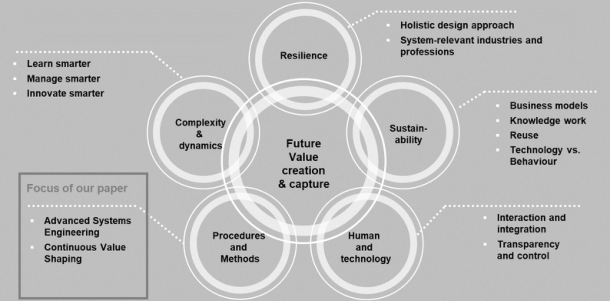
in international supply chains, increasing demand for sustainability, new global competitors as well as skilled labor shortage. Consequently, questions of the resilience in production and service processes, questions of resource protection and sustainability, and changing customer requirements are fur- ther challenges that companies are facing today. Figure 1 illustrates some of the key challenges for future value creation and capture.
Figure 1: Challenges in the transformation of value creation and value capture (source: own illustration).
On the one hand, these changes and challenges are critical stress factors affecting the economy and society; on the other hand, they also offer the opportunity to realign perspectives and design options for production, ser- vices and work, and thus for the future of value creation. However, the challenges for value-added service innovations are not limited to dynamics. Demands on innovations have also increased, such as in form of expec- tations that services will have an increasingly effective and measurable impact on environmental or societal challenges, such as climate change (Böhmann et al., 2021).
Due to the dynamics and changes, questions also arise as to how companies can create and capture new value through service innovations and what meth- ods and approaches can support a successful development of new services. Instead of focusing on singular development objects (e.g. isolated services or products), so-called value innovations are emerging that take a holistic and integrative view of more complex systems. Since services are becoming more and more important, we want to look at these development approaches from the perspective of services in particular. Before we look at these new approaches, which are still in the conceptual stage, it is worth taking a look at the existing approaches to service development.
LOOKING BACK: SERVICE ENGINEERING AND SERVICE SYSTEMS ENGINEERING Service research has long time dealt with the methods and tools that enable the development of innovative, useful and market-successful services. One research approach that has promoted the systematic development of services
is service engineering. It is related to the traditional engineering approaches of product engineering to develop and design services by using suitable mod- els, methods, and tools (Deutsches Institut für Normung e.V., 1998). In particular, the new sub-discipline added an engineering perspective to the previously more marketing-oriented service research. One of the core ideas of service engineering is to adapt established methods and approaches from product and software engineering to the special features of services, such as intangibility, integration of external factors or its process character. Ini- tial work was aimed at providing procedures for introducing new services to the market from a first idea through design and implementation. Almost without exceptions, the approaches generated followed a logic adopted from the development of physical products, i.e., an idea generation was followed by the design phase and finally the implementation, strongly sequentially oriented process models (Kim and Meiren 2010). Further research areas of Service Engineering have focused on the organizational embedding of new service development in companies. These ideas explored the question, which organizational forms - for example, the establishment of dedicated departments - would be best supporting the task of new service development (Meiren 1999, Bullinger und Scheer 2006).
In recent years, there have been interesting developments in the field of engineering that have implications for the development of new services. Two major trends are briefly described below. The first trend towards the use of flexible process models can be observed in Service Engineering over the last 15 years. Concepts of design thinking and agile development approaches have found their way into the world of services. Rigid linear process models have been broken up and the corresponding development models have been supplemented by iterative components, i.e., during development the service is continuously elaborated and optimized by repetition of essential process steps (Kreuzer and Aschbacher 2014).
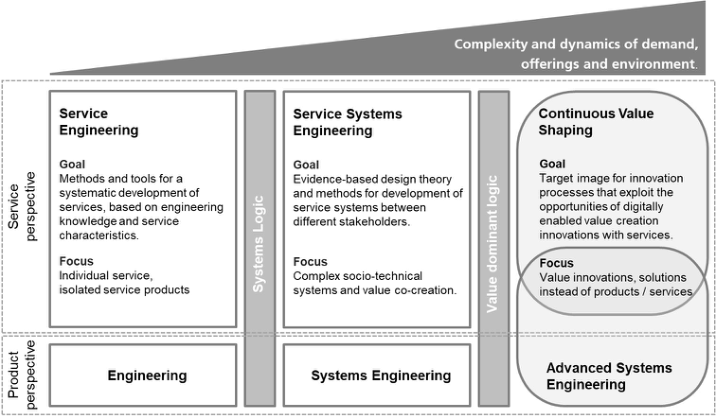
The second major trend can be seen in the incorporation of a systems logic, analogue to the paradigm shift in engineering, where complex products are constructed and developed as technical systems. Although the holistic devel- opment of services has always been a feature of service engineering, services have increasingly been understood in science as complex socio-technical sys- tems (Ravindran et al., 2018), which led to a further development of service engineering to service systems engineering (Böhmann et al., 2014). Currently, the focus is shifting to the provision of value-oriented service bundles in individual contexts and the design of value creation systems in which coop- eration is required across the boundaries of traditional providers and sectors (Tombeil and Nägele 2022). It ist clear, that advanced economies are char- acterized by a high prevalence of complex service systems and the digital transformation changes service systems even further, becoming increasingly automated, interactive, open, and learning systems (Böhmann et al., 2018). Figure 2 highlights the developments of approaches and procedures for value-added innovations with services.
The changes in value creation described in chapter one, and in particular the challenges posed by the increasing dynamics and complexity of demand and the corporate environment, have led in recent years to increasing calls for
Advanced Systems Engineering and Continuous Value Shaping 139
the merging of the previously separate development disciplines of products and services. Currently pursued approaches, however, continue to feature hardly any integrative approaches. For example, the guideline VDI 2206 has been used since its revision for the development of cyber-physical systems (VDI/VDE 2206), where service-oriented aspects are merely mentioned but not elaborated.
Figure 2: The development of procedures for value-added innovations with services (source: own illustration).
The situation is similar in the area of service development. DIN SPEC 33453 (2019), which is relevant here, focuses strongly on aspects of ser- vice development and leaves open questions about the integrated develop- ment of product-service systems. The consequence of such separate lines of development lead to limited value propositions, impeded coordination of development efforts, and a countering of the systems engineering approach (Abramovici 2018). The consequences of this are also evident in corporate practice. In a survey conducted in 2021, for example, 48% of all respondents named the provision of suitable methods when asked in which areas sup- port is needed in the development of integrated smart product-service systems (Friedrich and Schiller 2021).
As a result, there are currently two central directions of development towards a value-dominant logic in which value innovations are brought to the centre of attention, regardless of whether the resulting value is created by products, services or their interplay. The first stems from the development stream that is traditionally more focused on the engineering of physical prod- ucts and technical systems is called Advanced Systems Engineering (ASE). The second development stream comes from the service science community and addresses the question of how value-added innovations can be devel- oped in a highly dynamic and increasingly digitalized world and is called
Continuous Value Shaping (CVS). Although both approaches are still under development, they will be presented below and the information they contain on service development will be extracted.
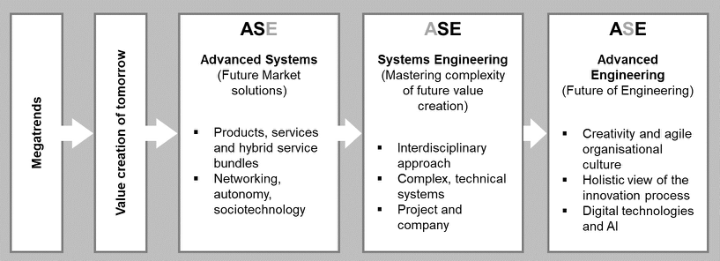
CURRENT DEVELOPMENTS: ADVANCED SYSTEMS ENGINEERING Advanced Systems Engineering (ASE) is an ambitious engineering approach for the successful design of innovative products, services and product-service systems as well as their development processes (Dumitrescu et al., 2021). The use of new digital capabilities - such as ubiquitous data availability, artificial intelligence, virtual and augmented reality, digital twins - also plays a major role here (ebenda). ASE is based on the fundamental assumption that the impact of megatrends on the value creation of tomorrow requires a holistic approach within engineering. For this purpose, the three pillars (1) Advanced Systems, (2) Systems Engineering and (3) Advanced Engineering are built up within ASE to enable a comprehensive development of future-proof products and services.
Figure 3: Three pillars of advanced systems engineering (source: Dumitrescu et al., 2021, page 28).
Such a system-oriented and model-based development systematic is required that encompasses all areas of strategic product planning and pro- duction system development, including the associated design of work, the associated services and consideration of the entire value-added system. In particular, the ASE concept takes into account the effects of increasing dig- itization, interdisciplinarity and networking to master the technical and organizational complexity in future engineering. Particularly of interest in the ASE approach to develop product-service systems are the ideas integrating the service perspective in the early steps of the product-service systems develop- ment process by designing for instance digital product and services models and -twins. But what we like to mention at this point, its not only about what can service innovation approaches learn from the ASE. The are many examples that indicate that ASE also got inspired from ideas from research of service systems design, such as process blueprinting or customer integration during development. It really is a mutual learning curve.
Advanced Systems Engineering and Continuous Value Shaping 141
However, the approaches of ASE to date have been technology-oriented and references to services are rare - with the exception of a few research papers on the design of smart product-service systems (e.g., Heinz et al., 2022). Furthermore, external factors hardly play a role in Advanced Systems Engineering so far and there is mostly no systemic design around the value proposition (Albers et al., 2022).
Nevertheless, central lessons for the development of services can be derived from the logic and approaches of ASE. On the one hand, the availability of data from service processes and their meanings also leads to an increased need in service development to create an integrated and continuous data flow during development as well as the subsequent life cycle. A so-called model-based service engineering would be a logical consequence and would allow to simulate different service scenarios beforehand. However, to date there are just a first steps to transfer concepts such as digital twins to the services themselves. Digital service twins, which take into account the char- acteristics of immateriality or interactive service creation, could represent a great added value for developers. On the other hand, service development can learn from the digital tools for development that are envisioned in ASE. The use of immersive technologies, for example, could particularly enrich the development of services, which are often based on interactions between peo- ple and have an immaterial character (Neuhüttler et al., 2022). Immersive service prototypes could support simulation of different service scenarios as well as early testing during concept stages. Furthermore, clearly defined inter- faces should be established between the methods and approaches of ASE and Service Engineering to enable a real integration for the development of value-based innovations. Besides virtual development environment ASE also provides new insights about physical field laboratories that could pro- vide new approaches for experimenting with innovations in service-oriented ecosystems.
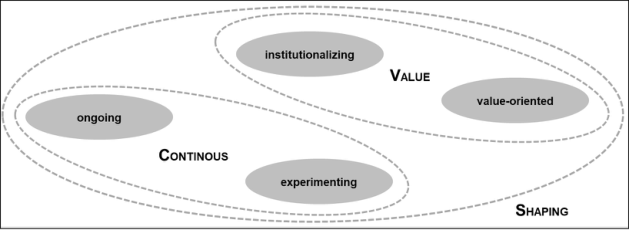
Continuous Value Shaping (CVS) Continuous Value Shaping is a target image for innovation processes that enable the opportunities of digital value creation to be taken seriously and find a new path to value creation. In order to open up the poten- tial of value-added innovations with services, new methods and tools should be developed that will be characterized by the following char- acteristics: ongoing, experimental, value-oriented and institutionalizing (see Figure 4). Continuous value shaping means permanent optimization and innovation in services and leads to a new perspective on Service Engineering.
While the latter is seen in both linear and agile models as a process that is usually completed with the market launch, continuous value shaping means permanent optimization and innovation in services. Thus, a development pro- cess would never come to an end, but there must be a constant exchange with service operations and changes must be adapted as quickly as possi- ble. New organizational concepts for service development are therefore in demand. Traditional R&D departments are expected to be partly replaced
by highly flexible, interdisciplinary teams that constantly monitor the market and interact closely with customers.
Figure 4: Four key characteristics for successful value innovations applying CVS (source: Deutsches Forum Dienstleistungsforschung 2021).
Development tasks and processes will also change. In particular, tasks such as collecting, analyzing and evaluating market- and user data will gain in importance. Ongoing experimenting thus becomes a central element even after the market launch, which leads to a shift of the locus of experimenta- tion from provider to customers. New experimentation tools are demanded which are enabling companies to transform companies R&D and probably entire industries (Thomke, 2003). However, it is less a matter of “big bang innovations” - as was still the case in the past - and more about a continu- ous series of interventions and innovations in the service system. This also affects the nature of the development processes: agile elements and service prototyping will become more prevalent and, in addition, feedback mecha- nisms will have to be newly established both inside and outside the company. New methods for testing and especially validating the perceived value of com- plex services are needed and can be built on existing approaches for testing quality perceptions of smart services (e.g. Neuhüttler et al., 2019). However, another challenge is to bring a value-oriented perspective to an experimen- tal setting. Until now, a well-designed experiment has been characterized by limiting itself to a few precisely isolated factors and studying their behavior in a narrowly defined experimental field. However, this often led to countless other factors being neglected or ignored (cf. Sloterdijk 2016). In the concept of CVS, a value-based innovation claims to develop methods and tools that take into account precisely these previously rather neglected factors, such as the mutual interrelations between value creating entities, environmental impacts or social effects in experimental settings, in an extended canon of test factors.
The challenges described above also lead to additional requirements for service engineers. On the one hand, a broader range of skills and compe- tencies must be covered in the CVS team. In addition to the development tasks described above, activities that were previously more the domain of market research and product management must also be permanently integrated. On the other hand, the work in the CVS team also requires
Advanced Systems Engineering and Continuous Value Shaping 143
overarching competencies from each individual employee, such as above all systems thinking, interdisciplinarity, agile working and communication. Ulti- mately, an open corporate culture will be essential. The explanations show that Continuous Value Shaping would mean a clear transformation for Ser- vice Engineering. New organizational solutions need to be institutionalized, including changes in collaboration and corporate culture.
The last main characteristic of CVS addresses the understanding of value. In the logic of CVS, great importance is attributed to the value-oriented devel- opment of value-creation innovations (Deutsches Forum Dienstleistungs- forschung 2021). Due to the complex and dynamically changing environment as well as more data-based and automated service offerings, a new under- standing of quality as well as quality perceptions by different stakeholders is called for. On the one hand, it is important to focus more on the quality assess- ment of complex service ecosystems, value contributions of partners as well as different elements of value innovations (e.g. products, services, data etc.). On the other hand, the understanding of the quality of services itself must be redefined. For this purpose, new values from overarching societal goals, for instance sustainability and human well-being, must be defined in addition to the traditional quality criteria as target parameters. First approaches can be found in the field of Smart Service Engineering (Neuhüttler et al., 2019), however, it is apparent that specific issues remain to be addressed and need to be further developed. For example, in the areas of surveying different non- monetary value dimensions in new ecosystems and creating comparability between these value dimensions, there is still a need for research. In addition, the questions of how value-oriented development of value-added innovations can be achieved and how effectiveness in use can be ensured have not yet been answered comprehensively. Finally, the approaches and methods described here need to be put into practice. This raises research questions both in the area of knowledge and technology transfer and in relation to the extent to which existing, established methods can be adapted or extended to the new approaches and requirements outlined here.
SUMMARY AND CONCLUSION Today, pervasive digital transformation drives more complex and dynamic value creation. New emerging service-oriented ecosystems are emerging. Despite their importance, our understanding of the mechanisms for form- ing such ecosystems is only beginning - we do not have reliable knowledge of their design. The mechanisms of ecosystems need to be better understood and systematically exploited. It seems necessary to develop design guidelines for the user-oriented design of ecosystems and services (Böhman et al., 2020).
Consequently, new methods and approaches to systematically address value-added innovation are needed to address both trends. As services play a major role in value creation in almost all economies today, we have approached this topic from a services perspective. There are currently two interesting approaches to method development in research. One, driven more by the engineering research community, is Advanced Systems Engineering. The other, coming mainly from the service science community, is Continuous
Value Shaping. Despite their different origins, both break away from previous paradigms and try to look at value innovation holistically. In our paper we have introduced both approaches and explored their implications and lessons for developing the service-related components of value innovation.
The remarkable thing about ASE, which should also be applied to ser- vice development in the future, is the consistent, end-to-end use of data in the development process. In a model-based development approach, all ele- ments are modelled, developed together and their interactions are taken into account. There is great potential here for the development of complex socio- technical service systems, which should be better exploited in the future. In addition, ASE uses immersive tools based on XR technologies that promote a collaborative and complexity-reducing development process. Again, there are particular opportunities for services, which are often difficult to develop due to their integrative and intangible nature.
A key feature of CVS is the paradigm of continuous experimentation and innovation, which does not stop at the end of a development project, but encompasses the entire service lifecycle. This requires new, adapted meth- ods and tools that can also be used to test and validate improvements at the customer site and during the in-service phase. It also requires adjust- ments to traditional structures, processes and corporate culture. The second key feature is a new understanding of value. In addition to the traditional understanding of value, the CVS highlights the need for additional dimen- sions (e.g. environmental sustainability, resilience and social aspects) to be taken into account in the future. New methods of service development should therefore help to continuously test the delivery of holistic values across differ- ent stakeholders and thus create real value innovations. “Design knowledge and development approaches are needed that make it possible to integrate these new quality aspects into the development and provision of services” (Böhman et al., 2020).
However, not only has service engineering learned from the ASE and CVS research approaches, but service engineering can also contribute to the development of these approaches. In fact, it is a mutual learning curve. For example, as mentioned above, ASE has shown the new technological possibil- ities for the design and development process of product service systems. But we have learned in SE projects that we should also consider the consequences for customers and employees in terms of changes in service work, service perceptions and the impact on the business models of service providers.
In summary, our paper has shown that the three research approaches - ASE, CVS and Service Systems Engineering - are already mutually beneficial to each other. In order to meet the challenges of value creation innovation with services, further in-depth conceptual research is needed, in particular to describe and make usable the integrative requirements (for new methods, digital tools and development process models) for the design of value creation and value capture. In particular, the development of value capture approaches seems to be underestimated in the context of distributed value creation in service ecosystems. But value creation is only profitable if a company captures value. On the other hand, these requirements for the framework concept for the value-oriented development of service innovations need to be evaluated
Advanced Systems Engineering and Continuous Value Shaping 145
through empirical evidence studies so that they can be translated into robust design knowledge.
REFERENCES
Abramovici, M. (2018): Engineering smarter Produkte und Services Plattform Industrie 4.0 STUDIE, acatech – Deutsche Akademie der Technikwissenschaften, Munich, Germany. Albers, A., Dumitrescu, R., Gausemeier, J., Lindow, K., Riedel, O., Stark, R. (2022,
eds.): Strategie Advanced Systems Engineering – Leitinitiative zur Zukunft des Engineering und Innovationsstandorts Deutschland. Munich: acatech. Böhmann, T.; Leimeister, Jan Marco; Möslein, Kathrin (2014): Service-Systems- Engineering. In: WIRTSCHAFTSINFORMATIK 56 (2), S. 83–90. Böhmann, T, et al. (2020): High Tech meets High Touch. The Service Transformation
as an Opportunity for Value Creation and Employment in the Future. Böhmann, Tilo; Roth, Angela; Satzger, Gerhard (2021): Continuous Value Shaping.
Working paper on the substantive impetus at the Service Congress ‘High-Tech meets High-Touch’. Bullinger, HJ., Scheer, AW. (2006): Service Engineering — Entwicklung und Gestaltung innovativer Dienstleistungen. In: Bullinger, HJ., Scheer, AW. (eds) Service Engineering. Springer, Berlin, Heidelberg. Deutsches Institut für Normung e. V., (1998): DIN-Fachbericht 75 - Service Engineer-
ing - Entwicklungbegleitende Normung (EBN) für Dienstleistungen. Berlin et al. 1998. Deutsches Institut für Normung e. V., (2019): DIN SPEC 33453: Development of digital service systems. Deutsches Forum Dienstleistungsforschung (2021): Continous Value Shaping- Arbeitspapier zum inhaltlichen Impuls auf dem Kongress “High-Tech meets High-Touch”. Dumitrescu, R.; Albers, A.; Riedel, O.; Stark, R.; Gausemeier, J. (Eds.): Engineering
in Germany -The status quo in business and science, a contribution to Advanced Systems Engineering, Paderborn, 2021. Friedrich, M.; Schiller, C. (2021): Smarte Produkt-Service-Systeme – Eine Bestandsaufnahme unter deutschen Unternehmen. Stuttgart: Fraunhofer IAO. Heinz, D., Park, H. R., Benz, C., Satzger, G. (2022). Innovating Smart Product-Service
Systems in Manufacturing SMEs: Current Practices, Affordances, and Constraints, IEEE 24th Conference on Business Informatics (CBI), Amsterdam, pp. 33–40. Kim, K.-J.; Meiren, T. (2010): New Service Development Process. In: Salvendy, G., Karwowski, W. (eds.). Introduction to Service Engineering. Hoboken: John Wiley & Sons, pp. 253–267. Kohtamäki, M.; Parida, V.; Patel, P. C.; Gebauer, H. The relationship between dig-
italization and servitization: The role of servitization in capturing the financial potential of digitalization. Technol. Forecast. Soc. Chang. 2020, 151. Kreuzer, E., Aschbacher, H. (2014). Strategiebasiertes und Agiles Service Engineering.
In: Granig, P., Hartlieb, E., Lercher, H. (eds). Innovationsstrategien. Wiesbaden: Springer Gabler. Meiren, T. (1999). Service Engineering: Systematic Development of New Services. In: Werther, W., Takala, J., Sumanth D. J. (eds.): Productivity & Quality Management Frontiers. Bradford: MCB University Press, pp. 329–343. Neuhüttler, J., Christel, P., Le, T., Wenzel, G., Ardilio, A. (2022). Potentials of a
Metaverse for Smart Service Engineering. In: Leitner C. et al. (eds) The Human Side of Service Engineering. AHFE Open Access (62), USA.
Neuhüttler, J., Fischer, R., Ganz, W., Urmetzer, F. (2020). Perceived Quality of Artificial Intelligence in Smart Service Systems: A Structured Approach. In: Shepperd, M. et al. (eds) Quality of Information and Communications Technology. QUATIC 2020. Communications in Computer and Information Science, vol.1266. Springer, Cham. https://doi.org/10.1007/978-3-030-58793-2_1. Neuhüttler, J., Woyke, I., Ganz, W., Spath, D. (2019). An Approach for a Quality-
Based Test of Industrial Smart Service Concepts. In: Ahram, T. (eds) Advances in Artificial Intelligence, Software and Systems Engineering. AHFE 2018. Advances in Intelligent Systems and Computing, vol 787. Springer, Cham. https://doi.org/ 10.1007/978-3-319-94229-2_17. Sloterdijk, Peter (2016). Was geschah im 20. Jahrhundert? Suhrkamp Verlag Berlin. Strunz-Happe, V., Böttcher, T., Weking, J., Krcmar, H. (2022). Digitale Geschäftsmodelle. In: Oswald, G., Saueressig, T., Krcmar, H. (eds) Digitale Transformation. Informationsmanagement und digitale Transformation. Springer Gabler, Wiesbaden. Thomke, Stefan H. (2003): Experimentation matters. Harvard Business School Press. Tombeil AS, Nägele R (2022) Towards a Concept of Governance as a Smart- Service in Service-Oriented Value-Creation-Systems. In: Leitner C. et al. (eds) The Human Side of Service Engineering. AHFE Open Access (62), USA. Verein Deutscher Ingenieure (2021), VDI/VDE 2206: Development of mechatronic
and cyber-physical systems.
LISTED IN THE AHFE DIGITAL BOOKSTORE CATALOGUE
Explore the complete digital volume
Application of Emerging Technologies
Read this individual research paper free through the original publisher, or explore the full digital proceedings book.
ISBN 978-1-958651-91-9
Explore this ISBN in the AHFE Bookstore ↗Listed in the July 2026 bookstore catalogue; search by ISBN to confirm current availability · Digital book purchase optional