Rune Stensrud, Sigmund Valaker, Olav Rune Nummedal (2023). Exploring Human Autonomy Teaming Methods in Challenging Environments: The Case of Uncrewed System (UxS) Solutions – Challenges and Opportunities (With AI). In: Application of Emerging Technologies. AHFE Open Access, vol. 115, pp. 103–114. https://doi.org/10.54941/ahfe1004307
Publisher statistics will load when you open Metrics.
AHFE OPEN ACCESS OPEN ACCESS CONFERENCE PROCEEDINGS PAPER
Exploring Human Autonomy Teaming Methods in Challenging Environments: The Case of Uncrewed System (UxS) Solutions – Challenges and Opportunities (With AI)
Current uncrewed system (UxS) solutions tend to operate with tightly coupled Command and Control systems, making it difficult to contribute to operating as an integrated force. The case presented in this article is used to reason at the conceptual level about the different requirements and approaches for a future Norwegian UxS Integrated C2 system in order to inform the national development of an UxS Integrated C2 Reference Architecture. This is one in a series of papers that will develop a mission engineering approach and represents functional analysis needed for future acquisition of Norwegian UxS. Based on this work and the development of the situated Cognitive Engineering (sCE)-method eliciting knowledge, and knowledge acquisition information, we make key findings for outlining a strategic guide for an initial Norwegian UxS reference system and set-up (manning, organization and technical know-how).UxS solutions must be available to support ISR services for a variety of tasks and units on all military branches and levels. An UxS reference system must be adapted to the operational area and be available to operate within a harsh environment at the Northern Flank of NATO supporting those who need the information. Modern UxS solutions are based on human control and management, which entails human autonomy teaming which can be labour-intensive, with the potential for cognitive overload as well as bottlenecks in information processing. In the article, we presents a framework that support future acquisition of Norwegian UxS that suggests that autonomy must be distributed to reduce vulnerability and be scalable to handle emergency adapted the Northern Flank of NATO environment e.g. an autonomous system that interacts with its surroundings demonstrating a cooperative design approach with new opportunities (e.g. with and without AI support). We claim that a common future acquisition framework of Norwegian UxS applications (with AI) can reduce the burden on the operator based on results from our Functional Analysis (sCE-method) and empirical studies.
∗“UAS need to be classified as munition rather than aircraft” Preliminary Lessons in Conventional Warfighting from Russia’s Invasion of Ukraine: February – July 2022, page 60.
In the article, we are presenting research of Norwegian Defence Research Establishment (FFI) (Mathiassen et al., 2022). Norway has chosen a development strategy that involves different parties from industry, defence and research under a common UxS-program. We name this the triangular collaboration model between industry, defence and research demonstrating a fast method to adapt military UxS solutions systems to its primary users. Small nations such as Norway need to conserve their development resources. One of the strategies is to allow a few demonstrator systems to be explored with almost the “same” framework of autonomy. E.g. a joint commitment to autonomy and several application projects under a common framework, which ensure synergies (Kaber, 2018). Exploration of limitations and possi- bilities with the “same”autonomy demonstrate a lean approach to separately handle UxS dilemmas and simultaneously integrate UxS in a C2 Reference Architecture in order to inform future national UxS investments.
There has been considerable work conducted towards a common C2 archi- tecture. The US Navy and US Air Force have followed services-oriented architecture (SOA) approaches with the Unmanned Systems Control Segment (UCS) architecture and Open Mission Systems (OMS) Universal Command and Control Interface (UCI) respectively. The US Army has adopted human portable “common controllers” with android smartphone-like technology and the development of the Robotics and Autonomous Systems - Ground (RAS-G) Interoperability Profile (IOP) AEP 4818. In parallel, the NATO community have restarted development of STANAG 4817 aiming for a multi-domain control system standard. Commercially, there are a number of industry offerings for multi-domain common control systems (O’Neill et al., 2023 [p. 2]). On behalf of Norwegian MoD (Norwegian Defence Staff), FFI explore several demonstrator systems at the same time. This ensures synergies with FFI’s partners and makes it uncomplicated to have a joint investment in autonomy in several application projects (UGV’s, AUV’s and UAV’s). Com- mon for all these applications are: (1) Autonomous systems interacts with its surroundings and cause high Operational Demands. (2) Modern UxS opera- tions are labour intensive and are dependent on Human Factors Knowledge. (3) Autonomous systems cause high pressure on drone pilots during opera- tion and need uncomplicated Interactions Design (Mathiassen, et al. 2022).
In this paper, we build on our prior discussion (Stensrud et al., 2023c) of how some human-autonomy teaming (HAT) design approaches (mechanisms for coordination), specifically levels of automation (LOA), mixed-initiative (MI), and coactive design (COAD) (Johnson et al., 2011; 2018) could be combined. We discussed how humans and artificial cognitive systems can be orchestrated to enable the handling of complexity and dynamics of an envi- ronment, e.g. handling military threats, and how different design are affecting mission solutions. Specifically we suggested that there are trade-offs between the HAT designs so that LOA and to some degree MI provide better coor- dination in low complexity and low dynamics environment, while COAD could support coordination in high complexity and high dynamics. LOA and
Exploring Human Autonomy Teaming Methods in Challenging Environments 105
MI could be relatively less costly in low complexity and dynamics while the opposite holds for COAD. Ways of using these HAT designs in a complemen- tary way were suggested to support coordination through both pre-scribed route planning and feedback, such as by integrating external and internal feedback in prediction of future action. We illustrated our suggestions previ- ously made through a conceptual use case of autonomous underwater drone collaborating with a mother ship, which provide additional nuance to our theoretical discussion (Stensrud et al., 2023c).
A STRATEGY TO SUPPORT NORWEGIAN UXS SYSTEMS DESIGN In this sub-chapter we present on-going research proposing an approach for development of UxS systems in Norwegian Defence. First, we discuss Interaction Design patterns to be considered, second, we introduce a fun- damental Functional Analysis method and third, future tools for evaluating the design and modelling of prototyped UxS applications. And, fourth, An UxS Common C2 System Reference Architecture are in use to ensure that the Common Controller implements the same set of interfaces as specified in future applications.
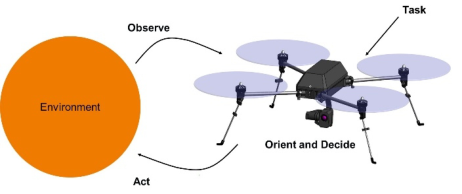
Figure 1: Domains of human systems integration: An autonomous system interacts with its surroundings. The shift of single to multi-UxS operations affect operators of these systems because their attention is limited, so UxS systems has to be built wisely (adapted from Nummedal, 2021).
Research, industry and military consider by ensuring that control and com- mand Functions integrate human capabilities and human limitations properly a prerequisite for enabling future multi-UxS system functioning safely. It has become clear that treating the system as separate from the users results in poor performance and potential failure in the operational setting. Continued growth in technology has not delivered desired results. Systems engineers and others are beginning to understand the role humans play in technology systems. The core challenge is to balance successful hardware and software solutions with human friendly implementations. The Foundation of Techno- logical Principles and Human Factors Knowledge is therefore needed to take the Operational Demands seriously when prototyping UxS systems.
In such cases, we have previously suggested (Stensrud et al., 2023c) that there are often requirements for interaction design patterns based on founda- tions in design theory, interaction between humans and UxS systems (Lyons et al., 2021, p. 2). This underscore the need for human-autonomy teams
(HATs) defined as “at least one human working cooperatively with at least one autonomous agent” (McNeese et al., 2018, p. 262). Prior research have suggested that when complexity of the environment is low more decisions may be delegated to the computer entity but when the complexity increases human control is needed (Abbink et al., 2018) yet the capability of both human (Demir et al., 2018) and machine (Kaber, 2018; Mouloua et al., 2020); Lundberg and Johansson (2021, p. 382)) may influence to what extent they can act autonomously in various environments. Specifically we discuss collaboration design approaches, in the face of environmental complexity and dynamism (operational demands), and suggests that the HAT designs have strengths and weaknesses, and to overcome such trade-offs one may use different HAT in concert (Stensrud et al., 2023c).
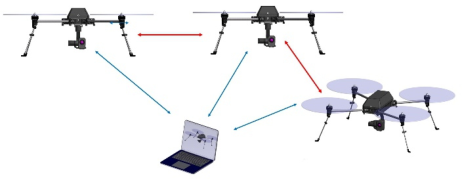
Figure 2: Domains of human systems integration: Autonomy is a prerequisite for enabling a multi-UAV system (adapted from Nummedal, 2021).
On this background, the purpose of this article is to elucidate the follow- ing research question: How do different HAT designs (Interaction Design patterns (Neerincx & Lindenberg, 2008) contribute to support the coor- dination of task under various environmental characteristics? While we have discussed this problem generically in prior work (Stensrud et al., 2023b), we now make more concrete suggestions. We specifically look at the subsurface environmental conditions and the tasks within this particular context.
In this article, we thus discuss how we can evaluate and specify this concerns using methods (sCE-method) to simplify how principles of HAT designs, specifically levels of automation, mixed-initiative and coactive design, may support changes to the workflow between man and machine in a military mission (Sheridan, 1978; Miller, Parasuraman, 2007), due to dif- ferent environmental characteristics (operational demands). This article thus explores some parts of a research gap identified by O’Neill et al. (2021) who call for investigating the role of different task conditions for HAT designs. In a 2020 paper, we discussed the prospect of HAT teaming in the context of unmanned combat aircraft collaborating with fighter jet. Stensrud et al. (2020b) indicated that the dynamic of tasks would influence the type of coor- dination between human and non-human entities requiring a mix of formal and informal mechanisms, but here we add the influence of environmental complexity and look upon a less controllable empirical setting. We discuss a use case building on prior empirical and conceptual work that we and others (Hamstra et al., 2019; Frey et al., 2018), have done regarding eval- uating UxS-systems (e.g., Mathiassen et al. 2022; Stensrud, 2020a; Stensrud,
Exploring Human Autonomy Teaming Methods in Challenging Environments 107
2021a; Stensrud, 2021b). Finally, we discuss future research and practical implications.
SUPPORTIVE TOOLS FOR DESIGN AND MODELLING The systems engineering team relies on each branch to assist in analyzing customer requirements (see Figure 4). Research has shown that aspects and components remained, until today, with no established methodologies or evaluation tools to link various human aspects to systems engineering models due to two reasons (Meilich, 2008): lack of relevant taxonomy linkage to SE needs and poor domain languages.
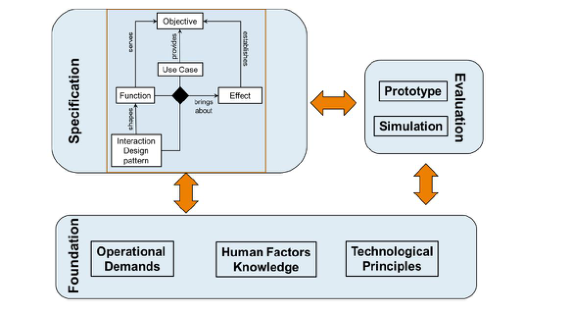
Most of the requirements for human systems integration are derived from requirements and specification for interaction design that shapes functions needed to provide use case that brings about effect providing the objec- tives for performance, efficiency, environmental, operational, maintenance, and training (see Table 1). One of the obstacles to realizing the substantial potential of proper interaction design patterns is the lack of clear articu- lation of foundation: technological principles, Human factors knowledge requirements (Neerincx & Lindenberg, 2008). Followed in the Statement of Work (SOW) or other authorizing documentation received from the customer, and the lack of a Reference Software Architecture decomposed into proper configuration items to track requirements changes.
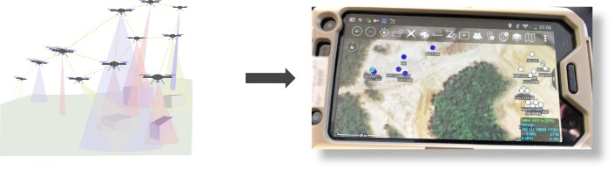
Figure 3: Domains of human systems integration: autonomy must be distributed to reduce vulnerability and be scalable (adapted from Nummedal, 2021).
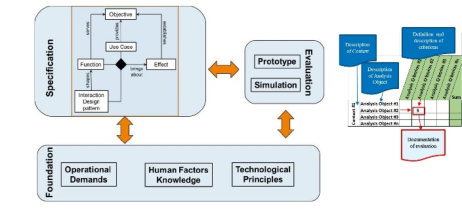
An important component of the human systems integration plan should be a verification and validation process that provides a clear way to evaluate the success of human systems integration. The human systems integration team should develop a test plan (Stensrud et al., 2023a) that can easily be incorporated into the systems engineering test plan. The effectiveness and performance of the human in the system needs to be validated as part of the overall system. It may seem more attractive to have stand-alone testing for human systems integration to show how the user interacts with controls or displays, how the user performs on a specific task. This methodology can address the performance of the human operator or maintainer with respect to the overall system and the situated use case (i.e. operational demands). The most important thing is to develop a close relationship between foundation and specification (Neerincx & Lindenberg, 2008) (Figure 4) when evaluating
the UxS system engineering process. To guide the functional analysis, we sug- gest following the method in Figure 4. In a capability requirements context illustrated in Figure 7 (i.e. the main boxes labelled Foundation, Specifica- tions and Evaluation) we use a Situated Cognitive Engineering (sCE) method (Neerincx & Lindenberg, 2008 cited in Vught et al., 2020).
Functional Analysis There are many different definitions of the term functional analysis. Func- tional analysis involves the use of some form of procedure, that is, a formal procedure, for collecting and organizing data about an empirical phenomenon modeled into an appropriate model with a known format.
Figure 4: Functional analysis - evaluation method are based on the situated cognitive engineering (sCE) method (Neerincx & Lindenberg, 2008 cited in Vught et al., 2020).Table 1. Functional analysis (Neerincx & Lindenberg, 2008 cited in Vught et al., 2020).
Table available in the original PDF paper.
Specification Description Function Function description (command, control, communicate, collaborate, sense, inform) Use Case (Operation Type) Use Case description (ISR/REA/SAR) Interaction Design pattern HAT design approach (LOA, mixed-initiative, coactive design) Objectives Optimizing route plan, optimum track Effect Emission control, counter measure
USE CASE In this sub-chapter, we presents an evaluation model and explains how it can be used. Our UxS system capacities will be codified to be surface vessels, underwater vessels and unmanned aircraft. Undersea, we have iden- tified three contexts that may be interesting to investigate further. These are ISR/REA, ASW and MCM.
Exploring Human Autonomy Teaming Methods in Challenging Environments 109
To guide the development of man-unmanned concepts we outline a set of tenets according to the following intentions: (1) Secure that the need of UxS development activities is identified, (2) Secure that relevant UxS ideas are developed further to solve future missions and tasks, (3) To ensure the integrity of the UxS framework, secure that the good ideas generated on lower level in the defence organization, is deeply top-down rooted, (4) Provide for sufficient resources to be allocated to the development of actual UxS con- cepts, and (5) Secure concept development (R&D activity) is improving the military decision-making process concerning UxS prototyping.
To be able to satisfy this there is a need for a systematic approach (Stensrud et al., 2021a).
Evaluation of an Use Case The assessment of a possible broad introduction of UxS in the Norwegian Armed Forces can be regarded as concept development where the hypothesis is that the UxS will provide a relevant operational effect that is interesting to utilize.
This article presents a framework and a method for how operational impact assessments can be carried out supporting a strategic UxS plan for Norwegian Defence. The chapter is structured by arguing why this type of framework is important. The following sub-chapters give an overall prin- cipled presentation of the method and model that has been developed, and present and discuss the various parts of the model. Readers interested in more details, it is described how such a model can be used in Stensrud et al. (2021a). Attempts have been made to illustrate the connection between scenarios, functions and types of operations in Stensrud et al. (2008). Our principled approach to context is done primarily through scenarios for example ISR / REA, this often means that the analysis object’s contribution to the exercise of the function must be considered within several scenarios. This focuses the analysis group in their assessment of the AUV’s operational effect.
Use Case: Subsurface UxS system In the sub-chapter we present a Use Case: Subsurface UxS system as an anal- ysis object. Subsurface UxS’s can be classified based on a number of criteria. Two overall criteria have so far been defined. One is related to size and weight (hereinafter referred to as weight class). The second is related to which payload / equipment the object carries (hereinafter referred to as equipment class). Below we are focusing on autonomy of a subsurface UxS as a main feature for future success in maritime operations.
Subsurface UxS payload/equipment and functions is presented below in Figure 5, framing on autonomy of a subsurface UxS as a future challenge.
Subsurface UxS’s can be classified based on a number of criteria. We have left this exercise to Stensrud et al. (2008). Ultimately, the analysis process may look at the aggregated system – i.e. the UxS in conjunction with the type of other entities (e.g. manned platform) it will support. The analysis teams will then have to evaluate the combined effect of the manned platform as well as the unmanned platform. The principle structure of the functional analysis,
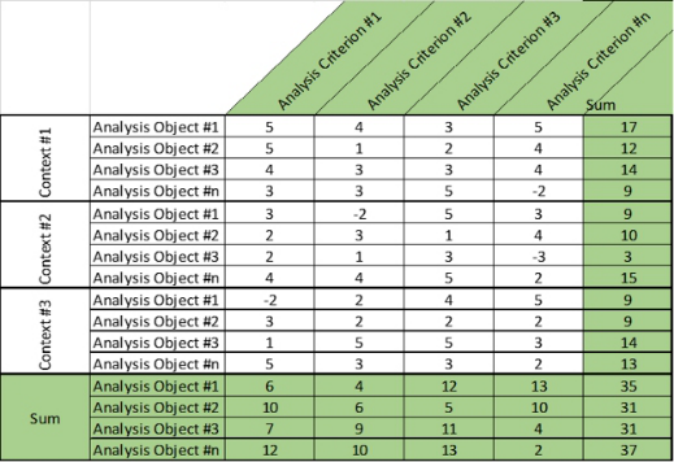
evaluation and compilation results (e.g. a semi-structured soft OR evaluation method), presented in Figure 7. However, showing where the analysis object with the maximum suitability in each context might not be the object with the highest overall score. There may be instances where the unmanned plat- form may for each context have a lower than maximum score, but where the sum total over all the contexts might be the highest of all the analyzed objects/configurations, as shown in Figure 8.
Figure 5: Autonomous control of underwater platforms is a main feature for future success in maritime operations (adapted from Kalloniatis, 2020).
Figure available in the original PDF paper.
The analysis object can be seen as the specific configuration of man- unmanned systems. Different analysis objects can be enumerated based on whether they conform to design principles. For example the first analysis object could utilize the traditional LOA-approach, while a second analysis object would use the mixed-initiative and the third would use coactive design.
These different configurations, analysis objects, will then be evaluated according to analysis criterions of how well they solve the tasks in differ- ent environments. In the analysis criterion 1 they would for example solve a surveillance mission in low complexity and low dynamism. Typically in well-known coastal regions in the country of origin. High complexity and dynamism, a criterion 2, could be off-coast missions or missions in foreign coastal regions, e.g. where there is less preparedness in terms of mapping of the subsurface environment (both the geographical and the exact pattern of movements in that environment). To ensure scientific rigour one would like to “tease” out the specific effects of say complexity and dynamism and the more precise analysis would treat these both separately and interactively. Evaluation of the human decision making and task load (i.e. human factors) under these different criterions is critical to enable the full analysis of the viability of the different configurations, analysis objects.
Figure 6: A slightly extended functional analysis - (Neerincx & Lindenberg, 2008 cited in Vught et al., 2020).
Exploring Human Autonomy Teaming Methods in Challenging Environments 111
Figure 7: Illustration of a possible evaluation: Scenarios - functions - types of opera- tions when assessing a new capability within the strategic planning process (adapted from Stensrud et al., 2008).
CONCLUSION
We have presented research of Norwegian Defence Research Establishment (FFI) that explored limitations and possibilities with a common experimen- tal approach independent of application with the “same” autonomy. This enables FFI to explore several demonstrator systems at the same time. This ensures synergies with FFI’s partners and makes it uncomplicated to have a joint investment in autonomy in several application projects (UGV’s, AUV’s and UAV’s).
Key answers from a Quick Evaluation on FFI’s demonstrator UxS system: A multi-UxS system increases capacity without increasing the number of UxS- operators. Autonomy makes it possible to control several vessels at the same time. Autonomy will redefine UxS operations. A multi-UxS system allows control of different types of vehicles.
ACKNOWLEDGMENT
The authors would like to acknowledge colleagues at FFI, Norway partici- pating in the Autonomy program at the Institute contributing to this research (Mathiassen et al., 2022; Nummedal, 2021).
REFERENCES
Abbink, D. A., Carlson, T., Mulder, M., de Winter, J. C. F., Aminravan, F., Gibo, T. L., & Boer, E. R. (2018). A Topology of Shared Control Systems—Finding Common Ground in Diversity. IEEE Transactions on Human-Machine Systems, 48(5), 509–525.
Bromley, D. B. (1986). The case-study method in psychology and related disciplines.
Chichester, Wiley. Cook, T. D., & Campbell, D. T. (1979). Quasi-Experimentation: Design and Analysis Issues for Field Settings. Cvetkovic, I., & Bittner, E. (2022). Task Delegability to AI: Evaluation of a Frame-
work in a Knowledge Work Context. Hawaii International Conference on System Sciences. Demir, M., Cooke, N. J., & Amazeen, P. G. (2018). A conceptual model of team dynamical behaviors and performance in human-autonomy teaming. Cognitive Systems Research, 52, 497–507. Frey, T. L., Aguilar, C., Engebretson, K., Faulk, D., & Lenning, L. G. (2018, June 25).
F-35 Information Fusion. 2018 Aviation Technology, Integration, and Operations Conference. 2018 Aviation Technology, Integration, and Operations Conference, Atlanta, Georgia. Hamstra, J. W. (Ed.). (2019). The F-35 Lightning II: From Concept to Cockpit.
American Institute of Aeronautics and Astronautics, Inc. Johnson, M., Bradshaw, J. M., & Feltovich, P. J. (2018). Tomorrow’s Human– Machine Design Tools: From Levels of Automation to Interdependencies. Journal of Cognitive Engineering and Decision Making, 12(1), 77–82. Johnson, M., Bradshaw, J. M., Feltovich, P. J., Jonker, C. M., van Riemsdijk, B., &
Sierhuis, M. (2011). The Fundamental Principle of Coactive Design: Interdepen- dence Must Shape Autonomy. In M. De Vos, N. Fornara, J. V. Pitt, & G. Vouros (Eds.), Coordination, Organizations, Institutions, and Norms in Agent Systems VI (Vol. 6541, pp. 172–191). Springer Berlin Heidelberg. Kaber, D. B. (2018). A conceptual framework of autonomous and automated agents.
Theoretical Issues in Ergonomics Science, 19(4), 406–430. Kalloniatis, A. (2020). “One Ring to Rule them All and through the Headquarters Bind them AI, emergence, and the Planning-Execution-Evaluation continuum in a Fifth Generation Headquarters.,” 25th ICCRTS, paper_61. Lundberg, J., & Johansson, B. J. E. (2021). A framework for describing interac-
tion between human operators and autonomous, automated, and manual control systems. Cognition, Technology & Work, 23(3), 381–401. Lyons, J. B., Sycara, K., Lewis, M., & Capiola, A. (2021). Human–Autonomy Teaming: Definitions, Debates, and Directions. Frontiers in Psychology, 12, 589585. Mathiassen, K., & Nummedal, O. R. (2022). LandX20 Experiment Report – exper-
iment for future land warfare capabilities with focus on increased situational awareness and unmanned systems (FFI-Report No. 22/00274). FFI; 978-82-464- 3390-5. https://www.ffi.no/publikasjoner/arkiv/landx20-experiment-report-expe riment-for-future-land-warfare-capabilities-with-focus-on-increased-situationa l-awareness-and-unmanned-systems McNeese, N. J., Demir, M., Cooke, N. J., & Myers, C. (2018). Teaming With a Synthetic Teammate: Insights into Human-Autonomy Teaming. Human Factors: The Journal of the Human Factors and Ergonomics Society, 60(2), 262–273. Meilich, A. (2008). INCOSE MBSE Initiative Status of HSI/MBSE Activity (Presen-
tation). Mercado, J. E., Rupp, M. A., Chen, J. Y. C., Barnes, M. J., Barber, D., & Procci, K.
(2016). Intelligent Agent Transparency in Human–Agent Teaming for Multi-UxV Management. Human Factors: The Journal of the Human Factors and Ergonomics Society, 58(3), 401–415.
Exploring Human Autonomy Teaming Methods in Challenging Environments 113
Miller, C., & Parasuraman, R. (2007). Designing for Flexible Interaction Between Humans and Automation: Delegation Interfaces for Supervisory Control. Human Factors, 49, 57–75. Mouloua, M., Hancock, P. A., & Ferraro, J. (Eds.). (2020). Human performance
in automated and autonomous systems. Current theory and methods. CRC Press/Taylor & Francis Group. Myers, C., Ball, J., Cooke, N., Freiman, M., Caisse, M., Rodgers, S., Demir, M., & McNeese, N. (2019). Autonomous Intelligent Agents for Team Training. IEEE Intelligent Systems, 34(2), 3–14. Neerincx, M., & Lindenberg, J. (2008). Chapter 18: Situated Cognitive Engineering
for Complex Task Environments. Nummedal, O. R. (2021). Flamingo - a UAV for autonomy research (FFI-Report No.
21/00318). FFI; 978-82-464-3307-3. O’Neill J.et al.. (2020). ‘Agile Control_ Distributed Collaborating Deciders.’ 25th ICCRTS, paper_122. O’Neill, J., J. McDonald, P. Brown, R. Newbold, T. Milas, (2021) A Knowledge-
Based Approach to Defining Decider Types for Decider Collaboration Implement- ing Agile Control, 26th ICCRTS. O’Neill J. et al. (2023). ‘Applying a Mission-Engineering Thread Approach Using Sense-Decide-Effect to the Problem of a Common C2 System for UxS’ 28th ICCRTS, paper_04. O’Neill, T., McNeese, N., Barron, A., & Schelble, B. (2022). Human–Autonomy
Teaming: A Review and Analysis of the Empirical Literature. Human Factors: The Journal of the Human Factors and Ergonomics Society, 64(5), 904–938. Open Mission Systems, https://www.vdl.afrl.af.mil/programs/oam/oms.php. Robotics and Autonomous Systems - Ground (RAS-G) Interoperability Profile (IOP), AEP 4818, 2023, https://standards.globalspec.com/std/14589990/aep4818-vol-i. Sheridan, T., Verplank, W., & Brooks, T. (1978). Human and Computer Control of
Undersea Teleoperators. Stensrud, R. F. Rutledal, F. Danjord, J. I. Hellesnes, and T. Bjørnsgaard, (2008) 25th ISMOR article, “A proposal for a Norwegian Defence Conceptual Framework,”. Stensrud, R., Haugen, T., & Valaker, S. (2023a). Unified Vision-series of military
exercise - the methodological struggles in conducting evaluation of Human Factors and Systems Interaction. Applied Human Factors and Ergonomics (AHFE 2023), July 20-24, 2023 - San Francisco Marriott Marquis, California, USA. Stensrud, R., Mikkelsen, B., Betten, S., & Valaker, S. (2021a). A proposal for a simple evaluation method in support of the initial concept phase assessing a future unmanned Loyal Wingman for Royal Norwegian Air Force (RNoAF). Stensrud, R., Mikkelsen, B., & Valaker, S. (2020a). 5th generation fighter aircraft and
future command and control: A note on some possible changes. 25th international command and control research and technology symposium. Stensrud, R., & Valaker, S. (2023b). Methods to meet changes in the security environment a proposal of qualitative and quantitative assessment attributes for coordination performance. 20th ISCRAM Conference. Stensrud, R., Valaker, S., Haugen, R., & Mikkelsen, B. (2021b). Possible conse-
quences for command and control of shifting coordination form: Navigating the murky waters of adverse situations and complex missions. International command and control research and technology symposium. Stensrud, R., Valaker, S., & Haugen, T. (2020b). Interdependence as an Element of the Design of a Federated Work Process. 2020 IEEE International Conference on Human-Machine Systems (ICHMS), 1–6.
Stensrud, R., Valaker, S., & Mikkelsen, B. (2023c). Orchestrating Humans and Teammates to counter security threats: Human-autonomy teaming in high and low environmental complexity and dynamism. Intelligent Human Systems Integration (IHSI 2023) Integrating People and Intelligent Systems. Unmanned Systems Control Segment (UCS) Architecture, AS6512, 2016, https://ww
w.sae.org/standards/content/as6512. Vagia, M., Transeth, A. A., & Fjerdingen, S. A. (2016). A literature review on the levels of automation during the years. What are the different taxonomies that have been proposed? Applied Ergonomics, 53, 190–202. Vught. (2020). Future hybrid human-robot teams: Functional requirements for Non-
human Intelligent Collaborators (NICs) in an operational context. 25th ICCRTS. Wikberg, P. (2014). Designing Case Studies. In Assessing C2 Effectiveness (pp. 31–48). Ashgate. Yin, R. K. (2018). Case study research and applications: design and methods (Sixth edition). SAGE. Zabrodskyi, M., Watling, J., & Reynolds, N. (2022). Preliminary Lessons in Con-
ventional Warfighting from Russia’s Invasion of Ukraine: February–July 2022 (p. 69) [RUSI]. Royal United Services Institute for Defence and Security Studies.
LISTED IN THE AHFE DIGITAL BOOKSTORE CATALOGUE
Explore the complete digital volume
Application of Emerging Technologies
Read this individual research paper free through the original publisher, or explore the full digital proceedings book.
ISBN 978-1-958651-91-9
Explore this ISBN in the AHFE Bookstore ↗Listed in the July 2026 bookstore catalogue; search by ISBN to confirm current availability · Digital book purchase optional