Rune Stensrud, Sigmund Valaker, Aleksander Simonsen, Ina Berby (2026). Engineering Safe Human-Autonomy Teaming in Swarm Drone Simulator Applications Using System-Theoretic Process Analysis extended for Coordination. In: Safety Management and Human Factors. AHFE Open Access, vol. 227, pp. 88–101. https://doi.org/10.54941/ahfe1007920
This paper presents a structured safety engineering approach to swarm drone simulator applications using System-Theoretic Process Analysis extended for Coordination (STPA-Coordination). The method is applied to the Valkyrie UAS certification program conducted by the Norwegian Defence Research Establishment, which involved multi-drone missions under dynamic environmental conditions. Observational data revealed coordination challenges such as degraded communication, role ambiguity, and misaligned intent between human operators and autonomous agents. STPA-Coordination was used to model control structures, identify unsafe control actions (UCAs), and generate coordination-related loss scenarios across nine essential elements. To better visualize results, we have included STPA-Coordination analysis and extended on modelling work functions as a network. Design constraints and training interventions were derived to mitigate risks. The integration of STPA-Coordination into simulator-based training enhanced cognitive comprehension and team coordination, supporting safer deployment of autonomous systems in reconnaissance and ISR missions. This work contributes to the Safety Engineering track by demonstrating how system-theoretical safety analysis can be embedded into certification and training workflows to proactively address coordination hazards.
The increasing operational demand for unmanned aerial systems (UAS) in defense contexts has accelerated the need for scalable, safe, and cognitively manageable human-autonomy teaming frameworks. As military operations evolve toward distributed and multi-agent autonomy, the challenge lies not only in deploying swarms of drones but in ensuring that human operators
Engineering Safe Human-Autonomy Teaming in Swarm Drone Simulator Applications 89 can effectively command and control these systems under dynamic and high- risk conditions. Further the increasing integration of autonomous systems into military operations requires frameworks that ensure for frameworks that ensure safe and trustworthy human–autonomy teaming.
In this paper, drone swarm operations refer to the coordinated control of multiple drones as a collective system.” This study examines coordination safety in drone swarm operations operations by applying STPACoordination to empirical data from the Valkyrie UAS certification program, specifically Sessions 2a and 2b. “The certification framework includes both structured training and subsequent certification processes.” The works contributes by showing how observed coordination breakdowns can be systematically modeled as unsafe control actions and transformed into actionable design constraints and training interventions.
Recent literature reviews by (Iftikhar et al. (2023), and Cools & Maathuis (2024)) highlight overlapping concerns in both Human–Agent Teaming (HAT) and Lethal Autonomous Weapon Systems (LAWS), particularly around trust, transparency, coordination, and ethical accountability. While (Cools & Maathuis (2024)) emphasize the regulatory and moral imperatives of trustworthy AI in military contexts, (Iftikhar et al. (2023)) provide a granular analysis of team dynamics, function allocation, and emergent coordination challenges. Complementing these perspectives, More et al. (2024) offer an exploratory literature review on shared leadership as a mechanism to enhance collaboration and function allocation in human–autonomy teams. Their synthesis underscores the importance of distributed authority, mutual influence, and adaptive role-switching—elements that are especially relevant in swarm drone operations where dynamic tasking and real-time coordination are critical. By framing shared leadership as a coordination enabler rather than a hierarchical control mechanism, More et al. (2024) provides a conceptual bridge between behavioral and systems-theoretic approaches. This aligns with the STPA-Coordination framework’s (Leveson et al., 2018; Pennington et al., 2025) emphasis on authority distribution (Stensrud et al., 2023), predictability, and common understanding, suggesting that leadership distribution should be explicitly modeled and trained within simulator-based certification programs. This synergy ensures that mission adaptability is preserved even under “degraded communication” while maintaining predictability and common understanding within and across human-autonomy teams human–autonomy teams. (Simonsen & Ruud et al. (2020)) While Miller & Parasuraman (2007) emphasize delegation interfaces for supervisory control based on predefined authorities, Simonsen & Ruud et al. (2020) operationalize these concepts through algorithmic control strategies that dynamically adjust autonomy levels based on situational demands, reinforcing the system’s ability to handle uncertainty without compromising safety.
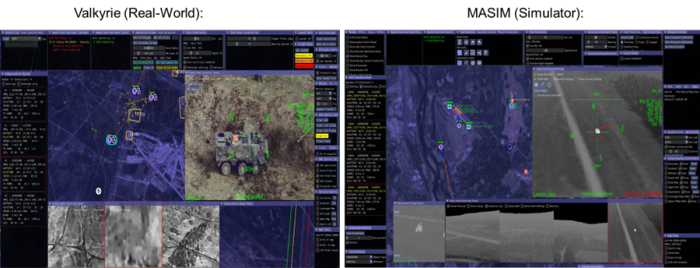
Figure 1: Bifrost Human-Swarm system interface. (Photo: Simonsen et al., 2024/ FFI).
Despite these advances traditional safety analysis methods such as Failure Modes and Effects Analysis (FMEA) and Fault Tree Analysis (FTA) fall short in addressing emergent behaviors and coordination failures in sociotechnical systems. To overcome these limitations, this study applies System-Theoretic Process Analysis extended for Coordination (STPA-Coordination) Pennington et al. (2026), a method grounded in systems theory that models safety as a control problem rather than a reliability issue. Integrating STPA- Coordination with Model-Based Systems Engineering (MBSE) via the Risk Analysis and Assessment Modeling Language (RAAML) provides a structured pathway for embedding coordination-related safety requirements directly into the system model.
The article addresses the central challenge of ensuring safe and reliable coordination between human operators and autonomous agents in drone swarm operations. Its contribution lies in showing how STPA-Coordination, applied within an operational certification program, can expose subtle coordination hazards and translate them into actionable design constraints and training interventions.
These findings suggest that drone operator certification programs should prioritize training that fosters team cognition, role clarity, and coordination skills, not just technical proficiency.
USE CASE AND CONTEXT FOR THE STPA-ANALYSIS This study applies System-Theoretic Process Analysis extended for Coordination (STPA-Coordination) to swarm-drone operations within the Valkyrie UAS certification program, a structured five-day course combining classroom teaching, simulator-based training, and live flight sessions. The program revealed recurring coordination challenges—such as degraded communication, role ambiguity, and misaligned intent between operators and autonomous agents (Okhuysen and Bechky, 2009; Dahmani et al., 2024; Capiola et al., 2023)—that highlight the need for proactive system-level safety analysis.
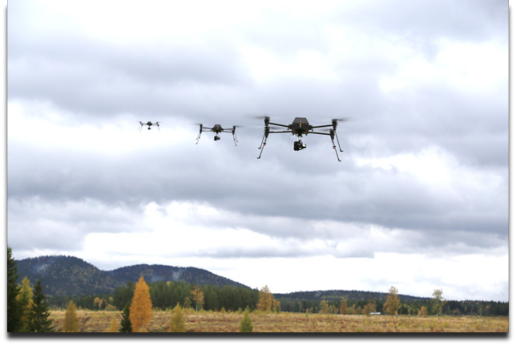
The Valkyrie system comprises three UAV types (Svale, Flamingo, Hubro), each equipped with onboard autonomy for collision avoidance, precision landing, and ISR tasks supported by machine-vision algorithms. The system
Engineering Safe Human-Autonomy Teaming in Swarm Drone Simulator Applications 91 has been exercised in operationally relevant environments such as Nordic Response 2024 and Joint Viking 2025, demonstrating autonomous surveillance, digitally assisted fire support (DAFS), and no-communication search missions. A central component is the HAL fallback module, responsible for autonomy-driven decision-making under “repeatedly observed coordination challenges under varying conditions” Operators control the swarm through the unified Bifrost Human–Swarm Interface— which is identical across MASIM simulations and real flight—enabling task allocation, sensor control, tactical overlays, and transitions between manual, autonomous, and human-in-the-loop modes. The interface’s design supports persistent tasking and seamless movement between simulated and operational contexts, reinforcing situational awareness and mission adaptability.
Figure 2: The “Valkyrie” research program. (Photo: Ragnar Smestad /FFI.).
A key contribution from Paul et al. (2024) in relation to the certification of drone operators is the emphasis on common understanding as a central coordination mechanism. The study shows that in complex, multi-team environments, like operating suites or drone operations—shared mental models, direct communication, and mutual trust significantly enhance performance.
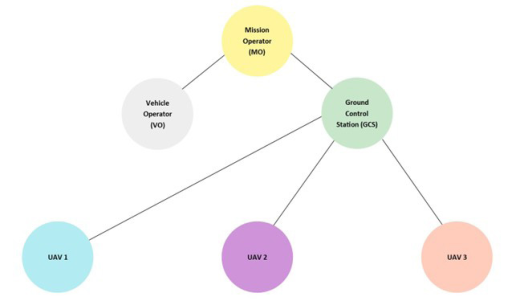
Certification Processes as a Supportive Framework for Learning The certification framework trains operators to manage multiple UAVs within human-autonomy teams and across dynamic environmental conditions, with explicit emphasis on Mission Operator (MO) and Vehicle Operator (VO) role switching. Observational data from the course documented coordination issues such as loss of radio contact, battery depletion, and inconsistent alignment between human intent and autonomous behaviors. These observations motivated the application of STPA-Coordination to systematically examine how unsafe control actions (UCAs) arise during swarm operations and how they can be mitigated through interface design and training interventions. Figure 3 provides the generic control structure underlying Valkyrie swarm operations.
Figure 3: Generic control structure diagram for Valkyrie swarm drone operations.
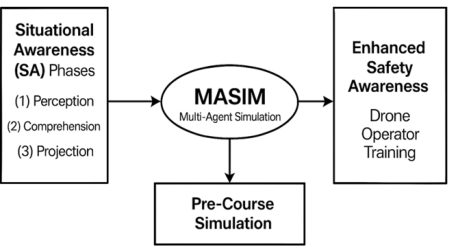
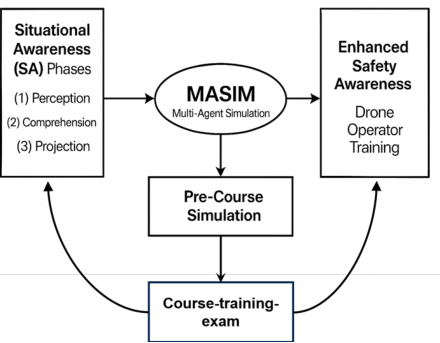
How Multi-Agent Simulation Connects Situational Awareness Phases With Enhanced Safety Awareness and Pre-Course Training Multi-Agent Simulation (MASIM) plays a central role by replicating swarm dynamics and human–automation interactions at low operational risk. MASIM supports persistent tasking, adaptive autonomy, and leader–follower coordination, consistent with flexible autonomy principles described by Simonsen & Ruud et al. (2020) and delegation interface models by Miller & Parasuraman (2007). MASIM enables operators to rehearse coordination- intensive scenarios before “actual flight training” strengthening predictability, resilience, and cognitive readiness. Figure 4 illustrates MASIM’s integration into situational awareness (SA) training.
Figure 4: MASIM integration diagram showing how multi-agent simulation connects situational awareness phases with enhanced safety awareness and pre-course training.
STPA-Coordination enables structured identification of unsafe control actions (UCAs), coordination-related hazards, and design constraints across nine essential coordination elements, including authority, communication, predictability, and common understanding.
Previous applications of STPA-Coordination in air combat scenarios and human-autonomy teaming have demonstrated its utility in modeling complex interactions between human and AI agents (Penningtion et al., 2026). This paper builds on those foundations by integrating STPA-Coordination into
Engineering Safe Human-Autonomy Teaming in Swarm Drone Simulator Applications 93 the Valkyrie certification workflow and Bifrost interface design, offering a proactive framework for engineering safe human-autonomy teaming in swarm drone operations adaptability.
Situational Awareness Training Combined With Enhanced Safety Multi-Agent Simulation in Pre-Course Training Situational awareness development in Valkyrie follows Endsley’s three-phase SA model (perception, comprehension, projection). Pre-course MASIM training supports each phase:
Perception: visual and tactical overlays reduce information clutter, improving detection of relevant cues;
Projection: exercises involving HAL fallback and contingency planning support prediction of future autonomy states.
Observational data showed that alert overload, role ambiguity, and autonomy misalignment occasionally degraded team SA, underscoring the need for structured coordination-safety interventions. Embedding STPA- derived constraints—such as clarified authority cues and prioritized sensor feedback—into simulation scenarios enhanced both individual and team SA. (Endsley,1995; Endsley,2015; Valaker et al., 2018)
Role of Multi-Agent Simulation (MASIM) As simulator-based approaches improve cognitive readiness while reducing operational risk, their integration with STPA-Coordination provides a dual pathway for hazard identification: (1) simulatorgenerated loss scenarios that expose unsafe control patterns, and (2) live-session observations that validate whether hazards occur under real environmental pressures. Simulation based training has been shown to improve learning outcomes (Lohman, 2020) and performance (Russel et al., 2016) compared to training in classroom instruction. Operators who complete pre-simulation training have also shown better “actual flight training” performance than those without (Sommerville et al., 2024). This combined approach offers a robust foundation for designing scalable, trusted, and safety-centered human– autonomy teaming frameworks for high-risk multi-UAS operations.
METHODS
This study employed a mixed-methods design combining (1) observational data from operator certification sessions in the Valkyrie UAS program, (2) systems-theoretic safety analysis using STPA-Coordination, and (3) interface evaluation of the Bifrost Human-Swarm system (Stensrud et al., 2021; Simonsen et al., 2023). The purpose was to identify coordination- related hazards and derive design constraints that enhance safety in swarm- drone operations. An extension of the MASIM illustration in Figure 4 is shown in Figure 5.
Figure 5: MASIM integration diagram showing how multi-agent simulation connects situational awareness phases with enhanced safety awareness and pre-course training and “actual flight training” - followed by safe certification.
Certification Framework and Data Collection The Valkyrie certification course spanned five days and consisted of 1.5 days of classroom instruction, one day of simulatorbased training (MASIM), and 2.5 days of “actual flight training” exercises. Operators alternated between Mission Operator (MO) and Vehicle Operator (VO) roles while managing up to three drones. Data collection included realtime voice logs, system messages, instructor debriefs, observer notes, and structured After-Action Reviews (AARs). These datasets captured coordination behaviors under varied environmental and operational stressors.
Simulator and Interface Evaluation The Bifrost Human-Swarm Interface was evaluated in both MASIM and live Valkyrie operations. The interface supports agent selection, task assignment, sensor and payload control, tactical overlays, persistent tasking, and monitoring of autonomous behaviors. Operators interacted with a unified graphical interface ensuring seamless transfer from simulated to real conditions, enabling assessment of usability, cognitive load, and coordination effectiveness across environments.
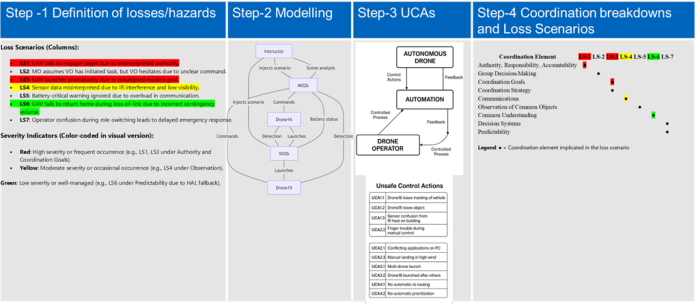
STPA-Coordination Analysis To systematically assess coordination safety, we applied STPA-Coordination using four analytical steps:
1. Define losses and coordination-related hazards 2. Model the multilevel control structure (MO–VO–UAS, instructor interventions, autonomy modules) 3. Identify unsafe control actions (UCAs) across nine essential coordination elements (authority, communication, feedback, predictability, etc.) 4. Generate coordination-related loss scenarios and derive system-level design constraints
Figure 6 systematically expresses the results of Step 1 to Step 4.
RESULTS
The application of STPA-Coordination to the Valkyrie UAS certification process yielded actionable insights into “coordination safety” system behavior, and operator performance under varying conditions. The results are organized into three categories: operational performance, coordination analysis, and design implications. Two pre-examination sessions (2a and 2b) were conducted on 1 February 2024 under different environmental conditions. Session 2a was interrupted due to high wind gusts, while session 2b was completed under reduced visibility and low cloud base. Both sessions confirmed that operators complied with the training syllabus and operational guidelines.
STPA-Coordination was applied to model the control structure and identify unsafe control actions (UCAs) across nine coordination elements. Key findings include: (1) Authority and Role Clarity: Misinterpretation of peer vs. command interactions, (2) Communication and Feedback: Alert overload during multi-drone operations, and (3) Predictability and Common Understanding: Uncertainty about sensor prioritization and task persistence.
Based on the analysis, several design considerations were proposed: i.e., Interface Improvements: (1) Clarify task status and role-based command authority, and (2) Training Enhancements: Emphasize scenario-based training with dynamic adversaries, as well as System Safeguards: Reinforce HAL and Captain Sully “(fail-safe ‘Captain Sully’ module, named after emergency landing principles)” modules for fail-safe behavior.
Hargis et al. (2024) propose that work functions (not just roles or tasks) can be modeled as nodes in a network, where the ties represent dependencies, communication, or coordination needs. This allows for:
Dynamic modeling of team behavior
Identification of bottlenecks or critical nodes
Understanding of interdependence between functions Hargis et al. (2024) emphasize construct level (individual, dyadic, team, multi-team) and model position (antecedent, mediator, moderator, outcome) to analyze how network structure affects performance. An extended STPA-coordination method will expose the following network structure based on our observation of certifying drone operators. Applying to the Mission Operator (MO) – Vehicle Operator (VO)-Drone Swarm Activity a map that defines nodes as work functions Hargis et al. (exemplified in Figure 6 (Step-2)) we can from the certification sessions, define nodes such as:
MO (Mission Operator): Tasking, monitoring, scene analysis
VO (Vehicle Operator): Launch, landing, battery management
System Voice: Alerts, detections (e.g., “new detection”) Each of these can be modeled as functional nodes, not just roles. Define ties as dependencies, where ties could represent:
Information flow (e.g., VO to MO: “Drone 2 low battery”)
Command flow (e.g., MO to Drone: “Track vehicle”)
Coordination (e.g., VO and MO during role switch or emergency landing) Construct-level mapping according to Hargis et al such as:
Individual level: VO1, MO1, Drone 1
Dyadic level: VO–MO coordination
Team level: VO+MO+Instructor
Multi-team level: Across sessions (e.g., 2a, 2b, 3a) Model position mapping supported by Hargis et al. such as:
Mediators: Communication quality, role-switching protocols
Moderators: System alerts, instructor interventions
Outcomes: Successful detection, tracking, landing No tabulator network model (Session 2b) displayed in Figure 6 (Step 2). STPA-Coordination Analysis of session 2b during pre-examination and certification of “drone operators” 1st of February 2024 based on Hargis et al. (2024) modelling method and Pennington et al. (2025) STPA approach is shown in Figure 6.
Figure 6: STPA-coordination analysis of session 2b during pre-examination and certification of drone operator’s 1st of February 2024 based on Hargis et al. (2024) and Pennington et al. (2025).
DISCUSSION
The application of STPA-Coordination to the Valkyrie swarm drone certification process revealed critical insights into the nature of coordination hazards in human–autonomy teaming. By analyzing real-world certification sessions and simulator-based training, we were able to identify coordination breakdowns across all nine essential elements defined in the STPA- Coordination framework. This structured approach provided a level of analytical completeness not achievable through ad-hoc methods. One of the
Engineering Safe Human-Autonomy Teaming in Swarm Drone Simulator Applications 97 key findings was the importance of role clarity and authority recognition. Operators occasionally misinterpreted whether commands were authoritative or peer-level, particularly during role-switching between Mission Operator (MO) and Vehicle Operator (VO). This ambiguity contributed to delayed task execution and misaligned expectations, reinforcing the need for interface cues and training that distinguish command intent.
Communication overload emerged as another challenge, especially during multi-drone operations. System-generated alerts such as “new detection” were effective but sometimes overwhelmed operators, leading to missed cues or delayed responses. This highlights the need for adaptive communication filtering and prioritization mechanisms within the Ground Control Station (GCS).
The analysis also underscored the value of predictability and common understanding in autonomous behavior. While the Valkyrie system’s fallback procedures performed reliably during loss-of-link and battery-critical events, operators expressed uncertainty about sensor prioritization and task persistence. This gap between system behavior and operator expectation suggests a need for improved transparency and explainability in autonomy logic. These results also reinforce that fidelity gaps—particularly the absence of socioemotional stressors, degraded environmental realism, and true temporal pressure—limit the transferability of simulator-trained coordination behaviours to live operations, underscoring the need for validation mechanisms that bridge simulation and operational environments. Table 1 summarizes these observations by outlining key research gaps directly relevant to coordination safety, ranging from bidirectional trust modelling to dynamic function allocation and ethical transparency in operator interfaces. By aligning these gap areas with concrete methodological directions—such as scenario-based STPA, agent-based simulation, and MBSE-driven traceability—the Table 1 provides a structured roadmap for advancing future applications of STPA-Coordination in increasingly complex autonomous systems.
Importantly, the STPA-Coordination matrix demonstrated that coordination hazards were not isolated but often involved multiple elements simultaneously. This interdependence reinforces the value of a systems- theoretic approach that accounts for emergent properties and interactions.
Simulation-based training (SBT) offers clear benefits for UAS operator certification. It provides a safe, controlled environment for practicing high-risk tasks without operational consequences, enabling repeated exposure to complex scenarios and fostering resilience under stress (Salas, Wildman, & Piccolo, 2009; Waller, Lei, & Pratten, 2014). SBT enhances cognitive capabilities such as situational awareness, shared mental models, and transactive memory systems—competencies shown to improve team performance in dynamic contexts (Endsley, 1995; Waller et al., 2014). For drone operations, simulation mitigates resource constraints by reducing reliance on physical assets and instructors, allowing learners to actively engage rather than wait passively for flight slots (Stensrud et al., 2025). Interactive simulations can replicate time pressure and uncertainty, improving adaptability and implicit coordination, which are essential for safe human– autonomy teaming. For instance, structuring the course syllabus so that
operators complete SBT prior to the “actual flight training” maximizing the value of the instructor-led physical flight training.
However, SBT has limitations. Fidelity gaps may lead to overconfidence or miscalibrated expectations when transitioning to live operations (Waller et al., 2014).
Simulations often fail to capture socio-emotional stressors or emergent behaviors fully, limiting transferability of skills. Designing and maintaining high-quality simulations requires significant investment in technology and scenario development, and there is a risk that operators perceive simulations as less consequential, reducing engagement. Finally, SBT cannot replace hands-on experience; “actual flight training” remains indispensable for reinforcing sensorimotor skills and validating decision-making under authentic environmental constraints (Stensrud et al., 2025). In sum, simulation-based training is most effective when integrated with live exercises and structured debriefs, ensuring cognitive, behavioral, and technical competencies align with operational realities. Finally, the results validate the utility of STPA- Coordination as a design-time safety analysis tool. By proactively identifying coordination-related loss scenarios, the framework supports the development of robust UAS systems and operator workflows.
Table 1: Future research gaps table tailored to STPA-coordination method ((Johnson, K.E. (2017))) and informed by the comparative literature reviews by Iftikhar et al. (2023) and Cools & Maathuis (2024).
Table available in the original PDF paper.
Gap Area Description Relevance to STPA- Coordination Suggested Methodologies Bidirectional Trust Modeling Simulation, behavioral modeling Agents adapting to human reliability and behavior
Enhances predictability and feedback loops Supports resilience and fallback design Scenario-based STPA, fault injection
Coordination Breakdown Recovery
Modeling recovery paths after coordination failure Dynamic Function Allocation Identifies unsafe control transitions
Adaptive control modeling, agent-based simulation
Real-time task reassignment in mixed-initiative teams
Interface prototyping, cognitive walkthroughs
Ethical Transparency in Interfaces
Making ethical reasoning visible to operators
Improves common understanding and accountability
Cross-Domain STPA Validation
Case studies, comparative analysis
Tests scalability and domain-specific constraints
Applying STPA- Coordination beyond aerial systems MBSE Integration
Toolchain development, systems modeling
Linking STPA outputs to system design tools
Enables traceability and certification alignment
CONCLUSION
This work delivers a significant methodological contribution by demonstrating how STPA-Coordination can be operationalized as a unified framework for engineering safe and trustworthy human–autonomy teaming in swarm-based UAS operations. By applying the method to real certification scenarios within the Valkyrie program, we show that coordination hazards emerge not from isolated human or autonomy failures, but from systemic interactions within the multi-agent control structure. Modeling unsafe control actions across all nine coordination elements enabled the derivation of precise, system- level design constraints and training interventions that directly improved operator predictability, authority clarity, and human–autonomy alignment. A key contribution of this study is the demonstrated integration of STPA- Coordination with simulator-based and live operational testing, providing a repeatable pathway for translating coordination-related loss scenarios into certifiable safety requirements. This bridging of analysis, design, and training establishes a replicable blueprint for proactive safety engineering in complex autonomous systems, something that traditional reliability- based methods cannot achieve. The results further indicate that extending STPA-Coordination with work-function network modeling provides a novel lens for identifying coordination bottlenecks and emergent dependencies in multi-agent teams. This strengthens the theoretical foundation for analyzing distributed authority, intent alignment, and adaptive role structures in swarm operations. Looking ahead, integrating STPA-Coordination artifacts into MBSE toolchains represents a promising direction for lifecycle safety assurance, enabling end-to-end traceability from hazard analysis to certification evidence. Broader cross-domain validation—across maritime, cyber, and humanitarian robotics—will be essential for establishing generalizability and operational robustness. As autonomous systems continue to expand in scale and authority, STPA-Coordination offers a high- leverage systems-theoretic approach for ensuring transparent, predictable, and resilient human–autonomy teaming.
Declaration of generative AI and AI-assisted technologies in the writing process During the preparation of this work the authors used Copliot to generate the introductory sentence. After using this tool/service, the authors reviewed and edited content as needed and took full responsibility for the content of the published article.
ACKNOWLEDGMENT
The authors would like to acknowledge colleagues at Norwegian Defence Research Establishment (FFI) participating in the Autonomy program at the Institute contributing to this research, led by Dr. Rikke Seehus. We are grateful to Six Robotics AS, for contributing important insights about VALKYRIE swarm system during the experiments in 2024.
REFERENCES
Capiola, August, Joseph B. Lyons, Krista N. Harris, Izz aldin Hamdan, Siva Kailas, and Katia Sycara. “‘Do What You Say?’ The Combined Effects of Framed Social Intent and Autonomous Agent Behavior on the Trust Process.” Computers in Human Behavior 149 (2023): 107966. https://doi.org/10.1016/j.chb.2023.107966. Chiou, Erin K., and John D. Lee. “Trusting Automation: Designing for Responsivity
and Resilience.” Human Factors: The Journal of the Human Factors and Ergonomics Society 65, no. 1 (2023): 137–65. https://doi.org/10.1177/00187208211009995. Cools, Kasper, and Clara Maathuis. “Trust or Bust: Ensuring Trustworthiness in Autonomous Weapon Systems.” In MILCOM 2024 - 2024 IEEE Military Communications Conference (MILCOM), 182–89. Washington, DC, USA: IEEE, 2024. https://doi.org/10.1109/MILCOM61039.2024.10773908. Dahmani, Souhayl, Mathias Waelli, and Odessa Dariel. “Contribution of
Coordination Theories to the Determination of Human Factors Associated With Operating Room Perceived Performance.” Anesthesia & Analgesia 139, no. 5 (2024): 1047–55. https://doi.org/10.1213/ANE.0000000000007075. Demir, Mustafa, Myke Cohen, Craig J. Johnson, Erin K. Chiou, and Nancy J. Cooke.
“Exploration of the Impact of Interpersonal Communication and Coordination Dynamics on Team Effectiveness in Human-Machine Teams.” International Journal of Human–Computer Interaction 39, no. 9 (2023): 1841–55. https://doi. org/10.1080/10447318.2022.2143004. Dennis, Alan R., Akshat Lakhiwal, and Agrim Sachdeva. “AI Agents as Team Members: Effects on Satisfaction, Conflict, Trustworthiness, and Willingness to Work With.” Journal of Management Information Systems 40, no. 2 (2023): 307– 37. https://doi.org/10.1080/07421222.2023.2196773. Dennis, Fuller, and Valacich. “Media, Tasks, and Communication Processes: A
Theory of Media Synchronicity.” MIS Quarterly 32, no. 3 (2008): 575. https:// doi.org/10.2307/25148857. Endsley, M. R. (1995). Toward a theory of situation awareness in dynamic systems.
Human Factors, 37(1), 32–64. Hargis, Salvatore, and Martijn IJtsma. “Functional Models of Work to Examine Human-Robot Coordination in Disaster Response.” Proceedings of the Human Factors and Ergonomics Society Annual Meeting 68, no. 1 (2024): 430–36. https:// doi.org/10.1177/10711813241276478. Iftikhar, Rehan, Yi-Te Chiu, Mohammad Saud Khan, and Catherine Caudwell.
“Human–Agent Team Dynamics: A Review and Future Research Opportunities.” IEEE Transactions on Engineering Management 71 (2024): 10139–54. https:// doi.org/10.1109/TEM.2023.3331369. Johnson, K.E. “Systems-Theoretic Safety Analyses Extended for Coordination.” PhD Dissertation, MIT, 2017. https://dspace.mit.edu/handle/1721.1/108922. Leveson, N.G., and J.P. Thomas. STPA Handbook. MIT., 2018. http://psas.scripts.
mit.edu/home/get_file.php?name=STPA_Handbook.pdf. Lohmann, R. (2020). Effects of Simulation-Based Learning and One Way to Analyze Them. Journal of Political Science Education, 16(4), 479–495. https://doi.org/10. 1080/15512169.2019.1599291 Lyons, Joseph B., Katia Sycara, Michael Lewis, and August Capiola. “Human–
Autonomy Teaming: Definitions, Debates, and Directions.” Frontiers in Psychology 12 (2021): 589585. https://doi.org/10.3389/fpsyg.2021.589585. Miller, Christopher A., and Raja Parasuraman. “Designing for Flexible Interaction Between Humans and Automation: Delegation Interfaces for Supervisory Control.” Human Factors: The Journal of the Human Factors and Ergonomics Society 49, no. 1 (2007): 57–75. https://doi.org/10.1518/001872007779598037.
Engineering Safe Human-Autonomy Teaming in Swarm Drone Simulator Applications 101 More, Anirudh, and Nathan Ka Ching Lau. “Exploratory Literature Review on
Shared Leadership to Aid Collaboration and Function Allocation in Human- Autonomy Teams.” In Proceedings of the Human Factors and Ergonomics Society Annual Meeting, 68:1491–95. HFES, 2024. https://doi.org/https://doi. org/10.1177/10711813241273500. Okhuysen, Gerardo A., and Beth A. Bechky. “10 Coordination in Organizations: An Integrative Perspective.” Academy of Management Annals 3, no. 1 (2009): 463–502. https://doi.org/10.5465/19416520903047533. Paul, Tanya S., and Daniel Lafond. “Adjustable Control for Enhanced Interoperability
of Human-Autonomy Teaming Within ISR Operations.” In 2024 International Conference on Military Communication and Information Systems (ICMCIS), 1–10, 2024. https://doi.org/10.1109/ICMCIS61231.2024.10541005. Pennington, Elizabeth S., Kip E. Johnson, Kerianne L. Hobbs, and John M. Colombi.
“Engineering Safe Human-Autonomy Teaming Using STPA-Coordination.” Safety Science 193 (2026): 107011. https://doi.org/10.1016/j.ssci.2025.107011. Russell, J.-E., Van Horne, S., Ward, A. S., Bettis, E. A., Sipola, M., Colombo, M., & Rocheford, M. K. (2016). Large Lecture Transformation: Adopting Evidence- Based Practices to Increase Student Engagement and Performance in an Introductory Science Course. Journal of Geoscience Education, 64(1), 37–51. https://doi.org/10.5408/15-084.1 Salas, E., Wildman, J. L., & Piccolo, R. F. (2009). Using simulation-based training
to enhance management education. Academy of Management Learning & Education, 8(4), 559–573. Simonsen, Aleksander S., and Else-Line M. Ruud. “The Application of a Flexible Leader-Follower Control Algorithm to Different Mobile Autonomous Robots.” In 2020 IEEE/RSJ International Conference on Intelligent Robots and Systems (IROS), 11561–66. Las Vegas, NV, USA: IEEE, 2020. https://doi.org/10.1109/ IROS45743.2020.9341780. Sommerville, A., Lynar, T., Joiner, K., & Wild, G. (2024). Use of Simulation for
Pre-Training of Drone Pilots. Drones, 8(11), 640. https://doi.org/https://doi. org/10.3390/drones8110640 Stensrud, R., Valaker, S., Simonsen, A. S., & Berby, I. (2025). Certifying unmanned systems: Simulator-based training for UAS safety and coordination. In Proceedings of the International Conference on Applied Human Factors and Ergonomics (AHFE). https://doi.org/10.54941/ahfe1006788. Stensrud, Rune, and Sigmund Valaker. “Mixed-Initiative Approaches in the
Design of a Trusted Shift of Coordination Forms in Air Operations: Supporting Collaboration to Handle Loyal Wingmen.” In 2021 International Automatic Control Conference (CACS), 1–6. Chiayi, Taiwan: IEEE, 2021. https://doi. org/10.1109/CACS52606.2021.9638711. Stensrud, Rune, Sigmund Valaker, Aleksander Simonsen, and Olav Rune Nummedal.
“Situation Awareness Training as a Prerequisite for Handling Complexity in Human-Autonomy Teaming: Demonstration and Experiment Proposal,” 2024. https://doi.org/10.54941/ahfe1004514. Stensrud, Rune, Sigmund Valaker, and Per-Andreas Langeland. “Methods to Meet Changes in the Security Environment a Proposal of Qualitative and Quantitative Assessment Attributes for Coordination Performance.” In 20th ISCRAM Conference, 676–91. Omaha, Nebraska, USA: WiPe Paper – Command and Control studies Proceedings of the 20th ISCRAM Conference – Omaha, Nebraska, USA May 2023 J. Radianti, I. Dokas, N. LaLone, D. Khazanchi, eds., 2023. https://idl.iscram.org/files/stensrud/2023/2556_Stensrud+Valaker2023.pdf. Waller, M. J., Lei, Z., & Pratten, R. (2014). Focusing on teams in crisis management
education: An integration and simulation-based approach. Academy of Management Learning & Education, 13(2), 208–221.
LISTED IN THE AHFE DIGITAL BOOKSTORE CATALOGUE
Explore the complete digital volume
Safety Management and Human Factors
Read this individual research paper free through the original publisher, or explore the full digital proceedings book.
ISBN 979-8-950676-03-1
Explore this ISBN in the AHFE Bookstore ↗Listed in the July 2026 bookstore catalogue; search by ISBN to confirm current availability · Digital book purchase optional