Ebo Kwegyir-Afful, Janne Heilala, Jussi Kantola (2023). A Scoping Review on Certified Immersive Virtual Training Applications. In: Human-Centered Metaverse and Digital Environments. AHFE Open Access, vol. 99, pp. 84–91. https://doi.org/10.54941/ahfe1003934
The fourth industrial revolution has given rise to virtual applications for training to meet the rapidly changing work environment. However, there are scanty reviews on the subject in the context of virtual training and certification. The current paper thus presents a scoping review of the literature regarding virtual applications for certification in training for specific competence building. The review essentially focuses on the required processes and outcomes of previous immersive virtual environments for certifications, and the effects of the training on competence measurement reliability. Additionally, the study investigates from the selected publications the learning outcome, competencies gained and the related training acquired. Besides, current weaknesses and strengths of VR applications are presented with suggestions for further improvements. Reviewed articles were obtained by extracting the salient information from publications indexed in four scientific digital libraries utilizing exclusion and inclusion methods. Our research design constituted five steps beginning with the research questions, literature extraction, relevant publication section, data extraction, evaluation and future research agenda. Selected publications also focused on fully immersive virtual reality utilizing HTC VIVE and Oculus Rift. Several advantages of the virtual certification training were discovered including enthusiasm, learning outcome, cost reduction, measurability and effects of the certifications. The majority of the publications focused extensively on the healthcare industry, especially medical/surgical. However, industrial virtual certifications such as hot work safety training, forklift safety operation, crane safety operation, and general work safety were discovered to be lacking. Despite these gaps, current interest and commitments are driving future alternatives for virtual training and certification for improving industrial training and competencies in other areas where utilization is conspicuously limited.
Employee development is a continuous process that must be tailored to the requirements of each organization. This is also essential for the proper gro- wth and development of institutions. Similarly, effective worker training contributes to the achievement of strategic goals and establishes its produ- ctive worth. Despite this, employee development is usually side-lined for direct product development and production process improvement ventures (Berg et al. 2017).
On the other hand, on-the-job training activities, which are usually the status co for employee development initiatives have some limitations worth
A Scoping Review on Certified Immersive Virtual Training Applications 85
addressing. Some of these limitations include; the employee offering the trai- ning might be handicapped in some vital knowledge-based areas, which can affect the trainee (Kiyozumi et al. 2022). Secondly, this method could result in more people being absent from work, which would decrease producti- vity (Stone et al. 2011). Thirdly, it is unlikely to introduce fresh perspectives and expertise to the company. Dangerous situations cannot be presented in real-life training sections due to the life-threatening nature of such situati- ons, thus limiting the trainees’ exposure. In light of this, Industry 4.0, which has the goal to enhance processes and boost productivity, has emerged in recent years to address these issues. The industrial internet of things (IIoT), virtual reality (VR), and augmented reality (AR) are some of the technolo- gies that have been employed in this regard (Mak et al. 2020). Hinging on virtual reality (VR), which is a virtual replica of reality having the user tran- sported to entirely digital and interactive surroundings, provides enormous effects for training (Pitana et al. 2020). Although this technology was initially developed for video games, it has now been used in several sectors, including education, industry, medical/surgical spheres, and the military (Chittaro et al. 2018; Kiyozumi et al 2022). VR is currently advancing and gaining popularity in various industries due to the shortcomings of conventional safety training methods and the expan- ding role VR plays in training, education and safety. This covers a variety of topics, such as medicine/surgery, workplace safety, fire safety, constru- ction safety training, mining safety training, healthcare, and disaster planning (Chittaro et al. 2018).
The focus of this review is specifically on the application of immersive VR for certified training. Thus, the following research questions (RQs) are sought after: RQ1: What is the publication year and channels of the articles selected for the review?
RQ2: Which fields of VR certification has the technology been applied to? RQ3: What is the specific area of the VR application for certified training? RQ4: What are the future research aims stated in the selected publications?
METHODOLOGY
Eligibility Criteria for Document Search The Field of study and data extraction processes: The study deals with a scoping literature review of the application of an immersive virtual reality (VR) environment for certified training. Our search criteria constituted: “Vir- tual reality”, Certifi*, and Training (Word search in titles, abstract, and keywords).
Literature Search Criteria Studies must contain ‘certifi*’, in combination with ‘virtual reality’ and ‘train*’ in their title, keywords or abstract. Studies were also included if they
have other words that are closely related to the idea of ‘certification’ and ‘vir- tual reality’ such as ‘authorization’, ‘recognition’ with ‘virtual environments’, or ‘3D simulation’.
Exclusion criteria: Articles that are only a literature review were exclu- ded to avoid including studies twice. However, those articles that include a literature review and a conceptual and/or empirical part are still included.
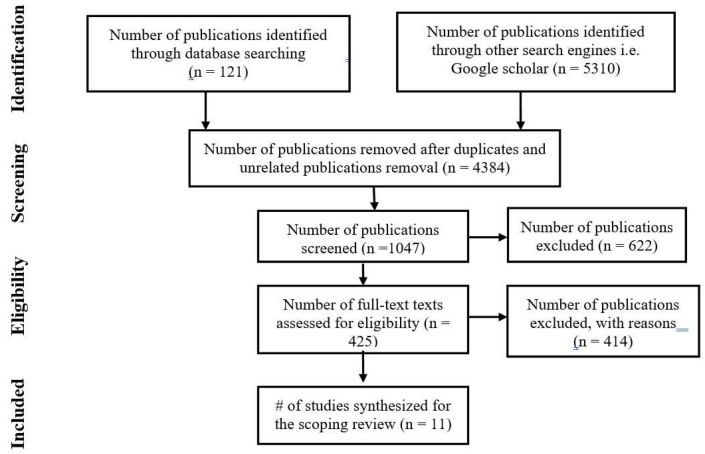
Publication Status and Paper Selection Only international peer-reviewed journal articles and conference proceedings that are indexed in Scopus (21 documents), IEEE Xplore (4 documents), and Web of Science Social Science Citation (96 documents) as well as Google Sch- olar (5310 documents) between 2010 and 2023 were included. This included articles in the early access category. Only studies in English were conside- red. After the first round of filtration, by removing duplicates and unrelated research articles, we achieved a total of 1047 publications. Furthermore, we filtered the search results by analysing the abstracts if the immersive aspects with certi* and train* were the focus of the studies. We achieved a total of 425 articles after removing 622 publications for further assessment. Further filtration discovered 11 potentially relevant publications for inclusion. These are detailed in Figure 1 below.
Figure 1: Data extraction process flow.
RESULTS AND DISCUSSIONS
Literature Review
This sub-section presents the summary of the reviewed selected articles regarding VR applications for certified training.
A Scoping Review on Certified Immersive Virtual Training Applications 87
Xiaohui et al.’s (2021) research focused on training for certification in the field of aviation. The training was to equip participants with the main- tenance, technical skills and theoretical skills as well as the know-how in flight manoeuvres for certification. In other areas, for example, According to Wandell et al. (2010), a virtual reality phlebotomy simulator is compared to a conventional teaching approach for blood collection to see which is more effective. The mannequin arm showed a somewhat better improvement than the other approaches in the results, but the self-directed learning and metrics recorded by virtual reality (VR) simulation may complement training with the mannequin arm in learning fundamental abilities.
Similarly, De Visser et al. (2011), state that VR simulation has offered sufficient and pertinent degrees of physical realism, case complexity, and per- formance assessment, which has rendered it useful as an advanced surgical teaching and assessment tool. Their study further emphasizes that, within the surgical training curriculum, VR simulators need to be properly validated and the medical community has to recognize and accept their capability more. Similar conclusions were obtained by another recent study, which found that while current VR simulations are useful for novice-to-intermediate training in colonoscopy and can be used to separate experts from novices, they are not yet suitable to completely replace traditional training or be utilized for certification. In the military and the aviation sector, simulation is also still expanding.
Giannotti et al.’s (2014) study evaluated the virtual reality laparoscopic simulator’s capacity to distinguish between advanced laparoscopic procedu- res and experience in those measures, as well as its function in the certification of image-guided surgeons. On the VR laparoscopic Lap-Mentor simulator, each participant underwent a basic skills test that included a gastric bypass with a linear stapler which required intense coordination. In this wise, the Lap-Mentor simulator was suggested as a tool for image-guided surgery in certifying surgeons mainly because it also acknowledges their expertise in the technical aspects of the process that have an impact on long-term outcomes. Additionally, the capability of doing a thorough performance analysis can aid in identifying the surgeon’s weak points. These results suggest that the Lap Mentor training simulator may play a part in promoting competence and development. The findings of the study indicated that the Lap Mentor image-guided module’s simulators can be utilized to teach and certify laparo- scopic surgeons even for complex laparoscopic procedures. Additionally, the capability of doing a thorough performance analysis can aid in identifying the surgeon’s weak points for possible improvements.
Dong et al. (2022) developed a VR module for training participants in macromolecular cryogenic electron microscopy (CryoVR), this was inten- ding to equip them to handle real-life CryoEM systems. With several training modules and receiving certificates after passing the built-in exam designed after the necessary verification, CryoVR can assist users in becoming fami- liar with practical operational procedures. CryoEM training has significant obstacles since it is difficult to provide quick, high-capacity training due to the complicated practical processes required by cryoEM. Also, it is essential to demonstrate safety protocols to lessen the danger associated with using the
equipment. However, both participants and the researchers hope to incorpo- rate VR CryoEM systems in future training with recommendations to other researchers and practitioners for its implementation.
Weistroffer et al. (2022) focused on industrial robotics virtual training at workstations in an Italian-Greek-French study. Markopoulos et al. (2022) also conducted a study on virtual training in the maritime sector based in Finland, the UK, and Norway. The study found that virtual training was an effective way of providing trainees with a realistic and safe environ- ment to learn and practice their skills (Markopoulos et al. 2022). In Italy, Giannotti et al. (2014) evaluated virtual reality in the context of medi- cal practice. The study found that virtual reality was an effective tool for improving surgical procedures for bariatric patients. (Giannotti et al. 2014.) An Indonesian study by Pitana et al. (2020) focused on firefigh- ting safety in the maritime sector. The study found that virtual training effectively taught workers how to respond to ship fire emergencies. Both Pitana et al. (2020) and De Visser et al. (2011) similarly conducted a study on integrating virtual surgical training into the medical curricula in Australia.
According to Giannotti et al. (2014), For example, medical module-based simulators can be easily used for training and certification for laparoscopic surgeons. These findings also demonstrate a potential role in Tailoring trai- ning on the tasks that can help to maximize improvement. The experiment thus indicated that simulators might be useful in recruiting new surgeons by evaluating them for the expertise required in specific fields.
Expanding the research-based narrowness of the sample in the future is recommended. The major out flaws could be improved by developing new technologies for virtual reality training (Pitana et al. 2020). The angle of entry is that human compatibility is crucial. Thus, the Global strategy for VR training scenarios and certification is to provide a means of verifica- tion for quality training” (Markopoulos et al. 2022, 41). Markopoulos et al. (2022) also recommended using virtual training to complement traditio- nal training methods because it gave trainees practical experience without the risk of real-world accidents. In turn, Giannotti et al. (2014) intro- spection recommended using virtual reality in surgical training to reduce complications and errors during surgery. The Pitana et al. (2020) study recommended using virtual training to complement traditional training meth- ods because it provided a safe and realistic environment for participants to practice skills. Especially in medicine, the best quality training is recom- mended to be virtualized by De Visser et al. (2011). The utilization of VR schematics in medical curricula complements traditional training meth- ods. The study found that VR effectively taught surgical skills to medical students.
Campo et al. (2016) study reports the certification of clinicians and practi- tioners on theoretical knowledge and specific practical psychomotor training acquired. The VR-based training could be acquired after examining the trai- ning content to acquire the necessary surgical competence for receipt of the corresponding certification.
A Scoping Review on Certified Immersive Virtual Training Applications 89
Answers to RQs This section discusses our research findings based on our RQs. In answer to RQ1, regarding the selected publications and the journals, our results as pre- sented in Table 1, ranges from 2010 to 2022, and publication origins are in these studies diverse as well as the specific journal and the country of research. Similarly, the research field (last column) of the table explains the research area in which the VR certification has been applied to answer RQ2. Although this shows diverse applications, the majority of the publications (36.36%) were however medical/surgical related. This is indicative of the fact that the medical field is championing the VR for training and certification agenda.
Regarding RQ3, which sought to understand the specific area of the VR application for certified training, our literature review section above of the individual publications also shows that the VR tool for certification has been used in specific scenarios, conditions and situations and not just generic as occurs in most real-life training sections.
Finally, in answer to RQ4, which sought to find the future research aims of the individual research, although some of the publications do not explicitly state it, most of the future aims hope that the growth in the certification of
Table 1. Sources and research directions of the reviewed publications.
Table available in the original PDF paper.
Research field
Publications Year Journal Country Origin
New York Medical/ Surgical
Wandell et al. 2010 Lab. Medicine
USA Welding
De Visser et al. 2011 Med. J. Aust. Australia Medical/ Surgical Stone et al. 2011 Human factors Italy Medical/ Surgical Giannotti et al. 2014 Surg. Endosc.
Ireland Medical/ Surgical
Campo et al. 2016 Gynecol. Surg.
Indonesia Fire Safety
Pitana et al. 2020 IOP Conf. Ser. Earth Envi. Sci
French Industrial
Xiaohui et al. 2021 ICEKIM China Aviation Weistroffer et al 2022 Front. virtual real.
Maritime and Shipping
Markopoulos et al. 2022 AHFE International
Finland, UK, and Norway.
USA Biology
Dong et al. 2022 ISRN Struct. Biol Kiyozumi 2022 JMIR Japan Education
ICEKIM = International Conference on Education, Knowledge and Information Management Surg. Endosc. = Surgical Endoscopy IOP Conf. Ser. Earth Envi. Sci. = IOP Conference Series: Earth and Environmental Science. Med. J. Aust. = Medical Journal of Australia ISRN Struct. Biol = ISRN structural biology JMIR = Journal of Medical Internet Research.
VR training will, by and large, become a tool that is generally accepted as a means of competence in the knowledge and skills of the specific training area. To lower the cost of training doctors and raise patient safety, for example, it is anticipated that the next generation of simulators will also advance into the crucial responsibilities of high-level training for the necessary validation for certification. Tools such as questionnaires can help assess and test VR applications and provide feedback on the various developments and shor- tcomings. However, evaluating VR programs’ design can be challenging, as the summative approach may not consider respondents’ reliabilities. Additio- nally, certification may require a broader framework to answer key questions measured. A certificate-validated VR application is required to meet spe- cific requirements. For example, the design that uses OpenAI supports 3D-modeling integration to Unity, enabling a rapid application interface design (Pitana et al. 2020, 5).
CONCLUSION
This scoping review has discovered that the use of virtual reality for training and certification is becoming increasingly popular as most of the reviewed publications (36.36%) were in 2022 when compared to (9.09%) in 2010 and (18.18%) in 2011. On the other hand, its effectiveness in improving skills and reducing accidents and errors makes it a valuable tool for the expan- sion of certified training. To this end, the virtual training certification meets only the requirements when the system constraints are correctly set. Conse- quently, the results of the research questions for the review also signify the efficacy and the potential of VR when certified after being used in training for occupational skills/safety improvement. Although utilization for safety in a manufacturing context such as forklift safety training, and fireworks safety training is conspicuously absent, in the last decade however, there has been an initially gradual but currently exponential growth of publications in the manufacturing industry that attest to its efficacy for safety enhance- ments in these areas. Finally, the review discovered that the applications of VR possess the capability to uncover real-life experiences for training for the intended certification in a safe scenario which hitherto was not possible without the use of an immersive experience. Besides, newer applications of VR technology are emerging with proven confidence for both training and financial gains.
ACKNOWLEDGMENT
The authors would like to acknowledge the contribution of the Virtual Training Certification Project Towards Metaverse in Certified Training.
REFERENCES
Berg, L. P., & Vance, J. M. (2017). Industry use of virtual reality in product design and manufacturing: a survey. Virtual reality, 1–17. Campo, R., Wattiez, A., Tanos, V., Di Spiezio Sardo, A., Grimbizis, G., Wallwie-
ner, D., & De Wilde, R. L. (2016). Gynaecological endoscopic surgical education
A Scoping Review on Certified Immersive Virtual Training Applications 91
and assessment. A diploma programme in gynaecological endoscopic surgery. Gynecological Surgery, 13(3), 133–137. Chittaro, L., Corbett, C. L., McLean, G. A., & Zangrando, N. (2018). Safety knowledge transfer through mobile virtual reality: A study of aviation life pre- server donning. Safety Science, 102, 159–168. doi: https://dx.doi.org/10.1016/j.ss ci.2017.10.012 De Visser, H., Watson, M. O., Salvado, O., & Passenger, J. D. (2011). Progress in
virtual reality simulators for surgical training and certification. Medical Journal of Australia, 194, S38-S40. Dong, J., Li, D., Ozcan, K., Wan, D., Jiang, W., & Chen, Y. (2022). Development of CryoVR, a virtual reality training system for hands-on cryoEM operations. Acta Crystallographica Section D: Structural Biology, 78(7). Giannotti, D., Patrizi, G., Casella, G., Di Rocco, G., Marchetti, M., Frezzotti, F., &
Redler, A. (2014). Can virtual reality simulators be a certification tool for bariatric surgeons? Surgical endoscopy, 28, 242–248. Kiyozumi, T., Ishigami, N., Tatsushima, D., Araki, Y., Yoshimura, Y., & Saitoh, D.
(2022). Instructor Development Workshops for Advanced Life Support Training Courses Held in a Fully Virtual Space: Observational Study. JMIR Serious Games, 10(2), e38952. Mak, S. L., Tang, F. W., Li, C. H., Lee, G. T., & Chiu, W. H. (2020). A review on development and application of virtual reality (Vr) training platform for testing, inspection and certification industry. International Journal of Information and Education Technology, 10(12). Markopoulos, E., Nordholm, A. D., Illiade, S., Markopoulos, P., Faraclas, J., &
Luimula, M. (2022, July). A Certification Framework for Virtual Reality and Metaverse Training Scenarios in the Maritime and Shipping industry. In Creativity, Innovation and Entrepreneurship (Vol. 31, pp. 36–47). AHFE International. Pitana, T., Prastowo, H., & Mahdali, A. P. (2020, August). The development of fire safety appliances inspection training using virtual reality (VR) technology. In IOP Conference Series: Earth and Environmental Science (Vol. 557, No. 1, p. 012064). IOP Publishing. Stone, R. T., Watts, K. P., Zhong, P., & Wei, C. S. (2011). Physical and cognitive
effects of virtual reality integrated training. Human factors, 53(5), pp. 558–572. Wandell, H. F. (2010). Using a virtual reality simulator in phlebotomy training.
Laboratory Medicine, 41(8), pp. 463–466. Weistroffer, V., Keith, F., Bisiaux, A., Andriot, C., & Lasnier, A. (2022). Using physics-based digital twins and extended reality for the safety and ergonomics evaluation of cobotic workstations. Frontiers in Virtual Reality, 3, p. 781830. Xiaohui, L. Shenlan, G. Liang and L. Chao, “Research of Teaching Reform based
on the Characteristics of Aircraft Mechanical and Electrical Equipment Main- tenance,” 2021 2nd International Conference on Education, Knowledge and Information Management (ICEKIM), Xiamen, China, 2021, pp. 681–684, doi: 10.1109/ICEKIM52309.2021.00154.
LISTED IN THE AHFE DIGITAL BOOKSTORE CATALOGUE
Explore the complete digital volume
Human-Centered Metaverse and Digital Environments
Read this individual research paper free through the original publisher, or explore the full digital proceedings book.
ISBN 978-1-958651-75-9
Explore this ISBN in the AHFE Bookstore ↗Listed in the July 2026 bookstore catalogue; search by ISBN to confirm current availability · Digital book purchase optional