Evangelos Markopoulos, Panagiotis Markopoulos, Akash Nandi, Kui Zhao, Mascha Samkova, Tong Wu, Jussi Kantola (2024). Aligning digital twins and metaverse with the UN SDGs and applying them to understand human behaviour in smart and virtual cities. In: Accessibility, Assistive Technology and Digital Environments. AHFE Open Access, vol. 121, pp. 36–45. https://doi.org/10.54941/ahfe1004612
Smart Cities have a strong environmental and social impact. Their digital operations eliminate emissions and accessibility challenges and contribute to the development of sustainable communities, economic growth, responsible production and consumption, climate actions, and more. However, since smart cities remain a vision without any such city being fully built yet, it is important to understand and test human behaviour, performance and well-being when functioning in digital environments. Metaverse technology can provide such information and operate as a test environment in future adaptations of smart technologies in the physical world. This paper explores the impact of metaverse in the built environment and the smart cities, highlights the technologies involved in such a digital ecosystem, the user’s behaviour in smart cities, and their contribution to the UN Sustainable Development Goals (SDGs). Furthermore, this work presents an initial process framework for the identification of the smart cities' functional characteristics and minimum technological applications that can relate them to specific SDGs.
The evolution of the internet in terms of speed, stability and bandwidth over the last 20 years revived technologies that have been forgotten for many years, such as Artificial Intelligence, Business Analytics, and Decision Sup- port Systems, due to lack of data volume; in addition, this evolution leads to the creation of many new technologies, including but not limited to Virtual
Aligning Digital Twins and Metaverse With the UN SDGs 37
and Augmented Reality, Digital Twins, Metaverse, and Building Information Modelling (Markopoulos and Luimula, 2020). The integration of revived technologies with newborn ones creates an optimism of nothing being impos- sible, and with their proper use, a better world can be built for all to live sustainably, responsibly, and rewardingly.
The new futuristic interactive technologies initially appeared with impres- sive applications in almost every economic sector, including finance (cryp- tocurrencies), transportation (autonomous vessels & vehicles), fashion (wear- able technology), health (expert systems), tracking and safety (digital twins); education, entertainment, and architecture (virtual worlds), among others. In less than ten (10) years their integration ended up creating technological ecosystems such as smart buildings, smart cars, smart roads, and smart cities that impact the overall built environment.
SMART CITY PROJECTS IN THE METAVERSE While smart cities remain an ambitious goal and vision none of them has been fully built yet. Smart city developers shall direct their efforts towards understanding and testing the human behavior, performance and well-being of virtual inhabitants when functioning in digital environments (Luimula, 2021). Examples of smart city projects that started recently and are con- sidered pioneering and strategic for the future of technology include the Libertland and the Creator’s City, among others.
The example of Libertland is an initiative of private investors to utilize an unclaimed and disputed piece of land between Croatia and Serbia. Since this area cannot be used by either country, investors decided to build a virtual city on it and declare it a virtual nation. Liberland or the Free Republic of Liberland was founded on April 13, 2015. It is a micronation that is not recognised by world organisations or governments but has made a formal claim of sovereignty to an area. There is no official government, no tax, no public services, and no physical population (Wadham, 2015), (Haristianti and Murdowo, 2023).
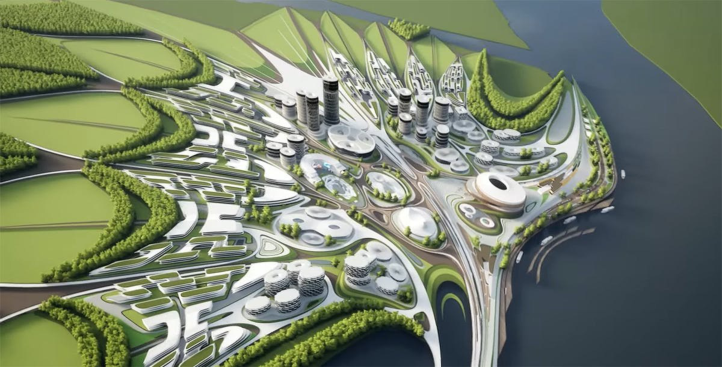
The British architecture studio ”Zaha Hadid Architects” designed and created “cyber-urban” city Libertland in the metaverse (see Figure 1).
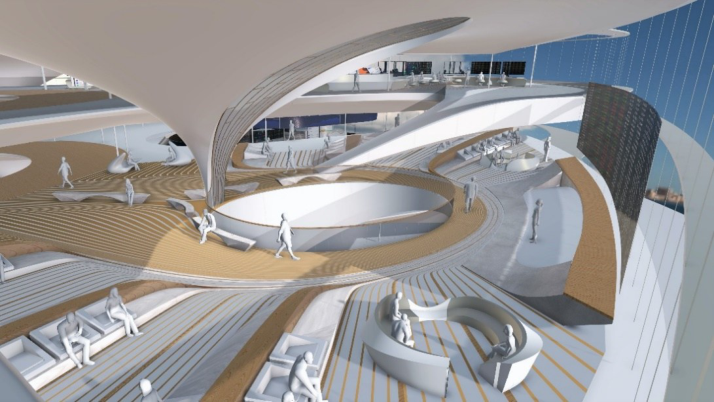
Libertarians can buy plots of land with cryptocurrency and enter dig- ital buildings as avatars (Finney, 2022). They are virtual citizens, living, working and doing business in what is the first virtual city. Libertarians repli- cate the operations of a physical city in a virtual environment (see Figure 2) (Schumacher, 2022).
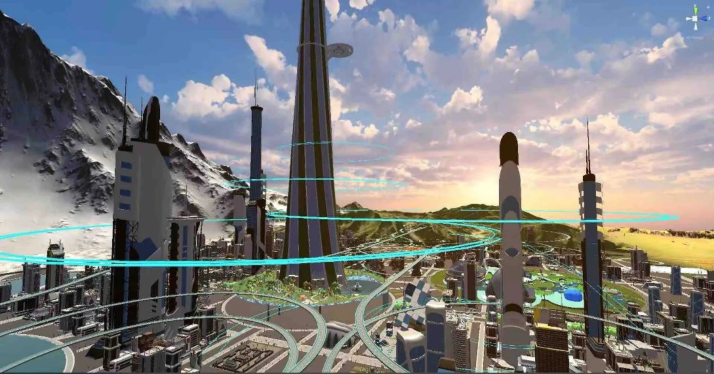
The second example is the ‘Creator’s City’, the first Smart City in XiRang metaverse (translated as the ‘Land of Hope’ in Chinese), built by the Chi- nese company Baidu (see figure 3). The Baibu Metaverse project is expected to be completed by 2027 and impressive in the capacity of simultaneous vir- tual users. In 2021, the project could host at least 100,000 virtual attendees (Cheng, 2021).
Besides the mega projects on smart cities in the metaverse, several orga- nizations developed smaller projects with similar enrolment to operate in virtual worlds. For example, the Italian fashion company Gucci developed
the “Gucci Vault Land,” an experimental space where users go on a jour- ney through the fashion brand’s history through games and NFTs. Currently, Gucci hosts its own metaverse experience in The Sandbox. The fashion house aims to be the first major luxury brand to build a digital world in the metaverse platform (Marr, 2022).
Figure 1: Panoramic view of Zaha Hadid’s design of Liberland.Figure 2: Interior design of Zaha Hadid’s interior spaces in Liberland (Chow, 2022).
On a similar note, in December 2021 the American fashion company Ralph Lauren launched a digital holiday world on Roblox, an online game platform and game creation system, that is shoppable and seasonable as the metaverse remains front of mind for fashion brands (McDowell, 2021).
Lastly, Siemens attempts to redefine the concept of metaverse by introduc- ing the industrial metaverse, claiming that such a version of the metaverse
Aligning Digital Twins and Metaverse With the UN SDGs 39
can be delivered faster in the market, with more practical and tangible results. The industrial metaverse can optimize processes and drive sustainable prac- tices, ultimately shaping the future beyond simulation. According to Siemens, the Industrial Metaverse is the concept of a digital world mirroring and simulating real machines and factories, buildings and cities, grids, and trans- portation systems, based on seamless integration of technologies like cloud and edge computing, industrial AI and digital twins (Siemens, 2024).
Figure 3: View of the Baidu’s XiRang metaverse (Chen, 2021).
METAVERSE, HUMAN BEHAVIOUR AND THE BUILT ENVIRONMENT Despite the hype signalled by societal and industrial expectations of the Meta- verse, the technology remains in its very early stages. It aims primarily to be accepted by users and to prove itself useful to individuals and organisa- tions (Markopoulos et al., 2021). The first signs are encouraging. The world widely adopted the term when Facebook renamed itself to Meta in October of 2021. This can be considered the biggest boost of social awareness ever given to any modern-day technology. Meta (formerly Facebook) has a user- base of 3.05 billion that is growing at 5% per year, and 68% of its users log in daily (Dean, 2024); therefore, any type of technology promotion by the social media company shakes the markets and creates trends.
The continuous trend of virtual worlds increased the metaverse projects, investments and academic research as well in every sector. The construction sector and the built environment are early adopters of the technology – even though, paradoxically, replacing physical with digital structures is against the nature and existence of the construction industry itself.
Large-scale metaverse projects such as the Libertland by the British archi- tecture studio “Zaha Hadid Architects” or the XiRang by the Chinese company Baidu, but also smaller virtual shopping projects like the Gucci Vault Land, or Ralph Lauren’s Winter Holiday World, gather a tremendous
amount of information on user behaviour, preferences, and operations that impact strategic decisions on the physical world.
Metaverse technology can provide such information and operate as a test environment in future adaptations of smart technologies in the phys- ical world. It moves from conceptual construction and theoretical explo- ration to the rapid development stage of practical exploration and industrial application (Wang and Medvegy, 2020).
Architects, civil engineers, building asset managers, construction project managers, and other professionals use the metaverse primarily as a test envi- ronment to understand their client’s requirements and expectations for a physical structure that will follow the one in the metaverse. Understanding user requirements is a critical issue in the build environments. Such require- ments can be either functional or non-functional requirements that derive from the user’s/client’s goals and behaviour (Araiqat and Al-Sartawi, 2023).
The physical environment can now acquire a new semiological density and coherence while at the same time, it is also transformed in many fur- ther respects as it gets enveloped by and infused with virtuality (Schumacher, 2022). This behavioural dimension can be understood and analysed best by observing the client in/on the future project environment. Furthermore, archi- tectural representation can be applied to four-dimensional (4D) spacetime through digital game environments. Entities like motion and distortion can be considered as a part of 4D forms of architectural representations (Uyan & Yazıcı, 2023).
The increasing application of gamified and futuristic interactive tech- nologies in the built environment brings closer the integration of digital game engines with building information modelling (BIM) software to model and evaluate cultural, social and experiential structures, besides spatial components, in an architectural environment (Pearson, 2020).
SUSTAINABLE DEVELOPMENT GOALS IN THE METAVERSE AND SMART CITIES Smart cities in the metaverse extend beyond the utilization of advanced and futuristic interactive technologies in terms of effectiveness, return on invest- ment and alignment with the United Nations Sustainable Development Goals. Smart Cities have a strong environmental and social impact due to their digital operations, emissions reductions, increased accessibility, sustainable communities, economic growth, responsible production and consumption, climate actions, and more, which impact the strategy and development of the built environment (Huovinen, 2022).
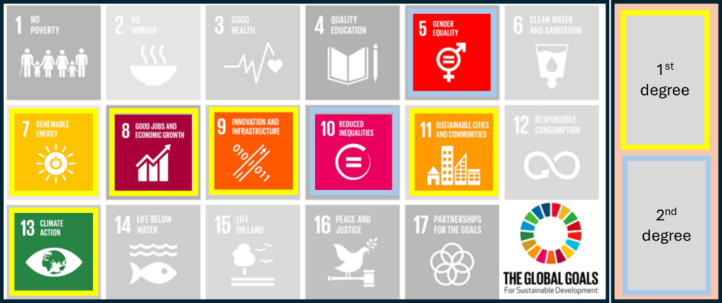
The impact of smart cities in the metaverse and their alignment with the 17 Global Goals can be analysed in 3 layers indicating the degree of alignment and relativity.
The first degree indicates the direct impact while the second degree indicates the indirect impact (see Figure 4).
The first degree includes Global Goals 9 (Innovation and Infrastructure), 10 (Sustainable Cities and Communities), 8 (Good Jobs and Economic
Aligning Digital Twins and Metaverse With the UN SDGs 41
Growth), 7 (Renewable Energy) and 13 (Climate Action). The second degree extends to the Global Goals 10 (Reduced Inequalities) and 5 (Gender Equality).
Further combinations can be generated based on organizational, societal, and industrial goals and strategies.
Figure 4: Smart cities and metaverse relativity with the UN-SDGs.
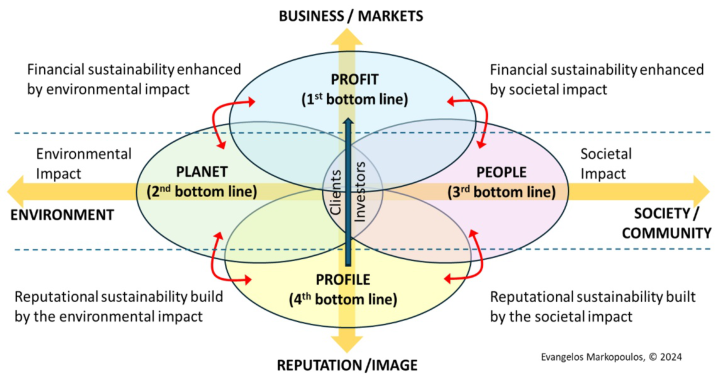
FROM THE TRIPLE BOTTOM LINE TO THE QUADRUPLE BOTTOM LINE The alignment of advanced technological projects with the UN-SDGs meets the Triple Bottom Line theory (TBL) or PPP theory (People, Planet, Profit) and extends beyond that (Hubbard, 2009).
The direct economic benefits organizations obtained by the TBL, extend to indirect benefits from the data collection, analysis, and utilization of user behaviour and activity in smart cities in the metaverse, which impact the future of the built environment. Furthermore, the environmental and societal benefits of the triple bottom line help organizations enhance their corporate profile/image. This creates reputational benefits and can be seen as a fourth bottom line. Thus, the TBL or PPP (People, Planet, Profit) can be extended to a fourth line, or a fourth P (Profile) which acts as a common denominator to the other three (see Figure 5).
This fourth bottom line and its associated benefits derive from the alignment of the organization with the ESG (Environmental, Social, Gov- ernance) index, and the UN Sustainable Development Goals (Markopoulos & Markopoulos, 2023).
A PROCESS FRAMEWORK FOR SMART CITIES’ FUNCTIONAL CHARACTERISTICS AGAINST THE UN-SDG AND ESG The ESG index has been considered a significant company valuation tool for corporate development and risk management. Organizations executing projects and initiatives on smart cities in the metaverse can comply with several ESG criteria.
Figure 5: From the triple to the quadruple bottom line theory.
Table 1 is a brief analysis of smart city projects in the metaverse and their relation to the Refinitiv ESG pillars, categories, and themes (Refinitiv, 2022).
Table 1. Smart city metaverse projects and ESG requirements.
Table available in the original PDF paper.
Pilar Category Theme Environmental Emission Emissions Waste Smart city projects in the metaverse
Innovation Product Innovation Green revenues, research and development (R&D) and capital expenditures (CapEx) Resource Use Environmental supply chain
Social Human Rights Human rights Workforce Diversity and inclusion Career development and training Working conditions Health and Safety
Governance CSR Strategy CSR Strategy
Therefore, by extending the Triple Bottom Line to the Quadruple Bot- tom line, the reputational line relates to the ESG index scoring potentiality: the extent to which the UN SDGs advance futuristic interactive projects and involve new technologies.
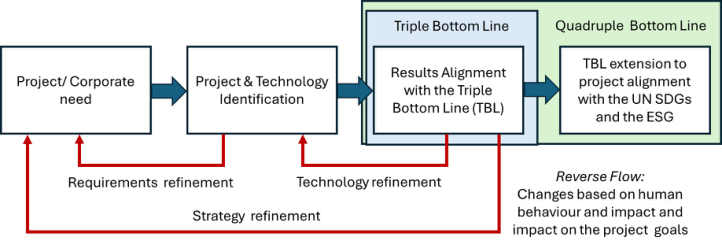
An initial process framework to obtain this added value is based on four stages. The first stage identifies the project needs (namely the company needs), the second stage defines the project and identifies the technologies
Aligning Digital Twins and Metaverse With the UN SDGs 43
involved, the third stage aligns the project’s outcomes with the Triple Bottom Line theory, and the fourth stage extends the Triple Bottom Line theory to the Quadruple Bottom Line theory with the compliance of the project’s oper- ations and outcome to the UN SDGs and the ESG Index. A fifth horizontal stage refines the project at the requirements, technology, and strategy levels to maximize the added value (see Figure 6).
Figure 6: Value added process of smart cities in metaverse projects.
LIMITATIONS AND AREAS OF FURTHER RESEARCH The research conducted for this work has been based on secondary research that gives a theoretical perspective of the actual impact of the metaverse’s smart cities in society and the economy based on the human behaviour of their digital citizens (Luimula et al., 2022). However, there are yet very few completed projects on smart cities and virtual worlds to be studied in detail and compare their results against the triple and quadruple bottom-line theories as presented in the proposed framework.
This research will extend towards the study of human behaviour in smart cities in the industrial and commercial metaverse, as they generate empirical data that can be used to validate the proposed framework and build on it.
CONCLUSION
Throughout history, the advancement of new technologies has often brought initial optimistic expectations among society that eventually went unmet. The distance between the expected results and the obtained results is largely related to the adaptation of each technology by its target users. Smart cities and metaverses are a promising technological combination, but the time needed for their actual application is the maturity period for users to recognize personal and social benefits.
This research highlighted some mega projects in smart cities in the meta- verse, but also smaller commercial projects with the same objectives but on different scales. Since all these projects share similar goals, objectives and technology, emphasis shall be given to incentives needed for the project’s wide application and further development. Aligning the benefits of such projects with the UN-SDGs can be a strong incentive for people to support
such initiatives as the environmental and social impacts are clear. Extend- ing this alignment to the ESG index can secure the funding needed for such projects to keep on being developed and optimized to reach their expected goals (Markopoulos et al. 2023).
This work demonstrated the relationship between advanced technologies such as smart cities in the metaverse with the need to understand human behaviour towards making such initiatives sustainable and viable.
REFERENCES
Araiqat, D. M., Al-Sartawi, A. (2023). The Introduction of Interior Design and Architecture into the Metaverse and Their Interrelation to the Reality-Enhancing Technologies. In: Hannoon, A., Mahmood, A. (eds) Artificial Intelligence, Inter- net of Things, and Society 5.0. Studies in Computational Intelligence, vol. 1113. Springer, Cham. https://doi.org/10.1007/978-3-031-43300-9_10 Chen (2021). Baidu to expand metaverse offerings and hold virtual conference via
revamped VR app. Technode. Dec. 31, 2021. https://technode.com/2021/12/13/ baidu-to-expand-metaverse-offerings-and-hold-virtual-conference-via-revamp ed-vr-app/ Cheng E. (2021). Chinese tech giant Baidu says it could be 6 years before it can fully deliver its metaverse. CNBC, De. 23, 2021. https://www.cnbc.com/2021/12/24/ba idu-says-it-could-be-6-years-before-it-can-fully-deliver-its-metaverse.html Chow A. (2022). Zaha Hadid Architects Designs Liberland Metaverse City. Hype-
beast. March, 13, 2022. https://hypebeast.com/2022/3/liberland-city-zaha-hadid- architects-metaverse-news Dean B. (2024). Facebook users and growth statistics. Backlink. Feb. 23, 2024.
Dezeen. March 11, 2022. https://www.dezeen.com/2022/03/11/liberland-metave rse-city-zaha-hadid-architects/ Haristianti V, Murdowo D. (2023). The development of the virtual environment and its impact on interior designers and architects. Case study: Zaha Hadid Architects. In Sustainable Haristianti V, Murdowo D. (2023). The development of the virtual environment and its impact on interior designers and architects. Case study: Zaha Hadid Architects. In Sustainable Development in Creative Industries: Embracing Digital Culture for Humanities. (296–301). DOI: 10.1201/9781003372486-55. Huovinen P. (2022). Incorporation of UN sustainable development goals into
built environments-related business management concepts IOP Conf. Ser.: Earth Environ. Sci. 1122 012057. Hubbard, G. (2009), Measuring organizational performance: Beyond the triple bottom line. Bus. Strat. Env., 18: 177–191. https://doi.org/10.1002/bse.564 Luimula M. Markopoulos E., Osterman M., Markopoulos P. Aho J., Ravise
W., Saarinen J., Reunanen T. (2021). Avatar Based Multiplayer Functionali- ties in Next Generation Communication and Learning in Virtual Reality Social Platforms – Case MarISOT Room. Conference: The 12th IEEE International Con- ference on Cognitive Infocommunications. https://discovery.ucl.ac.uk/id/eprint/ 10153240/ Luimula, M., Haavisto, T., Pham, D., Markopoulos, P., Aho, J., Markopoulos, E., Saarinen, J. (2022). The use of metaverse in maritime sector – a combination of social communication, hands on experiencing and digital twins. In: Evangelos Markopoulos, Ravindra S. Goonetilleke and Yan Luximon (eds)
Aligning Digital Twins and Metaverse With the UN SDGs 45
Creativity, Innovation and Entrepreneurship. AHFE (2022) International Con- ference. AHFE Open Access, vol. 31. pp. 115–123. AHFE International, USA. http://doi.org/10.54941 Markopoulos, E.; Luimula, M. (2020). Immersive Safe Oceans Technology: Developing Virtual Onboard Training Episodes for Maritime Safety. Future Inter- net 2020, 12, 80. https://doi.org/10.3390/fi12050080 Markopoulos, P., Markopoulos, E. (2023). Addressing the UN 2030 sustainable
development agenda and the ESG index with serious games in virtual environ- ments. In: Tareq Ahram and Christianne Falcão (eds) Human Factors in Virtual Environments and Game Design. AHFE (2023) International Conference. AHFE Open Access, vol. 96. AHFE International, USA. http://doi.org/10.54941/ahfe 1003862 Markopoulos P. Pyae A., Khakurel J. Markopoulos E., Saarnio R., Luimula M.
(2021). Understanding How Users Engage in an Immersive Virtual Reality-Based Live Event. Conference: 12th IEEE International Conference on Cognitive Info- communications (CogInfoCom) (pp. 447–452), 2021. ISBN 978-1-6654-2494-3. https://discovery.ucl.ac.uk/id/eprint/10153242/ Markopoulos, E., Zhao, K., Samkova, M., Vanharanta, H. (2023). ESG and UN SDGs Driven Strategy Generation Process for Green and Pink Oceans. In: Vesa Salminen (eds) Human Factors, Business Management and Society. AHFE (2023) International Conference. AHFE Open Access, vol. 97. AHFE International, USA. http://doi.org/10.54941/ahfe1003878 Marr B. (2022). Gucci Enters The Metaverse/ Forbes. Nov. 30, 2022. https://www.
forbes.com/sites/bernardmarr/2022/11/30/gucci-enters-the-metaverse/ McDowell M. (2021) Vogue Business, Feb. 3, Holidays in the Metaverse: Whats trending this year. December 8. 2021. https://www.voguebusiness.com/technolo gy/holidays-in-the-metaverse-whats-trending-this-year Pearson, L. C. (2020). A machine for playing in: Exploring the videogame as a
medium for architectural design. Design Studies, 66, 114–143. https://doi.org/ 10.1016/j.destud.2019.11.005 Refinitiv (2022). Environmental, social and governance scores from Refinitiv.
https://www.refinitiv.com/content/dam/marketing/en_us/documents/methodolog y/refinitiv-esg-scores-methodology.pdf?elqCampaignId=14314 Siemens (2024). The Industrial Metaverse. https://www.siemens.com/global/en/comp any/digital-transformation/industrial-metaverse.html Schumacher, P. (2022). The metaverse as opportunity for architecture and society:
design drivers, core competencies. ARIN 1, 11. https://doi.org/10.1007/s44223- 022-00010-z Uyan, B. & Yazıcı, S. (2023). A Method for Decoding and Representing Time in Fourdimensional Spaces via Digital Game Environment. JCoDe: Journal of Computational Design, 4(1), 99– 120. https://doi.org/10.53710/jcode.1248 185 Wadham M. (2015). Meet Liberland, the world’s newest country. UK INversor Mag-
azine. July 27, 2015. https://ukinvestormagazine.co.uk/meet-liberland-the-worlds -newest-country/ Wang, J. and Medvegy, G. (2022), Exploration of the future of the metaverse and smart cities. ICEB 2022 Proceedings (Bangkok, Thailand). 12. https://aisel.aisnet .org/iceb2022/12
LISTED IN THE AHFE DIGITAL BOOKSTORE CATALOGUE
Explore the complete digital volume
Accessibility, Assistive Technology and Digital Environments
Read this individual research paper free through the original publisher, or explore the full digital proceedings book.
ISBN 978-1-958651-97-1
Explore this ISBN in the AHFE Bookstore ↗Listed in the July 2026 bookstore catalogue; search by ISBN to confirm current availability · Digital book purchase optional